GoAffPro Pricing Explained
GoAffPro pricing: Hobby Free, Premium $49, Business from $99. No sales %, vs UpPromote.
Compare Strackr, WeCanTrack, and Affilimate for multi-network affiliate data. Pricing, jobs, and when a storefront beats a dashboard.

TL;DR: The best tool to aggregate affiliate data is the one that matches your job—not the longest network list. Use Strackr when you need a cheap multi-network commission dashboard (from €10/month). Use WeCanTrack when you must join conversions to ads and analytics (from €59/$69). Use Affilimate when page-level commerce ops matter and you accept quote pricing. feat. is a co-branded selling surface, not a CJ/Impact log puller.
You did not ask for another 22-logo “affiliate tools” roundup. You asked for the best tool to aggregate affiliate data when Amazon Associates, CJ, Impact, and Awin each insist you live inside their login. That is a publisher ops job. It is not the same job as launching a merchant program, cloaking a link, or generating a co-branded storefront.
If you still open thirty network tabs every morning, you do not have a content problem. You have an aggregation job without a named seat.
This page sits next to best affiliate marketing tools (four-layer stack) and how to track affiliate sales (attribution surfaces). Here the question is narrower: which product pulls multi-network commissions into one place, what those products actually charge, and when aggregation is the wrong buy.
Key takeaways:
Affiliate data aggregation is the practice of pulling clicks, conversions, commissions, and payouts from multiple affiliate networks or direct programs into one normalized view so a publisher can compare performance without logging into each network separately.
That sentence is the whole product category. It is not “affiliate marketing software” that sits on a merchant’s Shopify store. It is not Amazon’s Associates Central. It is not Impact’s Partnership Cloud for advertisers. It is the publisher-side layer that treats Amazon, CJ, Impact, Awin, Rakuten, and direct programs as data sources.
Operators already describe the pain in plain language. One Reddit publisher runs “30+ Tabs representing all the different Networks” and has not found a single login that replaces them (r/Affiliatemarketing). Another thread asks how people actually know which links make money; answers range from messy UTM-plus-spreadsheet stacks to Affilimate, with a reported Impact feed gap from one user (r/Affiliatemarketing). The demand is real. The category name is just late.
Three things aggregation is not:
Fragmented network dashboards create three expensive lies: you think you know EPC, you think you know which site wins, and you think last week’s “top program” is still paying.
Why this job shows up in search:
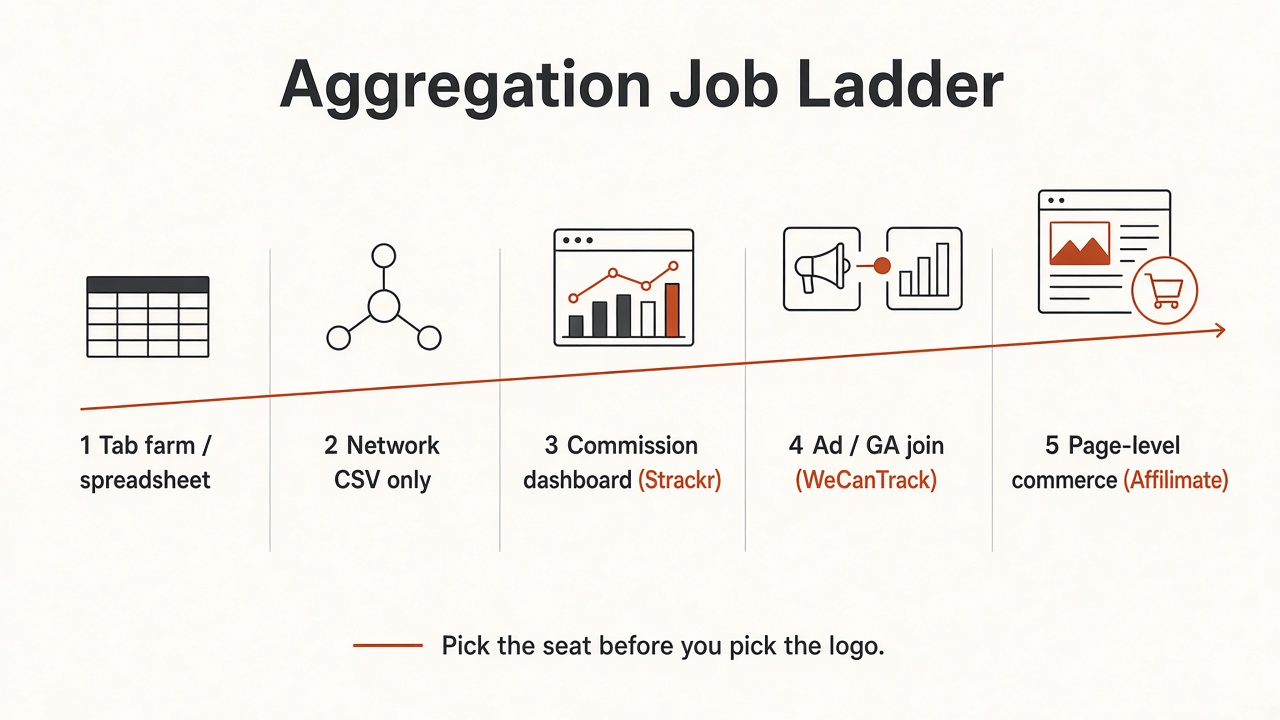
Source: Editorial Aggregation Job Ladder for this article. Vendor examples from Strackr, WeCanTrack, and Affilimate public pages (accessed 2026-10-11).
Pick the seat on the Aggregation Job Ladder first. Then compare vendors inside that seat. Score candidates on job fit, published meters (transactions, clicks, sessions, network connections), update cadence, and whether pricing is a sticker or a quote. Do not score them on recycled “average affiliate income” integers. There is no public dataset for a global aggregator earnings crown.
| Seat | What you get | Who it fits | Failure mode |
|---|---|---|---|
| 1. Tab farm / spreadsheet | Manual logins + pasted totals | Hobby scale, <3 networks | Lies by omission; no EPC discipline |
| 2. Network CSV only | Official exports per network | Finance reconciliation | Stale the next morning |
| 3. Commission dashboard | Normalized clicks/sales/pay across APIs | Multi-network publishers who need one P&L view | Still blind to ad spend and page attribution |
| 4. Conversion + ad/GA join | Network sales mapped to sessions, clicks, campaigns | Media buyers and SEO teams optimizing paid/organic together | Overkill if you never buy traffic |
| 5. Page-level commerce ops | Link/page revenue, rates, product enrichment, campaign tools | Premium publishers and portfolio sites | Quote sales cycles; wrong for a solo Amazon blogger |
Seats 3–5 are where Strackr, WeCanTrack, and Affilimate compete. They are not interchangeable logos.
| Product | Entry published price | What the entry meter includes | Higher published rungs | Pricing shape |
|---|---|---|---|---|
| Strackr | €10/mo Starter | 1,000 transactions · 10 network connections · 12h updates · 1 user | €25 Pro · €50 Enterprise · Custom (unlimited + API/MCP) | Self-serve sticker |
| WeCanTrack | €59 ($69)/mo Small | 500 transactions · 25k clicks · 100k sessions · 20 network accounts · GA + ad integrations | €129 ($149) · €279 ($322) · €499 ($576) · Custom | Self-serve sticker (EUR billed; USD approx.) |
| Affilimate | Quote | Creators / Premium publishers / Brands segments; Unify across 100+ networks | Volume + feature based after call | Quote only |
Sources: Strackr pricing; WeCanTrack pricing; Affilimate pricing. Third-party directories that invent Affilimate sticker ladders (for example Findstack’s $99–$749 grid) are not Affilimate’s public price list—do not treat them as vendor fact.
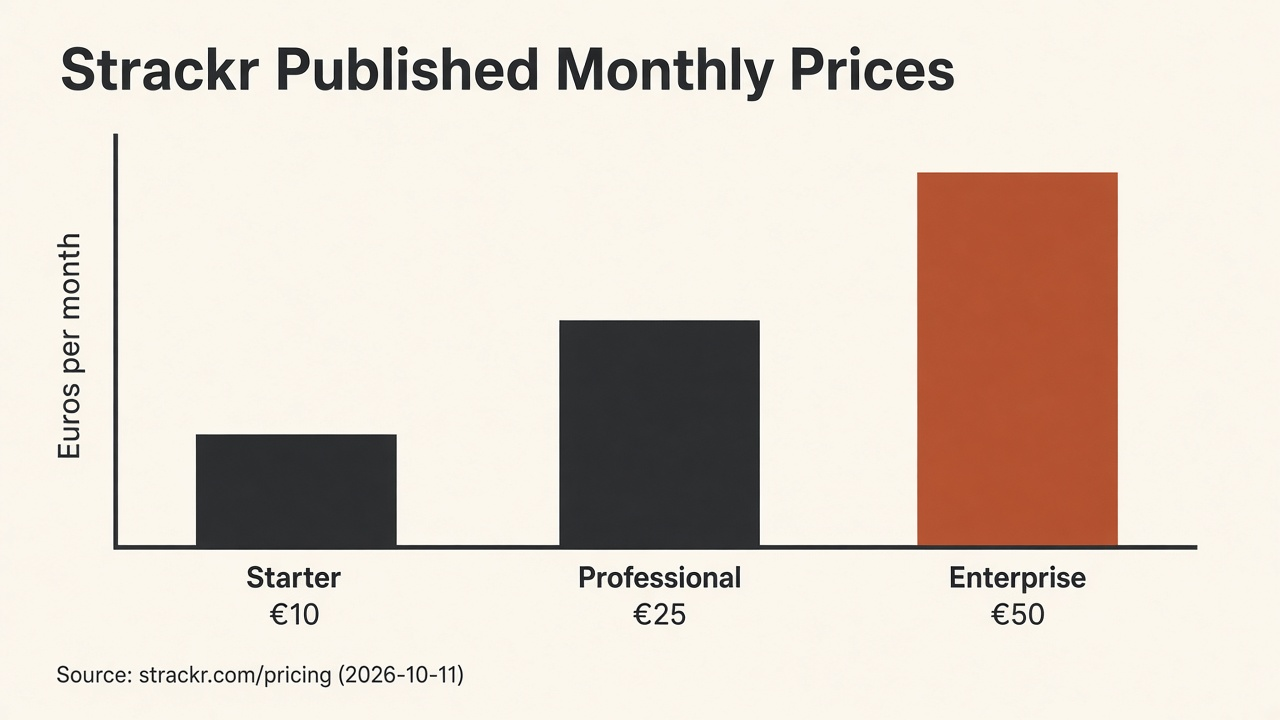
Source: Strackr pricing page, accessed 2026-10-11. https://strackr.com/pricing
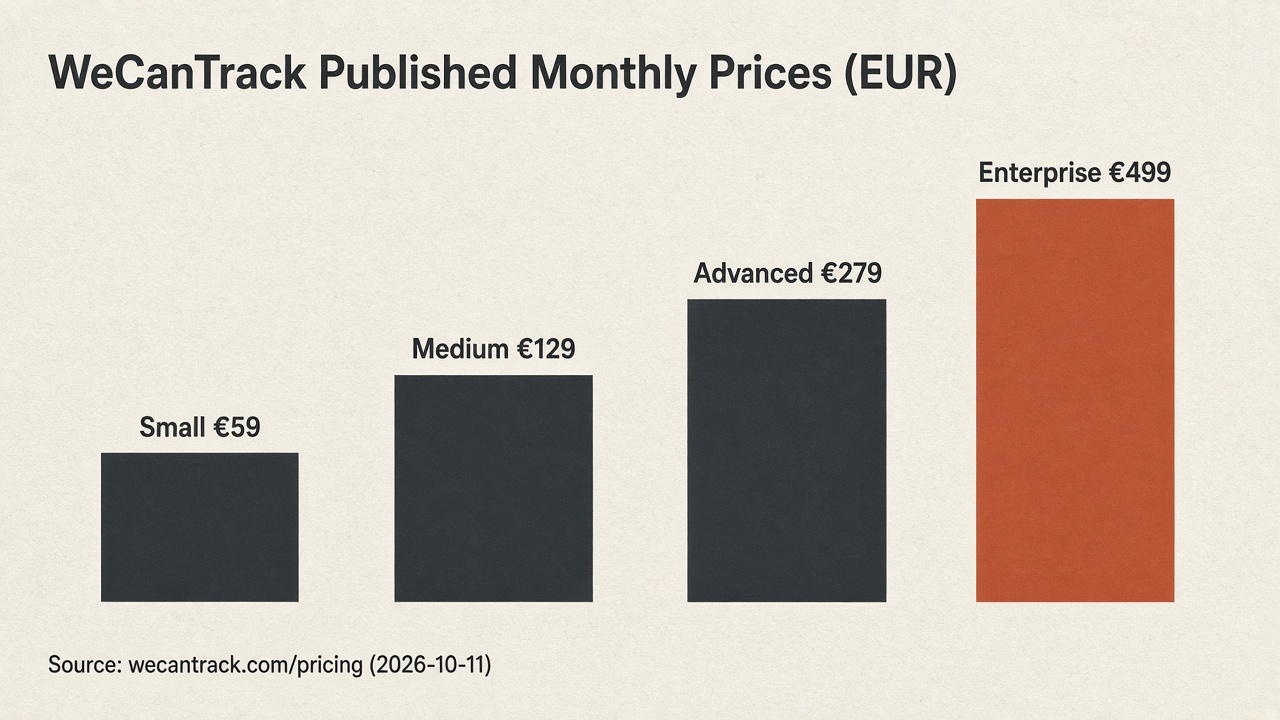
Source: WeCanTrack pricing page, accessed 2026-10-11. https://wecantrack.com/pricing/
Strackr sells the classic publisher dashboard: connect networks, see transactions and EPC-style metrics, segment by site, optionally buy API and MCP on Custom. The home page claims 289 network connections and a 30-day trial without a card (Strackr; Strackr pricing).
Buy Strackr when your pain is “I cannot see Amazon + Awin + CJ in one morning.” Do not buy it expecting Google Ads ROAS math. That is seat 4.
WeCanTrack positions conversion collection from 450+ networks into the marketing tools you already use—GA4, ad platforms, BigQuery on higher plans. Small starts at €59 ($69) with 500 transactions and 20 network accounts; Medium unlocks unlimited network accounts at €129 ($149) (WeCanTrack).
Buy WeCanTrack when unpaid dashboards are not enough because paid media or session analytics must see affiliate revenue. Community threads already route “small affiliates and influencers” toward WeCanTrack and “bigger publications” toward Affilimate or Trackonomics (r/Affiliatemarketing). Treat that as demand language, not a census.
Affilimate’s Unify product is built for commerce content teams: normalize transactions, rates, and payouts from 100+ networks, enrich with product data (70M+ tracked products claimed), and push into dashboards, API, warehouse, or MCP (Affilimate Unify; Affilimate pricing). Official pricing is not a public € ladder. You talk to sales.
Buy Affilimate when editors need page- and link-level revenue and your stack looks like a media company. One Reddit publisher likes Affilimate overall but reports an Impact feed import gap in their account—verify the networks you actually run before you sign (r/Affiliatemarketing). Anecdote, n=1.
StatsDrone, Voonix, Routy, Nifty Stats, Trackonomics, Affluent, StatSync, and StatSherpa appear in operator lists and vendor SERPs (r/Affiliatemarketing). Several skew iGaming or paid-media. They can win inside a vertical. They do not change the ladder: still ask which seat you are buying.
feat. is a marketplace where merchants list products and affiliates sell through co-branded storefronts with a revenue split on every sale. It is a monetization surface, not a multi-network stats aggregator. If your job is unifying Amazon Associates + CJ + Impact + Awin ledgers, buy seat 3–5 above. If your job is giving creators an on-brand place to sell a product you (or a merchant partner) already fulfill, compare Amazon Associates vs feat. and Impact vs feat.. We do not invent feat. fees, GMV, or payout totals here.
Q: What is the best tool to aggregate affiliate data across Amazon Associates, CJ, Impact, and Awin? A: Start with the job. For a self-serve commission dashboard, Strackr’s published ladder from €10/month is the clearest entry sticker. For ad and analytics joins, WeCanTrack from €59/$69. For page-level commerce at publisher scale, Affilimate Unify on a quote. Confirm each network’s live integration before you pay.
Q: Is Affilimate cheaper than Strackr or WeCanTrack? A: Affilimate does not publish a public monthly sticker ladder; pricing is volume- and feature-quoted after a call. Strackr and WeCanTrack publish euro prices you can verify today. Do not use third-party directory grids as Affilimate’s official rates.
Q: Do I need an affiliate data aggregator if I only promote one network? A: Usually no. One network’s native reporting is enough until a second or third login becomes a weekly tax. Aggregation earns its keep when cross-network comparison or ad joins matter.
Q: How long does setup take? A: Vendor claims vary. Strackr markets minutes-level network connection and a 30-day trial. Affilimate says standard setups can show first insights in under 24 hours and custom stacks often go live with a trial in under two weeks. Your bottleneck is API credentials and historical backfill, not the marketing copy.
Q: Does feat. aggregate Amazon, CJ, Impact, and Awin data? A: No. feat. generates co-branded storefronts and revenue splits for products listed on the marketplace. It is not a multi-network stats aggregator. Use Strackr, WeCanTrack, or Affilimate for that seat; use feat. when the job is selling through an on-brand storefront.
The best tool to aggregate affiliate data is the seat that matches the job you named: a cheap multi-network commission view, a conversion-to-ads join, or page-level commerce ops. Strackr, WeCanTrack, and Affilimate win different rungs of that ladder. None of them is a universal earnings machine, and none replaces a co-branded checkout when the work is selling—not reporting. If you want creators selling through storefronts instead of another dashboard login, start at feat..
GoAffPro pricing: Hobby Free, Premium $49, Business from $99. No sales %, vs UpPromote.
Refersion pricing: Launch $39+3%, Growth $199+2%. Affiliate-sales fees, crossover math, vs UpPromote.
UpPromote pricing: Free, Growth $29.99+2%, Pro $89.99+1.5%. Performance fees, crossover math, vs ReferralCandy.