Average Cost per Content Piece by Format (2026 Ranges)
Average cost per content piece by format: WebFX ranges, freelancer modal rates, and why one national average is a myth.
Blog sponsorship rates: RankSupply median $336; traffic bands $181 to $1,042 beat DR. Adsy averages are a second meter. Refuse one universal good rate.

TL;DR: Blog sponsorship rates are a job label first. RankSupply’s Aug 2026 sample of 69,597 marketplace listings shows a $336 median guest-post list price, with traffic-band medians from $181 to $1,042.50. Traffic tracks price harder than Domain Rating (Spearman 0.361 vs 0.204). Adsy means and newsletter CPMs are different meters. There is no one good rate.
Publishers ask for one number: “What are blog sponsorship rates?” Buyers ask for the same number from the other side of the invoice. Both questions collapse four products into one phrase. Marketplace guest-post list prices, audience-exposure sponsored posts, newsletter sends, and display RPM are not the same invoice.
Blog sponsorship rates means the dollar quote (or meter) attached to a paid placement on a blog property. Before you bargain, name which job you are selling. Pair this spoke with newsletter sponsorship rates by subscriber count, newsletter sponsorship CPM benchmarks, digital product vs sponsorship revenue, and sponsored content vs affiliate links disclosure.
Blog sponsorship rates means the commercial price of a paid blog placement, scoped to a named product: a marketplace guest post, a direct sponsored article for readers, a newsletter send, or display inventory. The search phrase is one string. The invoice is not.
That definition kills two bad habits. First, copying a marketplace guest-post median onto a deal where the buyer wants your readers, not a dofollow link. Second, treating Adsy’s $459 average and RankSupply’s $336 median as interchangeable “the rate.” One is a mean on Adsy inventory. The other is a median across RankSupply’s third-party vendor listings. Both are list-price samples for SEO-heavy guest-post inventory. Neither is a census of direct brand deals with engaged niche audiences.
For email-only pricing, leave this page and use the newsletter rates-by-subscriber and newsletter CPM spokes. For whether sponsorship should even be your primary wallet versus owned products, see digital product vs sponsorship revenue.
Rates matter because sellers underprice audience-exposure deals by copying SEO marketplace floors, and buyers overpay DR stickers that sit on low-traffic sites. The public datasets now make that fork measurable.
rel="sponsored" or rel="nofollow" per Google’s link spam policy. Label the commercial job before you publish. See sponsored content vs affiliate disclosure.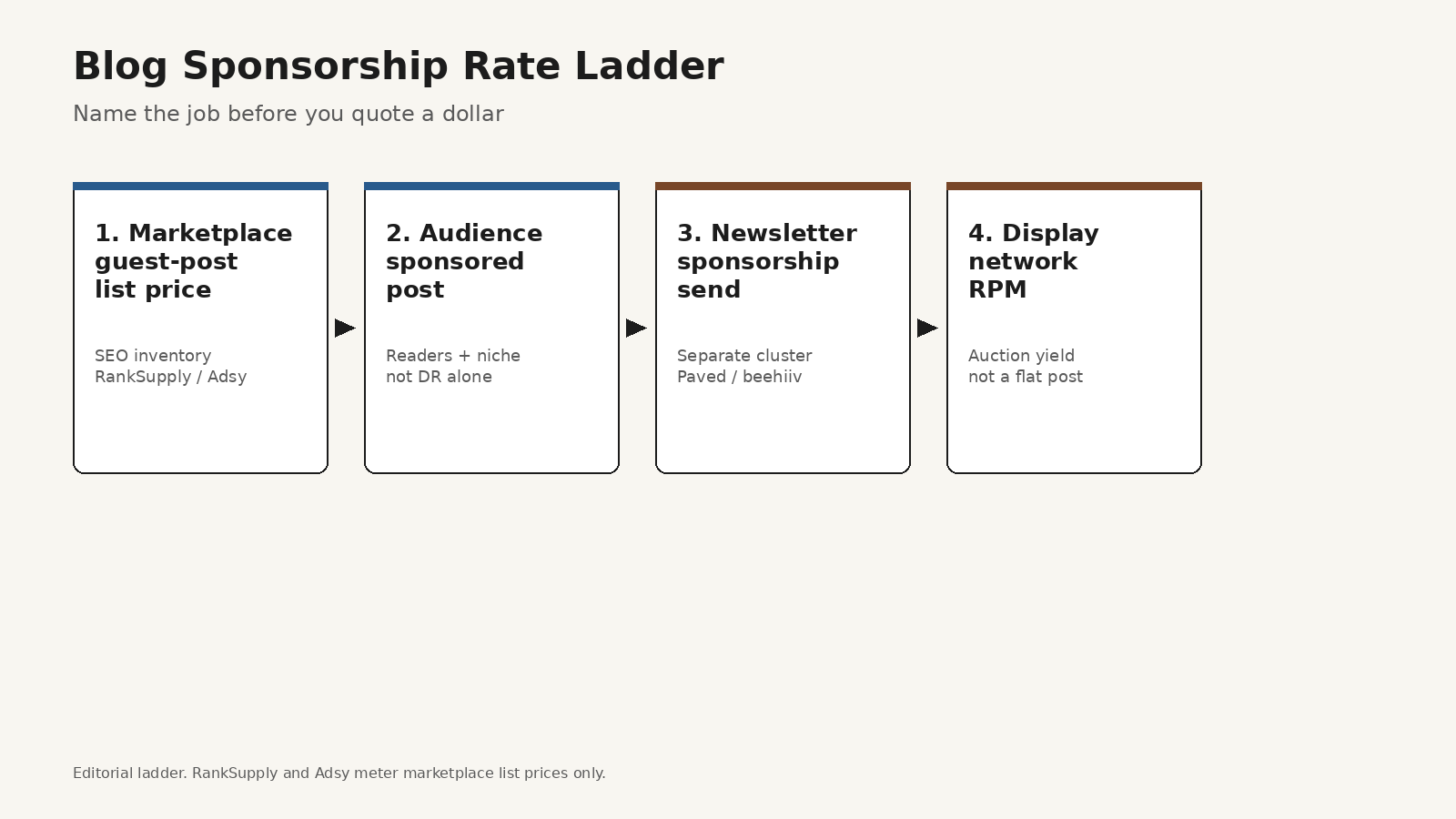
Source: Editorial Blog Sponsorship Rate Ladder. Marketplace figures from RankSupply and Adsy; newsletter and display are separate meters.
Blog sponsorship rates work as a three-step stack: name the job, pick a named public meter for that job, then adjust for niche, country, and whether you sell direct or through a vendor. Skip the job step and you will argue about Domain Rating forever without settling the deal.
This is the RankSupply / Adsy world: sites list a price for a guest or sponsored post, often with a dofollow link as the product. RankSupply finds 99.2% of 66,627 listings that state a link attribute offer dofollow links (RankSupply). Buyers shopping that inventory are usually buying SEO adjacency, not your email list.
| Monthly organic visits | Listings (share) | Median list price | IQR (25th-75th) |
|---|---|---|---|
| Under 100 | 13,432 (19.4%) | $181 | $116-$360 |
| 100-999 | 21,767 (31.4%) | $265 | $159-$618 |
| 1,000-9,999 | 21,723 (31.3%) | $400 | $198-$807 |
| 10,000-99,999 | 9,718 (14.0%) | $615.50 | $260-$1,223 |
| 100,000+ | 2,744 (4.0%) | $1,042.50 | $515-$2,018 |
Source: RankSupply Guest Post Pricing 2026, traffic table on 69,384 sites with traffic data. Half of those sites (50.7%) sit under 1,000 monthly visits.
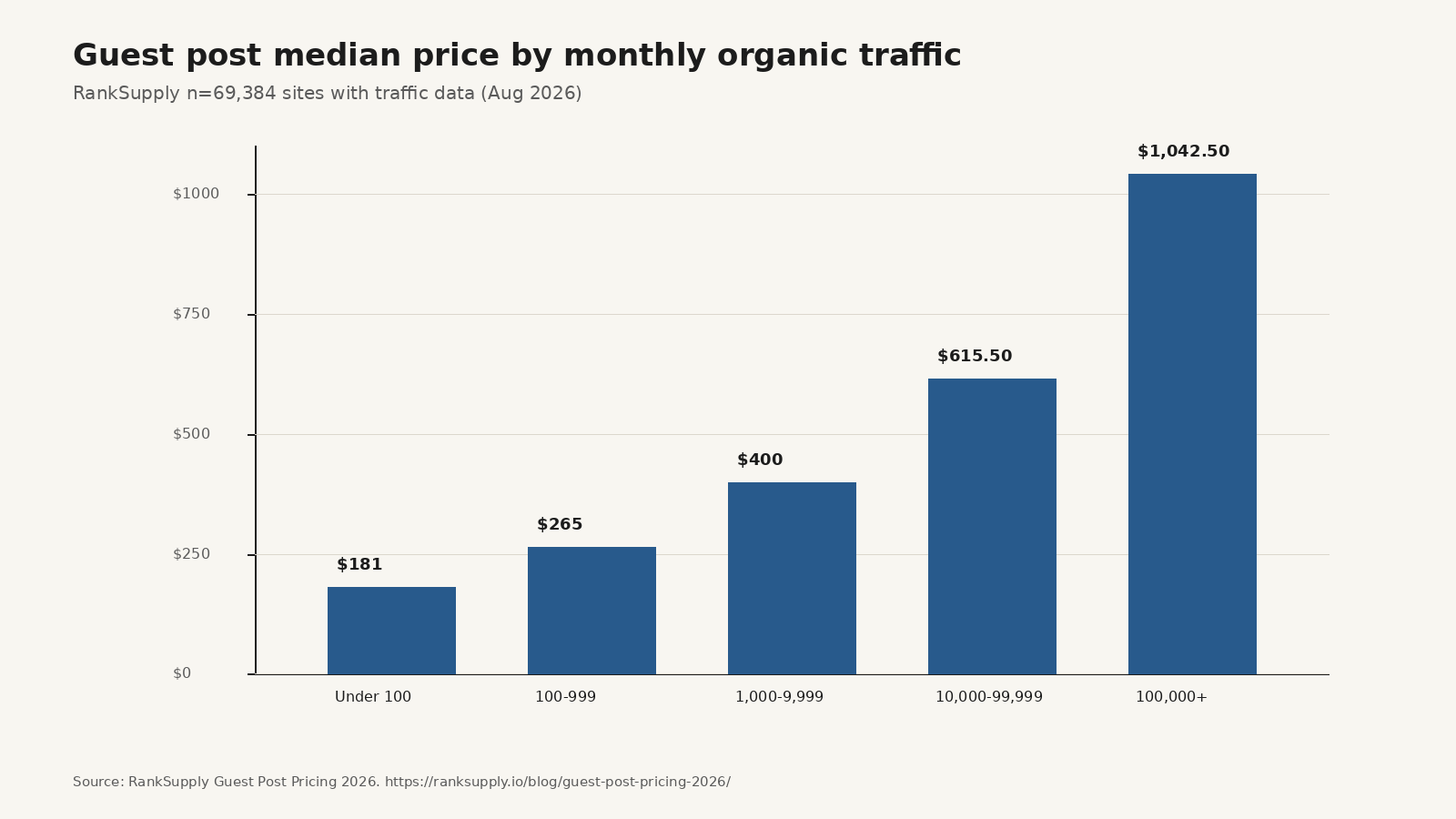
Source: RankSupply, Guest Post Pricing 2026. https://ranksupply.io/blog/guest-post-pricing-2026/
| Domain Rating | Listings | Median list price | IQR |
|---|---|---|---|
| DR 0-19 | 13,570 | $241 | $136-$508 |
| DR 20-39 | 28,167 | $286 | $165-$649 |
| DR 40-59 | 18,838 | $363 | $163-$798 |
| DR 60-79 | 7,433 | $688 | $259-$1,497 |
| DR 80+ | 1,373 | $782 | $260-$1,750 |
Source: same RankSupply study. DR still climbs. Traffic climbs steeper and correlates harder.
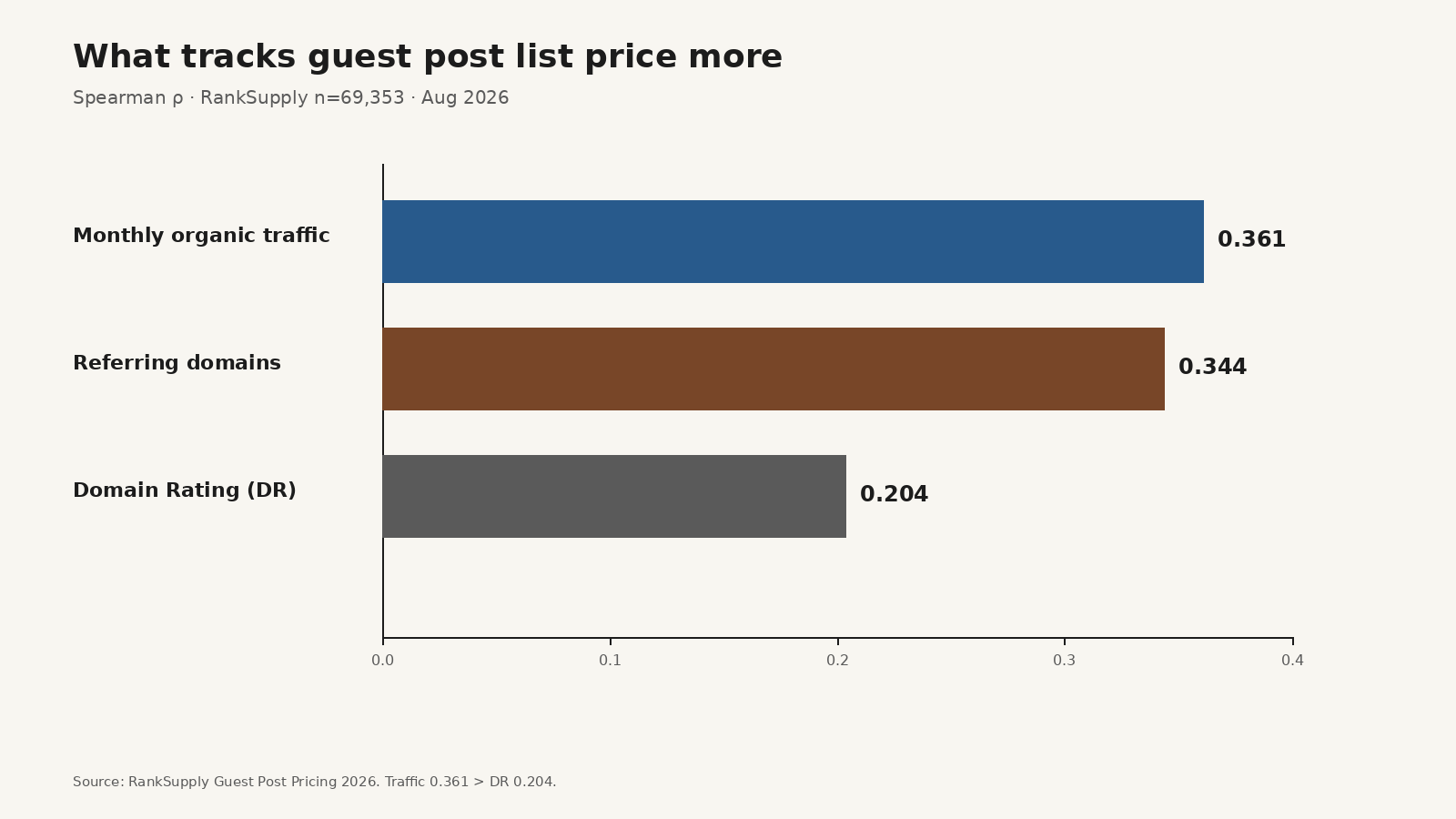
Source: RankSupply, Guest Post Pricing 2026. https://ranksupply.io/blog/guest-post-pricing-2026/
Adsy’s February 2026 report averages $459 per guest post ($427 in 2025, +7.5%), with DR-band means $332 (DR 1-30), $555 (DR 31-70), and $2,025 (DR 71+). It also claims about 32% price lift per additional 10 DR points, and about 21% more for sites with 10K monthly traffic versus 1K (Adsy). Link insertions average $225, about 56% cheaper than guest posts on that inventory.
Niche means on Adsy stretch from Personal blogs $341 to Beauty $1,171, with Finance $816 and Fashion $948 in between. RankSupply’s topic medians tell a related story with different labels: crypto $680, religion $160, among topics with at least 300 listings (RankSupply). Do not mash Adsy means and RankSupply medians into one fake “industry rate.”
Outrank’s format roundup also cites BuzzStream (June 2026, 257,267 sites): average direct buy $295 versus vendor $461 (Outrank). If you sell direct, the vendor markup is often your room to price above marketplace floors, provided your audience proof is real.
This is the deal where the brand wants your readers, not a free link graph boost. Public marketplace datasets under-sample that job. Forum anecdotes still matter as demand language, not as a census: r/Blogging and r/SEO threads quote everything from tens of dollars on thin sites to $250-$500 dedicated posts once traffic and niche tighten (r/Blogging; r/SEO). Treat those as operator gossip. There is no public dataset here for a verified average direct audience-sponsor rate by niche that you should chart as truth.
Price that job from your own proof pack: Search Console top queries, email or social click history, past sponsor outcomes, and disclosure posture. If the buyer only wants dofollow SEO, you are back in Job 1. Say so in the IO.
Newsletter sponsorship uses subscriber or category CPM meters (beehiiv size bands; Paved category CPMs from about $1.22 Lifestyle to $18.47 HR in the Q3 2026 ladder already published on feat.). Display uses network RPM: Productive Blogging’s 2025 survey (via Outrank) puts AdSense near $2.34, Mediavine $31.55, and Raptive $34.86 per 1,000 pageviews among 187 responding bloggers (Outrank). Sponsored-post-led blogs in that survey reported $51.74 RPM versus $33.80 for ad-led blogs. Those are useful contrasts. They are not substitutes for RankSupply’s guest-post medians.
Among RankSupply’s largest country markets, German listings median $846, US $209, UK $285, India $155. English-language listings median $230 versus $403 for non-English in that sample (RankSupply). Topic and country move the quote inside the traffic band. They do not erase the band.
rel="sponsored" or nofollow when the link is paid. No silent dofollow surprises.Q: What are typical blog sponsorship rates in 2026? A: For marketplace guest-post list prices, RankSupply’s median across 69,597 listings is $336, with traffic-band medians from $181 to $1,042.50. Adsy’s average on 52,671 sites is $459. Those are SEO inventory meters, not a universal direct-deal census.
Q: How much should I charge for a sponsored blog post? A: Name the job first. If buyers want a marketplace-style placement, start near your RankSupply traffic-band median and adjust for niche. If they want your readers, price from audience proof and past outcomes, not DR alone. There is no single good rate.
Q: Do Domain Rating or traffic matter more for guest post prices? A: In RankSupply’s 69,353-listing Spearman sample, monthly organic traffic (0.361) tracks price more than Domain Rating (0.204). DR still matters. Traffic separates prices more sharply, including inside high-DR bands.
Q: Are Adsy averages the same as RankSupply medians? A: No. Adsy reports means on its February 2026 inventory ($459 overall). RankSupply reports medians on 69,597 third-party listings ($336). Use both as rails. Do not average them into a fake industry price.
Q: Are blog sponsorship rates the same as newsletter sponsorship rates? A: No. Newsletter sends use subscriber or category CPM ladders covered in feat.'s newsletter spokes. Blog sponsorship rates in this article focus on on-site guest and sponsored posts, with display RPM as a separate contrast.
Blog sponsorship rates stop being a guessing contest when you refuse the universal number. RankSupply’s traffic ladder and Spearman result say organic visits outrank DR stickers for marketplace list prices. Adsy’s means and ask-vs-pay gap warn you not to confuse sticker with cash. Newsletter and display stay on their own meters. Pick the job, quote the matching band, and disclose the deal.
Browse products affiliates can sell through co-branded storefronts on the feat. marketplace.
Average cost per content piece by format: WebFX ranges, freelancer modal rates, and why one national average is a myth.
Evergreen vs trending content compared with OkDork share-decay data, evergreen format odds, and a job-first mix (not a fake 70/30).
How long content takes to rank by domain authority, with Ahrefs base rates, page-age data, and why DA score calendars are mostly fiction.