GoAffPro Pricing Explained
GoAffPro pricing: Hobby Free, Premium $49, Business from $99. No sales %, vs UpPromote.
Affiliate de-cloaking reveals dual-content cloaks—safe page for bots, money page for buyers. Amazon origin rules + Google Ads cloaking ban, with a merchant checklist.

TL;DR: Affiliate de-cloaking is the merchant and network job of proving a partner shows reviewers and buyers the same honest destination. Pretty redirects are hygiene. Dual-content cloaks (safe page for bots, money page for humans) and hijack cloaks are the crimes. Amazon origin rules and Google Ads’ cloaking ban are the sticks; there is no public “% of programs cloaked” census.
Affiliate de-cloaking is not the reverse of Pretty Links. Soft blogs treat “decloak” as showing shoppers a raw affiliate URL for vibes. That is a publisher aesthetics tip. Operators mean something harder: force a cloaked flow to reveal the page real buyers see when the review bot is not watching.
If you run a program, you have already read tip lists about affiliate fraud and link cloaking. Those pages name stuffing and branded redirects. This page is the compliance job in the middle: how you prove a partner is branching content, what contracts already ban, and which surface you should audit first.
Key takeaways:
Affiliate de-cloaking is the process networks, ad platforms, and merchant compliance teams use to uncover that a single promotion URL serves materially different content or destinations to review systems than to real users.
Cloaking is the hiding side. In the affiliate sense that matters for bans, it is not “my link looks prettier.” It is “bots and managers see a clean disclosure page; buyers see a different offer, a stripped disclosure, a competitor, or a cookie-stuff hop.” De-cloaking is every check that collapses that branch: multi-fingerprint crawls, geo and device swaps, referrer spoofing tests, full redirect-chain capture, and human review of the money page.
Publishers sometimes call “decloaking” the act of revealing a masked URL to readers. That usage is marketing English. Keep it out of your program playbook. Your job is detection and enforcement, not aesthetic transparency theater.
Program ops that skip de-cloaking are flying on the safe page affiliates want them to see. That is not paranoia. It is asymmetric information.
There is no public dataset for “what share of affiliate programs are dual-content cloaked this year.” Refuse vendor “100% decloak” marketing as a census. Use policy sticks and partner-level evidence instead.
| Audience | What de-cloaking answers | What it does not answer |
|---|---|---|
| Merchant / network ops | Do reviewers and buyers see the same honest destination? | Exact industry-wide cloak prevalence (no public dataset) |
| Publisher | Will my Pretty Links hop get me banned? | Whether a branded redirect alone is fraud (usually no—see cloaking spoke) |
| Paid-media lead | Is a partner circumventing ad review? | Your organic SEO score |
| Legal / brand | Are disclosures and claims present for real users? | A single screenshot from HQ wifi |
Affiliate de-cloaking works by comparing what a promotion URL returns across visitor identities—IP class, device, geo, referrer, logged-in state—and logging the full redirect chain until the final money page. When those paths diverge on offer, claims, disclosure, or destination, you have a cloak, not a “tracking preference.”
Name the surface before you buy a tool.
| Surface | What the URL does | De-cloak priority | Typical response |
|---|---|---|---|
| 1. Pretty redirect | Same final destination for bots and buyers; branded hop for CTR/tracking | Low (hygiene audit) | Document hop; enforce rel="sponsored" on paid placements (Google Search Central) |
| 2. Dual-content cloak | Safe/compliant page for reviewers; different money page for humans | High | Evidence pack → void commissions → suspend |
| 3. Hijack cloak | Brand-bid / cookie-stuff / unauthorized redirect layered with identity branching | High | Same as fraud spoke + paid-search capture |
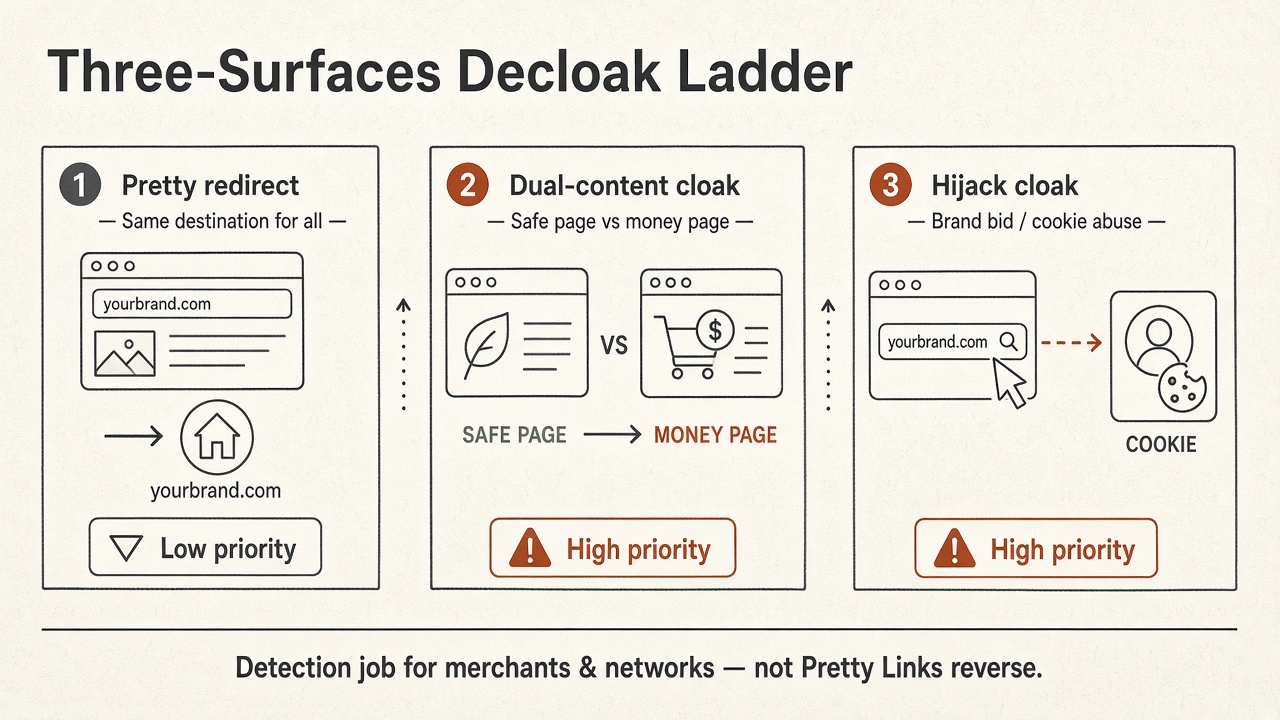
Source: feat. editorial framework synthesizing Amazon Associates Operating Agreement and Google Ads Circumventing Systems policy. https://affiliate-program.amazon.com/help/operating/policies · https://support.google.com/adspolicy/answer/15938075
Surface 1 is covered in depth in affiliate link cloaking and tracking explained. Surfaces 2 and 3 are why operators keep searching affiliate de-cloaking even while tip blogs still redefine the word.
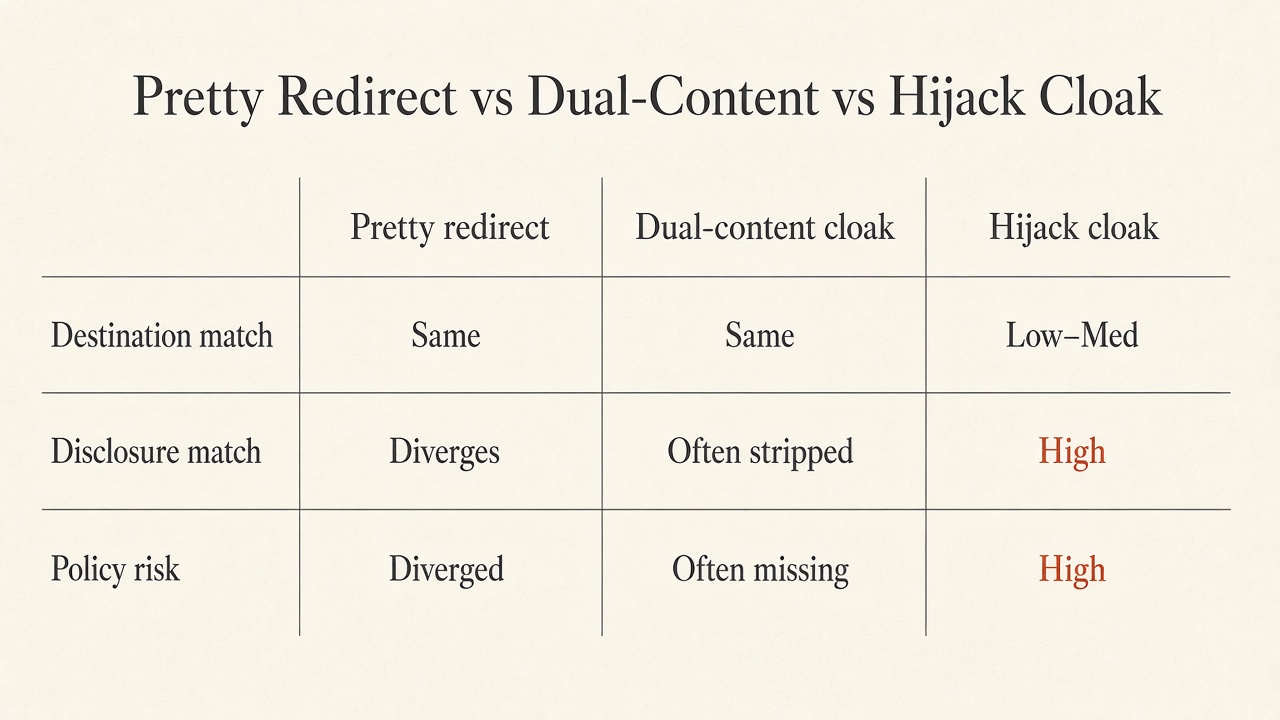
Source: feat. editorial comparison; policy anchors Amazon Associates (2026) and Google Ads Circumventing Systems. https://affiliate-program.amazon.com/help/operating/policies · https://support.google.com/adspolicy/answer/15938075
Operators do not need a secret sauce brochure. They need a boring, repeatable pack:
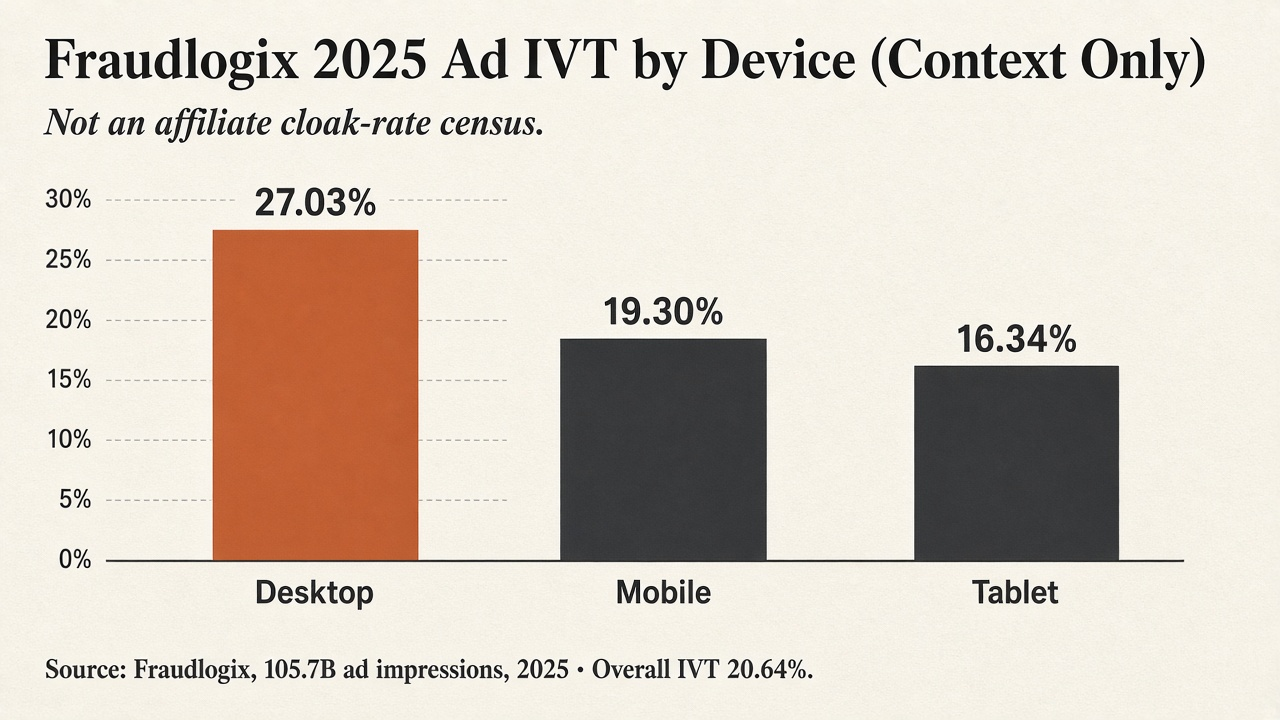
Source: Fraudlogix, State of Ad Fraud 2026 (105.7B ad impressions, full-year 2025). Ad IVT context only—not an affiliate cloak-rate census. https://www.fraudlogix.com/stats/ad-fraud-statistics-2026
| Referee | Written rule | What to store in the ticket |
|---|---|---|
| Amazon Associates | No cloak/hide/spoof of Site URL or user agent; no shortener that makes Amazon destination unclear | Origin Site URL, hop chain, whether Amazon destination is obvious |
| Google Ads | Cloaking banned under Circumventing systems; trackers OK only if they do not hide violations | Reviewer HTML vs buyer HTML, Final URL story |
| Your program terms | Usually “prohibited: cloaking / concealed landing pages” | Clause cite + evidence pack |
| FTC | Material connection disclosed clearly and conspicuously | Buyer-surface screenshot with disclosure visible |
Write the ban into affiliate program terms before you need it. After you catch one dual-content cloak, decloak the rest of that partner’s URLs. Cloaks rarely travel alone. Pair the ticket with your disclosure rules so FTC material-connection language is checked on the buyer surface, not only on the safe page.
Q: What is affiliate de-cloaking? A: Affiliate de-cloaking is how networks, ad platforms, and merchants reveal that a promotion URL shows reviewers a different page or destination than real buyers. It is detection, not a Pretty Links reverse.
Q: Is a branded affiliate redirect the same as cloaking? A: Usually no. A branded redirect that sends every visitor to the same honest destination is tracking hygiene. Cloaking that triggers bans is dual-content or destination branching keyed off identity. See affiliate link cloaking and tracking explained.
Q: How do networks detect cloaked affiliate links? A: They combine approval crawls, post-launch re-checks, multi-fingerprint visits, redirect-chain capture, and merchant reports. Divergence on offer, disclosure, or final URL is the signal—not a single HQ screenshot.
Q: Does Amazon allow cloaked affiliate links? A: Amazon Associates forbids cloaking, hiding, or spoofing so the Site of origin cannot be determined, and forbids shorteners that make the Amazon destination unclear. Treat those as Operating Agreement tests, not style tips.
Q: Is there a public rate for how often affiliates cloak? A: No public dataset publishes a universal dual-content cloak rate across programs. Fraudlogix’s ~20.64% figure is advertising invalid traffic on 105.7 billion impressions—context for fraud pressure, not your program’s cloak census.
Affiliate de-cloaking is how you stop trusting the safe page. Classify the surface, capture two identities, diff the money page, and enforce with Amazon and Google Ads language already on the books. Pretty redirects can stay. Dual-content and hijack cloaks cannot.
If you want creators selling from a co-branded storefront you can actually see, start at feat..
GoAffPro pricing: Hobby Free, Premium $49, Business from $99. No sales %, vs UpPromote.
Refersion pricing: Launch $39+3%, Growth $199+2%. Affiliate-sales fees, crossover math, vs UpPromote.
UpPromote pricing: Free, Growth $29.99+2%, Pro $89.99+1.5%. Performance fees, crossover math, vs ReferralCandy.