Organic vs Paid Growth Channel Comparison
Organic vs paid growth channel comparison: First Page Sage B2B organic CAC $942 vs paid $1,907, why PPC can beat basic SEO, and the B2C flip.
Beat marketing means drumbeat practice: one POV, content+social+PR+SEO, and about 20% create / 80% distribute. Ladder inside.

TL;DR: Beat marketing is the short search string for drumbeat marketing: one point of view, repeated through content, social, PR, and SEO until the market associates that POV with you. Own the message before you buy amplification. Plan about 20% of time to create and 80% to distribute.
Founders type beat marketing into Google and land on music playlists, BPM plugins, or vague “stay on beat” slogans. The useful answer is older and sharper: drumbeat marketing, a startup go-to-market habit built on messaging discipline, not campaign theater.
If you sell through affiliates, creators, or co-branded storefronts, the same failure mode shows up. The product page says one thing, the LinkedIn thread says another, and the partner brief invents a third. Beat marketing fixes the root: one POV, owned channels first, earned second.
Beat marketing is drumbeat marketing under the shorter query people actually type: a go-to-market approach that puts a clear point of view through owned and earned channels with enough repetition that the market associates that POV with your company.
York IE defines drumbeat marketing as a practice built on strong messaging, discipline, and consistency, especially for startups that still lack brand equity and spare budget (York IE). Kate Campbell restates the same three pillars: strong messaging, discipline, and consistency (Greenough).
The name matters because search intent splits. “Beat” alone pulls music marketing. “Drumbeat marketing” pulls the York IE lineage. This page owns the bridge: if you searched beat marketing for GTM help, you wanted the drumbeat ladder, not a Spotify ad playbook.
Beat marketing is not a media-mix model, not a paid-social tactic, and not features-versus-benefits copywriting on a product page. It is also not the opposite of performance. It is the narrative layer that keeps content marketing vs performance marketing from sounding like two different companies.
Startups abandon brand work after one quiet month, then restart after the next raise. That stop-and-go pattern is exactly what York IE warns against: momentum never compounds (York IE).
For merchants recruiting sellers, beat marketing is how the offer sounds the same on your site, in a co-branded storefront, and in a creator caption. For affiliates, it is how you refuse programs whose story changes every sprint.
Beat marketing works by locking a POV, pushing it through owned channels until repetition feels boring, then placing that same POV in earned channels while you spend most of your hours on distribution, not net-new drafts.
| Ladder rung | Job | Fail mode |
|---|---|---|
| Query map | Treat beat marketing as drumbeat GTM, not music BPM | Chasing playlist or ad-creative tips |
| POV / hierarchy | Write what you are and are not | Shiny-object commentary every news cycle |
| Owned cadence | Content + social + SEO on one message | One blog post, then silence |
| Earned layer | PR, speaking, awards with the same POV | Pitching before owned proof exists |
| Time split | ~20% create / ~80% distribute | Drafting forever; shipping never |
| Association test | Outsiders can repeat your POV cold | Still needing a 40-slide deck |
Source: Editorial Beat Marketing Ladder synthesizing York IE (2020), Greenough/Kate Campbell (2023), UMass Lowell (2021).
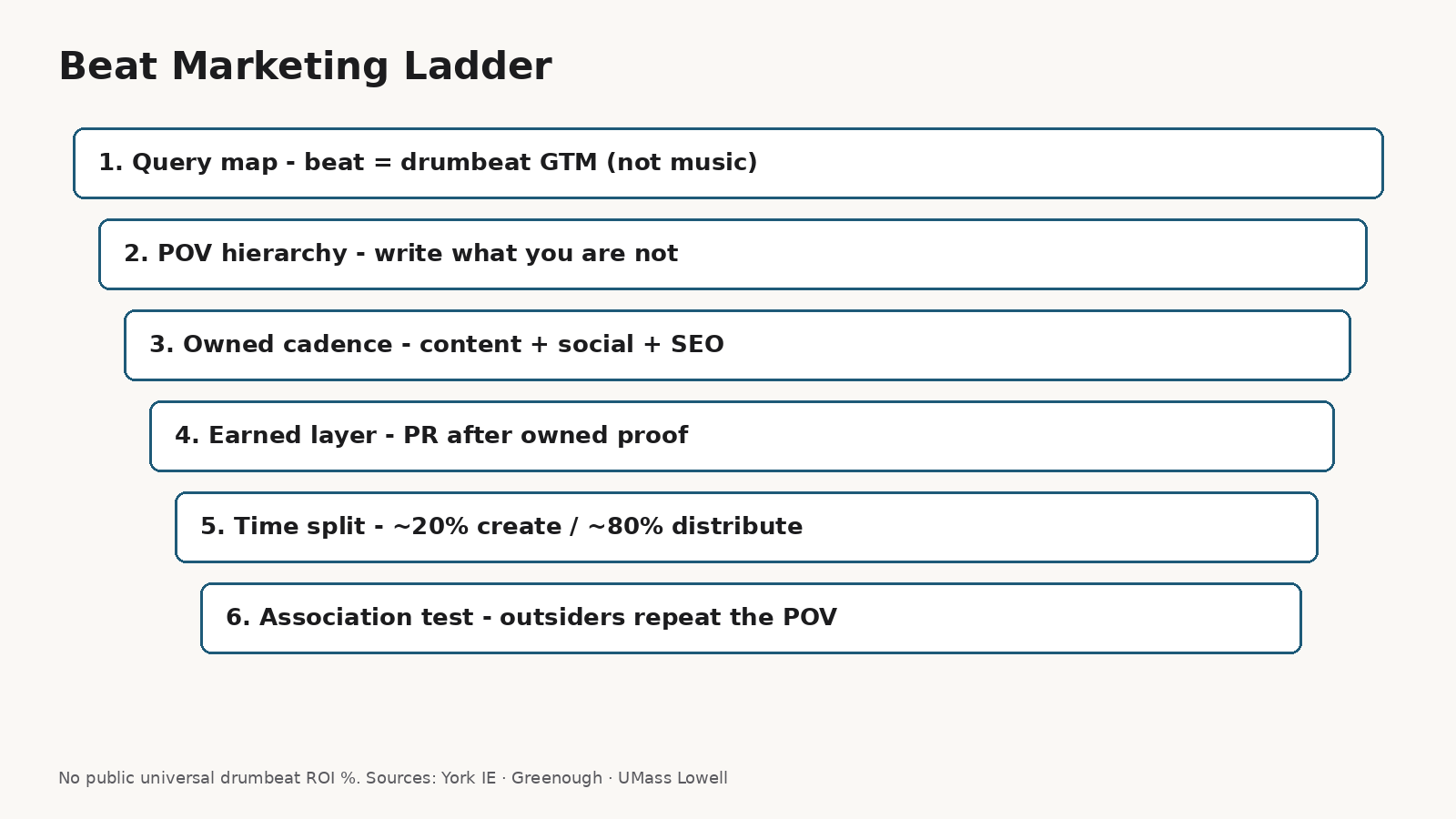
Source: Editorial framework from York IE, Greenough/Kate Campbell, and UMass Lowell. https://york.ie/blog/what-is-drumbeat-marketing/ · https://www.greenoughagency.com/news-insights/inside-the-moments-that-matter-kate-campbell-of-york-ie-on-why-start-ups-need-drumbeat-marketing · https://www.uml.edu/news/department-news/2021/drumbeat-marketing.aspx
If the SERP is music, you are in the wrong lane. If the SERP is York IE-style drumbeat, stay. Rename the work “drumbeat” internally if that helps the team, but keep beat marketing as the public phrase your buyers typed.
York IE’s hard step is deciding what the company is not. Without that cut, every hot take becomes brand drift (York IE). Put a messaging hierarchy on one page. Have two leaders answer “what do we do?” separately. If the answers diverge, you do not have a beat yet.
York IE’s sticker equation is simple: drumbeat marketing = content marketing + social + public relations + SEO (York IE). Kate Campbell repeats the same four-part formula for brand awareness (Greenough).
| Channel | Drumbeat job | Repurpose example (UMass Lowell) |
|---|---|---|
| Content | Long-form proof of the POV | White paper → company blog |
| Social | Micro repeats of the same lines | Blog quotes → short posts with a graphic |
| PR | Earned placement of the owned story | White paper → press release |
| SEO | Durable pages that answer the same questions | Cluster posts that reinforce the hierarchy |
Source: York IE formula; UMass Lowell repurpose path (Kate Campbell / Colin Steele session, 2021).
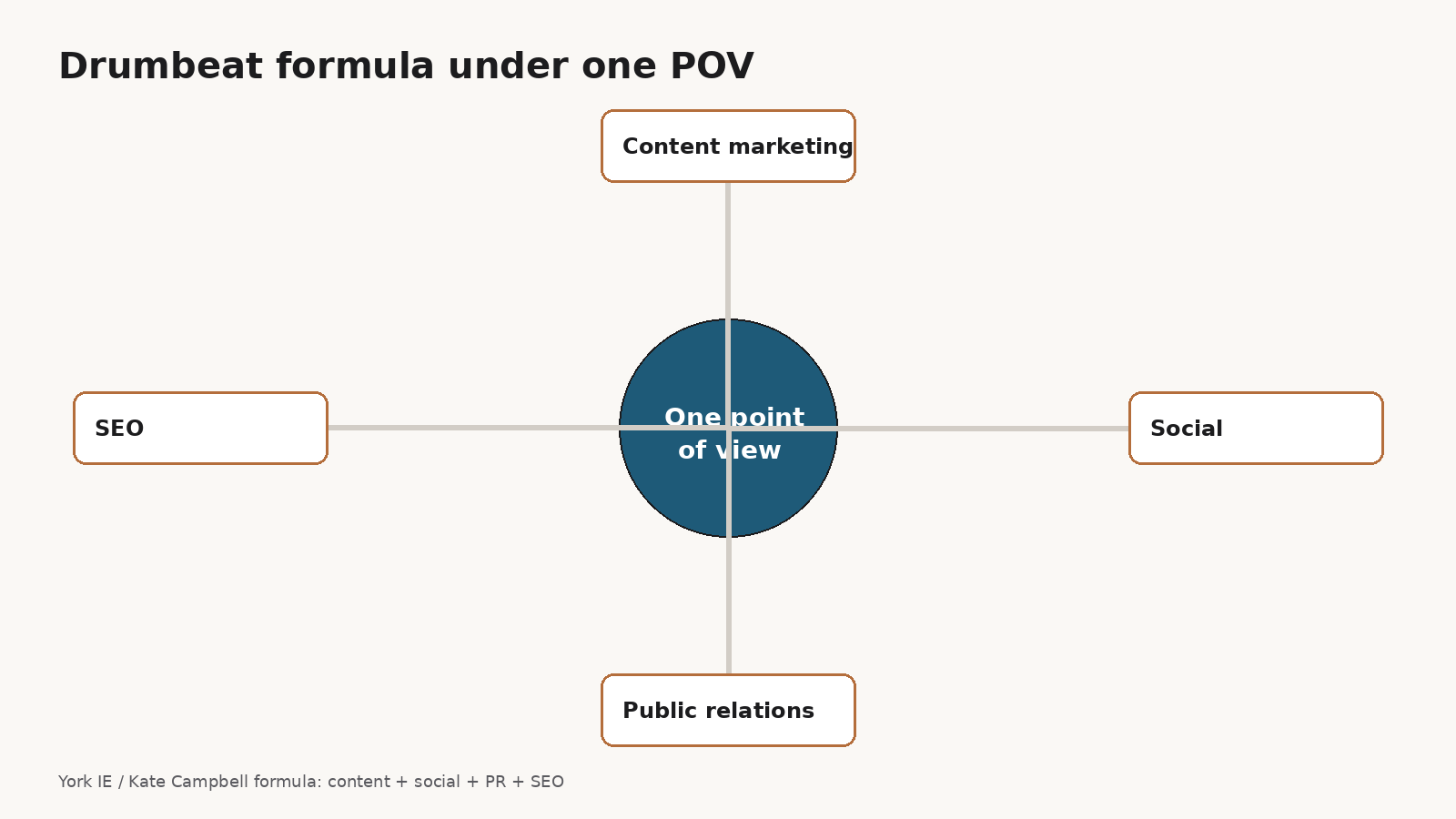
Source: York IE drumbeat formula (content + social + PR + SEO). https://york.ie/blog/what-is-drumbeat-marketing/
That repurpose path is the practical link to content repurposing frameworks and a topic cluster: one pillar claim, many surfaces, zero new personalities.
Kate Campbell’s hot take: spend about 20% of time creating and 80% distributing (Greenough). Treat that as an operator ratio, not a law of physics. If your calendar is inverted, you are drafting a museum, not a drumbeat.
| Time bucket | Share | Examples |
|---|---|---|
| Create | ~20% | Messaging hierarchy, core essay, primary asset |
| Distribute | ~80% | Social cuts, SEO refreshes, partner one-pagers, PR pitches, email snippets |
Source: Kate Campbell via Greenough Agency, September 21, 2023. https://www.greenoughagency.com/news-insights/inside-the-moments-that-matter-kate-campbell-of-york-ie-on-why-start-ups-need-drumbeat-marketing
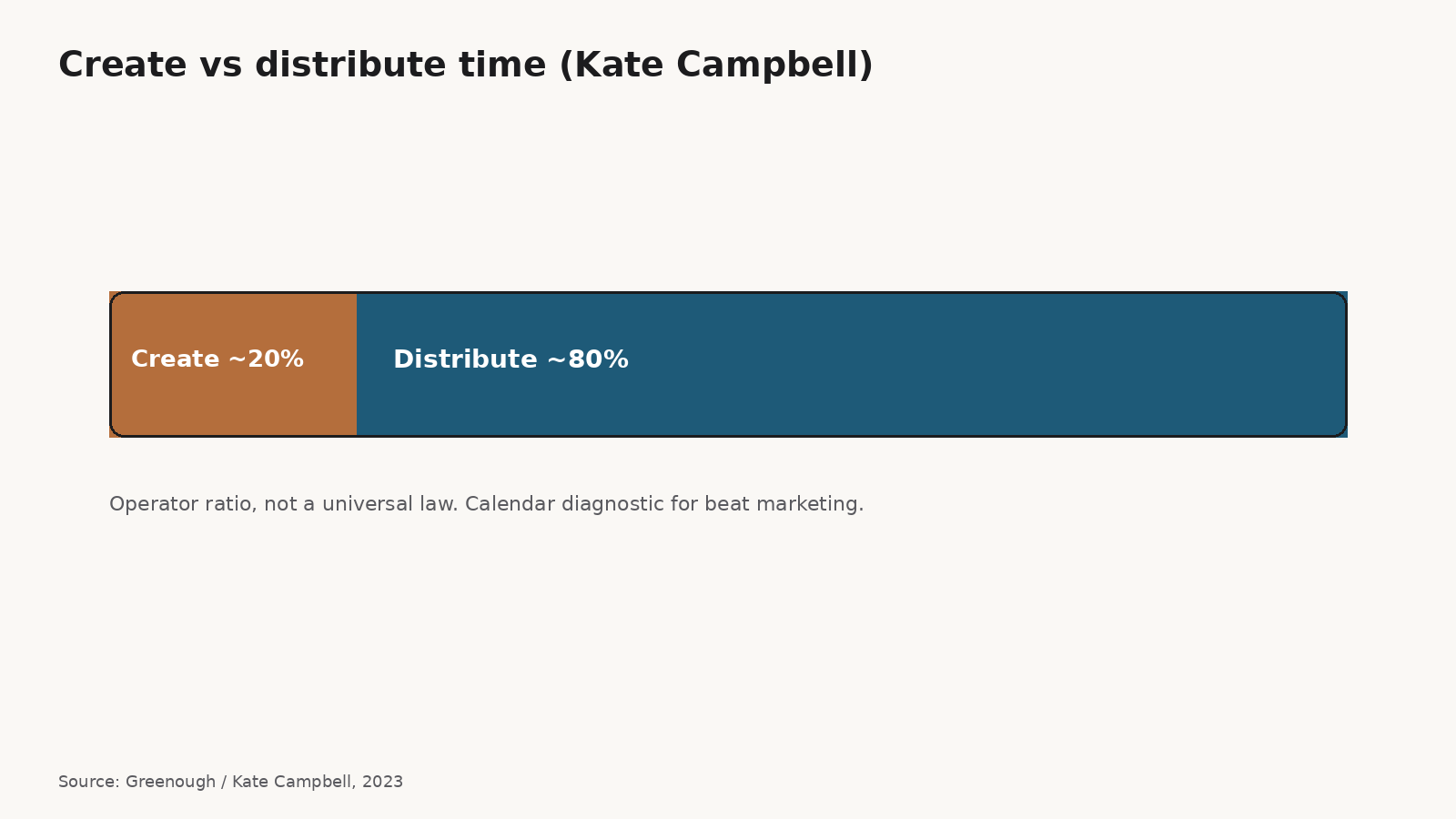
Source: Kate Campbell via Greenough Agency, 2023. https://www.greenoughagency.com/news-insights/inside-the-moments-that-matter-kate-campbell-of-york-ie-on-why-start-ups-need-drumbeat-marketing
Campbell told the UMass Lowell Innovation Hub audience that drumbeat marketing does not begin on launch day, and that a daily habit (a post, a scheduled social piece, a short video) builds the consistency that becomes recognition (UMass Lowell). Daily does not mean viral. Daily means the POV never goes quiet long enough for the market to forget the last version of you.
York IE’s success condition is association: the POV becomes linked with the startup in the market (York IE). A practical test: ask a friendly outsider to explain what you stand for in one sentence without looking at your site. If they cannot, you are still in the owned-cadence rung. If they can, earned outreach and partner kits get cheaper because you are not re-teaching the story every time.
Beat marketing does not set your commission table, cookie window, or payout rail. It does not replace organic vs paid growth math. It does not invent a public ROI benchmark. When someone sells you a “drumbeat package” with a guaranteed pipeline percentage, ask for the dataset. Row 11 in our citation log is empty on purpose.
Q: What is beat marketing? A: Beat marketing is the common search label for drumbeat marketing: a startup go-to-market habit that repeats one point of view through content, social, PR, and SEO until the market associates that POV with you. It is about messaging discipline and cadence, not music production or a single campaign burst.
Q: Is beat marketing the same as drumbeat marketing? A: For GTM intent, yes. Practitioners and York IE publish “drumbeat marketing”; many searchers type the shorter “beat marketing.” This article treats them as the same ladder and separates that intent from music “beat” results.
Q: What is the drumbeat marketing formula? A: York IE and Kate Campbell describe drumbeat as content marketing plus social plus public relations plus SEO, all carrying one POV. The channels are legs under the message, not a menu of unrelated programs you rotate monthly.
Q: How should teams split create vs distribute time? A: Kate Campbell’s published hot take is about 20% creating and 80% distributing. Use it as a calendar diagnostic. If almost all hours go to drafting and almost none to shipping cuts, pitches, and refreshes, you do not have a beat yet.
Q: Does beat marketing guarantee revenue or affiliate sales? A: No. There is no public dataset for a universal drumbeat ROI percentage. Beat marketing improves message consistency so performance channels and partner distribution are not fighting three brand stories. It is not a substitute for offer, tracking, or payout design.
Beat marketing is drumbeat practice with the query people type: lock a POV, run content, social, PR, and SEO as one instrument, bias hours to distribution, and start before launch. When outsiders can repeat your line without a deck, you have a beat worth putting in every affiliate brief and storefront kit.
List a product for creators to sell on feat.: https://www.feat.press
Organic vs paid growth channel comparison: First Page Sage B2B organic CAC $942 vs paid $1,907, why PPC can beat basic SEO, and the B2C flip.
Marketing budget allocation by company stage: SaaS Capital's 8% median, equity-backed +100% vs bootstrap, and why unit economics beat round-label tables.
Marketing funnel benchmarks by stage and industry: First Page Sage Lead-to-MQL rates, channel gaps, and why B2B and ecommerce funnels differ.