GoAffPro Pricing Explained
GoAffPro pricing: Hobby Free, Premium $49, Business from $99. No sales %, vs UpPromote.
Cost per sale affiliate marketing pays on purchases. Shopify CPS bands, Collabs holds, labeled Awin CPS quotes, and when CPS loses to CPL or a storefront.

TL;DR: Cost per sale affiliate marketing pays a partner only when an attributed purchase clears. Shopify treats CPS as a CPA subtype and publishes category bands such as physical 5%-15% and digital 20%-50%. Holds (Shopify Collabs 7-90 days) claw back returns. Labeled Awin programs show both % and fixed-dollar CPS. There is no honest universal average rate.
Operators say “we run affiliate” when they mean three different machines. Pay per lead. Pay per click. Pay per sale. Only one of those waits for money to land. If you asked for cost per sale affiliate marketing and got a CPL form-fill guide, you got the wrong seat.
This page is the purchase twin of cost per lead affiliate programs. Pair it with affiliate commission structures for the model map and recurring vs one-time affiliate commissions when the sale renews.
Cost per sale affiliate marketing is a performance partnership that pays a publisher a percentage or fixed amount only when a referred customer completes an attributed purchase.
Shopify’s CPA taxonomy names this cost-per-sale (CPS) and notes it can be a one-time acquisition payment or a recurring payment each time the customer buys again (Shopify). Shopify’s commission guide uses the everyday label pay-per-sale (PPS) for the same purchase event (Shopify). If the payable event is a form, you are on CPL. If it is a click, you are on CPC. If it is a checkout, you are here.
This is not a second copy of affiliate commission structures. That spoke maps CPS beside CPA, CPL, and RevShare. Here the job is operating the purchase seat: rate shape, holds, margin math, and when to leave for leads or a storefront.
It matters because the payable event is the only honest alignment with ecommerce cash.
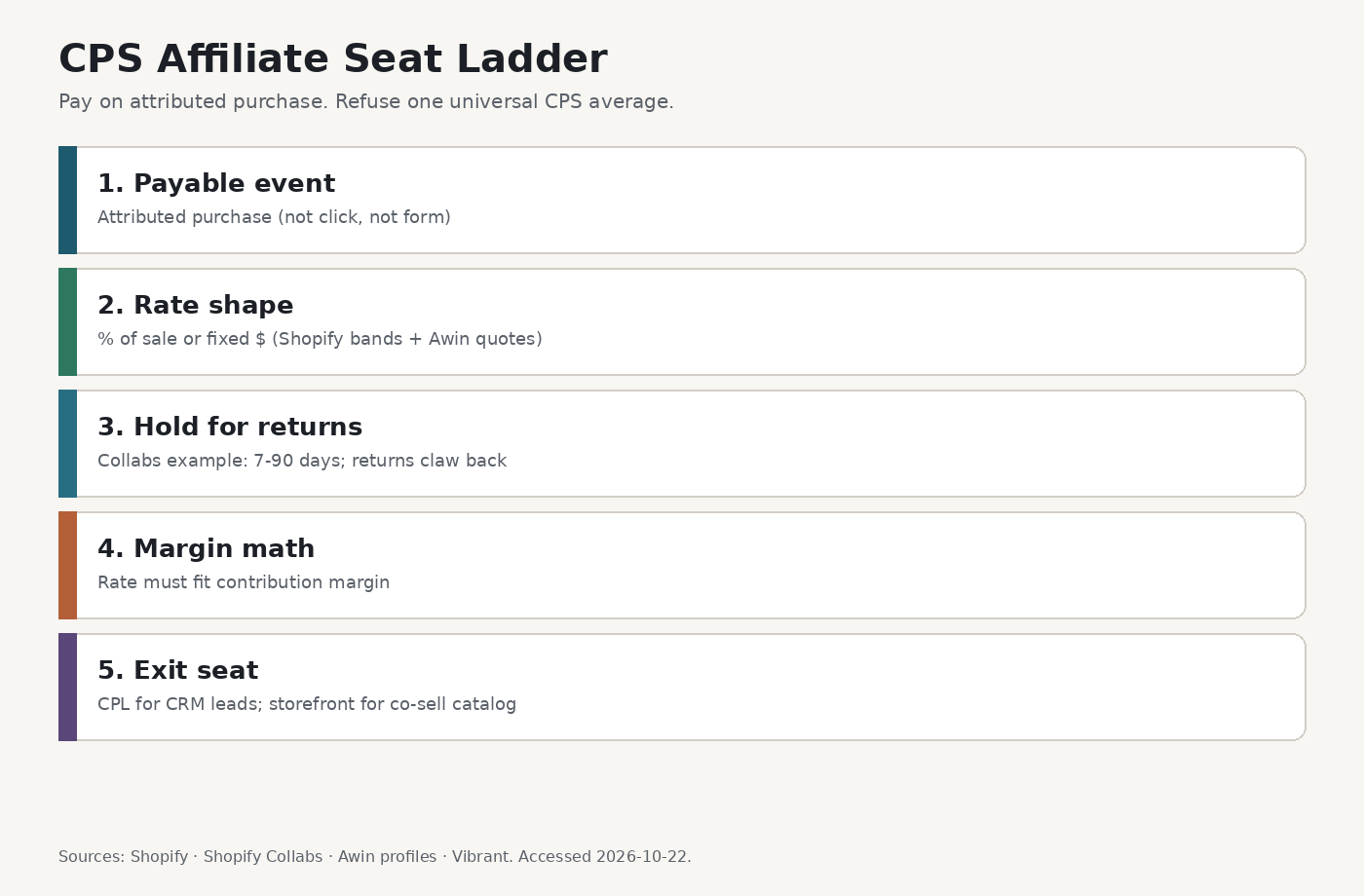
Source: Editorial CPS Affiliate Seat Ladder. Taxonomy and bands from Shopify; holds from Shopify Collabs; labeled Awin CPS examples. Accessed 2026-10-22.
Cost per sale affiliate marketing works as a five-rung seat: name the purchase event, choose % or fixed dollars, hold for returns, run margin math, then exit when the job is not a checkout. Quote labeled sources. Do not invent a market-average CPS.
CPS starts when tracking ties an order to a partner click or code under your attribution rules. Shopify’s PPS example is blunt: 10% of a $100 sale is a $10 commission (Shopify). No order, no pay.
Write the exclusions next to the rate: canceled, refunded, and fraudulent transactions pay nothing. Skoove’s Awin terms state that explicitly for its 25% lifetime-sale commission (Awin).
Shopify’s 2026 guide publishes category reference bands (widely reported ranges, not a single census mean):
| Category (Shopify guide) | Published reference band |
|---|---|
| Physical goods (fashion, home, beauty) | 5%-15% per sale |
| Digital products and online courses | 20%-50% per sale |
| Subscription services | 15%-30% recurring |
| B2B software and services | 10%-30% of first contract value |
| High-ticket (furniture, mattresses) | 3%-8% per sale |
Source: Shopify affiliate commission guide (May 11, 2026). Accessed 2026-10-22.
The same guide notes well-known publishers often land near 10%-15%, sometimes up to 20%, and that some subscription brands pay 75%-100% of first-month revenue (Shopify). Those are planning bands. Your SKU margin still wins.
Public Awin menus show the fixed-dollar fork:
| Program (labeled Awin profile) | CPS quote | Notes |
|---|---|---|
| Skoove US | 25% of valid lifetime sales | Worked example: €149.99 deal → €37.50 |
| Marley Spoon US | $25 per sale ($10 for voucher/cashback/performance partners) | Cookie 30 days |
| Born To Sell | $40 per sale | Also lists $5 per lead; cookie 90 days |
Sources: Skoove; Marley Spoon; Born To Sell. Accessed 2026-10-22.
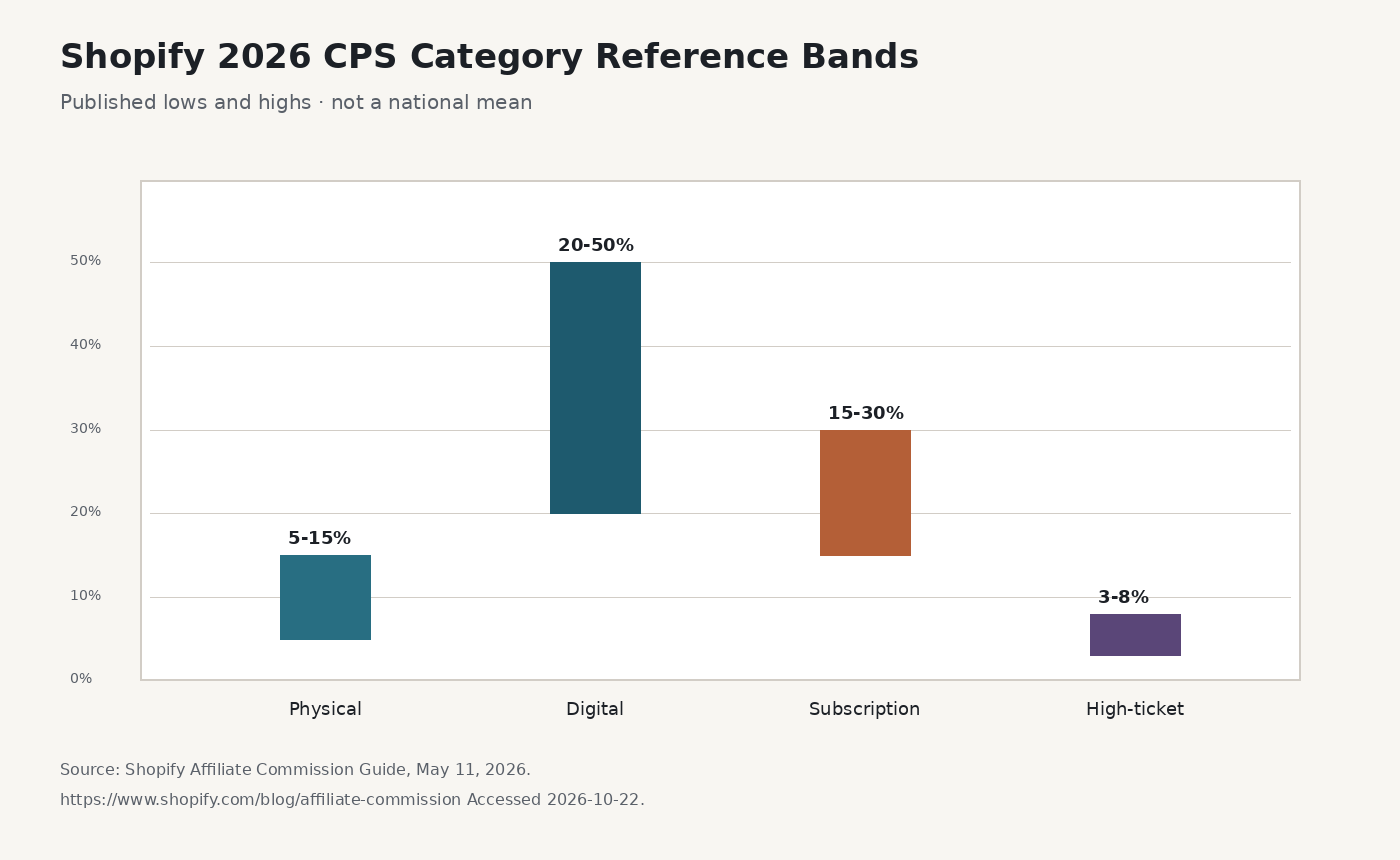
Source: Shopify, Affiliate Commission Guide (May 11, 2026). Bands are published reference ranges, not a national mean. https://www.shopify.com/blog/affiliate-commission Accessed 2026-10-22.
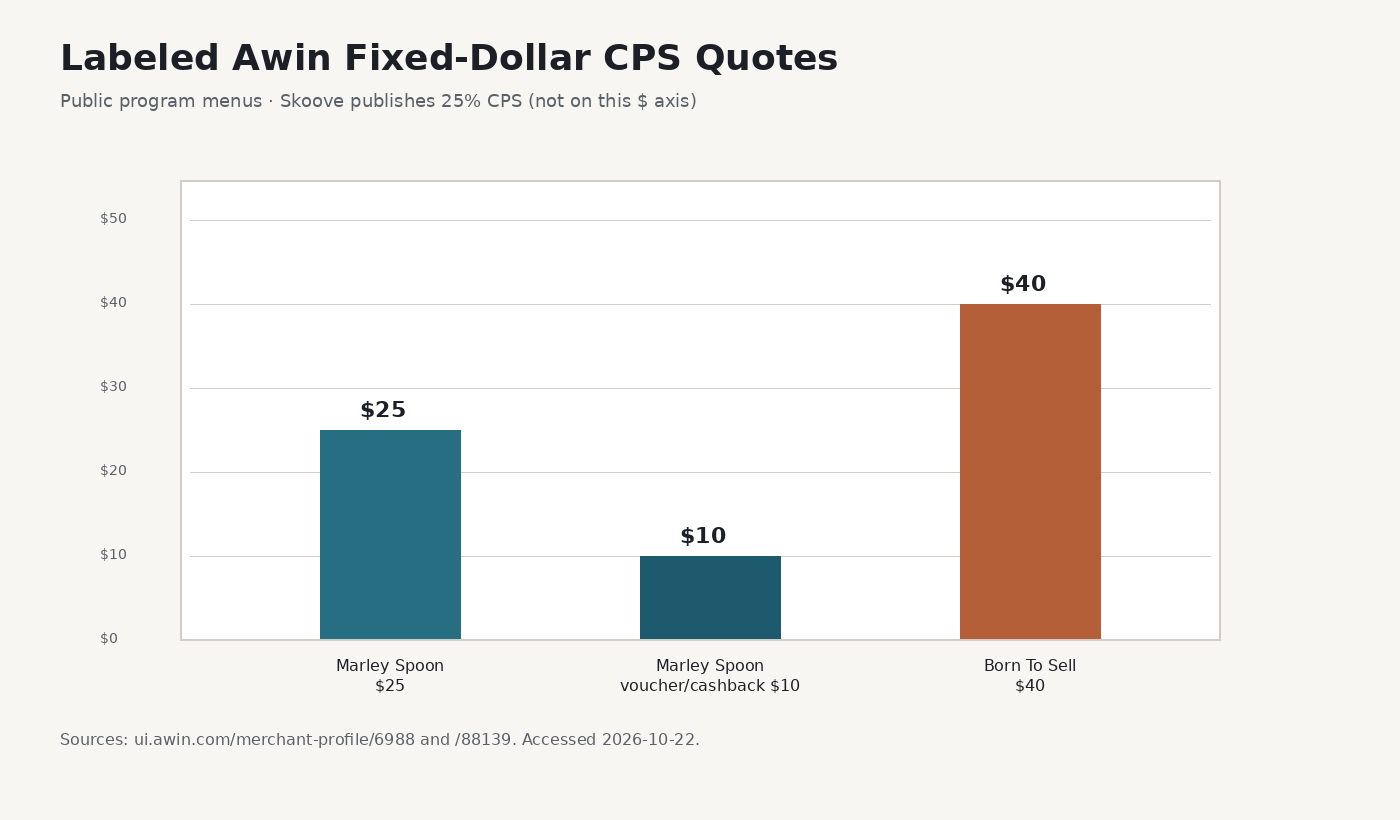
Source: Awin merchant profiles for Marley Spoon US and Born To Sell. Skoove publishes 25% CPS (see caption in article). Accessed 2026-10-22.
Shopify Collabs starts a holding period as soon as a sale is made. Merchants can set that hold between 7 and 90 days. Creators need a $25 minimum before automatic payout via the Shopify bill. If the order returns inside the hold, the commission is removed (Shopify).
Publishers who forecast weekly cash on CPS without reading the hold are planning fiction. Merchants who pay same-day on refundable goods are donating reverse logistics.
A 15% CPS on a 20% gross-margin SKU is not a growth plan. Shopify’s guide says slim-margin products may not support affiliate rates partners will promote, and suggests PPC or PPL only when the goal is awareness or leads instead of net sales (Shopify).
Worked sketches (labeled, not averages):
| Job | Better seat | Why |
|---|---|---|
| Online product purchase | CPS / PPS | Pay when revenue lands |
| Sales-team CRM fill | CPL | Purchase may never happen on-site (CPL ladder) |
| Subscription retention | Recurring CPS or RevShare | One-time CPS underpays lifetime value (recurring vs one-time) |
| Named creators need a page to sell your catalog | feat. storefront | Co-branded sell surface + revenue split on sales |
feat. is a marketplace where merchants list products and affiliates sell through co-branded storefronts with a revenue split on every sale (feat.; marketplace). It is not an Awin-style CPS network rate card, and this article invents no feat. percentage. If your partners only need a tracked link into your existing checkout, a CPS program (Rewardful/Tapfiliate/Impact/Awin-class) can be enough. If they need a storefront to sell for you, evaluate feat. beside those trackers. Do not mash the invoices.
Shopify parks CPS inside the CPA family as the sale-shaped action (Shopify). Vibrant’s risk frame still helps: CPL pushes more risk onto the advertiser, RevShare onto the affiliate, and sale-based pay sits between (Vibrant).
In Slack, “CPA offer” can mean a lead or a sale. In the contract, write “payable on captured order net of returns inside the hold.”
Q: What is cost per sale affiliate marketing? A: It is affiliate pay tied to an attributed purchase. Shopify calls this CPS (and PPS): the partner earns a percentage or fixed amount when a referred order counts under your rules, not when someone only clicks or fills a form.
Q: How is CPS different from CPA or CPL? A: CPS is the sale-shaped member of the CPA family. CPL pays on a qualified lead before a purchase. People often say “CPA” for both. Write the payable event in the contract.
Q: What commission rate is typical for cost per sale affiliate marketing? A: There is no public universal average. Shopify’s 2026 guide cites physical goods near 5%-15%, digital near 20%-50%, subscriptions near 15%-30% recurring, and high-ticket near 3%-8%. Labeled programs also use fixed dollars, such as Marley Spoon’s $25 per sale on Awin.
Q: When do CPS commissions get reversed? A: When orders cancel, refund, or fail fraud checks inside the hold. Shopify Collabs removes commissions for returns during a merchant-set 7-90 day hold. Skoove’s Awin terms pay nothing on canceled, refunded, or fraudulent transactions.
Q: Should every brand use cost per sale instead of cost per lead? A: Use CPS when the job is an online purchase you can attribute. Use CPL when the real job is feeding a sales CRM. Use a co-branded storefront when partners need a page to sell your catalog, not only a link into your PDP.
Cost per sale affiliate marketing is a purchase seat: attributed order, % or fixed dollars, return hold, margin math. Quote labeled bands and program menus. Leave for CPL or a storefront when checkout is not the job. When the job is getting other people to sell finished products through co-branded storefronts with a revenue split, start at feat..
GoAffPro pricing: Hobby Free, Premium $49, Business from $99. No sales %, vs UpPromote.
Refersion pricing: Launch $39+3%, Growth $199+2%. Affiliate-sales fees, crossover math, vs UpPromote.
UpPromote pricing: Free, Growth $29.99+2%, Pro $89.99+1.5%. Performance fees, crossover math, vs ReferralCandy.