GoAffPro Pricing Explained
GoAffPro pricing: Hobby Free, Premium $49, Business from $99. No sales %, vs UpPromote.
Most finance programs ban open trademark bidding. “Allow” means a written TM+ exception for named partners—not a public free-for-all.

TL;DR: Finance affiliate programs that allow trademark bidding are almost never an open directory. Compliance-heavy brokers default to ban brand terms + force negatives. When “allow” exists, it is a written TM+ exception for 1–2 trusted partners—not a free brand-SERP free-for-all. Google letting you bid a keyword is not program approval.
Searchers hunting finance affiliate programs that allow trademark bidding usually want a cheat code: bid the broker’s name, skim last-click commission, skip content. That cheat code is why finance SEM terms read like a security policy. Brokers, lenders, and fintech apps treat brand-term PPC as a compliance and CAC problem first—and an affiliate growth lever second.
This page is the seller-facing twin of affiliate brand bidding on brand terms (merchant policy). Here the job is different: decide whether “allow trademark bidding” is a real program feature or a rumor. Sibling rails: affiliate program terms of service, affiliate fraud detection, and how to choose an affiliate program to promote.
Key takeaways:
Trademark bidding in finance affiliate programs is when a partner buys paid search (or similar auction) ads on a broker’s, lender’s, or fintech brand name—or brand-plus modifiers—and routes that click through an affiliate tracking link for commission.
PMA splits the stack cleanly. Trademark bidding / brand bidding targets the brand alone. Trademark plus (TM+) adds a second word such as review, fees, login, or coupon (PMA). Brand term hijacking is the fraud-adjacent version: using the advertiser’s name, display URL, and/or keywords to send PPC traffic to a competitor (PMA).
Finance adds a compliance layer retail catalogs rarely need. Awin’s Publisher Code expects paid search to follow each advertiser’s profile, bans third-party brand infringement in SEM, and notes financial-services activities commonly require licences and registrations (Awin Code of Conduct). That is why “which programs allow it?” is the wrong first question. The first question is what the SEM schedule and financial-promo rules say in writing.
Open brand-term affiliate PPC looks free to the publisher and expensive to the brand. Finance programs optimize for the brand’s CAC, regulators, and risk warnings—not for your CPC arbitrage.
Why the door stays closed:
In finance, “allow trademark bidding” almost always means a narrow written exception, not a public free-for-all. Treat the stack as three layers that must all say yes before you spend.
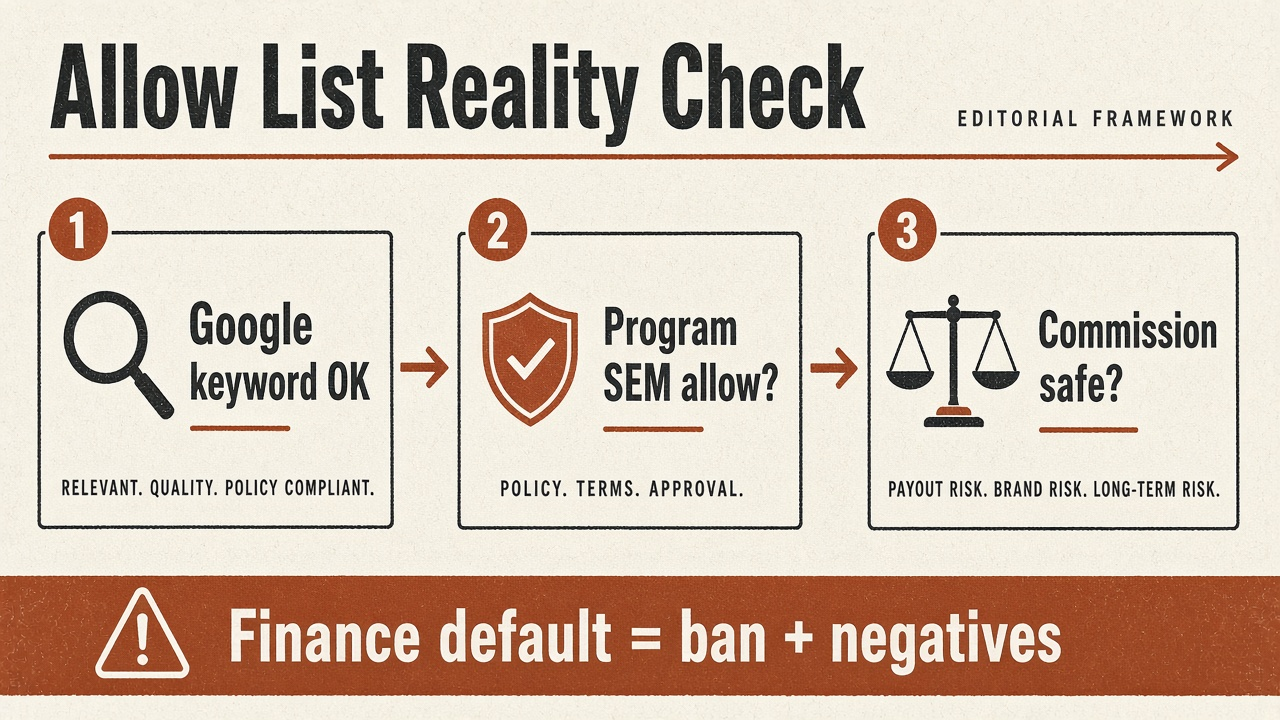
Source: Editorial framework synthesizing Google Ads trademarks policy, PMA TM+ best practices (default no TM+, 1–2 trusted partners), and Pepperstone Affiliate T&Cs brand-bid ban. Accessed 2026-10-10.
Google may let the auction accept a brand keyword. That is permission from the ad platform, not from the broker. Filing a trademark complaint can restrict trademarks in ad text after review; it does not delete every affiliate’s ability to target the brand as a keyword (Google).
Read the affiliate T&Cs and the network PPC matrix. Pepperstone’s public Affiliate Program Terms state affiliates must not “bid on our brand terms, derivatives and/or other misspellings,” and must add brand terms and misspellings as negative keywords in all paid search (Pepperstone T&Cs). Marketing guidelines repeat: partners are not permitted to actively bid on branded keywords such as “Pepperstone” or similar variations (guidelines). FAQs say the same in plain language: do not bid on branded or trademark keywords in SEM (FAQ PDF).
That is a named finance/broker primary source for prohibit, not allow. Use it as the default mental model when a listicle claims “finance programs love brand bidding.”
PMA’s best-practice stack for advertisers who want TM+ at all: state no TM+ in public terms, then select one or two trusted affiliates, set exact allowed/prohibited keywords, and monitor with search tooling (PMA). On the publisher side, that means:
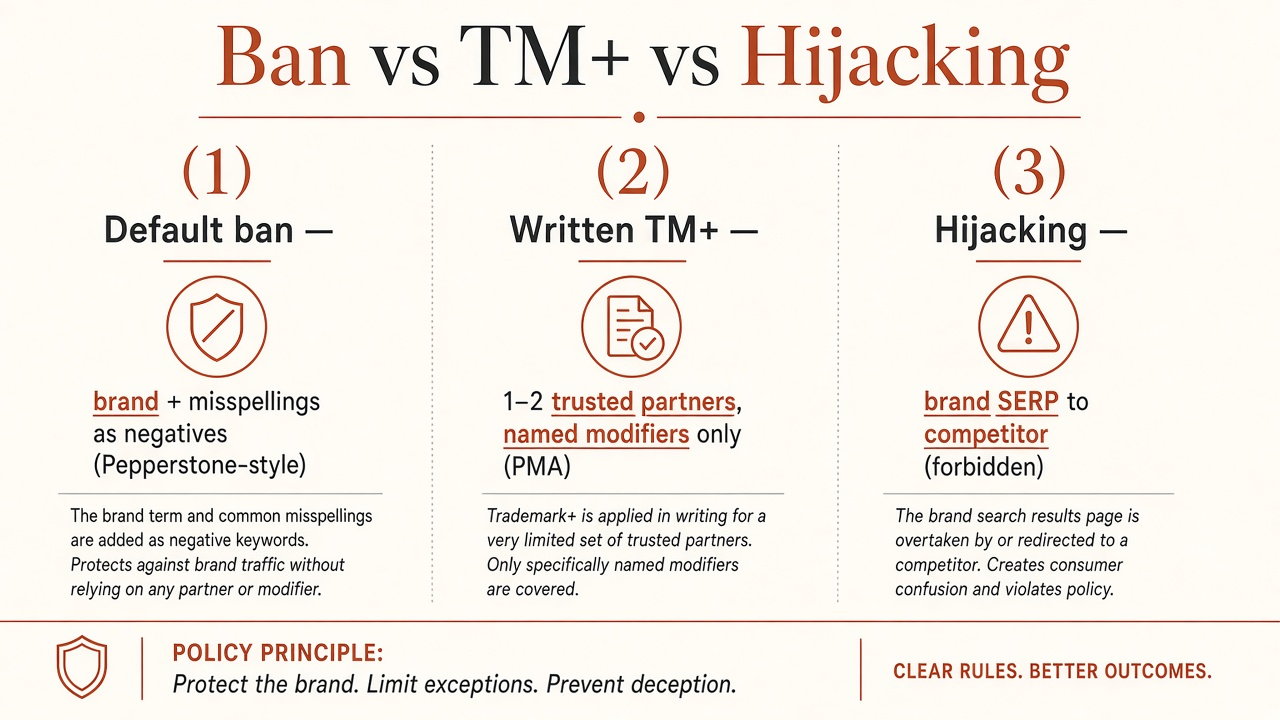
Source: PMA Trademark + Bidding PDF (2023); Pepperstone Affiliate Program T&Cs; Google Ads trademarks policy. Accessed 2026-10-10.
| Posture | What you may buy | What you must prove | Finance-typical? |
|---|---|---|---|
| Open brand bidding | Exact brand + misspellings without limits | Almost never documented publicly | Rare / unicorn |
| Written TM+ exception | Named modifiers only (e.g. brand + review) for named partner | Written approval + negatives + disclosure | Occasional (PMA 1–2 model) |
| Default ban (Pepperstone-style) | Generic / category terms only if otherwise allowed | Negatives for brand + misspellings | Common in public broker T&Cs |
| Hijacking | Competitor landing on brand SERP | Nothing legitimizes this | Forbidden / fraud-adjacent |
Sources: PMA; Pepperstone T&Cs; Google.
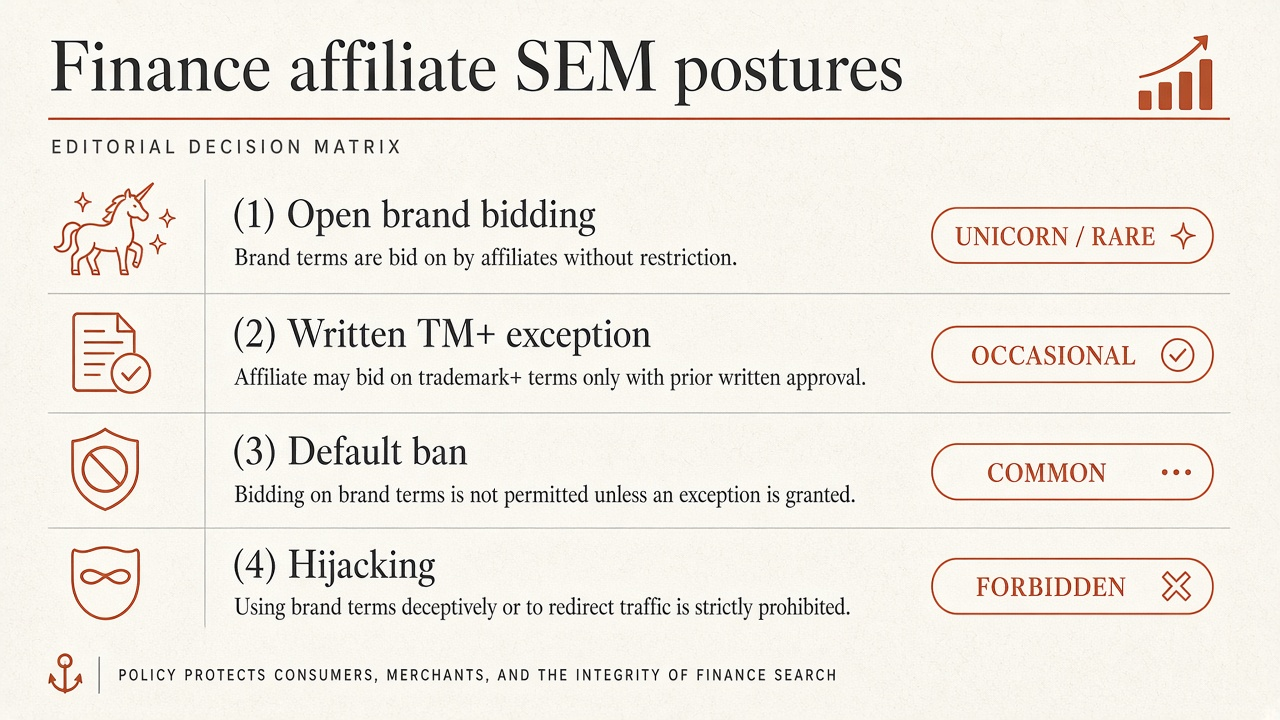
Source: Same matrix as above; taxonomy illustration, not a census of every finance program.
Skip “allow list” Google results. Run this checklist before you spend.
Q: Which finance affiliate programs allow trademark bidding? A: Treat open allow-lists as unreliable. Public broker terms often ban brand bidding outright—Pepperstone forbids brand terms, derivatives, and misspellings and requires negatives. When allowance exists, it is usually a written TM+ exception for one or two named partners, not a directory of open brand SERPs.
Q: Is trademark bidding the same as TM+ in finance affiliates? A: No. Trademark / brand bidding targets the brand keyword alone. TM+ adds a modifier such as review or fees. PMA recommends a public no-TM+ default, then optional rights for one or two trusted affiliates with strict rules.
Q: Does Google approval mean my finance program allows brand bidding? A: No. Google Ads generally allows trademarks as keywords and focuses complaints on trademarks in ad text. Your affiliate T&Cs, network PPC matrix, and written approvals decide whether the commission stands.
Q: Can I bid on “broker name + review” without exact-match brand rights? A: Only if the program’s SEM schedule or a written exception says so. Many finance programs ban brand-plus modifiers as well as exact brand. Ask for named keywords in writing before you spend.
Q: What should I promote instead if brand bidding is banned? A: Generic and educational queries, comparison content that does not impersonate the brand, and co-branded storefront surfaces where the merchant wants distribution. Browse non-broker offers on the feat. marketplace when the product is a merchant-listed digital offer—not a regulated trading account.
Finance affiliate programs that allow trademark bidding are not a shopping aisle. The public default in named broker terms is ban-plus-negatives. PMA’s “allow” path is a written TM+ exception for 1–2 trusted partners. Google’s keyword policy will not save a clawback. Read the SEM schedule, get the exception in writing, or earn on generics and honest content instead. When you want a co-branded sell page for a merchant-listed product outside broker SEM wars, start on the feat. marketplace.
GoAffPro pricing: Hobby Free, Premium $49, Business from $99. No sales %, vs UpPromote.
Refersion pricing: Launch $39+3%, Growth $199+2%. Affiliate-sales fees, crossover math, vs UpPromote.
UpPromote pricing: Free, Growth $29.99+2%, Pro $89.99+1.5%. Performance fees, crossover math, vs ReferralCandy.