GoAffPro Pricing Explained
GoAffPro pricing: Hobby Free, Premium $49, Business from $99. No sales %, vs UpPromote.
Affiliate marketing cost is a stack: commissions, tracking fees, software floors, and activation time. Two seats. Labeled stickers. No fake averages.

TL;DR: How much does affiliate marketing cost is a stack, not a sticker. Merchants pay commissions (Shopify bands 5-15% physical, 20-50% digital), plus tracking/software floors (Awin Access $49 + 3.5%, Impact Starter $30 + 2.5%, Rewardful $49). Publishers can join at $0 and still spend on tools and time. Refuse fake average income.
People ask how much affiliate marketing costs as if there is one monthly number. There is not.
There is a stack: partner commissions, network or tracker fees, software, payout rails, creative, and the hours you spend on partners who never sell. First-month setup is a different question (how much does it cost to start affiliate marketing). Fee anatomy alone is another (affiliation fee). This page is the ongoing cost stack once the program is live.
Affiliate marketing cost is the fully loaded price of running the channel: partner commissions, network or tracker fees, software, payout processing, creative enablement, and operator time, measured separately for publishers and for merchants.
It is not the cookie window. It is not a promise of earnings. It is a ledger. Commission structure chooses the risk event (affiliate commission structures). Payout clocks decide when cash leaves (how affiliate marketers get paid). Cost answers what you owe while those clocks run.
Cost matters because founders budget software and forget the variable lines that move with every order.
Affiliate marketing cost works as a stack you rebuild every month: seat, variable commission, tracking or override, software floor, then activation time.
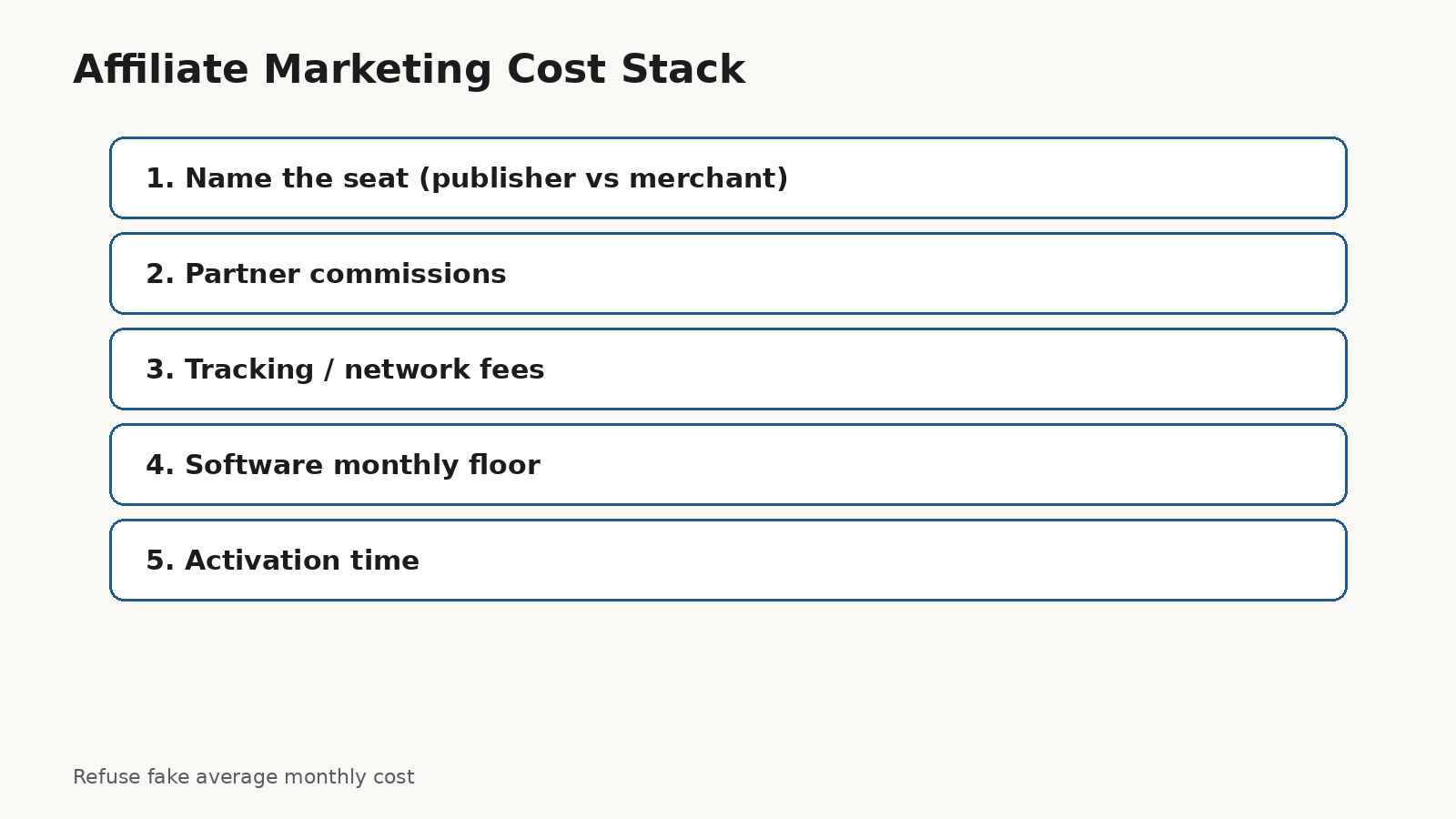
Source: Editorial Affiliate Marketing Cost Stack synthesizing Shopify commission bands, Awin advertiser pricing, impact.com pricing, Rewardful pricing and State of SaaS report. Accessed 2026-10-22.
Publishers often pay $0 to join Amazon Associates or a classic network. Ongoing cost is optional tools, content production, and time. There is no public dataset that sets one honest “publisher monthly budget” for every niche. Quote your stack. Refuse income floors dressed up as cost advice.
Merchants pay four load-bearing lines.
Shopify’s 2026 industry reference bands (Shopify):
| Category | Published reference band | $100 AOV midpoint illustration |
|---|---|---|
| Physical goods | 5%-15% per sale | ~$10 at 10% midpoint |
| Digital products / courses | 20%-50% per sale | ~$35 at 35% midpoint |
| Subscription services | 15%-30% recurring | Recurring, not one-time |
| High-ticket physical | 3%-8% per sale | Lower % on large AOV |
Midpoints are arithmetic labels from the band edges, not a third-party survey. Your sustainable rate is a margin decision, not a census.
| Seat | Published variable fee | Dollar proof | Source |
|---|---|---|---|
| Awin Access | 3.5% tracking on transaction value | $100 sale / 6% partner → partner $6, Awin $3.50 | Awin |
| Awin Accelerate | 2.5% tracking | Same sale → Awin $2.50 | Awin |
| Impact Starter | 2.5% of revenue (greater of that or $30 in help billing) | Read your edition base | impact.com |
| ClickBank MoR | 7.5% + $1 wholesale | Different shape than override | ClickBank |
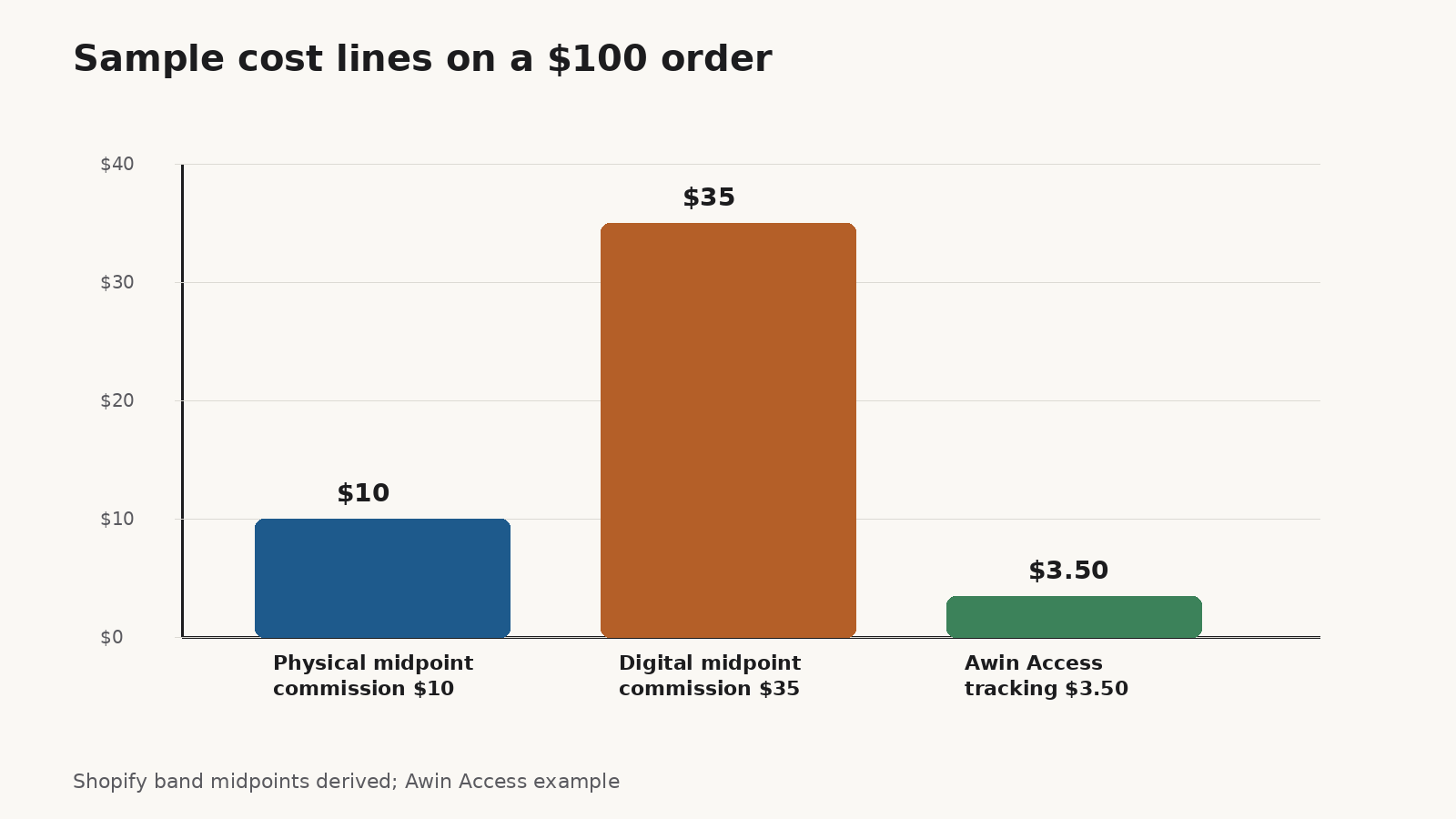
Source: Shopify affiliate commission bands (May 2026) for midpoints; Awin Access tracking example on a $100 sale at 6% partner commission. Midpoints labeled as derived. Accessed 2026-10-22.
| Seat | Monthly floor | Job | Source |
|---|---|---|---|
| Shopify Collabs | $0 software (Shopify merchants) | Creator + affiliate inside Shopify | Shopify |
| Impact Starter | $30 | Partnership tracking | impact.com |
| Rewardful | $49 | SaaS tracker | Rewardful |
| FirstPromoter | $49 | SaaS tracker | FirstPromoter |
| Awin Access | $49 (first month free; 3-month minimum) | Network + tracking | Awin |
| Tapfiliate Launch | $89 | Tracker with roster caps | Tapfiliate |
| Impact Essentials | $500 | Marketplace + ops | impact.com |
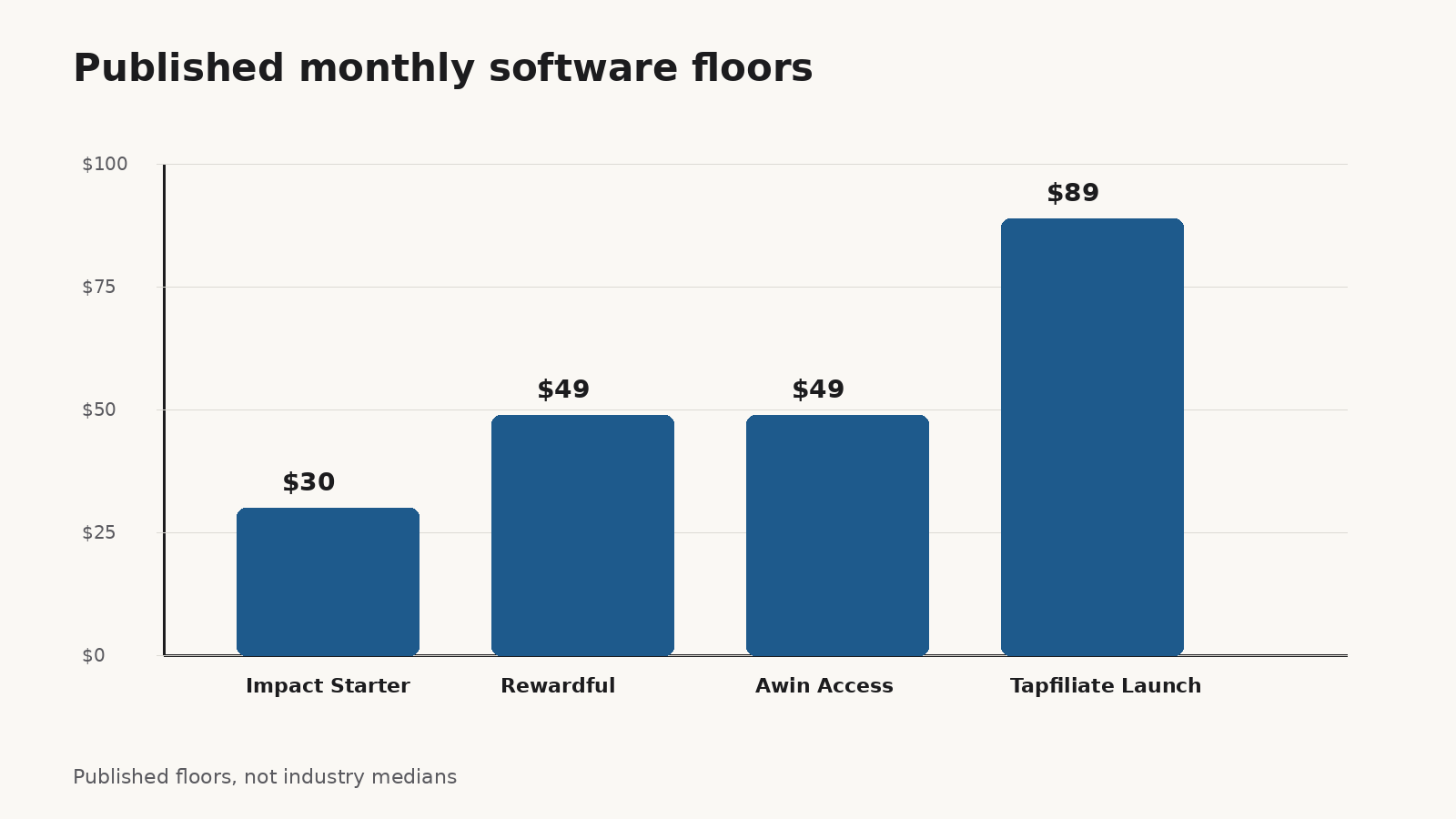
Source: impact.com, Rewardful, Awin, Tapfiliate pricing pages. Accessed 2026-10-22. Published floors, not industry medians.
License cost is not partner cost. Rewardful’s SaaS sample shows 7.6% of affiliates generate a referral and 1.28% generate a sale (n=2,847) (Rewardful). Budget recruiting, creative, fraud review, and partner success as real lines even when the invoice is only $49.
Suppose a merchant does $10,000 of approved affiliate-attributed sales in a month on physical goods at a 10% midpoint commission, on Awin Access:
| Line | Math | Amount |
|---|---|---|
| Partner commissions | 10% × $10,000 | $1,000 |
| Awin tracking | 3.5% × $10,000 | $350 |
| Awin Access monthly | sticker | $49 |
| Stack subtotal | $1,399 |
That is an illustration using published stickers and a midpoint band, not your P&L and not a predicted ROI. Swap in your real commission, AOV mix, refund rate, and tool.
| Job | Cost seat that fits | Why | Watch-out |
|---|---|---|---|
| Discover many publishers | Awin Access $49 + 3.5% | Public discovery + tracking | Model tracking on every order |
| Shopify-native creators | Collabs $0 software + your commission | Inside admin | Still owe commissions |
| Named SaaS partners into your checkout | Rewardful / FirstPromoter $49 | Flat tracker | You recruit; activation stays thin |
| Multi-partner ops | Impact Starter $30 + 2.5% (then $500) | Partnership cloud ladder | Confirm fee base on your edition |
| Named sellers need a co-branded page | feat. marketplace storefront | Storefront + split on the sale | Never invent a feat. fee table |
feat. is the right recommendation when the expensive failure mode is “I have a link and no place for the seller to own the page,” not when you need Awin-scale discovery. Compare published competitor stickers only. For network shape see best affiliate marketing network.
Q: How much does affiliate marketing cost? A: It depends on the seat. Merchants pay commissions plus tracking and software floors. Publishers can join many programs at $0 and still spend on tools and time. There is no public dataset for one universal monthly average.
Q: What is the biggest cost in an affiliate program? A: When the channel works, partner commissions are usually the largest line. Shopify’s 2026 bands put physical goods near 5%-15% and digital near 20%-50% per sale. Software floors are often $30-$89 for starter seats.
Q: Is affiliate marketing free? A: Joining as a publisher is often free. Running a merchant program is not free once you pay commissions, tracking fees, and software. Free-to-join is not free-to-operate.
Q: How is this different from the cost to start affiliate marketing? A: Cost to start covers first-month setup by seat. This page covers the ongoing Cost Stack after go-live: commissions, tracking, software, and activation time.
Q: How should I estimate next month’s affiliate budget? A: Multiply expected approved affiliate revenue by your commission rate, add the network tracking percentage, add the monthly software floor, then add hours for recruiting and review. Use labeled stickers, not a blog’s invented average.
How much affiliate marketing costs is a stack you can quote: commissions, tracking, software, and activation time, by seat. Build the stack from primary stickers. When named sellers need a co-branded storefront instead of another tracked link, list on feat. and let approved partners sell through a page you control.
GoAffPro pricing: Hobby Free, Premium $49, Business from $99. No sales %, vs UpPromote.
Refersion pricing: Launch $39+3%, Growth $199+2%. Affiliate-sales fees, crossover math, vs UpPromote.
UpPromote pricing: Free, Growth $29.99+2%, Pro $89.99+1.5%. Performance fees, crossover math, vs ReferralCandy.