GoAffPro Pricing Explained
GoAffPro pricing: Hobby Free, Premium $49, Business from $99. No sales %, vs UpPromote.
Negotiate affiliate agency contracts with an MSA/SOW clause ladder: account ownership, named fee base, KPIs, FTC monitoring, clawbacks, and exit.

TL;DR: How to negotiate contract terms with an affiliate marketing agency means locking six rungs before you wire the retainer: MSA vs SOW stack, brand-owned network logins, a fee base named in writing (GMV vs commissions), KPI reporting, FTC monitoring plus clawbacks, and a written exit. Skip polite PDFs that leave the agency holding your partner graph.
You do not hire an affiliate marketing agency for prettier slides. You hire it to recruit publishers, police fraud, and grow attributed sales—then you discover the “standard MSA” never said who owns the Impact login when the relationship ends.
How to negotiate contract terms with an affiliate marketing agency is the job of turning a retainer into a program you can still run without that agency. This page is for merchants, not for agencies selling their own paper. It sits beside affiliate program terms of service (brand↔affiliate rules) and how to negotiate affiliate commission rates (publisher economics). Different contracts. Different seats.
Key takeaways:
Negotiating contract terms with an affiliate marketing agency is the process of locking the MSA, SOW, fee base, account ownership, compliance duties, and exit handback so the brand—not the agency—still owns the affiliate program after day one.
An MSA sets the recurring legal and commercial rules. Each SOW names scope, deliverables, KPIs, and price for a period of work. Hamster Garage’s 2026 contract guide treats that split as the default architecture for outsourced affiliate program management (Hamster Garage). If a term is not in the SOW, assume the agency is not obligated to do it.
This is not the same document as your affiliate program terms of service. The TOS binds affiliates. The agency contract binds the firm that recruits, monitors, and reports on those affiliates. Confusing the two is how brands discover—at termination—that partner lists, creative approvals, and network seats were never assigned back.
Retainer invoices feel calm until offboarding. Then the only login that knows your top 40 partners sits in someone else’s password manager.
Why the paper earns its keep:
How to negotiate contract terms with an affiliate marketing agency works as a six-rung Agency Contract Clause Ladder. Climb in order. Skipping a rung is how you pay for a program you cannot take with you.
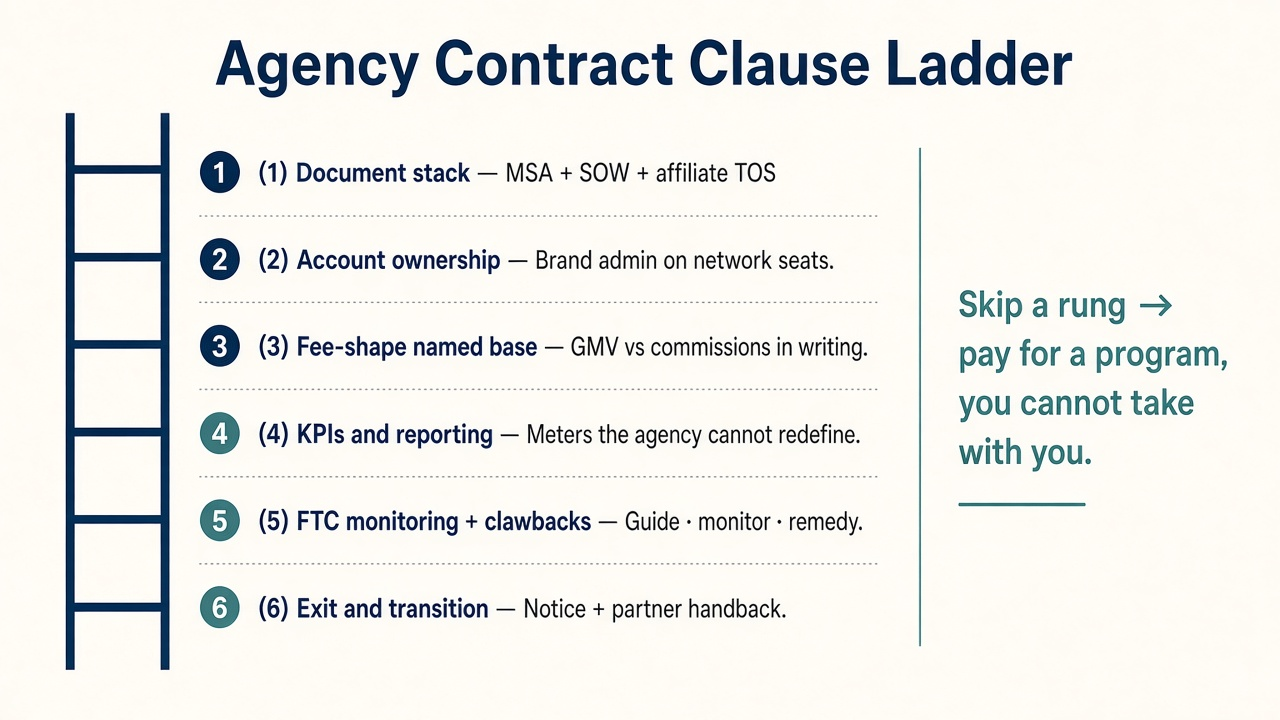
Source: Editorial Agency Contract Clause Ladder synthesizing Hamster Garage MSA/SOW guidance, Elevarus fee-base warning, and FTC §255.1(d) monitoring triad. https://www.hamstergarage.com/article/affiliate-marketing-agency-contract-guide
Put three binders on the table and label them. The MSA is the relationship. The SOW is the job for this quarter. The affiliate TOS is the publisher contract you already publish (or should). Hamster Garage’s guide treats MSA + SOW as the agency pair and keeps affiliate agreements separate (Hamster Garage).
Write an order of precedence. If the SOW and MSA conflict, which wins? TechCorpLegal’s MSA guidance is clear: do not assume—say it (TechCorpLegal).
The brand must be the named advertiser on the network seat (Impact, CJ, Awin, PartnerStack, or your in-house tracker). The agency gets user access, not title. Put in writing:
Community operators make the same point for Google Ads: the business that pays should keep full administrative access (r/googleads). Affiliate desks that ignore this learn it at churn.
Hamster Garage’s 2026 pricing guide frames four primary models brands actually see: monthly retainer, hybrid retainer + revenue share, pure revenue share / CPA, and one-time setup (Hamster Garage). Post Affiliate Pro publishes a wider commission envelope of 5%–30% of sales and flat fees of $1,000–$10,000/month as a vendor-blog range (Post Affiliate Pro). Treat both as market guides, not a census of every agency.
| Fee shape | Published guide band | Lock this sentence in the SOW |
|---|---|---|
| Monthly retainer | ~$3,500–$8,000/mo ops; full-service often quoted to $10,000+ | “Fixed fee covers [named tasks]; out-of-scope needs written change order.” |
| Hybrid | ~$2,500–$5,000/mo + 3%–8% of gross affiliate sales | “Variable % applies to [gross attributed sales / net sales / commissions paid].” |
| Pure % / CPA | ~5%–15% (Hamster) or up to 5%–30% (PAP blog) of sales, or fixed CPA | “Denominator = [definition]. Caps / new-customer-only rules = [yes/no].” |
| Setup / launch | ~$2,500–$10,000+ | “Deliverables for setup fee: tracking live, baseline partners, reporting pack.” |
Sources: Hamster Garage Agency Pricing 2026; Post Affiliate Pro agency pricing blog. https://www.hamstergarage.com/article/affiliate-marketing-agency-pricing-models-costs · https://www.postaffiliatepro.com/blog/affiliate-agency-pricing/
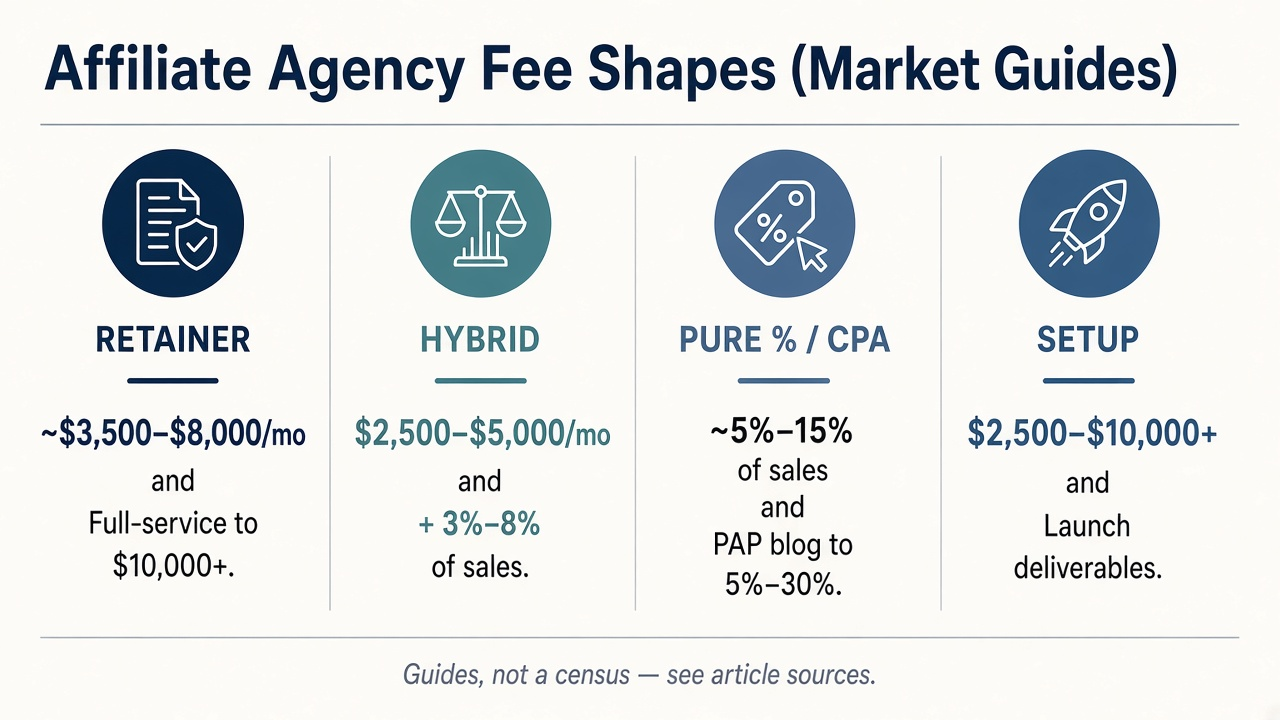
Sources: Hamster Garage 2026; Post Affiliate Pro. Ranges are market guides, not a feat. survey.
The negotiation that matters is the denominator. Elevarus walks the arithmetic: on $500,000 of monthly affiliate sales with a 10% publisher commission, a 10% agency fee is about $50,000 if the base is gross sales and about $5,000 if the base is commissions paid (Elevarus).
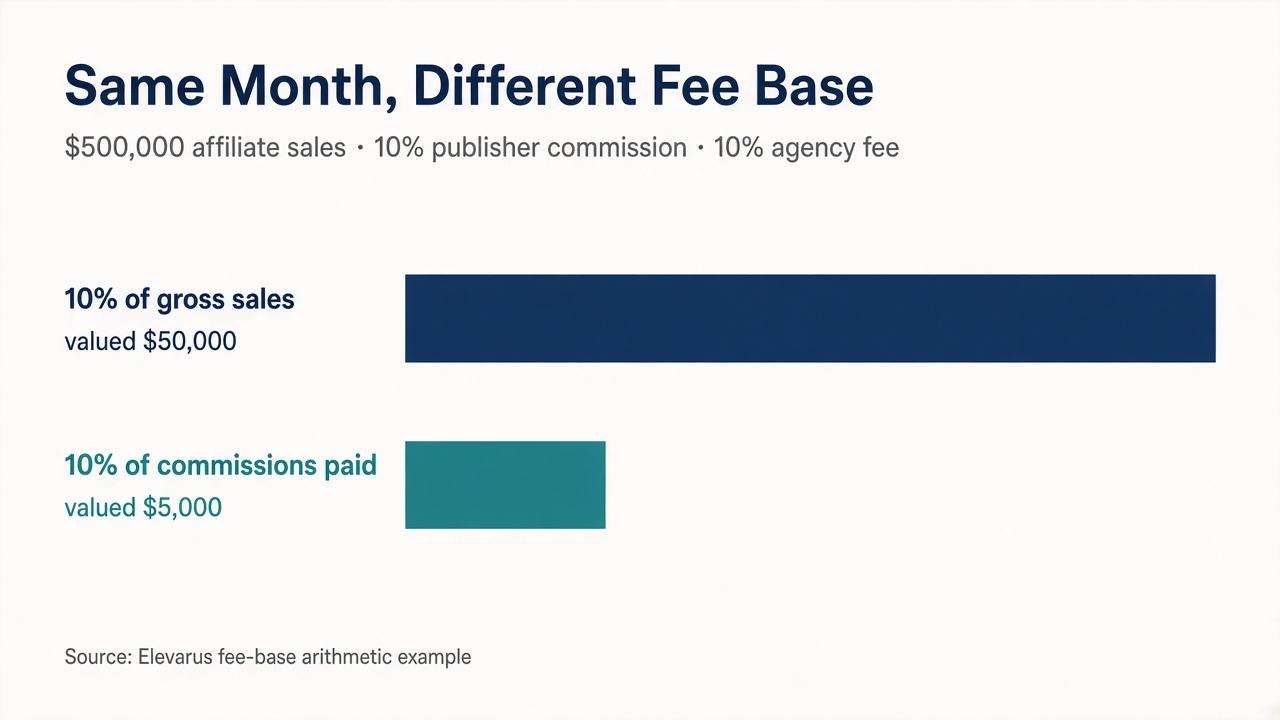
Source: Elevarus fee-base arithmetic on a $500,000 sales / 10% commission example. https://elevarus.com/affiliate-marketing/
Name meters the agency does not get to redefine mid-quarter:
Require a weekly or monthly report pack you can open without the agency on the call. If incrementality is in scope, say whether you mean a holdout, a geo test, or only last-click—see incrementality testing explained.
Copy the triad from 16 CFR §255.1(d) into the SOW: provide guidance, monitor compliance, take remedial action (eCFR). The FTC’s FAQ adds the outsourcing rule: your company remains responsible when a firm runs the network (FTC FAQ). Pair that with affiliate marketing disclosure rules and affiliate fraud detection.
Clawback language should cover returns, chargebacks, and proven fraud before agency performance fees lock. Do not let variable fees pay on reversed orders.
Write notice (often 30 or 90 days in market guides), what happens to live partners, and a transition assistance window (Hamster Garage). Require export of partner lists, pending approvals, creative, and login transfer steps before the final invoice clears.
Agencies win when you need specialist recruitment across classic networks and you will staff brand-side compliance. They lose when you only needed a co-branded sell surface for creators who already trust you. That job is a storefront and a revenue split—not a six-figure OPM desk. See affiliate software vs storefront and how to turn anyone into a seller.
Q: How do you negotiate contract terms with an affiliate marketing agency? A: Lock six clauses in order: MSA/SOW stack, brand-owned accounts, fee base in writing, KPIs/reporting, FTC monitoring plus clawbacks, and exit/transition. Refuse signatures until the denominator of any percentage fee is explicit.
Q: What should an affiliate marketing agency contract include? A: An MSA for ongoing legal terms, SOWs for scope and fees, account-ownership language, compliance duties under 16 CFR §255.1(d), reporting cadence, clawbacks on reversed or fraudulent orders, and a handback plan for partners and data.
Q: How much do affiliate marketing agencies charge? A: Market guides commonly quote roughly $3,500–$10,000+/month retainers or 5%–15% of affiliate-driven revenue, with hybrids often $2,500–$5,000 plus 3%–8%. Post Affiliate Pro also cites 5%–30% commission-style bands. Always name the fee base.
Q: Who owns the affiliate network account—brand or agency? A: The brand should. Give the agency user access; keep admin, billing, partner exports, and the right to remove agency users at termination. Parallel lessons from paid-media account ownership apply.
Q: Does hiring an agency remove FTC disclosure responsibility? A: No. Advertisers should guide, monitor, and remedy endorsers under §255.1(d), and the FTC’s FAQ states that delegating to an outside firm does not relieve responsibility under the FTC Act.
How to negotiate contract terms with an affiliate marketing agency is a ownership-and-denominator problem dressed up as legal review. Climb the Agency Contract Clause Ladder, force the fee base into English, keep the network seat in your name, and write the exit while everyone is still friendly. There is no public dataset that crowns one agency’s ROI; there is only paper that keeps the program yours.
If what you actually need is creators selling your product through co-branded storefronts with an automatic revenue split—not an OPM retainer—list on feat.: https://www.feat.press.
GoAffPro pricing: Hobby Free, Premium $49, Business from $99. No sales %, vs UpPromote.
Refersion pricing: Launch $39+3%, Growth $199+2%. Affiliate-sales fees, crossover math, vs UpPromote.
UpPromote pricing: Free, Growth $29.99+2%, Pro $89.99+1.5%. Performance fees, crossover math, vs ReferralCandy.