beehiiv vs Kit for Newsletter Monetization
beehiiv vs Kit compared for newsletter monetization: free tiers, paid scale pricing, Ad Network vs Sponsor Network, and which model each platform fits.
Storefront in e-commerce means a buyer-facing sell surface. Ladder: branded shop, marketplace listing, retailer creator shelf, co-branded affiliate page.

TL;DR: In e-commerce, a storefront is any buyer-facing sell surface—not one Shopify theme. Name the rung: physical metaphor, branded online shop, marketplace listing, retailer creator shelf, or co-branded affiliate page. Wrong name buys the wrong software and hires the wrong sellers.
Founders type storefront meaning in e commerce as if one glossary line will settle the budget. It will not. Shopify, Amazon, Sephora, Linktree, and co-branded affiliate pages all use the same noun for different hosts, fee shapes, and who owns the customer.
If you cannot name which surface you are building, you will buy a theme when you needed a listing, fund a bio hub when you needed checkout, or recruit “affiliates” who only needed a retailer shelf.
Key takeaways:
A storefront in e-commerce is a buyer-facing digital (or physical-metaphor) surface where visitors browse offers and can start or complete a purchase under a named commercial contract.
That one sentence is the definition. Everything else is which surface you mean.
Shopify’s enterprise guide calls a digital storefront the online equivalent of a brick-and-mortar display window—the first thing buyers see—with essential functions such as browsable catalogs, carts, secure payments, and order tracking (Shopify Enterprise). That definition is correct for a branded online shop. It is incomplete when operators say “storefront” and mean an Amazon listing, a My Sephora shelf, a Linktree commerce add-on, or a co-branded affiliate sell page for an indie merchant.
The word also collides with engineering jargon. Shopify’s Storefront API is a headless buyer-experience layer—frontend talking to commerce backends—not a synonym for a shopfront on Main Street (Shopify.dev). If your brief mixes “we need a Storefront API migration” with “we need creator storefronts,” you are already buying two different products.
Treat “storefront” as a category label. The category includes at least five surfaces on the ladder below. If your brief does not name which one, you are not ready to buy software or open a seller program.
Storefront meaning matters because budgets, hiring, and attribution all hang on the host. Misname the surface and you optimize the wrong KPI.
Why operators get burned:
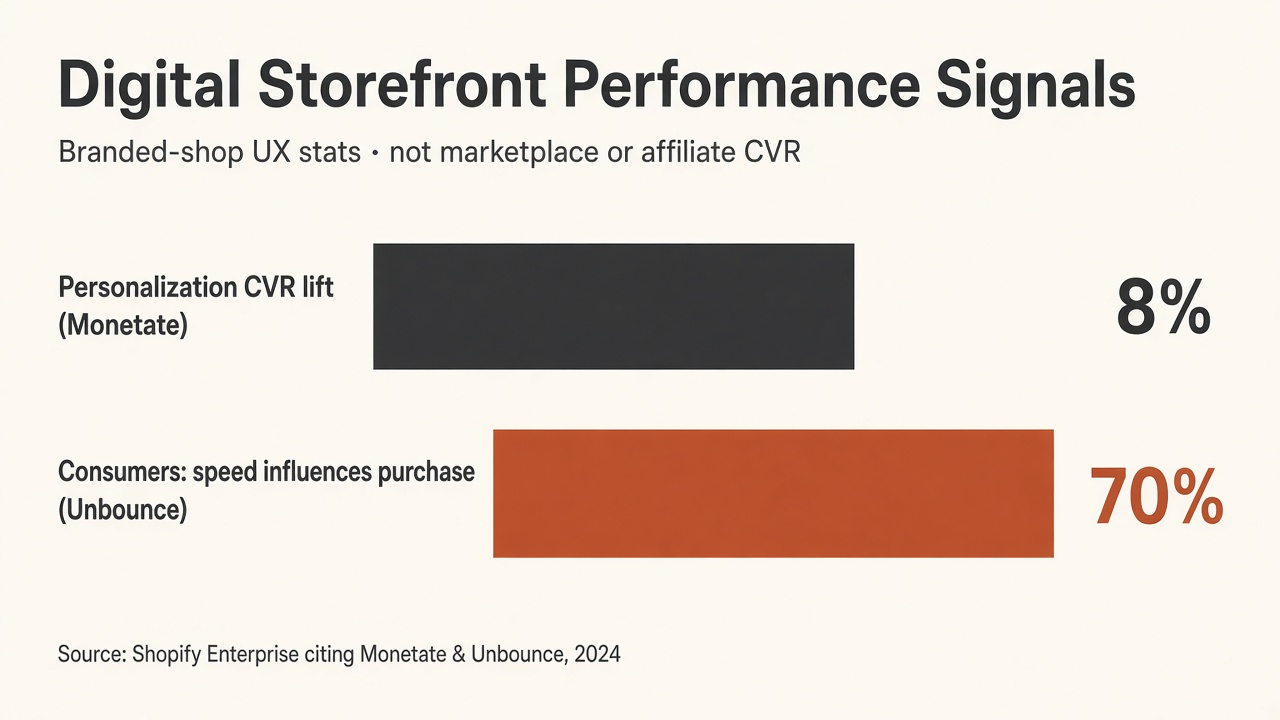
Source: Shopify Enterprise digital storefront guide citing Monetate and Unbounce, updated Mar 7, 2024. https://www.shopify.com/enterprise/blog/digital-storefront
Storefront surfaces work by putting a named catalog between a visitor and a checkout (or click-out), then settling fees or commissions under whoever hosts the page and owns the customer. The Storefront Surface Ladder is how you keep those jobs separate when the same English word shows up in five decks.
| Rung | Surface | Who hosts | What the buyer buys | How money typically moves | Good fit |
|---|---|---|---|---|---|
| 1 | Physical shopfront metaphor | Brick location / window | In-store SKUs | Retail margin | Offline analogy only |
| 2 | Branded online store | Merchant site (Shopify-class) | Merchant’s catalog | Platform subscription + processor fees (e.g. Shopify Basic $29; 2% third-party payments) (Shopify) | Brand control, first-party data |
| 3 | Marketplace listing / offer | Multi-seller platform (Amazon-class) | Merchant SKU inside platform UX | Marketplace referral / category fees (e.g. Amazon 15% footwear; 17% clothing >$20) (Shopify) | Built-in traffic, less brand control |
| 4 | Retailer creator shelf | Retailer.com page tied to a creator | Retailer’s SKUs | Affiliate commission (Sephora 15% / 15-day; Lowe’s up to 20% / 30-day; Walmart 1%–4%) (Sprout) | Creator curation inside a big retail brand |
| 5 | Co-branded affiliate storefront | Marketplace generates a sell page for a creator + merchant | Indie merchant offers via creator page | Revenue split on tracked sale (program-specific; never invent feat. fees) | Merchant distribution + creator sell surface |
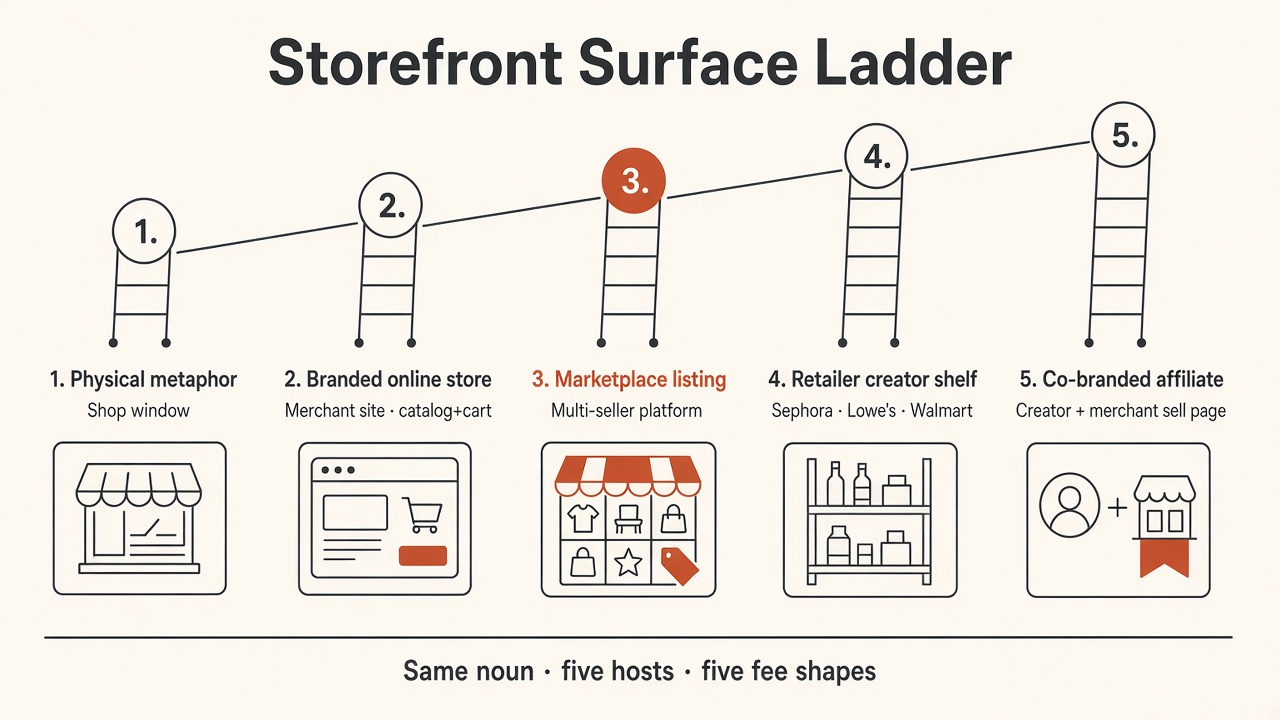
Source: feat. editorial Storefront Surface Ladder synthesizing Shopify digital-storefront and platform-vs-marketplace definitions (2024–2025) with Sprout retailer creator storefront bands (2025). https://www.shopify.com/enterprise/blog/digital-storefront · https://www.shopify.com/blog/ecommerce-platform-vs-marketplace · https://sproutsocial.com/insights/creator-storefronts/
An online storefront usually represents a single retailer or brand with control over branding, shopping experience, and pricing. An online marketplace hosts many sellers and facilitates transactions among them (Shopify Enterprise; Shopify).
| Dimension | Branded storefront (platform) | Marketplace listing |
|---|---|---|
| Brand / UX control | High — you design the shop | Low — platform templates and rules |
| Traffic responsibility | You acquire visitors | Platform brings browsers |
| Customer data | Typically first-party to the merchant | Often owned/gated by the marketplace |
| Fee shape | Subscription + processor fees (Shopify Basic $29; 2% third-party payments cited) | Category / referral % (Amazon 15% footwear; 17% clothing >$20 cited) |
| Competitive set | Your category outside the mall | Sellers next to you on the same SERP |
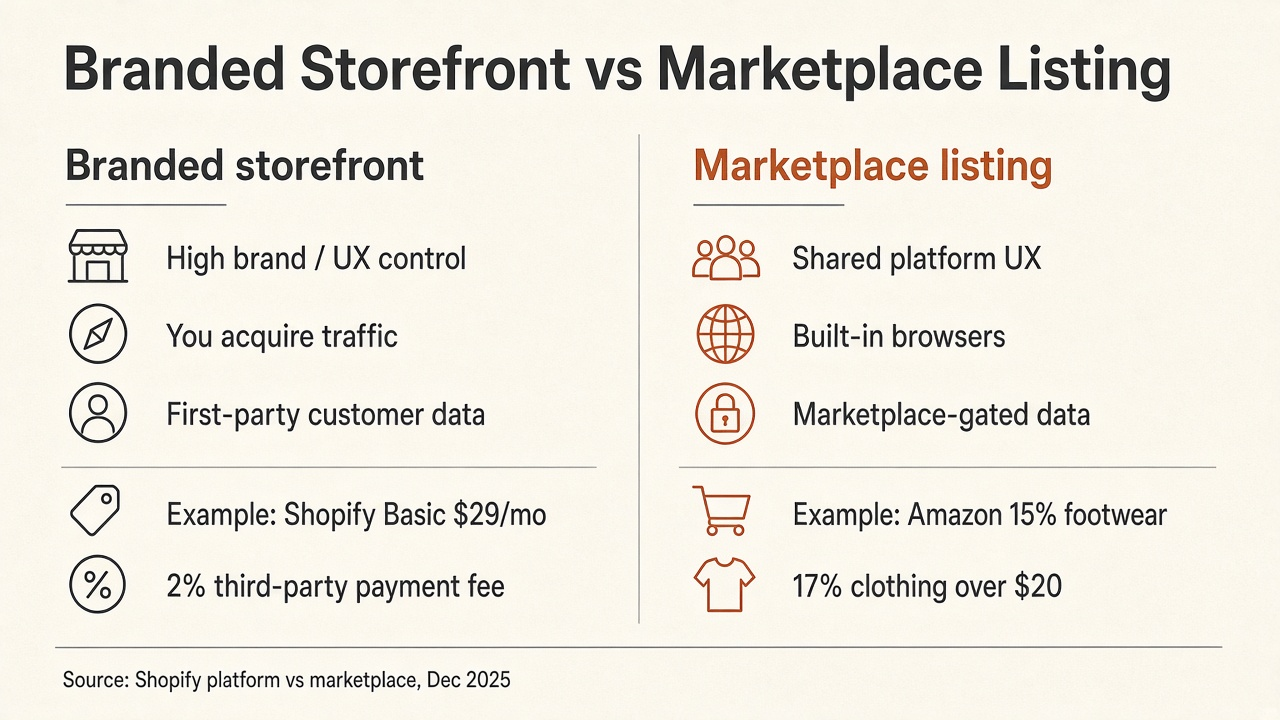
Source: Shopify, Ecommerce Platform vs. Marketplace (Dec 10, 2025) and Digital Storefront FAQ (Mar 7, 2024). https://www.shopify.com/blog/ecommerce-platform-vs-marketplace · https://www.shopify.com/enterprise/blog/digital-storefront
Many merchants run both: own the brand shop, list on marketplaces for reach. That is a channel mix, not proof the nouns are the same.
Sprout defines the retailer version of a creator storefront as a branded shopping page hosted on the retailer’s site, with curated picks and affiliate commissions (Sprout Social). That is rung 4. It is not Stan Store, not Linktree, and not a co-branded page for an indie SKU.
| Retailer program (published ladder) | Commission | Window / notes |
|---|---|---|
| Sephora | 15% | 15-day window; 3,000-follower floor (Glossy; Sprout) |
| Lowe’s | up to 20% | 30-day window (Sprout) |
| Walmart | 1%–4% by category | No follower minimum cited (Sprout) |
Rung 5 is the co-branded affiliate storefront: a sell page that presents a merchant’s offer under a creator’s brand with tracked settlement. That job is why feat. exists as a marketplace of those pages—not as a Shopify theme competitor and not as Amazon Influencer. For the four creator-side surfaces (link hub, sell-own, retailer shelf, marketplace co-branded), use what is a creator storefront. For tool choice between bio hubs and shops, use Linktree vs storefront platforms. For storefront vs single-offer LP, use storefront vs landing page for selling digital products.
Name the surface before you buy software. Each step is one decision, not a redesign.
Q: What does storefront mean in e-commerce? A: A storefront is a buyer-facing sell surface—usually digital—where visitors browse offers and can buy or click through to buy. The same word covers branded shops, marketplace listings, retailer creator shelves, and co-branded affiliate pages. Name the host before you name the software.
Q: What is the difference between an online storefront and a marketplace? A: A storefront usually means a single brand’s shop with control over branding and UX. A marketplace hosts many sellers and brings shared traffic with less brand control. Shopify’s own FAQ draws that line; fee shapes and data ownership follow it.
Q: Is a digital storefront the same as a Shopify theme? A: No. A digital storefront is the buyer-facing commerce experience (catalog, cart, checkout). A theme is one presentation layer on a platform. Headless Storefront APIs are another architecture for the same job, not a different retail noun.
Q: What is a creator storefront versus a brand storefront? A: A brand storefront sells the merchant’s catalog on the merchant’s site. A creator storefront is tied to a named creator and may be a link hub, sell-own shop, retailer shelf, or co-branded affiliate page. See the four-type map on our creator storefront guide.
Q: Is there one average storefront conversion rate? A: No reliable public census covers branded shops, marketplace listings, retailer creator shelves, and co-branded affiliate pages as one rate. Use surface-specific benchmarks (for example Shopify-cited personalization and speed studies for branded shops) and refuse undated universal CVR claims.
Storefront meaning in e-commerce is a surface problem, not a dictionary problem. Climb the Storefront Surface Ladder—metaphor, branded shop, marketplace listing, retailer creator shelf, co-branded affiliate page—before you buy tools or recruit sellers. When the job is letting creators sell your product through a co-branded page with a revenue split, start at feat..
beehiiv vs Kit compared for newsletter monetization: free tiers, paid scale pricing, Ad Network vs Sponsor Network, and which model each platform fits.
Storefront vs landing page for selling digital products: Unbounce's 6.6% median LP CVR, Monetate-cited 2x vs stores, and when a multi-SKU shop wins.
A creator storefront is a shoppable page tied to a creator. Four surfaces: link hub, sell-own shop, retailer affiliate page, marketplace co-branded page.