GoAffPro Pricing Explained
GoAffPro pricing: Hobby Free, Premium $49, Business from $99. No sales %, vs UpPromote.
Content provenance authenticity platforms for affiliates are C2PA Content Credentials seats, not a best-score crown; use the Provenance Seat Ladder.

TL;DR: Content provenance authenticity platforms for affiliate marketing are not a public “best authenticity score” ranking. Climb the Provenance Seat Ladder: no credentials, invalid, signed-untrusted, trusted Content Credentials (a nutrition label, not a real-vs-fake verdict), then capture-chain or enterprise verify. Refuse invented score crowns.
Affiliate and brand teams ask for the best content provenance authenticity platforms as if there is a podium. The honest answer is uglier than a listicle crown: there is no public dataset that ranks platforms by an affiliate authenticity score.
This page owns the provenance-seat job for affiliate creatives. Fraud tactic catalogs live in affiliate fraud and how to detect it. Disclosure rules live in affiliate marketing disclosure rules. Do not mash AI detectors into a fake “best score” chart.
Content provenance authenticity platforms are tools and standards that attach, verify, or display cryptographically signed history for media so affiliates and merchants can see origin, edits, and signer trust, not a single magic authenticity percentage.
In practice that means C2PA Content Credentials and the products that mint, inspect, or enforce them. The Content Authenticity Initiative (CAI), founded by Adobe in 2019, builds open-source tooling around those standards (Content Authenticity Initiative). When someone asks for the “best authenticity score platform,” they are usually smuggling a classifier ranking into a provenance question. Those are different seats.
Content provenance authenticity platforms matter because affiliate programs now run on product images, UGC, and AI-assisted creatives that can misrepresent SKUs, strip metadata after upload, or look “real” while lying about capture. A score without a seat is theater.
| Seat question | Provenance answer | Detection answer |
|---|---|---|
| Who signed this asset? | Content Credentials / C2PA claim | Usually none |
| Was the file altered after signing? | Tamper-evident validation | Pattern guess |
| Was AI used in the tool chain? | Possible if the tool recorded it | Unreliable guess |
| Is the product claim true? | Not proven by credentials alone | Not proven by a detector score |
Sources: Content Authenticity Initiative (nutrition label; not “real”); C2PA for Brands (signals ≠ truth). https://contentauthenticity.org/how-it-works · https://c2.pa/c2pa-for-brands
Content provenance authenticity platforms work as a Provenance Seat Ladder. You do not crown a vendor. You decide which seat an affiliate creative must clear before it earns a commission path, a paid placement, or a storefront slot.
Five seats for the same creative file:
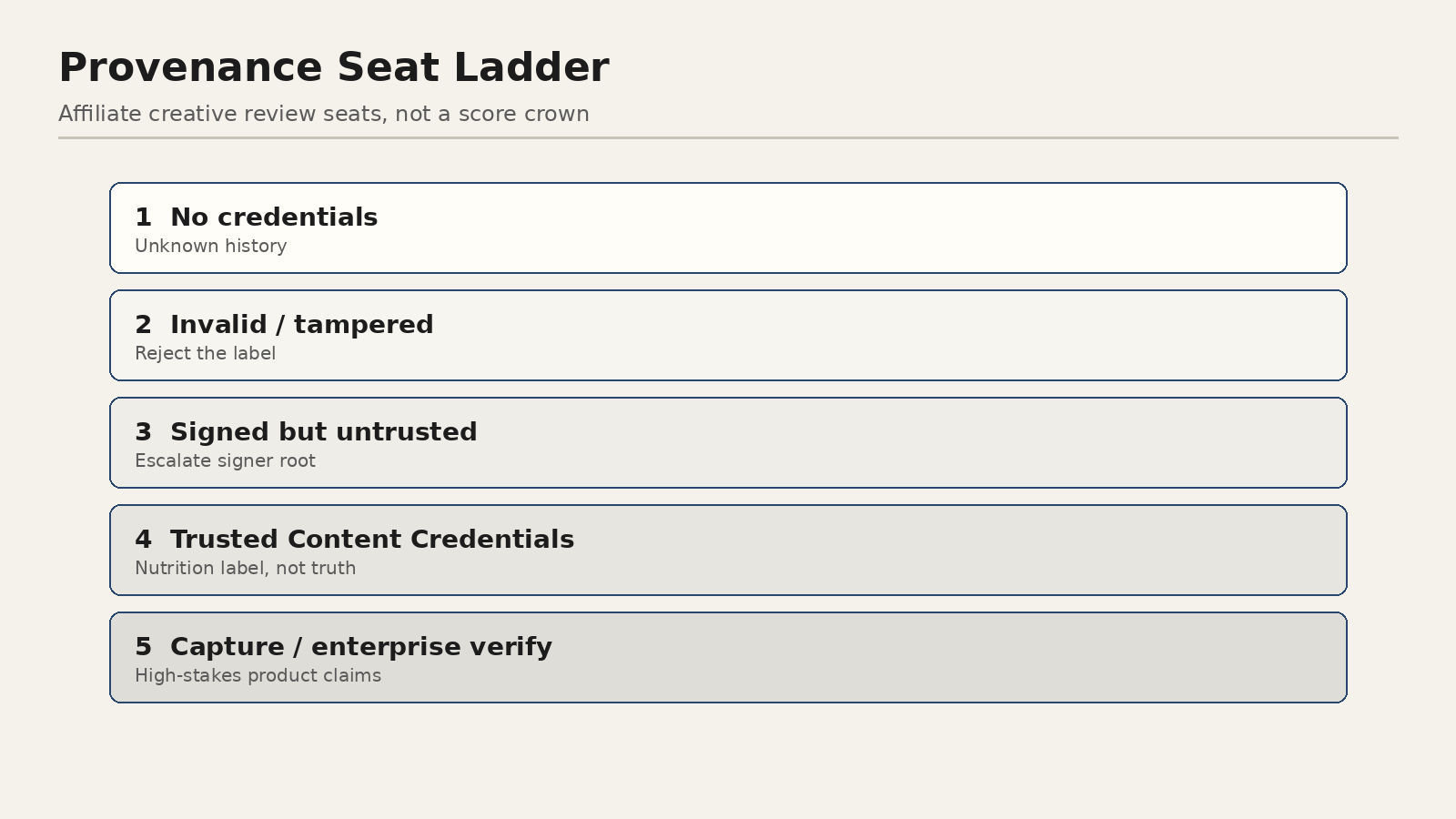
Source: Editorial Provenance Seat Ladder from CAI, C2PA-for-brands badge language, Truepic verification tests, and Adobe enterprise Content Authenticity announcements. https://contentauthenticity.org/how-it-works · https://c2.pa/c2pa-for-brands · https://vision.truepic.dev/docs/verification-tests · https://business.adobe.com/blog/content-authenticity-arrives-for-enterprises
| Badge / seat | Typical meaning | Affiliate ops use |
|---|---|---|
| No credentials | No signed history on the file you received | Require re-export from a signing tool, or reject for high-risk claims |
| Invalid | Manifest or binding failed | Reject; treat as broken or tampered |
| Signed but untrusted | Signature exists; signer not on your trust list | Escalate; allow only if you accept that root |
| Trusted | Valid signature + recognized chain + intact asset | Eligible for brand-safe creative review |
| Capture / enterprise | Extra capture integrity or enterprise certificate workflow | Use for high-stakes product truth claims |
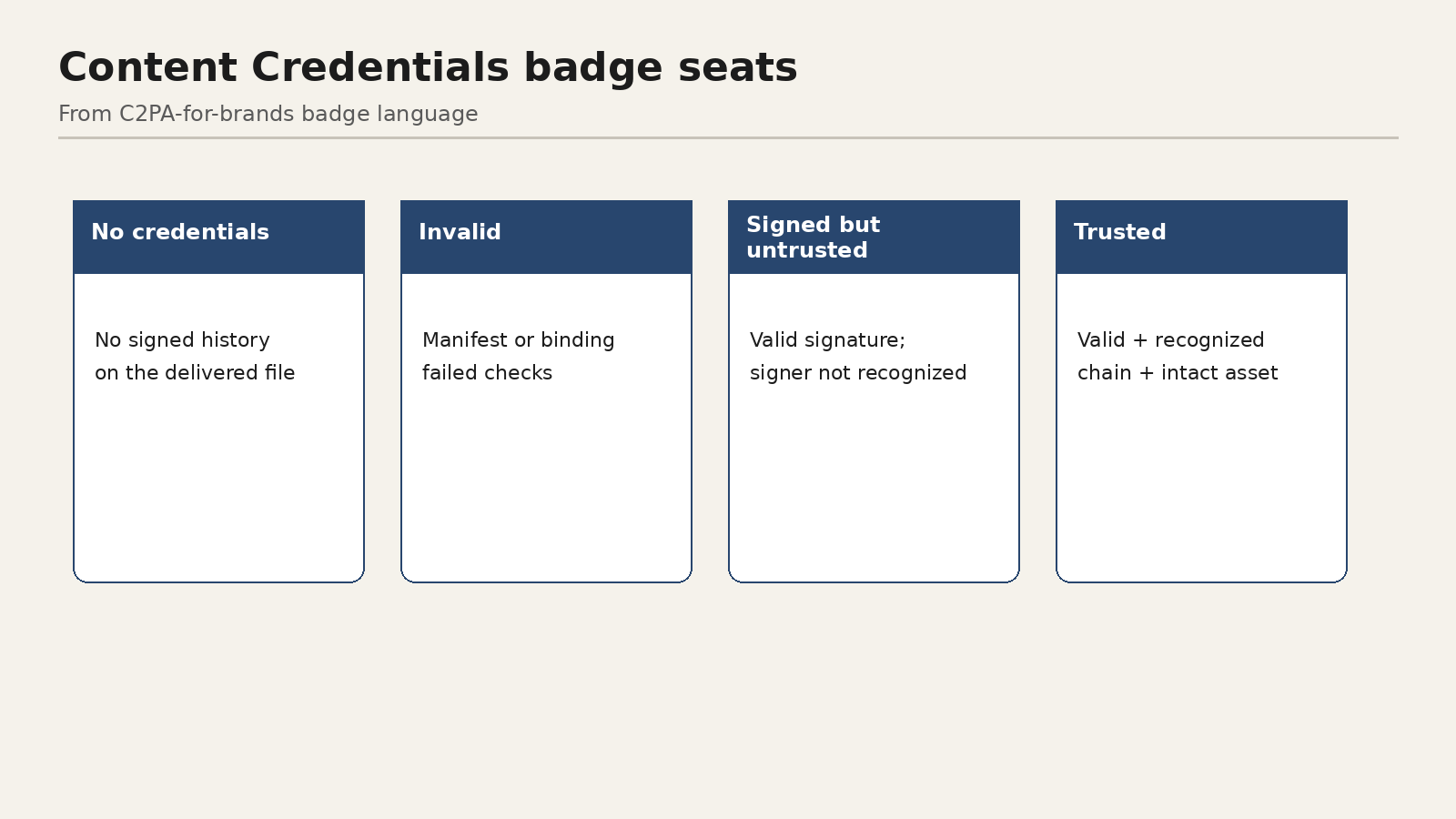
Source: C2PA for Brands badge states; CAI nutrition-label framing. https://c2.pa/c2pa-for-brands · https://contentauthenticity.org/how-it-works
| Platform / standard seat | What it publicly does | What it does not prove |
|---|---|---|
| C2PA / Content Credentials | Open standard for signed provenance manifests (specs from 2022) | That the product claim is true |
| CAI open tooling + Verify / Inspect sites | Generate, display, inspect credentials | A ranked affiliate authenticity score |
| Adobe GenStudio / Firefly / Content Authenticity API | Enterprise attach and manage credentials across campaigns | Automatic affiliate commission truth |
| Adobe Advertising Creative Studio | Attaches C2PA metadata on GenAI ad generations/edits | That the ad is non-misleading under FTC rules |
| Truepic Lens / trusted capture | C2PA 1.4/2.0 validation (changelog Sep 26, 2024); capture integrity tests on Truepics | A cross-vendor “best score” ranking |
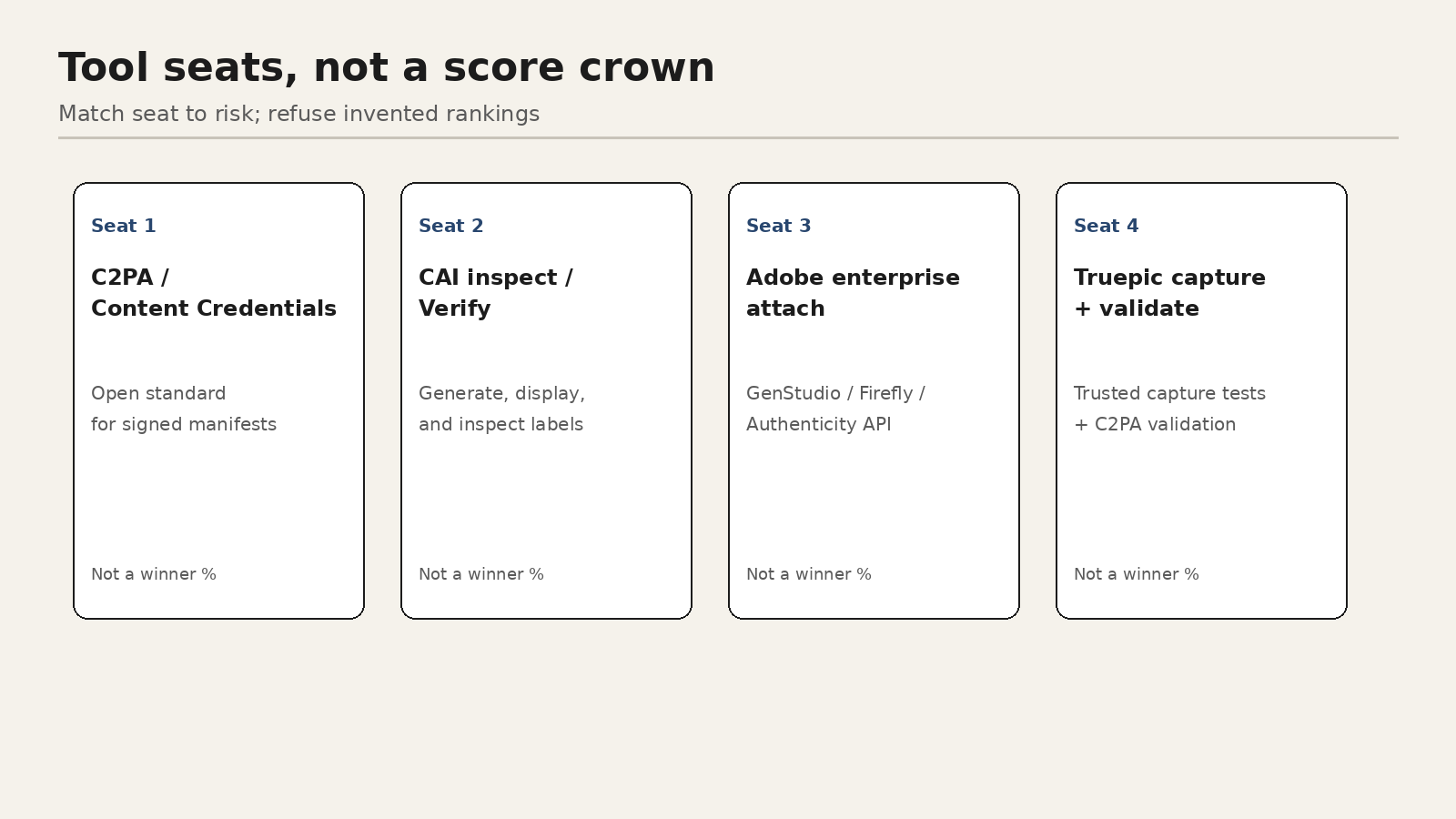
Sources: CAI; Adobe Business / Experience League; Truepic Lens changelog and validation docs. https://contentauthenticity.org/how-it-works · https://business.adobe.com/blog/content-authenticity-arrives-for-enterprises · https://experienceleague.adobe.com/en/docs/advertising/creative/creative-studio/creative-studio-content-credentials · https://vision.truepic.dev/docs/lens-api-changelog · https://lens.truepic.dev/docs/libc2pa-validation
Common mistakes start when teams buy a detector dashboard and call it provenance policy.
Q: What is the best content provenance authenticity score platform for affiliate marketing? A: There is no public ranked census for that crown. Choose a provenance seat (Trusted Content Credentials, then capture or enterprise verify when stakes are high) instead of shopping for an invented score leaderboard.
Q: Do Content Credentials prove an affiliate image is real? A: No. The CAI describes Content Credentials as a nutrition label for origin and history, not a prescription that content is “real.” A trusted label can still describe an AI generation if the tool recorded it.
Q: How is C2PA different from AI image detection? A: C2PA Content Credentials are signed attribution. Detection tools guess from patterns and stay in an arms race. Use credentials for history; use human review and program rules for misleading claims.
Q: Which tools should affiliates and merchants actually open? A: Start with public inspect surfaces (for example Adobe’s inspect / Verify sites), then pick a seat: Adobe enterprise attach for campaign-scale signing, or Truepic capture/validation when you need trusted-capture tests. Match the seat to risk, not a listicle ranking.
Q: Should every affiliate creative require Trusted Content Credentials? A: There is no public dataset for how many programs mandate C2PA. Require Trusted credentials when the creative could mislead buyers about a physical product or when you pay for the placement. Keep disclosure and accuracy rules either way.
Content provenance authenticity platforms answer a seat question, not a crown question. Climb from no credentials through invalid and signed-untrusted into Trusted Content Credentials, then into capture-chain or enterprise verify when product truth is on the line. Content Credentials are a nutrition label. They are not a fake-vs-real oracle, and there is no public “best authenticity score” ranking for affiliate marketing.
List products for partners to sell on feat.: https://www.feat.press.
GoAffPro pricing: Hobby Free, Premium $49, Business from $99. No sales %, vs UpPromote.
Refersion pricing: Launch $39+3%, Growth $199+2%. Affiliate-sales fees, crossover math, vs UpPromote.
UpPromote pricing: Free, Growth $29.99+2%, Pro $89.99+1.5%. Performance fees, crossover math, vs ReferralCandy.