GoAffPro Pricing Explained
GoAffPro pricing: Hobby Free, Premium $49, Business from $99. No sales %, vs UpPromote.
Cost per lead affiliate programs pay a fixed fee per qualified lead. Awin CPL examples, quality gates, holds, and when CPL loses to CPS or a storefront.

TL;DR: Cost per lead affiliate programs pay a fixed fee when a referred user becomes a qualified lead, not when they buy. Shopify treats CPL as a CPA subtype. Public Awin examples run from about €3.22 to €40 per accepted lead depending on the offer. Quality gates, holds, and scrub decide whether that fee sticks. There is no honest national average CPL.
People hear “CPL” and invent a side hustle. Fill a form, collect $50, repeat. Merchants hear the same letters and invent a bargain: buy leads cheaper than sales commissions. Both stories skip the seat that actually matters: who defines a qualified lead, who pays when the CRM rejects it, and whether the job was ever a lead job.
If you need cost per lead affiliate programs explained as an operating seat, start here. Pair this with affiliate commission structures for the full model map, affiliate fraud and how to detect it for junk-traffic patterns, and how affiliate marketers get paid for payout rails after a lead clears.
Cost per lead affiliate programs are performance partnerships that pay a publisher a fixed amount when a referred person becomes a qualified lead under the advertiser’s written rules.
Shopify places CPL inside the broader CPA family: the “action” is a lead that meets agreement terms, not necessarily a purchase (Shopify). That is the whole argument in one sentence. If your program pays on a completed checkout, you are running CPS (or sale CPA), not CPL. If it pays when a form clears validation, you are on the lead seat.
This article is not a second copy of affiliate commission structures. That spoke maps CPS, CPA, CPL, and RevShare as risk models. Here the job is operating a CPL program: definition, payout quotes, holds, quality gates, and when to leave the seat.
They matter because the wrong payout event wrecks either cash or supply.
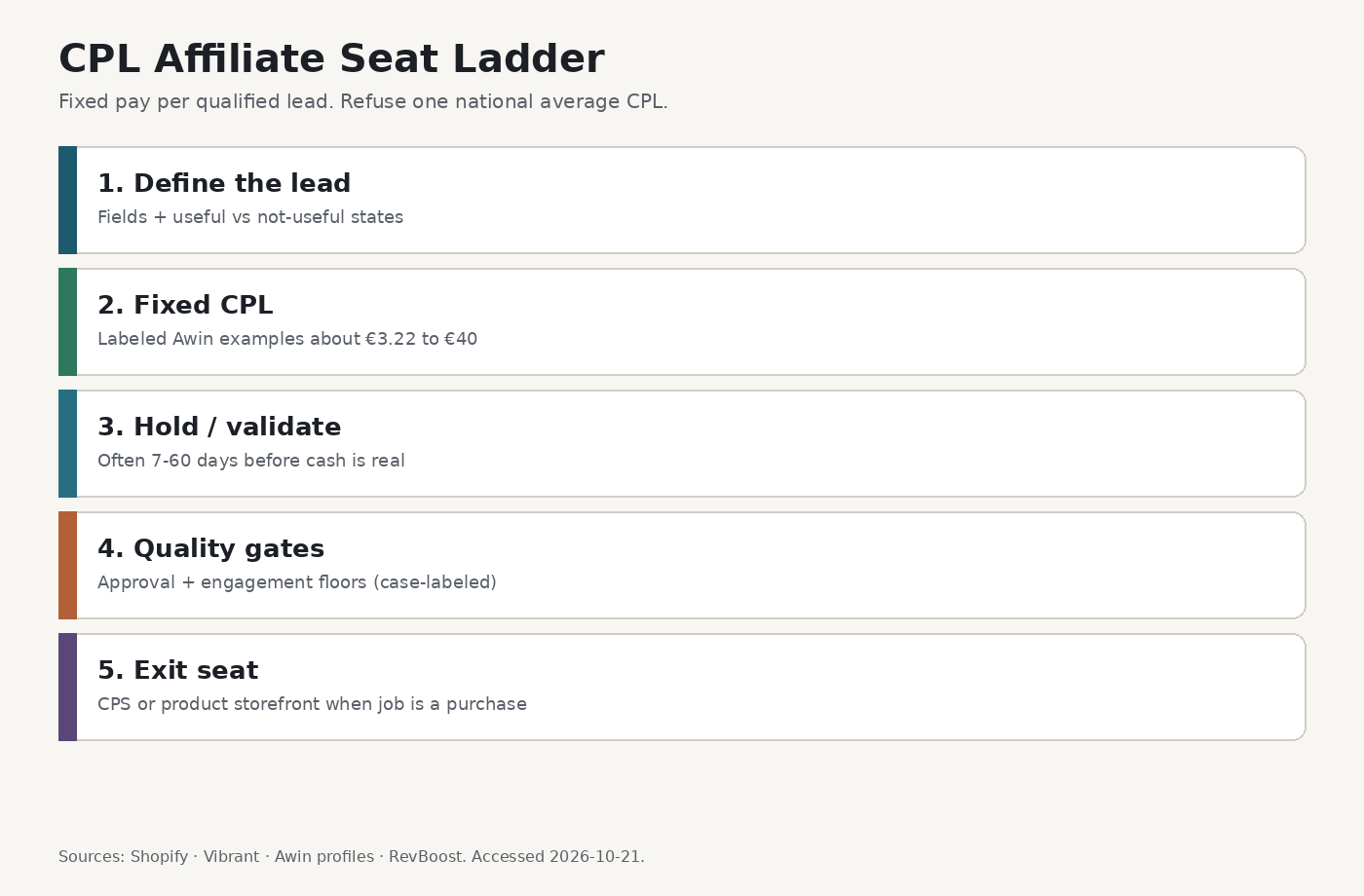
Source: Editorial CPL Affiliate Seat Ladder. Taxonomy from Shopify and Vibrant; holds from RevBoost; labeled Awin CPL examples. Accessed 2026-10-21.
Cost per lead affiliate programs work as a five-rung seat: define the lead, publish a fixed payout, validate inside a hold, enforce quality gates, then exit to CPS or a product sell surface when the job is a purchase. Open every rung with a labeled source. Do not invent a market-average CPL.
A “lead” is not a form submit. It is a form submit that passes your useful-state list.
Awin’s Movistar Prosegur Alarmas program pays only leads whose close status sits in named useful buckets (for example opportunity, sale, or competition-offer states) and refuses “not interested” or “not useful” closes (Awin). That is the operating standard: payable states and non-payable states on the same page publishers can read.
If your brief only says “email opt-in,” you will buy emails. If it says age, geo, phone validity, and CRM disposition, you will buy something closer to pipeline.
Payouts are offer-specific. Public Awin profiles already prove the spread.
| Program (labeled Awin profile) | Published CPL | Cookie | Notes |
|---|---|---|---|
| LesFurets FR - Habitation | €3.22 | 30 days | Category CPL |
| LesFurets FR - Moto/Scooter | €3.71 | 30 days | Category CPL |
| LesFurets FR - Auto | €5.5 | 30 days | Category CPL |
| LesFurets FR - Sante | €6.64 (€8.35 retiree-declared) | 30 days | Category CPL |
| LesFurets FR - Emprunteur | €7.25 | 30 days | Category CPL |
| Movistar Prosegur Alarmas | €25 to €40 by TCA band | 30 days | Useful-lead tiers; validation up to 60 days |
Sources: Awin LesFurets; Awin Movistar Prosegur Alarmas. Accessed 2026-10-21.
Those figures are not a US national average. They are dated public program menus. A catalog merchant comparing them to a 10% CPS on a $80 SKU is comparing different machines.
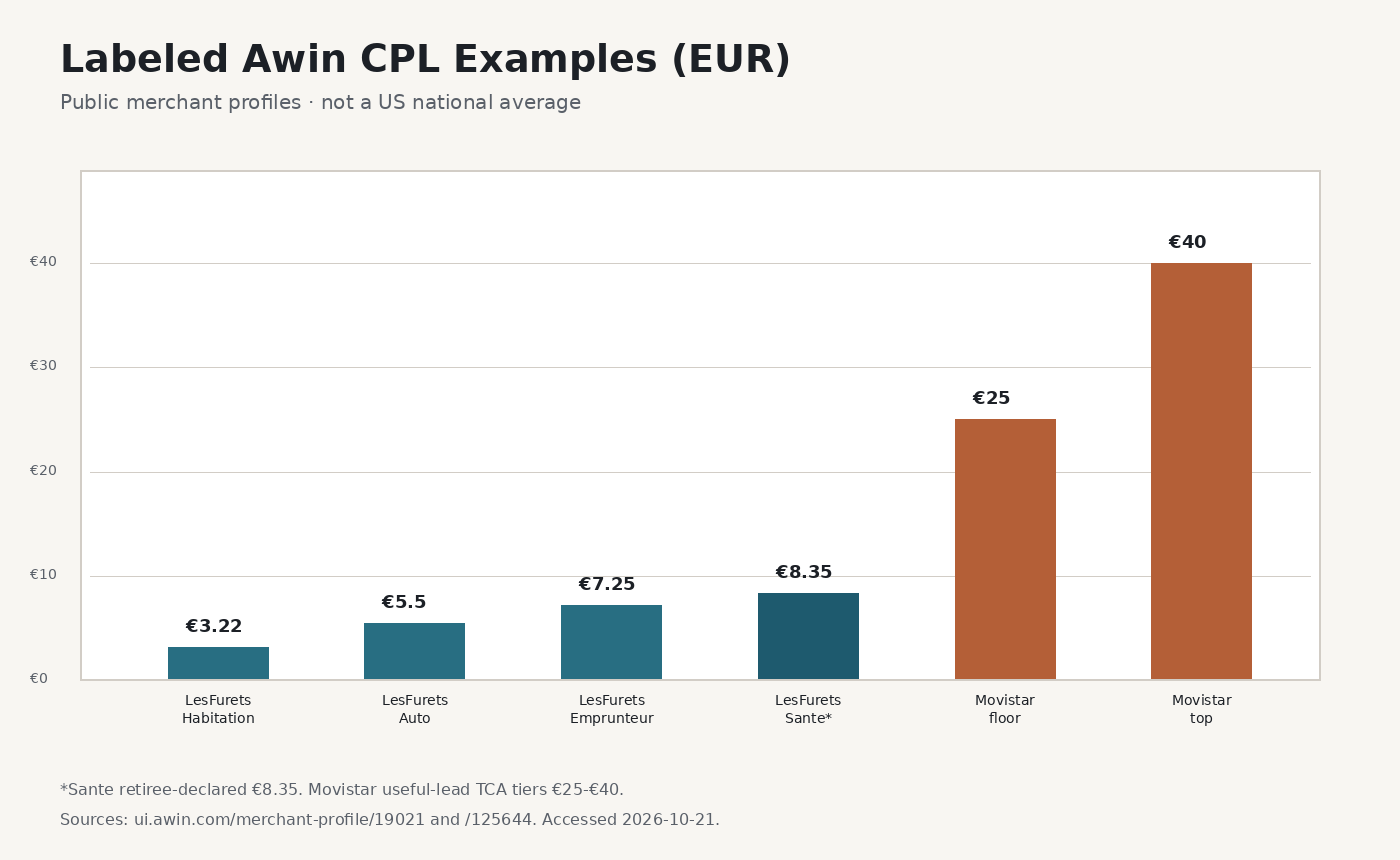
Source: Awin merchant profiles for LesFurets FR and Movistar Prosegur Alarmas. https://ui.awin.com/merchant-profile/19021 · https://ui.awin.com/merchant-profile/125644 Accessed 2026-10-21.
CPL economics die in the gap between “pixel fired” and “finance approved.”
RevBoost describes holdbacks as an extra delay on top of network payment terms, commonly 7-60 days, with new publishers often at 15-30 days and high-risk verticals at 30-60 (RevBoost). Movistar’s Awin profile states conversions process and validate within a maximum of 60 days from registration (Awin).
Publishers who plan weekly cash on CPL without reading the hold are planning fiction. Merchants who approve every form overnight are buying reverse logistics later.
Vibrant’s WiserAdvisor case is useful because it publishes gates, not vibes: stay active at 65% approval and 80% engagement; the program reports 44% lead-to-engaged conversion and $76 CPL versus a $115 goal (Vibrant). That is one advertiser’s operating scorecard. Copy the habit (named gates + measured CPL vs goal), not the dollars, unless your vertical matches.
Oxford BioChronometrics’ 2023H2 client panel in financial services and insurance still found fraudulent traffic on every affiliate ranked, with desktop fraud at 38.9% in H2 and lead-gen fraud rates that differ sharply between smaller and larger affiliate tiers (Oxford BioChronometrics). Pair CPL programs with the detection habits in affiliate fraud and how to detect it.
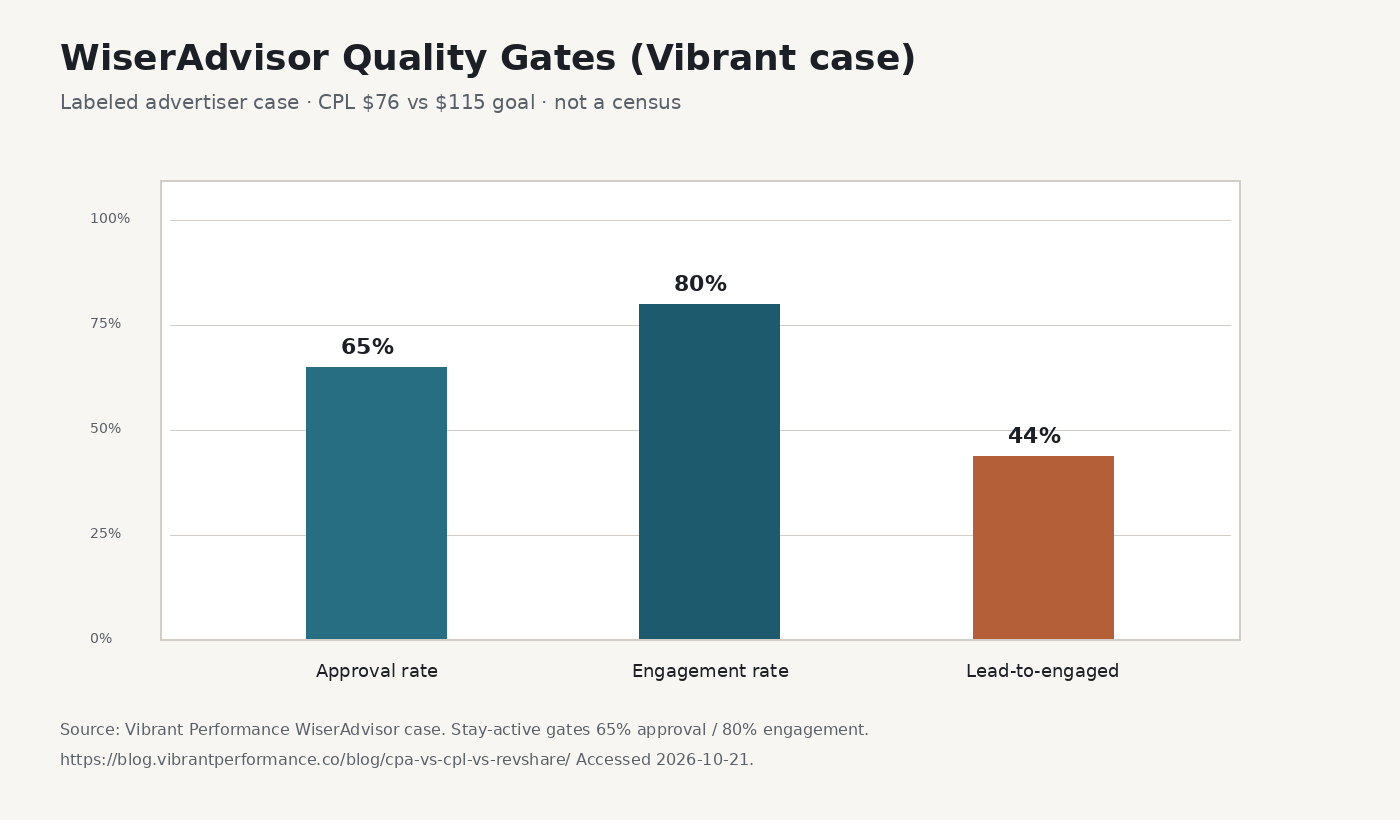
Source: Vibrant Performance, CPA vs CPL vs RevShare (WiserAdvisor case). https://blog.vibrantperformance.co/blog/cpa-vs-cpl-vs-revshare/ Accessed 2026-10-21. Labeled case, not a census.
CPL is the wrong default for a finished product with a checkout.
| Job | Better seat | Why |
|---|---|---|
| Fill a sales CRM (insurance, lending, B2B demo) | CPL (or hybrid CPL + CPA) | Payable event matches offline close |
| Sell a SKU online | CPS / sale CPA | Pay when revenue lands |
| Let named creators sell your catalog on a co-branded page | feat. storefront | Revenue split on purchase; not a lead network |
| Recurring SaaS | Often CPA trial/paid + RevShare | Lead-only CPL ignores retention |
feat. is a marketplace where merchants list products and affiliates sell through co-branded storefronts with a revenue split on every sale (feat.; marketplace). It is not a CPL lead network and does not publish a feat. CPL rate card here. If your partners need to generate quote forms for a sales floor, stay on Awin/CJ/Impact-class CPL offers with written useful-lead states. If your partners need to sell a product, prefer CPS or a storefront split. Do not mash those invoices.
Vibrant’s risk frame still holds: CPL puts more risk on the advertiser (pay before close), RevShare puts more on the affiliate, and sale CPA sits between (Vibrant). Shopify’s consumer vocabulary still lists CPL beside CPS and other action types (Shopify).
In Slack, people say “CPA offer” for both a sale and a lead. In the contract, write the event. Ambiguity is how scrub fights start.
Q: What are cost per lead affiliate programs? A: They are affiliate programs that pay a fixed fee when a referred user becomes a qualified lead under written rules. Shopify lists CPL as a CPA subtype. The payable event is the accepted lead, not the eventual purchase.
Q: How is CPL different from CPA or CPS? A: CPL is a lead-shaped CPA: pay per qualified form or registration. CPS (pay per sale) pays when money clears. People often say “CPA” for both. Write the event in the contract so scrub fights have a source of truth.
Q: What do cost per lead affiliate programs typically pay? A: There is no public national average. Labeled Awin examples include LesFurets category CPLs from about €3.22 to €8.35 and Movistar Prosegur Alarmas useful-lead tiers from €25 to €40. Quote the offer page, not a blog mean.
Q: Why do CPL commissions get rejected or delayed? A: Leads fail useful-state rules, fail validation, or sit inside a holdback. RevBoost describes holds commonly from 7 to 60 days. Some Awin programs state validation windows up to 60 days. Junk and fraud raise scrub rates further.
Q: Should a product brand run a CPL affiliate program? A: Only if the real job is feeding a sales CRM. If buyers checkout online for a SKU, CPS or a co-branded storefront split is usually cleaner. feat. is built for product revenue splits, not for buying quote-form leads.
Cost per lead affiliate programs are a qualified-lead seat: fixed pay, written useful states, holds, and quality gates. Use labeled program menus, not invented averages. Leave the seat when the job is a purchase. When the job is getting other people to sell finished products through co-branded storefronts with a revenue split, start at feat..
GoAffPro pricing: Hobby Free, Premium $49, Business from $99. No sales %, vs UpPromote.
Refersion pricing: Launch $39+3%, Growth $199+2%. Affiliate-sales fees, crossover math, vs UpPromote.
UpPromote pricing: Free, Growth $29.99+2%, Pro $89.99+1.5%. Performance fees, crossover math, vs ReferralCandy.