GoAffPro Pricing Explained
GoAffPro pricing: Hobby Free, Premium $49, Business from $99. No sales %, vs UpPromote.
Endorsely vs PartnerStack is a seat ladder: Endorsely Free/$39/$99 revenue caps vs PartnerStack Spark $0+10% vs Launch-Enterprise demo quotes.

TL;DR: Endorsely vs PartnerStack is a seat ladder, not a logo fight. Endorsely publishes Free (cap $1,000/mo affiliate revenue), Pro $39/mo (cap $5,000), and Scale $99/mo (cap $20,000). PartnerStack Spark is $0/mo plus 10% of commissions paid. Launch / Growth / Enterprise stay demo-quoted. Pick the rung you will operate this quarter.
Searchers type endorsely vs partnerstack when a SaaS team already knows it wants affiliates. The spreadsheet fails because one product prints revenue caps and the other prints plan names without dollars. Impact shortlists and “best SaaS affiliate tools” roundups blur three different jobs: track Stripe referrals, buy a B2B partner ecosystem, or give sellers a page to sell.
Related cluster pages: PartnerStack vs feat, PartnerStack vs Impact for B2B affiliates, PartnerStack marketplace features, and best affiliate marketing platforms.
Endorsely vs PartnerStack is a comparison between a SaaS-focused affiliate tracker with published revenue caps and a B2B partner platform that separates a low-friction Spark seat from a demo-quoted ecosystem ladder.
Endorsely markets itself as affiliate software for SaaS: Stripe or manual API tracking, recurring commissions, affiliate finder credits by plan, and PayPal bulk payouts on Free (Endorsely Pricing). The commercial shape is a meter on affiliate revenue tracked per month, not a mystery quote.
PartnerStack is two products in one brand story. Spark is the self-serve Stripe referral seat with a single user and a 10% fee on commissions paid (PartnerStack Spark). Launch, Growth, and Enterprise add Marketplace access, deal registration options, LMS / MDF on Growth, and Network success on Enterprise, with pricing “confirmed during your demo” (PartnerStack Pricing).
If you only need Impact-style horizontal partnership cloud comparison, use the Impact spoke. If you only need feat. as the sell surface, use PartnerStack vs feat. This page owns the Endorsely contrast.
Wrong seat waste shows up as either overpaying for PRM you will not staff or underbuying discovery you actually need.
Endorsely vs PartnerStack works as a five-rung seat ladder: start from the Stripe tracker job, climb only if you need published caps, percentage-of-commission pricing, Marketplace / PRM ops, or a separate storefront. Stop at the first rung that matches the motion you will staff.
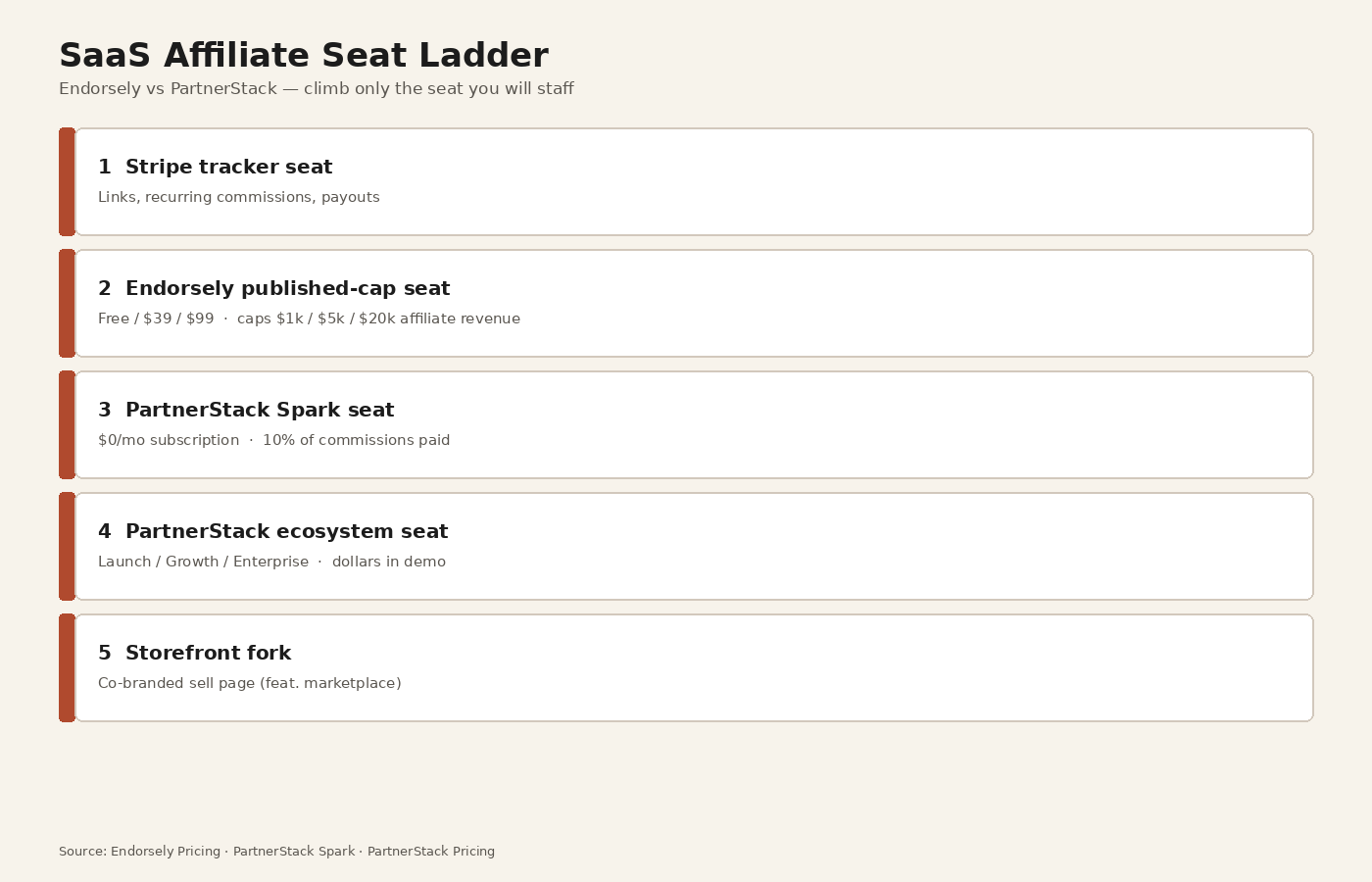
Source: Editorial framework from Endorsely Pricing and PartnerStack Spark / Pricing pages. https://www.endorsely.com/pricing · https://partnerstack.com/platform/spark · https://partnerstack.com/pricing/
| Surface | Endorsely | PartnerStack Spark | PartnerStack Launch / Growth / Enterprise |
|---|---|---|---|
| Public monthly subscription | Free; then $39; then $99 | $0 | Demo-quoted (no public floor) |
| Usage meter | Affiliate revenue caps $1k / $5k / $20k | 10% of commissions paid | Program size / features / support |
| Stripe sale tracking | Yes (or manual API) | Yes (simple sale tracking) | Plan-dependent integrations |
| Recruiting | Finder credits 15 / 100 / 250 | Invite partners you know | Marketplace; Enterprise Network success |
| Users | Unlimited on Pro/Scale | Single user | Unlimited internal users (FAQ) |
| Partner motions | Affiliate program focus | Referral / simple commissions | Affiliate, referral, deal reg options |
Source: Endorsely Pricing; PartnerStack Spark; PartnerStack Pricing.
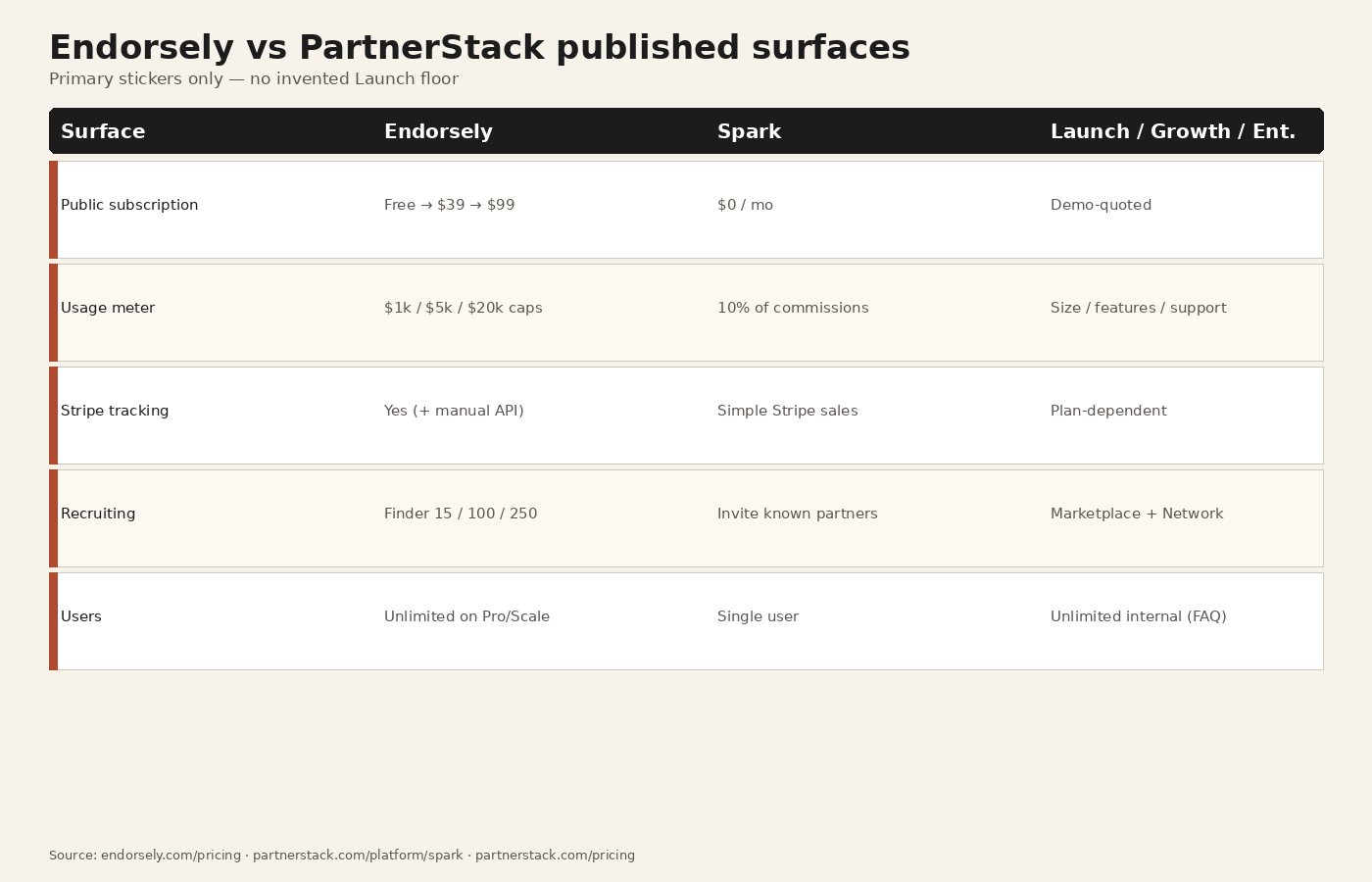
Source: Endorsely Pricing; PartnerStack Spark; PartnerStack Pricing. https://www.endorsely.com/pricing · https://partnerstack.com/platform/spark · https://partnerstack.com/pricing/
| Plan | Published price | Affiliate revenue cap | Finder credits (vendor) |
|---|---|---|---|
| Starter | Free | Up to $1,000/mo | Up to 15 |
| Pro | $39/mo | Up to $5,000/mo | Up to 100/mo |
| Scale | $99/mo | Up to $20,000/mo | Up to 250/mo |
| Enterprise | Talk to sales | Unlimited finding (vendor claim) | Unlimited (vendor claim) |
Source: Endorsely Pricing, fetched 2026-10-13.
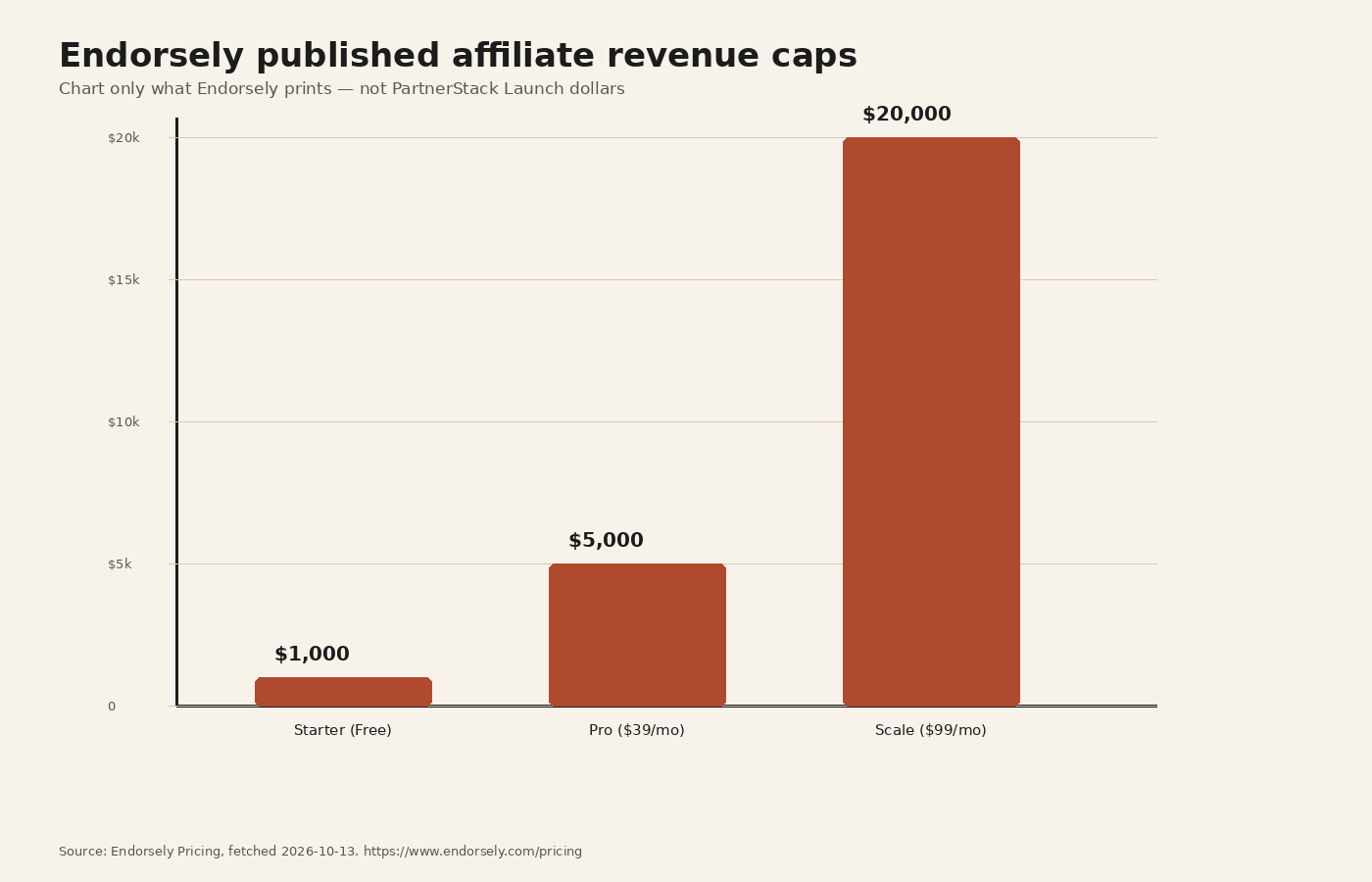
Source: Endorsely Pricing, 2026. https://www.endorsely.com/pricing
Do not draw a PartnerStack Launch dollar next to these bars. That number is no public dataset.
Q: What is the difference between Endorsely and PartnerStack? A: Endorsely is a SaaS affiliate tracker with published Free / $39 / $99 plans tied to affiliate revenue caps. PartnerStack offers Spark ($0 + 10% of commissions) for simple Stripe referrals and Launch / Growth / Enterprise for Marketplace and PRM ops with demo pricing.
Q: Is Endorsely cheaper than PartnerStack? A: At published stickers, Endorsely Free and Pro ($39) undercut any quote-only Launch seat you have not seen. Spark can be cheaper or costlier than Pro depending on commissions paid, because Spark charges 10% of those commissions. There is no public PartnerStack Launch floor to crown a universal winner.
Q: Does PartnerStack Spark replace Endorsely for SaaS affiliates? A: Only if you accept Spark’s single-user, invite-first surface and the 10% processing fee. If you need Endorsely’s published finder credits and revenue-cap ladder, Spark is a different seat.
Q: When should I pick PartnerStack Launch over Endorsely? A: When you need PartnerStack Marketplace discovery, lead or deal registration options, Growth LMS/MDF tooling, or Enterprise Network success. Those are ecosystem jobs, not tracker jobs.
Q: Does either platform publish a co-branded affiliate storefront? A: No. Both focus on tracking, payouts, and (for PartnerStack) partner ecosystem ops. If affiliates need a page that sells your product with a split, that is a storefront job on feat.
Endorsely vs PartnerStack is a seat ladder: published revenue caps, Spark’s 10% of commissions, then a demo-quoted ecosystem, then a storefront fork. Climb with primary pricing pages, not with a fake PartnerStack monthly census. If your partners need a co-branded page to sell, start on the feat. marketplace.
GoAffPro pricing: Hobby Free, Premium $49, Business from $99. No sales %, vs UpPromote.
Refersion pricing: Launch $39+3%, Growth $199+2%. Affiliate-sales fees, crossover math, vs UpPromote.
UpPromote pricing: Free, Growth $29.99+2%, Pro $89.99+1.5%. Performance fees, crossover math, vs ReferralCandy.