GoAffPro Pricing Explained
GoAffPro pricing: Hobby Free, Premium $49, Business from $99. No sales %, vs UpPromote.
HoneyBook bans bids on HoneyBook keywords, coupon platforms, and parasitic tools. Named-Keyword Bid Ban Ladder + $50 / 100-day affiliate seat.

TL;DR: HoneyBook affiliate program ppc policy brand bidding is a named-keyword bid ban, not a total paid-ads ban. The Affiliate Agreement forbids bids on HoneyBook, HoneyBook.com, www variants, and misspellings, plus coupon platforms and parasitic tooling. Affiliates earn $50 per Qualified Referral after 100 days in good standing.
You want a yes or no before you buy “HoneyBook” keywords. Aggregators guess. The Affiliate Agreement already lists the banned strings. HoneyBook affiliate program ppc policy brand bidding is a named-keyword bid ban with coupon-platform and parasitic-tool add-ons, not SuiteDash’s total paid-ads wall.
This page owns the HoneyBook SEM compliance job. The general taxonomy lives in affiliate brand bidding on brand terms. CRM siblings already exist for SuiteDash (total paid ban), Ontraport (engine split), Salesflare (known-brand harvest), and Drip (agency seat). Do not invent a CRM-industry allow rate.
HoneyBook affiliate program brand bidding is the practice of buying paid search on HoneyBook brand terms (or misspellings and close variants), or otherwise harvesting HoneyBook-aware searchers through affiliate links, under HoneyBook’s published Affiliate Agreement.
Under §8.2, the core ban is a named keyword list. It is not written as “no paid advertising of any kind.” That distinction matters when you compare HoneyBook to SuiteDash’s total paid ban. Category PPC that never uses HoneyBook brand strings is a different compliance question than the named list. The Agreement still forbids unfair or deceptive practices and parasitic tooling, so do not treat silence on category keywords as a green light to spoof the brand.
The definition also includes coupon intercept and cookie hijack behaviors named in §8.2 and §8.3. Brand bidding here is a compliance stack: keywords, tools, and deal platforms, not a single Google Ads checkbox.
HoneyBook affiliate program brand bidding matters because the flat $50 affiliate seat only clears after 100 days, while §8 violations can forfeit pending balances and terminate the account. Buying brand keywords against a named ban list is not a growth experiment. It is a write-off.
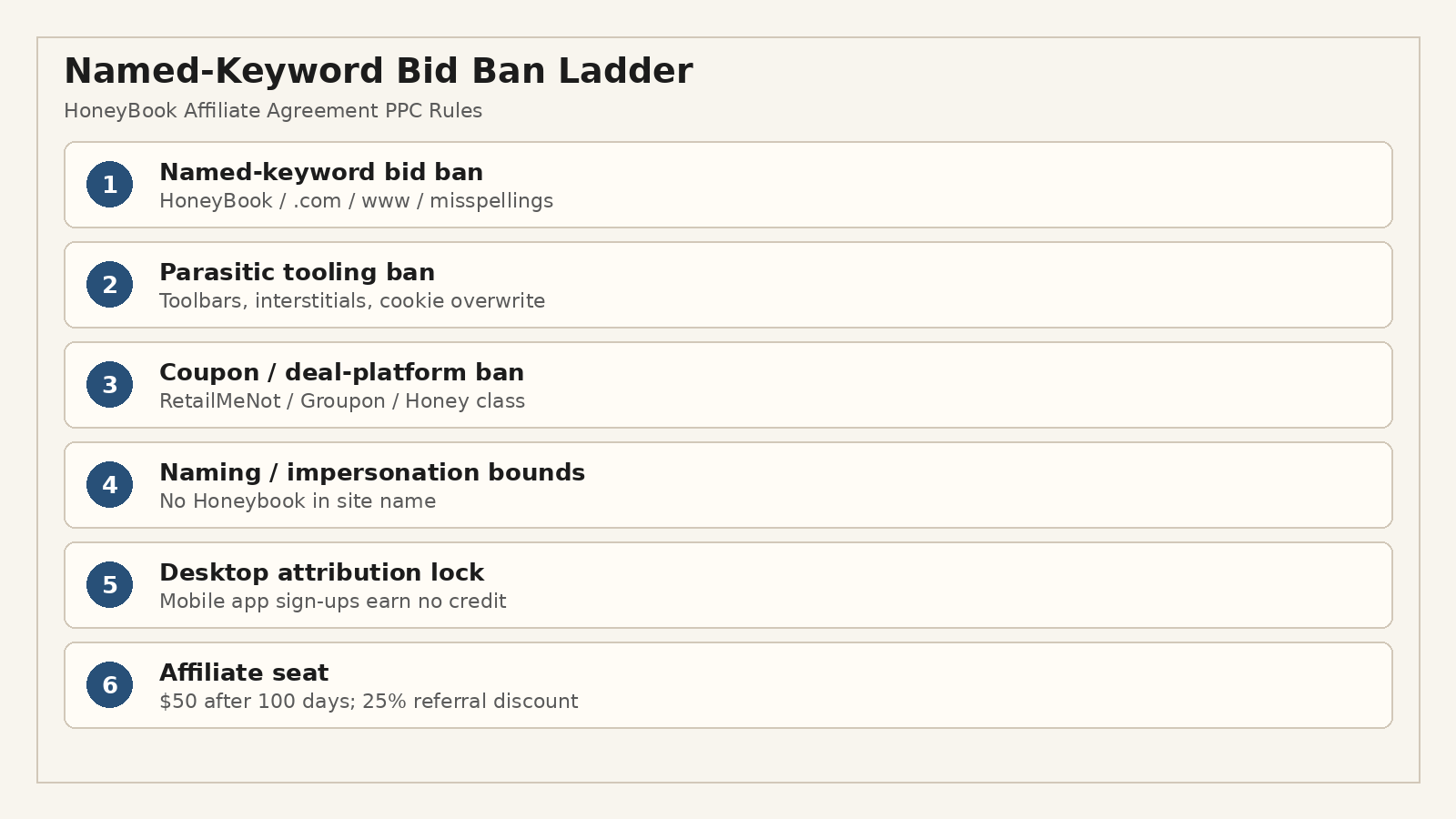
Source: Editorial Named-Keyword Bid Ban Ladder from HoneyBook Affiliate Agreement and Program Fees. https://www.honeybook.com/lp/referrals-tos · https://www.honeybook.com/lp/policy/premium-program
| Behavior | Status in HoneyBook Agreement / Fees | Why |
|---|---|---|
| Bid on “HoneyBook” or “HoneyBook.com” | Banned (§8.2) | Named brand keywords |
| Bid on misspellings / www variants | Banned (§8.2) | Explicit alterations clause |
| Coupon / deal-aggregator referral posts | Banned (§8.3) | Discount-platform prohibition |
| Toolbar / interstitial cookie hijack | Banned (§8.2) | Parasitic tooling list |
| Site or brand name containing “Honeybook” | Unsuitable (§2.1.6) | Naming / impersonation risk |
| Desktop sign-up through affiliate link | Tracked path (§2.5 + Fees) | Mobile app sign-ups excluded |
Source: HoneyBook Affiliate Agreement (Jan 20, 2025) and Affiliate Program Fees. https://www.honeybook.com/lp/referrals-tos · https://www.honeybook.com/lp/policy/premium-program
How HoneyBook affiliate program ppc policy brand bidding works is a Named-Keyword Bid Ban Ladder. You refuse the listed brand strings, refuse parasitic tooling, refuse coupon platforms, keep naming and desktop attribution clean, then collect the flat affiliate seat only if the Qualified Referral survives 100 days.
Six rungs for the same affiliate link:
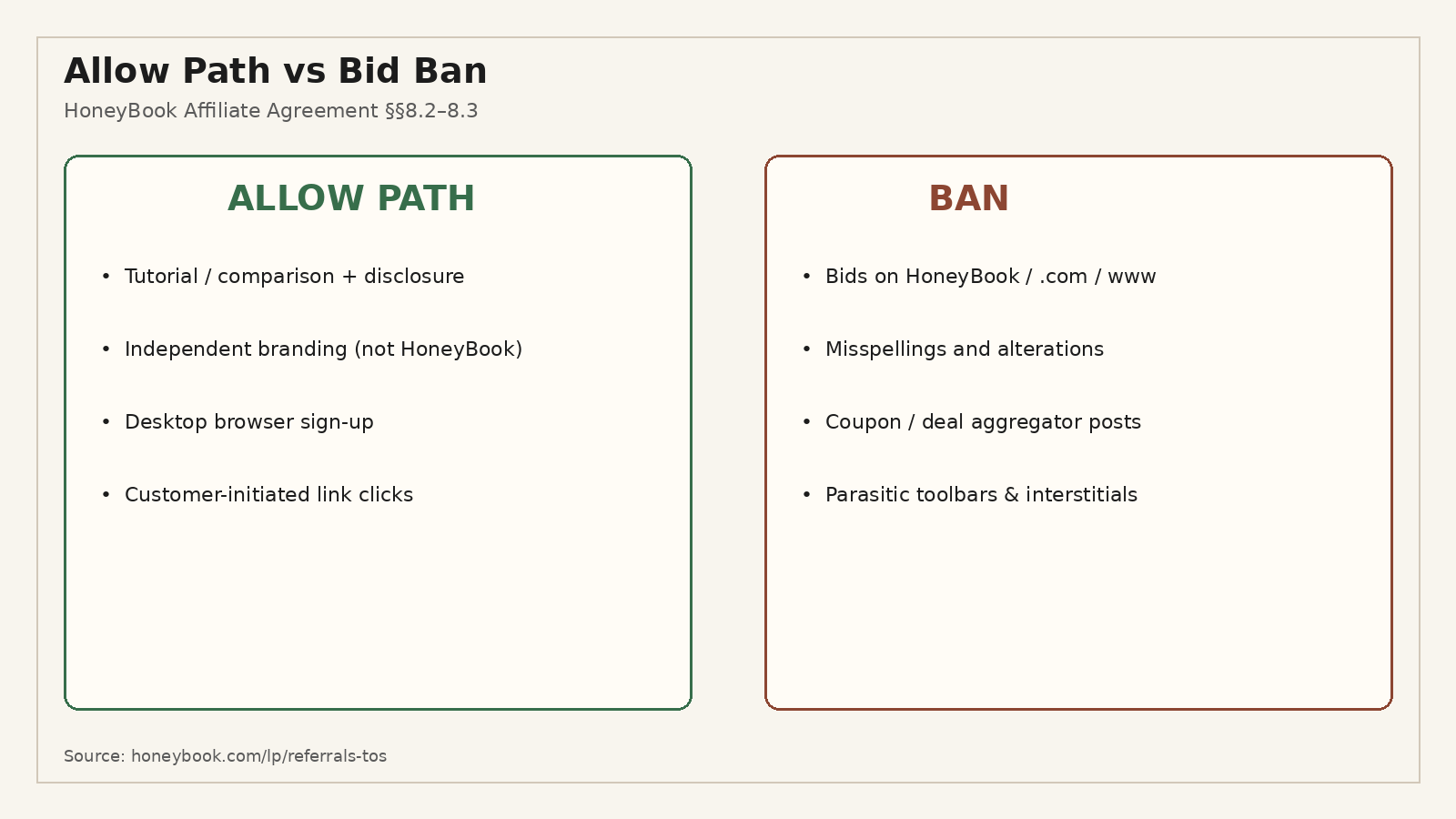
Source: HoneyBook Affiliate Agreement §§8.2-8.3. https://www.honeybook.com/lp/referrals-tos
| Channel idea | Compliant? | Notes |
|---|---|---|
| Tutorial or comparison content with affiliate link + disclosure | Path exists | Stay independent; no HoneyBook-in-name branding |
| Exact-match Google Ads on “HoneyBook” | No | Named keyword ban |
| Ads on “HoneyBook pricing” / misspellings | No | Alterations / combination clause |
| Coupon-site HoneyBook code page | No | §8.3 platform ban |
| Toolbar that drops HoneyBook cookies | No | Parasitic tooling ban |
| Referral who signs up only in the mobile app | No credit | Desktop-only tracking rule |
| Seat | Discount to referred buyer | Commission | Payout clock | Cookie / lock |
|---|---|---|---|---|
| Affiliates | Annual 25% off first year; Monthly 25% off first 2 months | $50 all plans | 100 days | 30-day cookie; 180-day lock after trial |
| Members (contrast) | Annual 30% / Monthly 30% first 2 months | $100 | 100 days | Same cookie / lock pattern |
| Educators (contrast) | Annual 30% / Monthly 30% first 2 months | $100 monthly plan / $200 annual + step bonuses | 100 days | Same cookie / lock pattern |
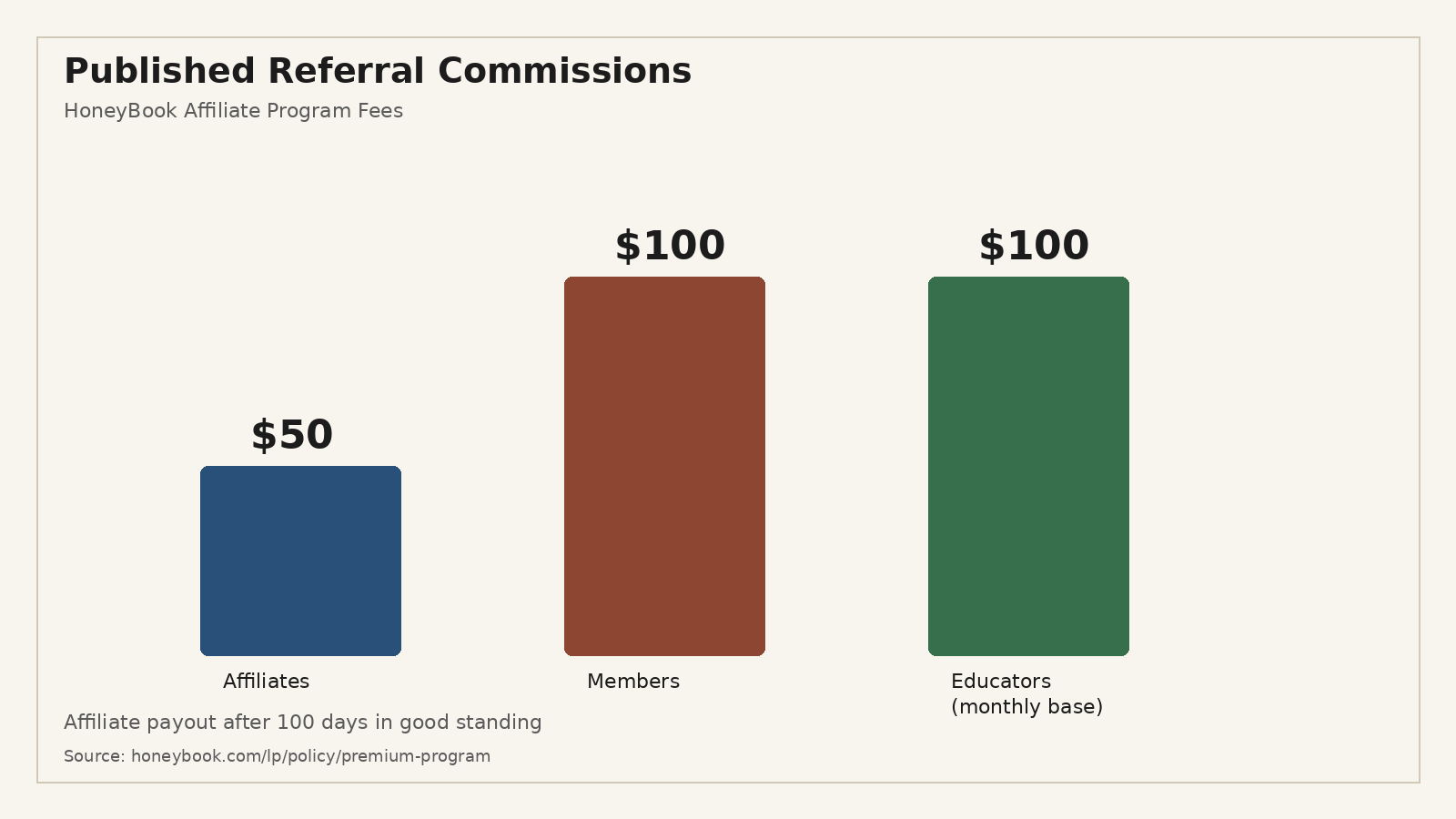
Source: HoneyBook Affiliate Program Fees. https://www.honeybook.com/lp/policy/premium-program
Auto-approve at enrollment does not mean forever. HoneyBook may re-evaluate and cancel unsuitable affiliates later (Affiliate Agreement). Treat approval as a provisional seat, not a SEM license.
| Program | Public SEM shape | feat. spoke |
|---|---|---|
| HoneyBook | Named brand-keyword bid ban + parasitic + coupon bans | This page |
| SuiteDash | Total paid-ads ban | SuiteDash |
| Ontraport | Engine-split ban | Ontraport |
| Salesflare | Known-brand harvest ban (PPC + review SERP + coupons) | Salesflare |
Copying SuiteDash’s total paid ban onto HoneyBook overstates the written rule. Copying Ontraport’s other-engine allow lane understates HoneyBook’s named list. Read §8.2 as written.
Q: Is HoneyBook brand bidding allowed for affiliates? A: No for the named brand list. The Affiliate Agreement forbids bids on HoneyBook, HoneyBook.com, www.HoneyBook, www.HoneyBook.com, and misspellings or similar alterations, alone or combined with other keywords.
Q: What is the HoneyBook affiliate program PPC policy? A: It is a Named-Keyword Bid Ban Ladder: brand-keyword bids banned, parasitic tooling banned, coupon platforms banned, Honeybook-in-name sites unsuitable, and desktop sign-up required for referral credit. It is not written as a total ban on all paid advertising.
Q: What commission does the HoneyBook affiliate program pay? A: Affiliates earn $50 per Qualified Referral that remains subscribed and in good standing for 100 days, with a 25% discount offered to referred buyers on eligible subscriptions. Tracking uses a 30-day cookie and a 180-day lock after trial begins.
Q: Can I promote HoneyBook on coupon or deal sites? A: No. Section 8.3 prohibits distributing referral links on couponing or discount-focused platforms, including deal aggregators and promotional-code directories such as RetailMeNot, Groupon, and Honey.
Q: Does feat. replace the HoneyBook affiliate program? A: No. feat. is a marketplace for co-branded storefront selling with a revenue split on products you list or promote. HoneyBook’s affiliate program is a software-referral seat with a named-keyword bid ban. Use feat. when the job is selling a product through a storefront, not when the job is referring HoneyBook subscriptions.
HoneyBook affiliate program ppc policy brand bidding is a Named-Keyword Bid Ban Ladder. Refuse the listed brand strings, refuse parasitic tools, refuse coupon platforms, keep desktop attribution, and clear the $50 seat only after 100 days. If you learned “no PPC at all” from SuiteDash, recalibrate. If you learned “engine split allows other surfaces” from Ontraport, recalibrate again.
If you want partners selling through co-branded storefronts instead of a bare tracking link, list your product on feat. and let affiliates claim a storefront seat.
GoAffPro pricing: Hobby Free, Premium $49, Business from $99. No sales %, vs UpPromote.
Refersion pricing: Launch $39+3%, Growth $199+2%. Affiliate-sales fees, crossover math, vs UpPromote.
UpPromote pricing: Free, Growth $29.99+2%, Pro $89.99+1.5%. Performance fees, crossover math, vs ReferralCandy.