GoAffPro Pricing Explained
GoAffPro pricing: Hobby Free, Premium $49, Business from $99. No sales %, vs UpPromote.
After your first affiliate sale, densify—repeat the winning offer and surface, change one variable per sprint. Rewardful: only 1.28% ever sell.

TL;DR: How to scale affiliate sales after the first sale is densification: repeat the offer×surface×CTA that locked sale #1, then change one variable per sprint. Rewardful finds only 1.28% of affiliates ever sell (n=2,847). Joining twenty new programs is how you rejoin the non-sellers. Merchant first-100 recruiting is a different job.
Most people who ask how to scale affiliate sales after the first sale treat sale #1 like a lottery win. They celebrate, open five more networks, and dilute the only experiment that worked. Rewardful’s SaaS sample is blunt: 7.6% of affiliates refer traffic and only 1.28% ever sell (n=2,847) (Rewardful). The first locked commission proves you can leave that pile. Scaling is proving you can stay out.
This is the seller densify playbook. It sits after how to get your first affiliate sale and beside the choose / promote / join spokes. It is not the merchant job of your first 100 affiliate sales—that page is for brands activating a roster. You already have one proof of concept. Now you densify it.
Key takeaways:
Scaling after the first affiliate sale means turning one locked, attributed commission into a repeatable densify loop—same buyer intent, tighter measurement, controlled expansion—not a second onboarding tour through every network directory.
Sale #1 answered “can this offer×surface×CTA convert once?” Scaling answers “can I produce locked attributions on a schedule without guessing which change mattered?” If you cannot name the winning combo in one sentence, you are not ready to scale—you are ready to re-run the First-Sale Sprint.
Merchant scaling (more affiliates, more GMV) uses a different ladder. Keep that link for founders recruiting sellers. Your job here is publisher density.
Tip lists multiply channels. Densify multiplies learning per week. After sale #1, the expensive mistake is pretending you are still in discovery when you already have a control.
Why constraints win:
There is no public dataset for a universal median “days between sale 1 and sale 10.” Refuse invented streaks. Log your own sprint cadence.
The densify ladder is a fail-closed scale plan: protect the control, add one change, measure locked attributions, then decide whether to deepen or graduate the surface.
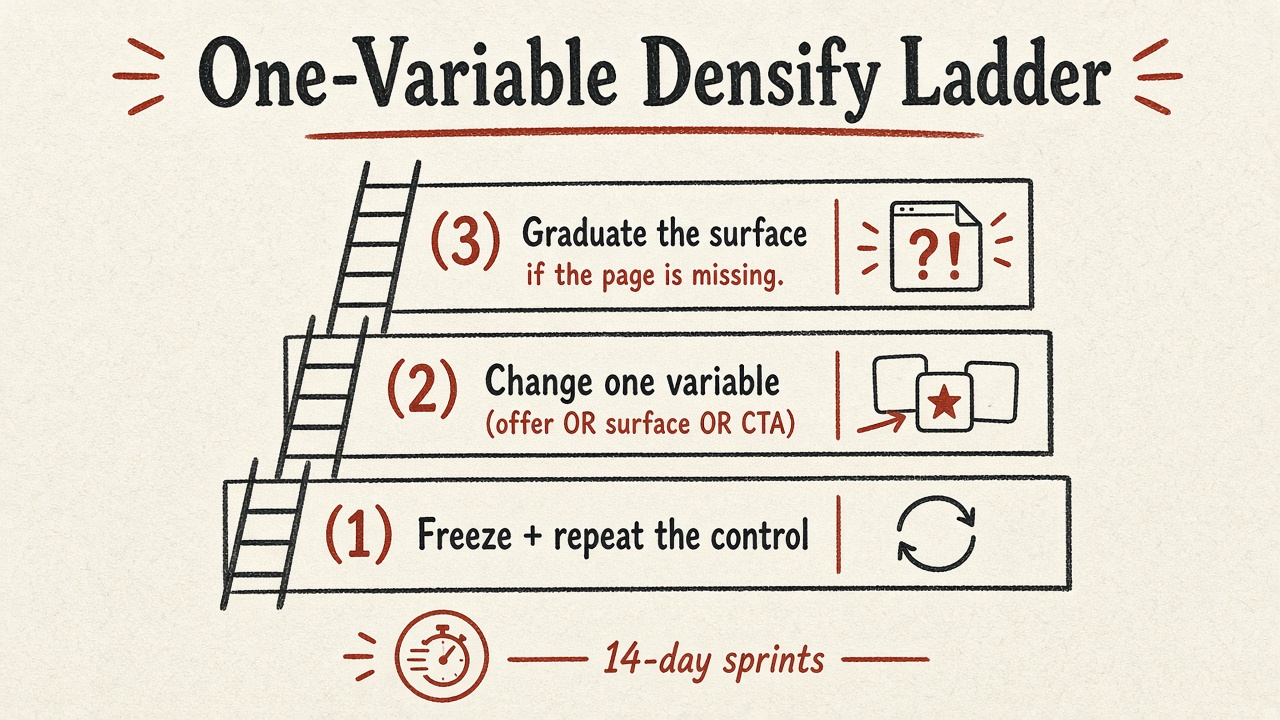
Source: Editorial framework synthesizing Rewardful activation rates, Amazon cookie/payment help, Shopify commission bands, and the feat. seller cluster (Five-Gate / Promotion Surface Ladder / First-Sale Sprint). Taxonomy diagram; no invented sale-gap medians.
Write the sale #1 autopsy in four fields:
If any field is fuzzy, re-run one First-Sale Sprint before you claim a scale plan. Guessing is not densification.
Ship the same offer on the same surface again. New angle on the same URL is fine. A brand-new TikTok funnel is not. Goal: a second locked attribution without changing the model. That second sale is more valuable than ten pending clicks on a new niche. It proves the first lock was not a fluke visitor who already intended to buy.
Match the CTA to the cookie every time. Slow educational posts fail Amazon’s 24-hour cart rule even when the review is “good” (cookie help). Detail: affiliate cookie duration. Keep the same sub-ID family so reporting shows densify traffic separately from random bio-link noise. If you must refresh creative, change the hook—not the destination and not the offer.
Pick exactly one:
| Lever | When to pull it | What “one change” looks like |
|---|---|---|
| Offer | Economics too thin (Table 1 pennies) | Swap to higher band / digital midpoints; keep surface |
| Surface | Clicks exist, carts die | Move email ↔ owned page ↔ video; keep offer |
| CTA / asset | Traffic weak or CTA buried | Rewrite lead, move disclosure+link, keep offer+surface |
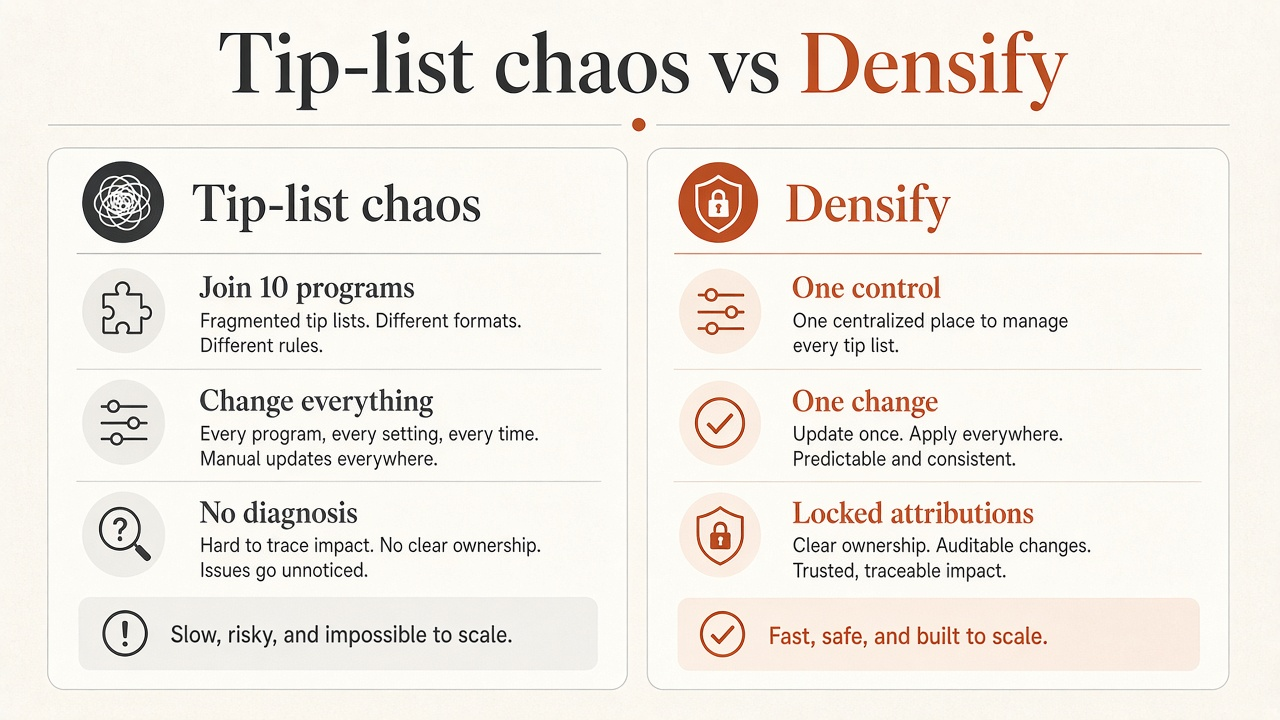
Source: Editorial comparison grounded in Rewardful 1.28% sell rate and First-Sale Sprint one-variable rule. Accessed 2026-10-10.
If readers need a shoppable page—not another UTM—step up the ladder: owned page → email sequence → video → community (only with trust) → co-branded storefront. Retail examples: Lowe’s up to 20% with a 30-day window; Sephora storefront 15% (Sprout Social). feat. is the marketplace co-branded rung when a merchant-listed product needs your page, not Amazon’s catalog—see what is a creator storefront and Amazon Associates vs feat.
| Offer shape | Published signal | On $100 labeled sale |
|---|---|---|
| Amazon Table 1 (many retail) | Often 1%–4% | $1–$4 |
| Shopify-style physical | 5%–15% | $5–$15 |
| Shopify-style digital | 20%–50% | $20–$50 |
| Shopify-style subscriptions | 15%–30% recurring | $15–$30 first period |
| Rewardful SaaS average | 24.16% | $24.16 |
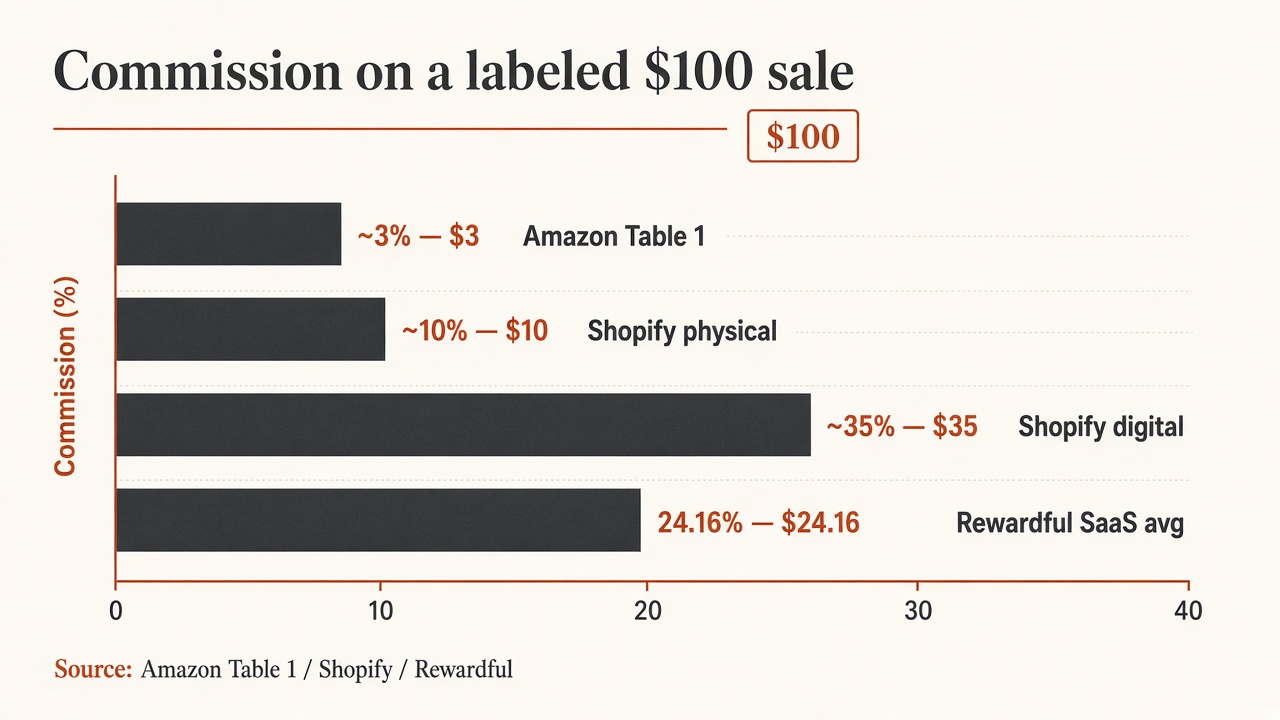
Source: Amazon Table 1. https://affiliate-program.amazon.com/help/node/topic/GRXPHT8U84RAYDXZ · Shopify Affiliate Commission Guide. https://www.shopify.com/blog/affiliate-commission · Rewardful State of SaaS Affiliate Programs. https://www.rewardful.com/articles/state-of-saas-affiliate-programs-report
Scale the row that makes the next asset worth writing. Pennies on cheap ASINs rarely justify a third video.
Beginners without a list still densify from one owned page—see how to start affiliate marketing with no audience. Tracking hygiene: how to track affiliate sales. If the control keeps producing locked sales, protect it the way a merchant protects a winning ad set: do not “refresh” by deleting the page and starting over. Add supporting assets that point back to the same checkout path. That is densify. Opening five new networks because a thread said “diversify” is how you erase the only signal you have.
Q: How do you scale affiliate sales after the first sale? A: Freeze the winning offer×surface×CTA, repeat it until you earn another locked attribution, then change only one variable per sprint. Densify beats joining more programs. Score locked sales, not bank deposits that can lag ~60 days on Amazon.
Q: Should I join more affiliate programs after my first commission? A: Not as your first move. Rewardful finds only 1.28% of affiliates ever sell. Prove you can repeat the control before you add offers. New programs are a one-variable change—treat them like an experiment, not a shopping spree.
Q: How is scaling after the first sale different from a merchant’s first 100 sales? A: Seller densify improves your promotions. Merchant first-100 activates a roster of sellers. Different jobs, different pages—link the merchant playbook when you are the brand, not when you are the publisher.
Q: How long until sale #2 or #10? A: There is no public median for days between sale 1 and sale 10. Run 14-day densify sprints and log your own cadence. Invented “average” streaks are marketing, not measurement.
Q: When should I move to a creator storefront to scale? A: When the bottleneck is the sell page, not the tracking link—readers need a co-branded checkout for a merchant-listed product. Retail storefront commissions (for example Sephora 15%, Lowe’s up to 20%) show the surface can matter. Browse the feat. marketplace when that is the job.
Scaling after the first affiliate sale is densification of a proven combo, not a second tour of network directories. Repeat the control, change one variable, graduate the surface only when the page is missing, and keep Scorecards on locked attributions. If the next step is a co-branded page for a merchant-listed product, start on the feat. marketplace.
GoAffPro pricing: Hobby Free, Premium $49, Business from $99. No sales %, vs UpPromote.
Refersion pricing: Launch $39+3%, Growth $199+2%. Affiliate-sales fees, crossover math, vs UpPromote.
UpPromote pricing: Free, Growth $29.99+2%, Pro $89.99+1.5%. Performance fees, crossover math, vs ReferralCandy.