Ad Revenue at 20K Followers: Merit Gates Compared
At 20K followers, compare YouTube, TikTok, and Twitch ad-revenue gates versus commission storefronts. Official thresholds only. No invented RPM.
How to start an online store selling other people's products: Store-or-Not Ladder, Shopify floors, affiliate vs dropship seats.

TL;DR: How to start an online store selling other people’s products starts with a seat choice, not a theme. Affiliate links and co-branded storefronts leave checkout with the maker. Dropshipping and reselling make you the merchant of record. Shopify Basic lists at $29/mo (yearly). Physical affiliate cuts sit near 5%-15%. Pick the lowest seat that still pays.
People who search how to start an online store selling other people’s products usually open a Shopify trial the same afternoon. That order is backwards. The hard question is whether you need to be the store at all.
I have sat on both sides of that choice. As a merchant I want sellers who never touch my inventory. As a promoter I want a page that feels like mine without owning the refund queue. The Store-or-Not Ladder below is the sequence I wish someone had forced me through before the theme pack.
An online store selling other people’s products is a commerce surface where buyers purchase items you did not manufacture, either by checking out with the maker through your tracked page or by paying you as the merchant of record while a supplier or warehouse ships.
That sentence hides the fork that ruins beginners. In the referral version, you curate and recommend. The maker runs checkout. You earn a commission. In the retail version, the buyer pays you. You owe the refund, the chargeback, the late package email, and often the sales-tax posture. Both versions answer the search query. Only one of them needs a Shopify plan on day one.
If you want the full ownership taxonomy without the launch checklist, read how to sell someone else’s product online. This page is the start sequence: which seat to open, in what order, with which public floors.
The seat you pick decides cash risk, support load, and legal exposure before the first order. Two people can sell the same bottle of serum. One owns a link. The other owns a store, a payment processor, and a Monday refund.
How to start an online store selling other people’s products is a four-seat ladder: start with an affiliate link if you only need attribution, move to a co-branded storefront when you want a page with your name on the maker’s checkout, open a dropship or print-on-demand store only when you accept merchant-of-record duties, and buy stock for resale only when authorization and cash allow it. Climb one rung at a time.
| Seat | Merchant of record | Inventory | Typical keep (public bands) | Day-one cash | Best when |
|---|---|---|---|---|---|
| Affiliate link | Maker | None | Amazon 0%-10% by category; Shopify physical 5%-15%, digital 20%-50% | None | You have content or an audience and refuse support tickets |
| Co-branded storefront | Maker (checkout stays with maker) | None | Commission the maker sets (same Shopify bands as planning context) | None | You want a sell page with your name without owning refunds |
| Dropship / POD store | You | None held; supplier ships after sale | Collective-style 20%-50% gross; open marketplace often 10%-15% before ads | Shopify plan + samples + ads | You can buy traffic profitably and answer “where’s my order” |
| Authorized reseller | You | Yes | Your markup minus fees and unsold stock | Inventory + platform | You have wholesale terms and brand blessing |
Sources: Amazon Associates Table 1; Shopify affiliate commission guide (2026); Shopify Collective / dropshipping guides (2026).
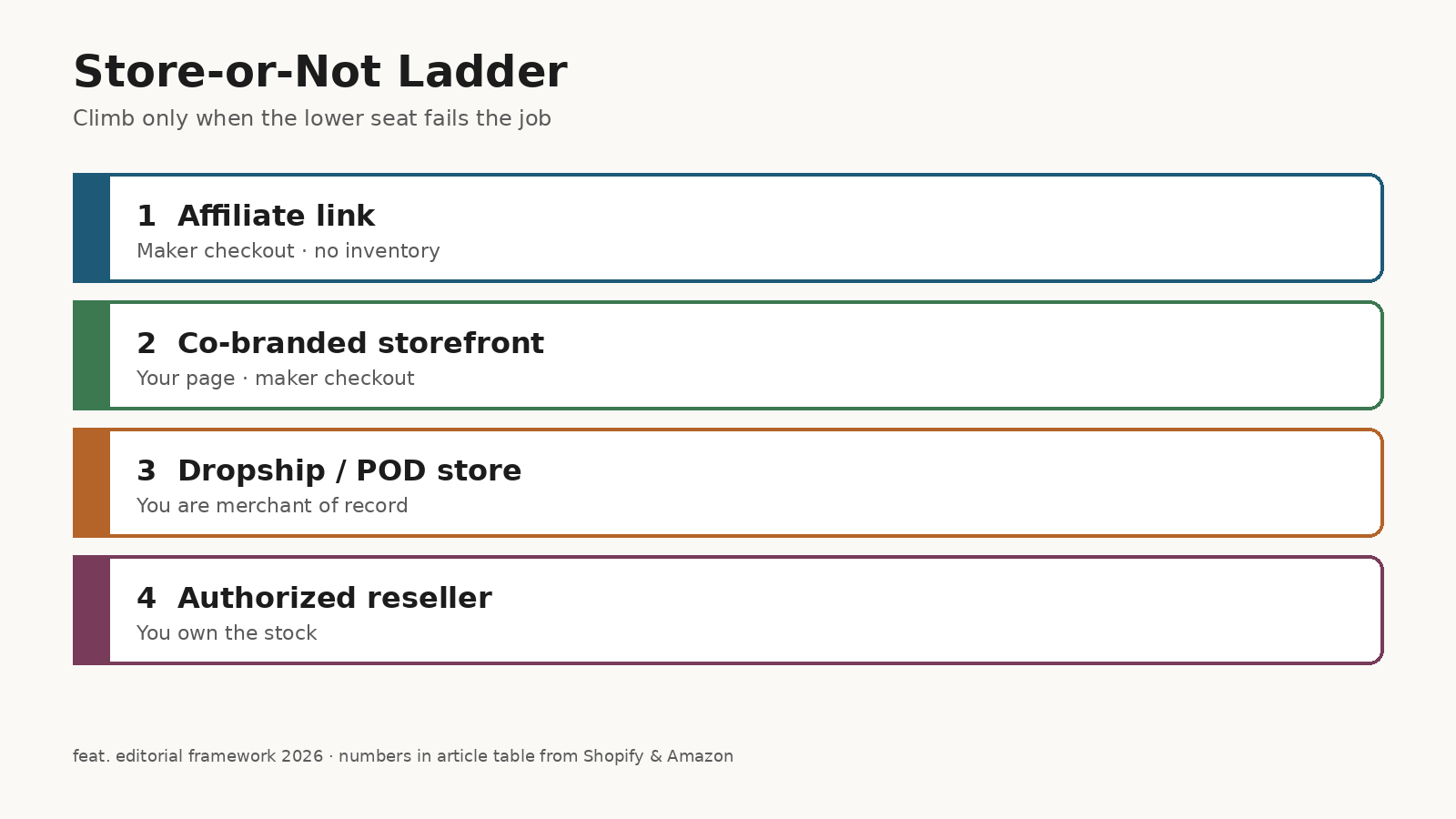
Source: feat. editorial framework, 2026. Numbers in the table from Amazon Associates and Shopify (2026). URLs in citation log.
Join programs, disclose the relationship, and send traffic to the maker’s checkout. Shopify’s physical band is 5%-15%; digital often 20%-50% (Shopify). Amazon category rates sit in a published 0%-10% table, and the cart must catch within 24 hours (Amazon; cookie rule).
The FTC’s own example line still works: “I get commissions for purchases made through links in this post” (FTC). Full surface rules live in affiliate marketing disclosure rules.
Operator advice matches the ladder. On r/ecommerce, a ten-year builder told someone hunting other brands: start with affiliate marketing, then transition into ecomm (thread).
A co-branded storefront is the middle rung people skip. You get a page with your handle and the maker’s product. The maker keeps checkout, fulfillment, and refunds. You keep attribution. That is the difference between a raw affiliate link and a place that looks like your shop, covered in depth in affiliate marketing vs storefront and what is a creator storefront.
Honest feat. recommendation. When the job is “I want people to buy through a page that is mine, but I do not want to be the merchant of record,” feat. is built for that seat: merchants list products, affiliates sell through co-branded storefronts feat. generates, and both sides split revenue on the sale. Compare that to opening Shopify plus a dropshipping app (you become the store) or Amazon Associates (you get a link and a 24-hour cart clock). Live feat. fees stay in-product; this article does not invent a platform cut or GMV. Browse offers on the feat. marketplace when you are the affiliate, or list on feat. when you are the merchant.
Now you need the platform. Shopify Basic’s public sticker is $29/mo on yearly billing (Shopify Pricing). You import products, set retail price, and forward orders to a supplier. Shopify Collective is pitched with 20%-50% profit margins for many brand partners (Shopify). The affiliate-vs-dropshipping guide also cites 20%-40% as achievable on many dropship products when pricing works (Shopify). Open marketplaces often compress closer to 10%-15% before ads (Shopify).
Print-on-demand is the branded cousin: you own the design, a printer ships after each order. Same merchant-of-record duties. Sample every SKU before you spend on ads. Head-to-head risk math lives in dropshipping vs affiliate marketing.
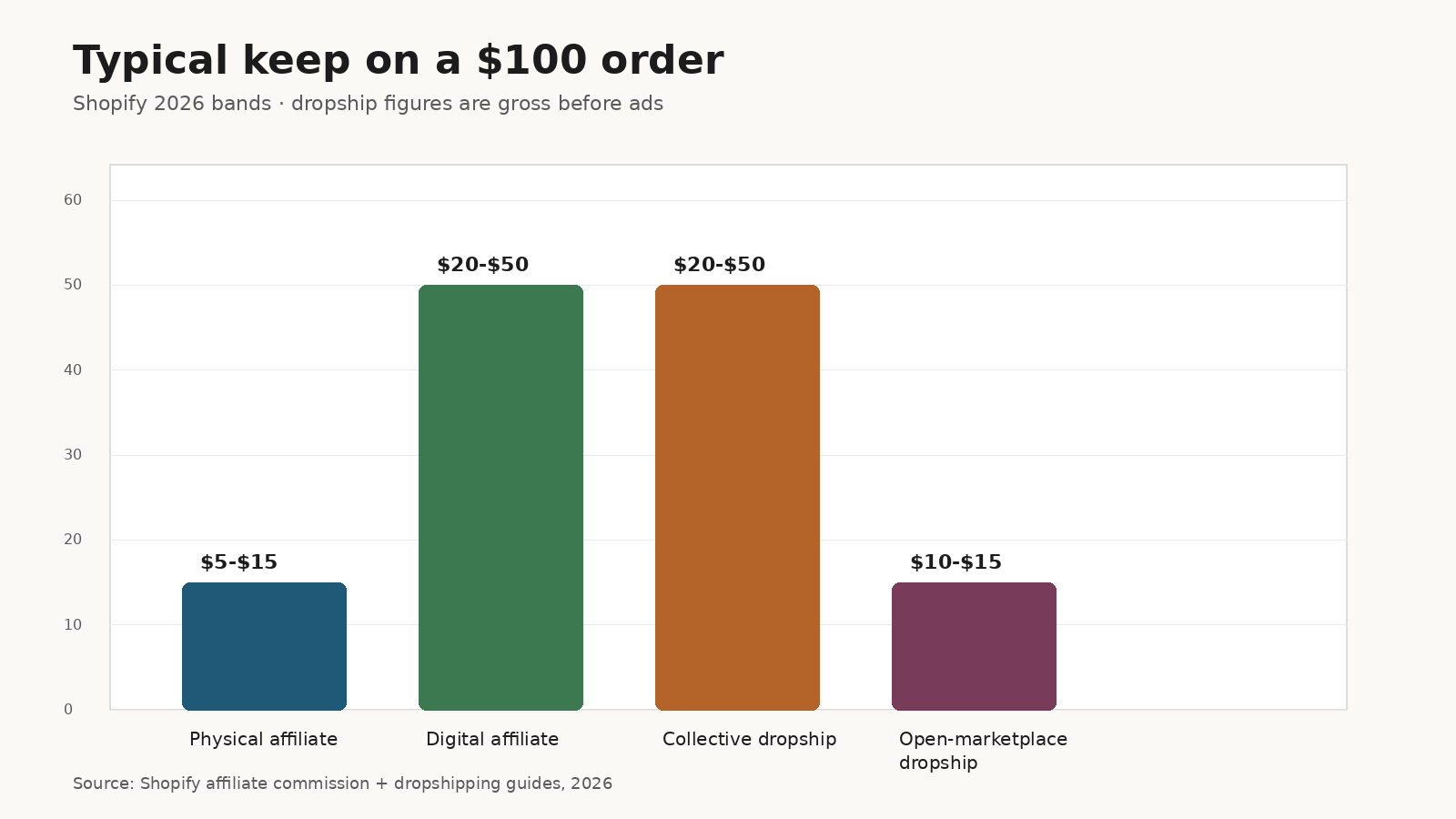
Source: Shopify affiliate commission guide and dropshipping guides, 2026. https://www.shopify.com/blog/affiliate-commission · https://www.shopify.com/blog/how-to-start-dropshipping · https://www.shopify.com/blog/what-is-dropshipping
Buy genuine inventory under wholesale or retail terms you can defend. First sale can cover reselling the copy you bought. It does not hand you the brand’s marketing assets (17 U.S.C. §109(a)). For Nike-class marks, operators treat unauthorized storefronts as a shutdown risk (r/ecommerce). Get the agreement in writing before you photograph the shelf.
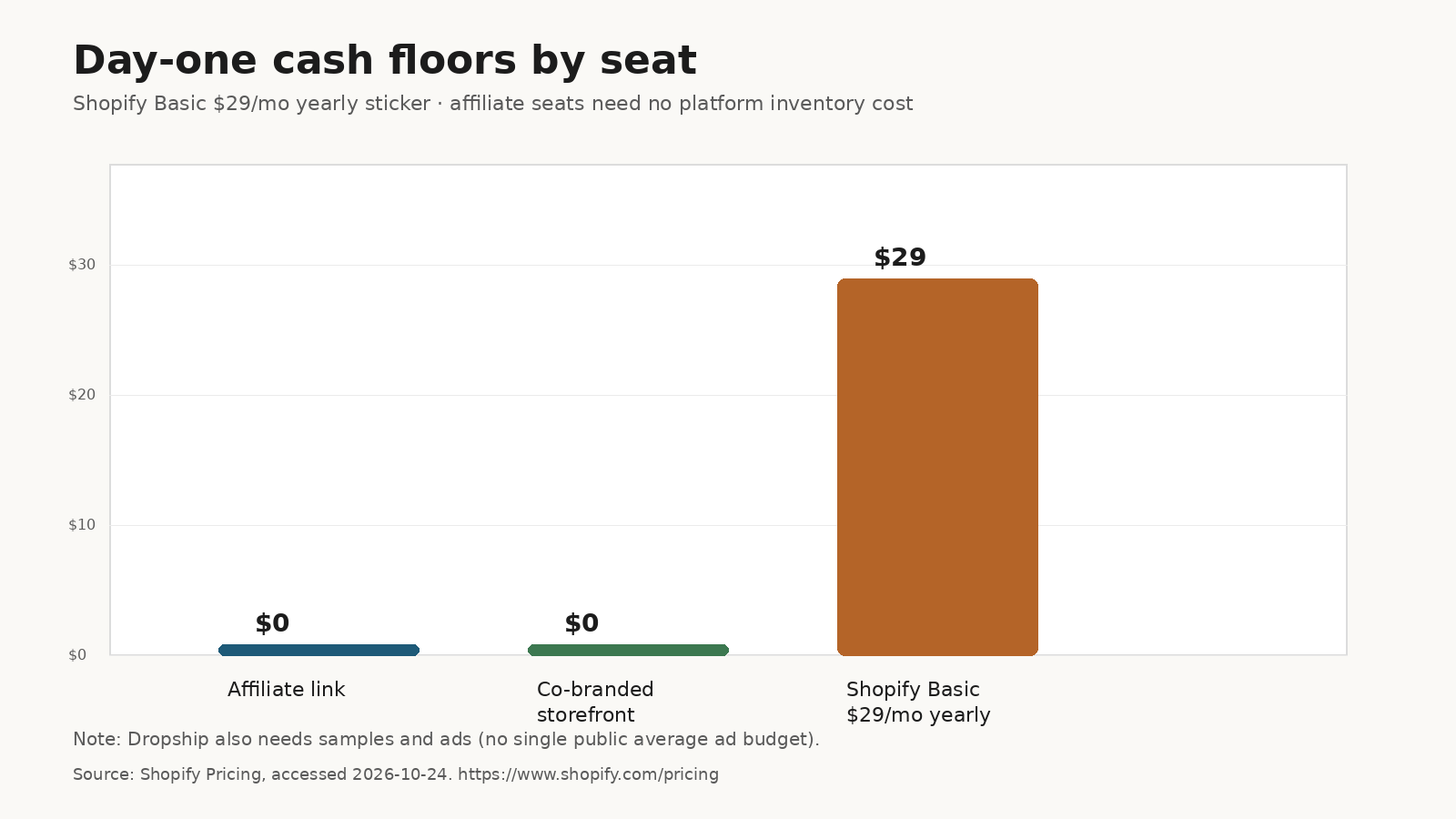
Source: Shopify Pricing page (Basic $29/mo yearly), accessed 2026-10-24. https://www.shopify.com/pricing. Affiliate and storefront seats have no platform inventory cost.
Q: How do I start an online store selling other people’s products without inventory? A: Use an affiliate link or a co-branded storefront so the maker keeps inventory and checkout. Open a dropship or print-on-demand store only if you accept being the merchant of record while a supplier ships. Reselling requires stock by definition.
Q: Is dropshipping or affiliate marketing better for selling other brands? A: Affiliate marketing is better when you refuse support tickets and refunds. Dropshipping is better when you can set price and buy traffic profitably. Shopify puts physical affiliate commissions near 5%-15% and many dropship margins near 20%-40% before ads.
Q: Do I need Shopify to sell other people’s products? A: No. Affiliate programs and co-branded storefronts do not require a Shopify plan. Shopify becomes the default when you want to be the store. Basic lists at $29/mo on yearly billing on Shopify’s pricing page.
Q: Can I sell Nike or other big brands on my store without permission? A: Buying genuine units may let you resell those specific copies under first sale rules, but using brand assets or listing without authorization can trigger takedowns. Operators report Shopify will close stores when aggressive brands complain. Get written permission.
Q: How much can you make selling other people’s products online? A: There is no public dataset for a universal income average across affiliate, storefront, dropship, and reseller seats. What is public are commission and margin bands (for example Shopify’s 5%-15% physical affiliate range) and activation rates like Rewardful’s 1.28% of affiliates generating a sale. Refuse any single “monthly income” promise.
How to start an online store selling other people’s products is a Store-or-Not decision. Climb from affiliate link to co-branded storefront before you accept merchant-of-record duties on dropship or resale. Use the public floors: Shopify Basic at $29/mo yearly, affiliate bands at 5%-15% physical, Collective-style dropship margins at 20%-50% before ads, Amazon’s 24-hour cart rule. If the job is a co-branded page where someone else still runs checkout, list or sell through feat..
At 20K followers, compare YouTube, TikTok, and Twitch ad-revenue gates versus commission storefronts. Official thresholds only. No invented RPM.
Amazon storefront earnings use Standard Table 1 offsite and lower Onsite Table A rates. Bound $100 sales; Amazon publishes no average.
No fee to join an Amazon Influencer storefront. Associates alone has no shop page. Compare gates, Table 1 pay, and paid bio tools.