GoAffPro Pricing Explained
GoAffPro pricing: Hobby Free, Premium $49, Business from $99. No sales %, vs UpPromote.
PartnerStack pricing is Spark at $0 plus 10% of commissions paid; Launch, Growth, and Enterprise confirm dollars in a demo. Worked fee math included.

TL;DR: PartnerStack pricing is two seats. Spark publishes $0/month plus a 10% processing fee on commissions you pay out. Launch, Growth, and Enterprise confirm dollars only in a demo. Chart the Spark meter. Do not invent a Launch floor from listicles.
People search partnerstack pricing when finance asks for a line item and the homepage answers with plan names. That is not a broken Google result. It is the product’s commercial design: one self-serve meter you can read, and an ecosystem ladder you cannot.
This page owns PartnerStack pricing as a price-seat question. It sits beside Endorsely vs PartnerStack (comparison ladder), PartnerStack vs feat (ecosystem vs storefront), and PartnerStack marketplace features (ops surface). It does not invent feat. fees or a fake PartnerStack monthly census.
Key takeaways:
PartnerStack pricing is the commercial split between PartnerStack Spark—a published $0 + 10%-of-commissions seat—and the Launch / Growth / Enterprise ecosystem plans whose dollars are confirmed in a demo.
Spark is the self-serve referral seat: single user, simplified tracking links, simple commission offers, Stripe sale tracking, partner applications, automated payouts, a performance dashboard, and a custom domain (PartnerStack Spark). The price sentence is short on purpose: subscription $0, then 10% on commissions you pay out.
Launch, Growth, and Enterprise are the ecosystem ladder. The pricing page names features—Marketplace access, lead and deal registration options, LMS, MDF, Network success—and answers “How does PartnerStack pricing work?” with program size, feature needs, support level, and a demo confirmation (PartnerStack Pricing). Reddit’s vernacular matches the page: operators complain it “doesn’t show pricing — they just want me to ‘book a demo’” (r/Affiliatemarketing).
A SaaS founder who budgets “PartnerStack ≈ $X” from a listicle ships a wrong model. The only sticker you can defend in a board deck without a quote is Spark’s meter. Everything else is a conversation with sales, and that conversation should start from the job you need—not from a scraped monthly floor.
Why the seat split matters:
PartnerStack pricing works as a PartnerStack Price Seat Ladder. Climb only when the next rung’s job shows up in your week.
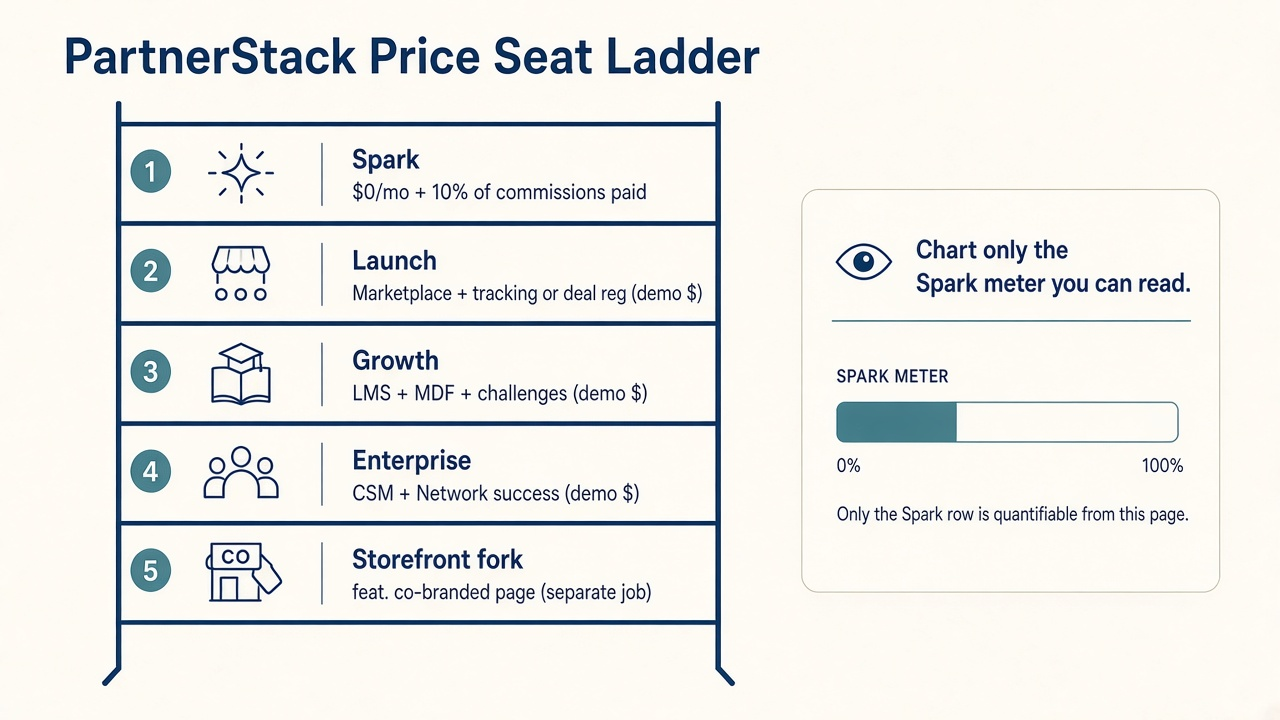
Source: Editorial PartnerStack Price Seat Ladder from PartnerStack Spark and Pricing pages fetched 2026-10-15. https://partnerstack.com/platform/spark · https://partnerstack.com/pricing/
Spark’s published price: $0 per month subscription fee, plus a 10% processing fee on commissions you pay out (PartnerStack Spark). Included surface: single user, simplified tracking links, simple commission offers, Stripe sale tracking, partner application management, automated payouts, performance dashboard, custom domain (PartnerStack Spark).
Worked fee table (arithmetic on the 10% rule—not a PartnerStack earnings claim):
| Monthly commissions you pay out | Spark processing fee (10%) | Notes |
|---|---|---|
| $2,000 | $200 | Still below many flat SaaS trackers |
| $10,000 | $1,000 | Crosses common $49–$99 tracker bands |
| $20,000 | $2,000 | Percentage seat dominates |
| $50,000 | $5,000 | Ecosystem quote territory for many teams |
Source: Derived from PartnerStack Spark’s published 10% processing fee on commissions paid. https://partnerstack.com/platform/spark
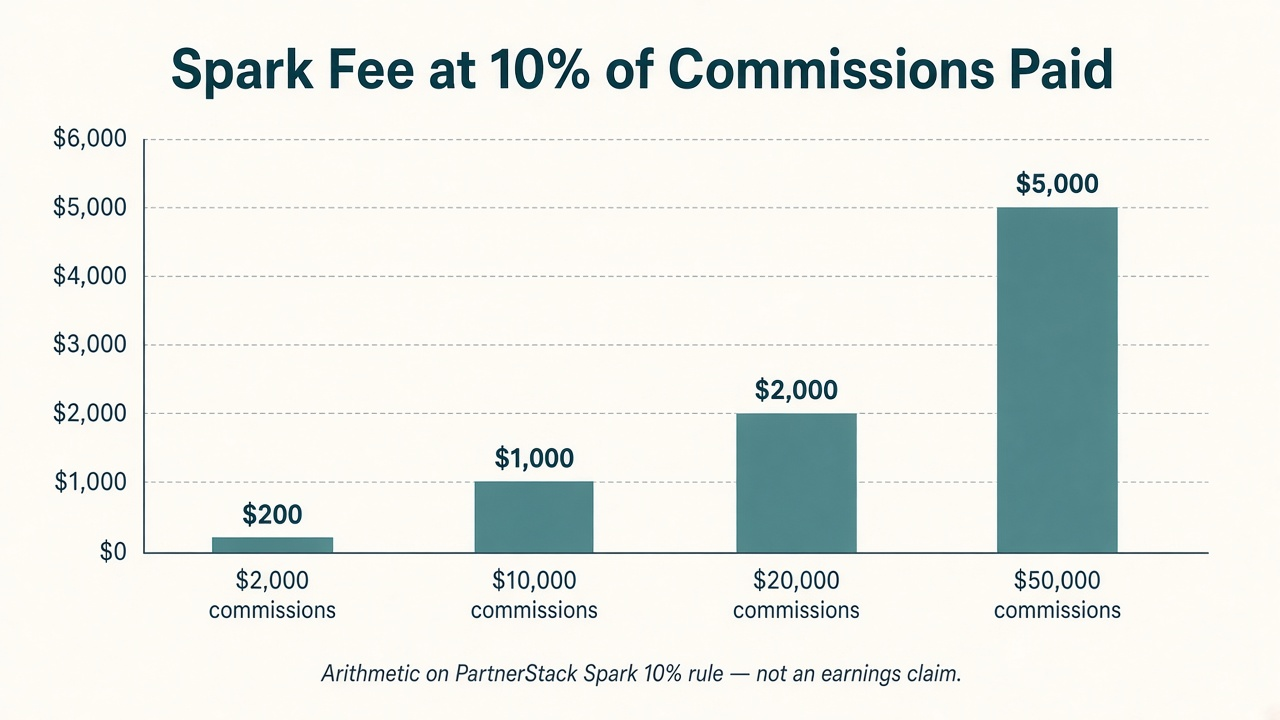
Source: Arithmetic on PartnerStack Spark 10% rule. https://partnerstack.com/platform/spark
Launch is framed for teams launching or formalizing a partner program. Published inclusions: affiliate link tracking or lead and deal registration; PartnerStack Marketplace access; PartnerStack AI + MCP connector; partner payments; onboarding/enablement tools; CRM integrations (PartnerStack Pricing). Dollars: demo.
Growth includes Launch, plus advanced integrations support, a learning management solution, partner challenges and incentives, MDF management and payments, and advanced partner segmentation (PartnerStack Pricing). Dollars: demo.
Enterprise includes Growth, plus full access to link tracking and lead/deal registration, custom workflows and integrations, strategic customer success (designated CSM, executive sponsorship, semi-annual reviews), Network success (intros and recruitment support), and priority support (PartnerStack Pricing). Dollars: demo.
| Seat | What you can read without a call | What stays unpublished on the pricing page |
|---|---|---|
| Spark | $0 + 10% of commissions paid; feature checklist | Network / Marketplace depth (not a Spark bullet) |
| Launch | Feature list (Marketplace, tracking or deal reg, AI+MCP) | Monthly platform dollars |
| Growth | Feature list (LMS, MDF, challenges, segmentation) | Monthly platform dollars |
| Enterprise | Feature list (CSM, Network success, priority support) | Monthly platform dollars |
Sources: PartnerStack Spark; PartnerStack Pricing. https://partnerstack.com/platform/spark · https://partnerstack.com/pricing/
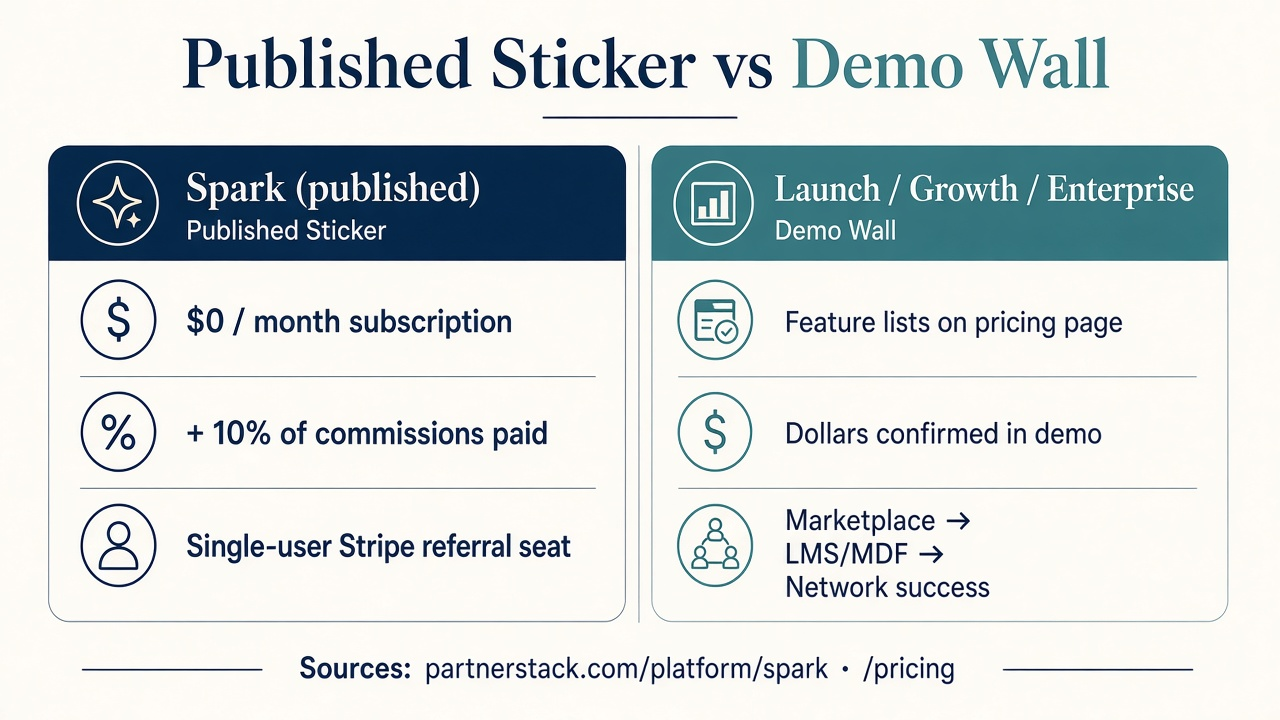
Sources: PartnerStack Spark and Pricing pages, 2026-10-15. No invented Launch floor.
There is no public dataset that crowns PartnerStack’s median customer invoice. Secondary blogs that print Launch $1,000 or Growth $1,520 from page structured data are not PartnerStack’s visible sticker. This page refuses those numbers as primary price.
Use this order so finance and growth argue about the same seat:
Q: How much does PartnerStack cost? A: Spark publishes $0/month plus 10% of commissions you pay out. Launch, Growth, and Enterprise confirm pricing in a demo based on program size, features, and support. There is no public monthly floor for those three plans on the pricing page.
Q: What is PartnerStack Spark pricing? A: Spark is $0 subscription and a 10% processing fee on commissions paid, with a single-user surface for simplified links, Stripe sale tracking, applications, automated payouts, and a dashboard.
Q: Does PartnerStack publish Launch and Growth prices? A: Not as readable stickers on the pricing page. PartnerStack states that final plan and pricing are confirmed during your demo. Treat third-party structured-data figures as secondary, not as PartnerStack’s published card.
Q: When does Spark’s 10% cost more than a flat tracker? A: When monthly commissions paid are high enough that 10% exceeds the flat SaaS seat. Example arithmetic: $10,000 in commissions paid → $1,000 Spark fee, which already clears a $49/month tracker many times over.
Q: Is PartnerStack pricing the same as PartnerStack vs Endorsely? A: No. This page owns PartnerStack’s own price seats and Spark math. Endorsely vs PartnerStack owns the head-to-head seat ladder against Endorsely’s published caps.
PartnerStack pricing is a Price Seat Ladder, not a single SKU. Read Spark’s $0 + 10% meter when you only need a Stripe referral seat. Book the demo when Marketplace, LMS/MDF, or Network success is the job—and refuse invented Launch floors until PartnerStack prints them. If what you need is creators selling an existing product through co-branded storefronts, list on feat.: https://www.feat.press.
GoAffPro pricing: Hobby Free, Premium $49, Business from $99. No sales %, vs UpPromote.
Refersion pricing: Launch $39+3%, Growth $199+2%. Affiliate-sales fees, crossover math, vs UpPromote.
UpPromote pricing: Free, Growth $29.99+2%, Pro $89.99+1.5%. Performance fees, crossover math, vs ReferralCandy.