GoAffPro Pricing Explained
GoAffPro pricing: Hobby Free, Premium $49, Business from $99. No sales %, vs UpPromote.
Unattached affiliate marketing means promoting with no niche connection - usually paid ads. Attachment Ladder vs related and involved. Merchant rules.

TL;DR: Unattached affiliate marketing means promoting a product with no niche expertise, personal use, or trusted audience relationship-usually by buying ads and sending traffic to an offer. Salesforce splits seats into unattached, related, and involved. Merchants should approve by attachment, not by logo count.
People treat “affiliate” as one job. It is not.
Some partners buy clicks and never touch the product. Some write niche content without claiming personal use. Some film a teardown after they paid with their own card. Those are different seats. Call them the same thing and you will approve the wrong applications, price the wrong commissions, and blame “affiliate marketing” when the attachment was wrong.
Unattached affiliate marketing is the zero-attachment seat: paid traffic to an offer with no authority relationship. This page names that seat, contrasts it with related and involved partners, maps network partner types onto the ladder, and gives merchant rules you can run in a weekly review.
Unattached affiliate marketing is promoting a merchant’s offer without niche expertise, personal product use, or an audience that trusts your recommendation-typically by buying paid traffic and sending it to a tracked link.
Salesforce frames it as the marketer “relaying information without having any relation to that product,” and notes it as the usual pattern for paid advertising (Salesforce). Post Affiliate Pro’s glossary sharpens the same idea: no personal connection, no niche authority, no trusted audience; the role is transactional traffic buying (Post Affiliate Pro).
This is not a moral ranking. It is an ops label. Media buyers can be excellent unattached partners when the offer, landing page, and compliance rules are built for ads. They are a terrible substitute for a creator who was hired to build trust.
Do not confuse the attachment ladder with affiliate vs influencer marketing (fee vs commission risk) or affiliate vs referral marketing (partner vs customer identity). Attachment answers a different question: how close is the promoter to the product and the buyer.
Attachment mistakes show up as “our program is full of affiliates and nothing sells,” or as “we paid commissions on traffic that looks like stolen brand search.” Naming the seat early prevents both.
Unattached affiliate marketing works as a traffic arbitrage loop: join a program, buy attention, send tracked clicks, earn commission when the merchant’s qualifying event fires. The Attachment Ladder sits underneath that loop so you do not confuse ad skill with endorsement.
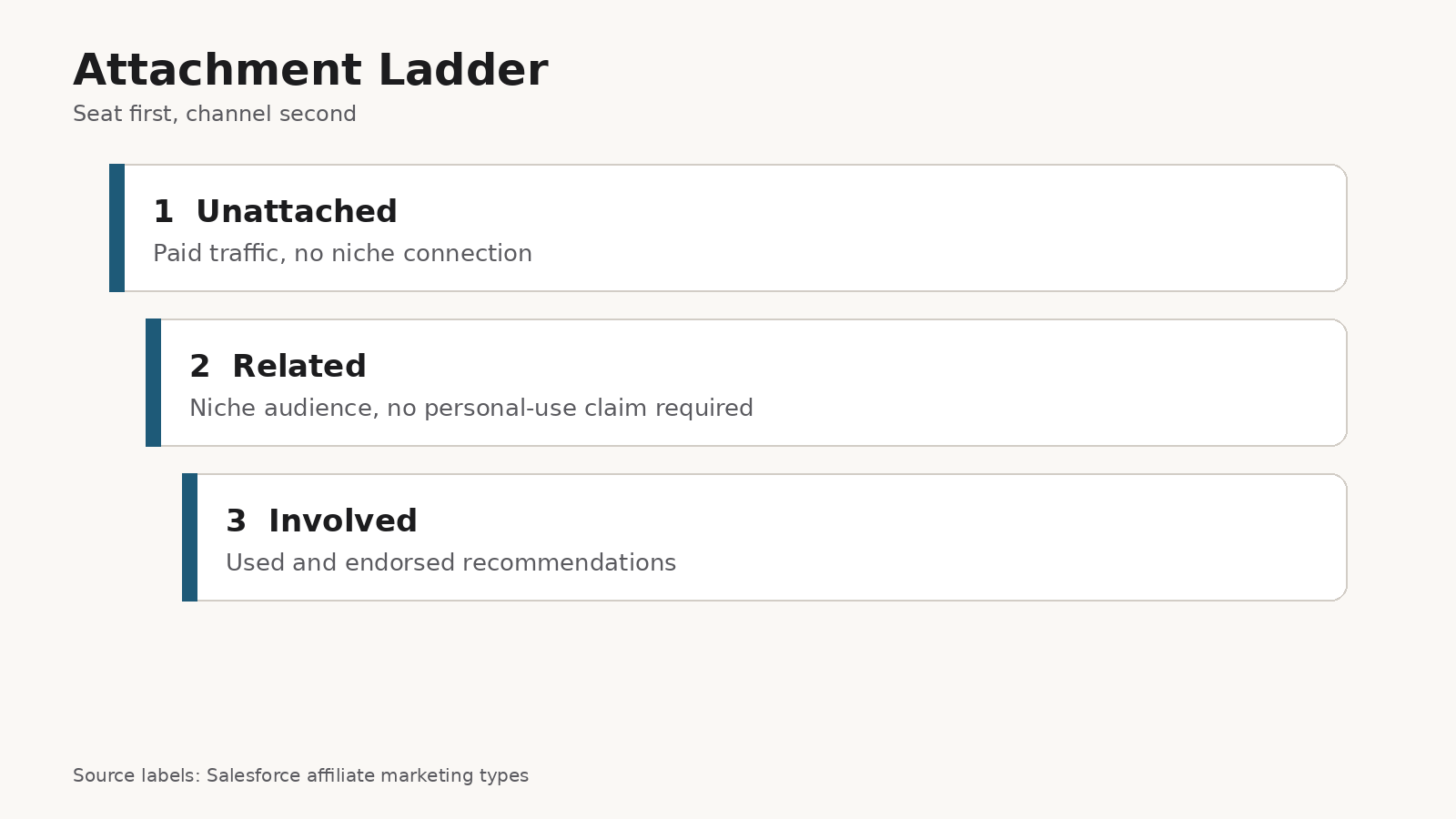
Source: Editorial framework from Salesforce affiliate marketing types (unattached, related, involved). https://www.salesforce.com/marketing/affiliate-marketing/
| Seat | Product connection | Audience relationship | Typical method | Merchant question |
|---|---|---|---|---|
| Unattached | None; no expertise or personal use | Minimal trust; often cold traffic | Paid ads, direct linking, some display | Will this traffic clear compliance and margin after ad cost? |
| Related | Niche alignment; may not personally use the SKU | Moderate; audience expects theme fit | Blogs, YouTube roundups, newsletters | Does the niche match our ICP without fake “I use this” claims? |
| Involved | Personal use and endorsement | High when the proof is real | Reviews, tutorials, demos, co-branded selling | Can we verify use, disclosure, and creative quality? |
Salesforce’s type table puts unattached with paid adverts, related with social and influencer-style niche promotion, and involved with review-style sites (Salesforce). Treat that as a seat map, not as proof that one seat always converts better. There is no public dataset for a universal CVR ladder across the three seats.
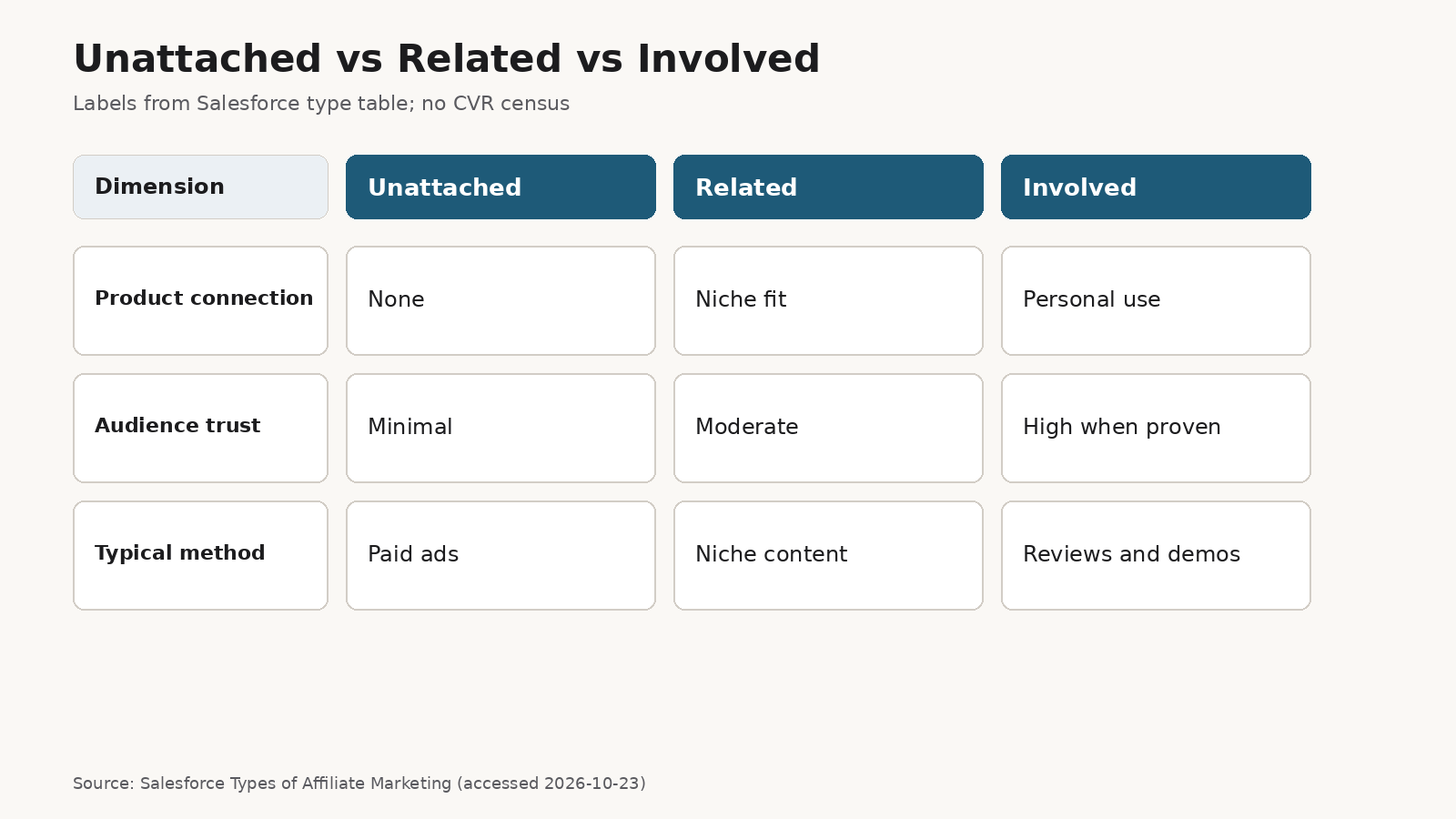
Source: Salesforce Types of Affiliate Marketing table labels (accessed 2026-10-23). https://www.salesforce.com/marketing/affiliate-marketing/ Editorial comparison; no invented conversion rates.
Networks rarely print “unattached” on the application form. They print promotional types. Awin’s Content group includes content creators and influencers, media content, communities/UGC, cashback, loyalty, discount code, lead generation, and virtual incentives. Search includes direct linking and linking via landing pages (Awin).
A practical map for merchant review:
| Awin-style type (examples) | Usual attachment seat | Why |
|---|---|---|
| Content creators and influencers | Related or involved | Opinionated content; involved only when use is real and shown |
| Discount code | Often unattached or weak-related | Captures code seekers; low personal endorsement |
| Cashback / loyalty | Transactional related | Member base, rebate mechanic, not a product teardown |
| Search direct linking | Often unattached | SERP hop with little interim content |
| Search via landing pages | Unattached or related | Depends whether the LP teaches or only cloaks |
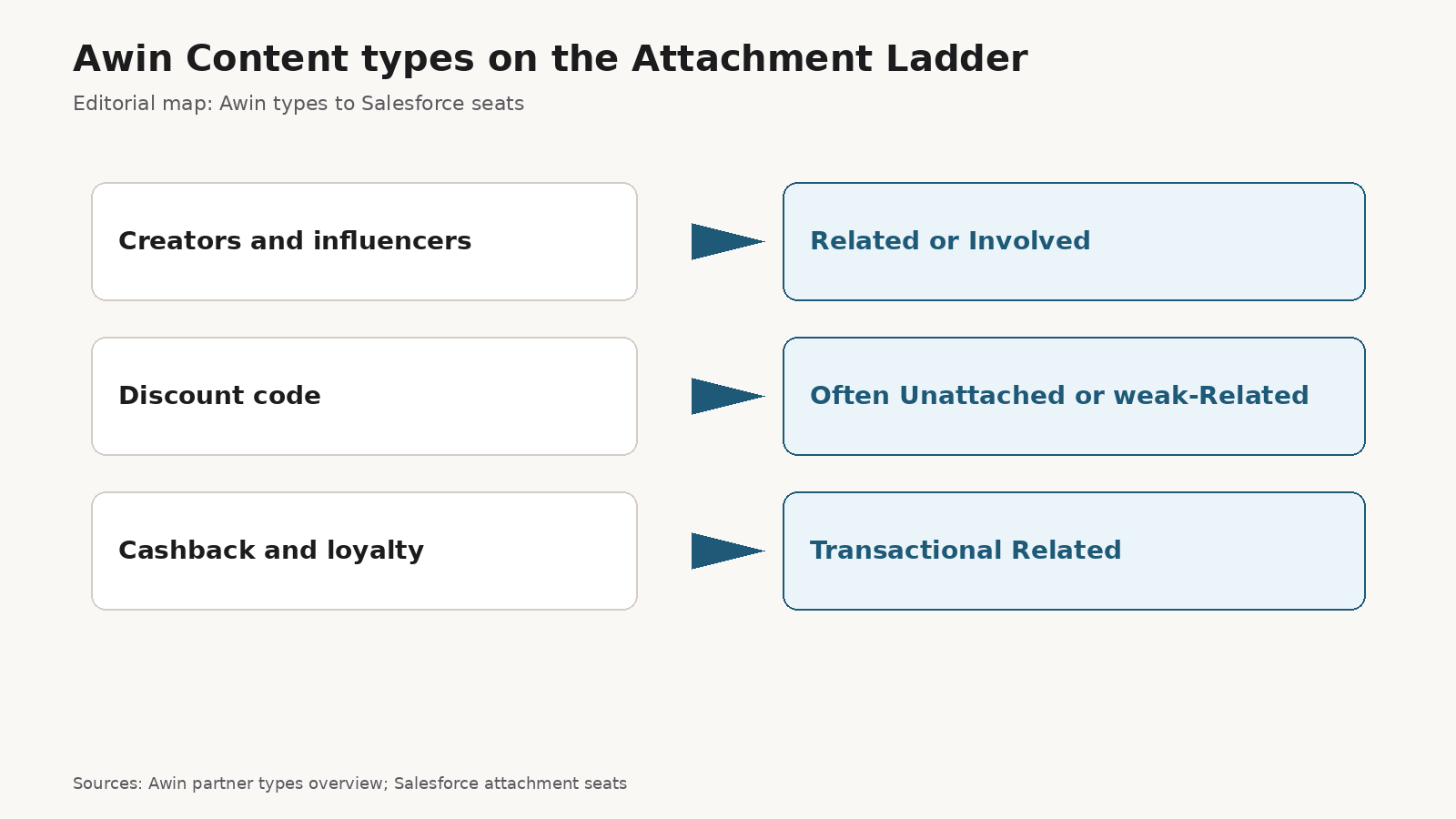
Source: Awin Partner types overview (Content group) mapped editorially to Salesforce attachment seats. https://help.awin.com/docs/partner-types-overview · https://www.salesforce.com/marketing/affiliate-marketing/
Post Affiliate Pro stresses that Facebook-style platforms often block raw affiliate links, so unattached operators add funnels and email (Post Affiliate Pro). That stack is a media business. It is not “building a creator brand.”
If you want creators to sell merchant-listed products through co-branded storefronts with a revenue split, you are recruiting related or involved seats, not unattached PPC hops. feat. is built for that storefront job. Impact, Awin, and similar networks remain the better fit when you need coupon, cashback, and search partner types at network scale. Published Impact Starter pricing remains a software floor conversation elsewhere; do not invent a feat. fee to win the comparison. Pick the seat first, then the rail.
Q: What is unattached affiliate marketing? A: It is promoting a product with no niche expertise, personal use, or trusted audience relationship, usually through paid ads to a tracked offer. Salesforce lists it beside related and involved affiliate marketing as one of three major types.
Q: Is unattached affiliate marketing the same as coupon affiliate marketing? A: No. Coupon and discount-code partners are a promotional type that often behave like unattached or weakly related seats, but cashback, loyalty, and cold PPC are also common unattached patterns. Judge attachment and type separately.
Q: Unattached vs involved affiliate marketing: which should merchants prefer? A: Prefer the seat that matches the job. Involved creators fit trust and education. Unattached media buyers fit scalable paid traffic when compliance and margin allow. There is no public dataset that crowns one universal winner by conversion rate.
Q: Do unattached affiliates still need FTC disclosure? A: If there is a material connection such as commission, disclosure rules still apply. Clear, conspicuous disclosure belongs on the same surface as the endorsement or promotional claim. See the FTC Endorsement Guides framework and your program terms.
Q: Can you do unattached affiliate marketing without an audience? A: Yes. The seat is defined by buying traffic without relying on an owned audience. That is also why cash risk and learning-curve risk sit with the publisher, not with follower count.
Unattached affiliate marketing is the zero-attachment rung on the Attachment Ladder: paid traffic without niche trust. Related and involved seats add audience fit and personal proof. Map network partner types onto those rungs, price and police them differently, and stop blaming “affiliates” when you hired the wrong attachment. If you want creators selling through co-branded storefronts instead of cold ad hops, start on the feat. marketplace.
GoAffPro pricing: Hobby Free, Premium $49, Business from $99. No sales %, vs UpPromote.
Refersion pricing: Launch $39+3%, Growth $199+2%. Affiliate-sales fees, crossover math, vs UpPromote.
UpPromote pricing: Free, Growth $29.99+2%, Pro $89.99+1.5%. Performance fees, crossover math, vs ReferralCandy.