GoAffPro Pricing Explained
GoAffPro pricing: Hobby Free, Premium $49, Business from $99. No sales %, vs UpPromote.
A typical affiliate commission is surface-specific: Shopify 5-15% physical, 20-50% digital; SaaS samples near 20-30%. No universal average.

TL;DR: A typical affiliate commission is not one percentage. Name the surface first. Shopify planning envelopes put physical goods near 5%-15%, digital near 20%-50%, and subscriptions near 15%-30% recurring. SaaS labeled samples sit near 20%-30% (Rewardful average 24.16%). There is no public dataset for one universal typical rate across every network and SKU.
Someone asks what is a typical affiliate commission and expects a single number. That number does not exist. A Shopify physical SKU, a SaaS subscription, an Amazon ASIN, and a TikTok Shop collab do not share one “typical” percentage.
This page owns what is a typical affiliate commission as a mirage check. Model types live in affiliate commission structures. SaaS depth lives in SaaS affiliate commission rates. Amazon’s table lives in Amazon Associates commission rates by category. Negotiation tactics live in how to negotiate affiliate commission rates.
A typical affiliate commission is the rate operators expect for a named product surface and payout model, usually expressed as a percentage of sale (CPS) or a flat bounty, not a single global constant.
When people say “typical,” they usually mean CPS: pay when a tracked sale clears. That is only one structure. CPA, CPL, revenue share, and hybrids answer different risk questions (affiliate commission structures). Mixing those models into one percentage is how board decks invent false precision.
Amazon Associates pays by category table. TikTok Shop lets sellers set 1%-80%. SaaS partner clouds publish samples near 20%-30%. Those are different machines. Calling any one of them “the typical affiliate commission” erases the surface.
Typical affiliate commission questions matter because the wrong envelope wrecks margin or recruitment before the first payout clears.
| Surface | What “typical” usually means | Primary labeled source |
|---|---|---|
| Physical ecommerce | About 5%-15% CPS | Shopify planning envelope |
| Digital products / courses | About 20%-50% CPS | Shopify planning envelope |
| SaaS subscriptions | About 20%-30% (often recurring) | Rewardful / LinkJolt / PartnerStack samples |
| Amazon Associates | Category Table 1 (10% to 0%) | Amazon rate card |
| TikTok Shop | Seller-set 1%-80% | TikTok seller docs |
Sources: Shopify; Rewardful; LinkJolt; PartnerStack; Amazon; TikTok. Links in citation log.
A typical affiliate commission works as a Typical Commission Mirage Ladder. You refuse the single-number answer, name the surface, quote a labeled envelope or sample, then check activation before you raise the rate.
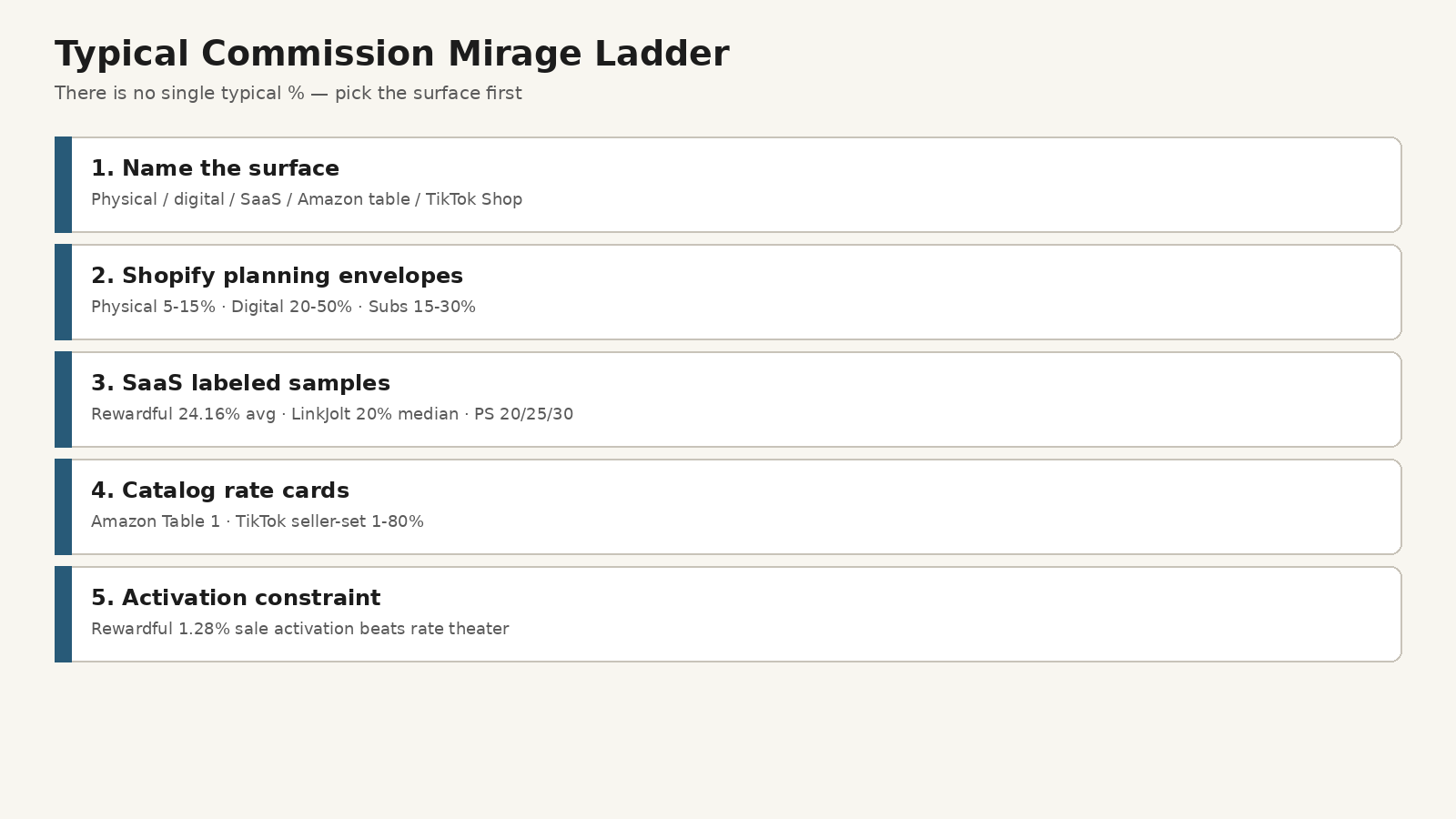
Source: Editorial ladder from Shopify, Rewardful, LinkJolt, PartnerStack, Amazon, and TikTok primary sources. https://www.shopify.com/blog/affiliate-commission
Shopify’s guide is the clean public envelope set for merchants who do not yet have a cohort sample. Physical goods sit near 5%-15%. Digital products and online courses sit near 20%-50%. Subscriptions sit near 15%-30% recurring. Shopify also notes well-known publishers often near 10%-15%, with some brands stretching to 20% for visibility, and some subscription brands paying 75%-100% of the first month instead of a thin lifetime share (Shopify).
Those are envelopes, not medians from a named n. Midpoint bars below illustrate the ranges only. Do not quote the midpoint as “the typical rate.”
| Category (Shopify) | Published planning range | Midpoint (illustration only) |
|---|---|---|
| Physical goods | 5%-15% | 10% |
| Digital products / courses | 20%-50% | 35% |
| Subscriptions (recurring) | 15%-30% | 22.5% |
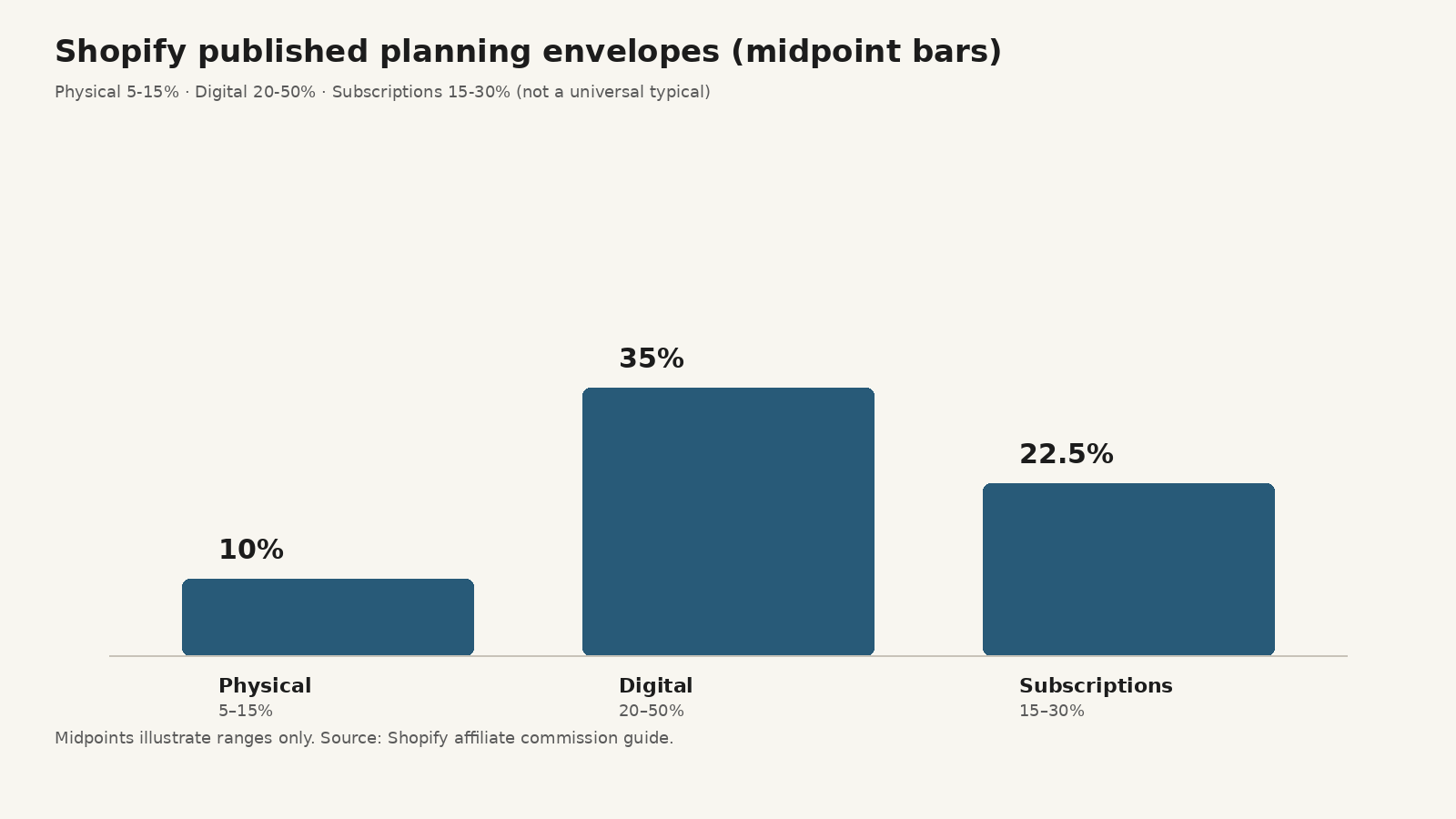
Source: Shopify affiliate commission guide. Midpoints illustrate ranges only. https://www.shopify.com/blog/affiliate-commission
Holds of 30-60 days before payout are common in the same Shopify framing to absorb returns. A “typical” rate that ignores hold and refund risk is incomplete (Shopify).
SaaS deserves labeled samples, not a Shopify envelope alone. Rewardful’s State of SaaS Affiliate Programs analyzes 2,847 programs and reports an average selected rate of 24.16%, with most programs between 20% and 30% (Rewardful). LinkJolt’s September 2, 2026 snapshot of 121 live campaigns reports a 20% median and 22.9% average among percentage offers (LinkJolt). PartnerStack’s top 25 vendors (2023) show best-performing offers at 20%, 25%, and 30%, averaging about 23.5% (PartnerStack).
| Sample | n / cut | Headline rate | Read |
|---|---|---|---|
| Rewardful State of SaaS | 2,847 programs | Average 24.16%; band 20%-30% | Stripe-oriented SaaS tooling cohort |
| LinkJolt Sep 2026 | 121 campaigns | Median 20%; average 22.9% | Early-stage skew; one platform |
| PartnerStack top vendors 2023 | Top 25 vendors | Ladder 20/25/30; avg ~23.5% | Top-performer cut, not all vendors |
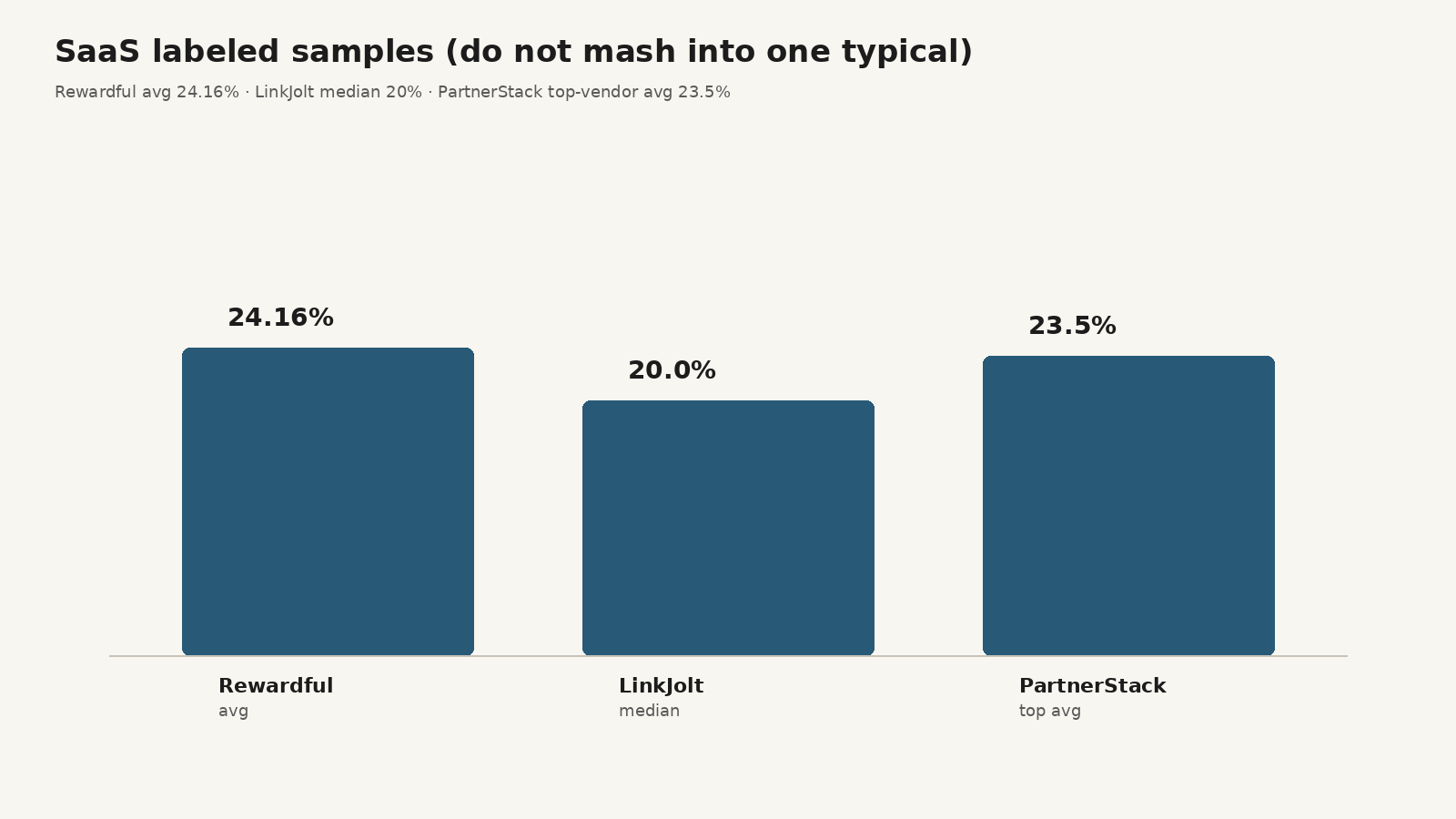
Sources: Rewardful; LinkJolt; PartnerStack Research Lab. Do not average these into a fake universal typical. https://www.rewardful.com/articles/state-of-saas-affiliate-programs-report
Rewardful also reports average payout per commission around $14.10 in that sample. A high percentage on a cheap monthly plan can still lose to a mid percentage on a sticky annual plan (Rewardful). For full SaaS depth, use the SaaS affiliate commission rates spoke.
Amazon Associates is a category table, not a vibes average. Luxury beauty and Amazon Explore sit at the high end (10% in the US Table 1 framing used on our Amazon rates spoke). Grocery and health sit near 1%. Gift cards and other excluded lines sit at 0%. All Other Categories sit at 4% (Amazon Associates commission rates by category).
TikTok Shop is seller-priced inside 1%-80%. Open and Target collabs can differ. Refunds shrink the commission base. There is no public dataset here for a universal TikTok category-average commission (TikTok Shop affiliate marketing explained).
If your “typical” answer ignores those cards, you are answering a different question. The honest sentence for a founder is shorter than a fake average: “Typical depends on the surface; here is the envelope we will operate inside this quarter.” That sentence survives diligence. A scraped “industry average of 22%” without a primary n does not.
Rate without activation is theater. Rewardful’s SaaS sample puts sale activation at 1.28% and referral activation at 7.6% (Rewardful). Raising commission from 20% to 25% on a roster that never sells does not create a typical outcome. It creates a more expensive inactive program. Pair this page with why is our affiliate program flat even though we keep adding creators when the dashboard is busy and the contribution is not.
Q: What is a typical affiliate commission? A: There is no single typical percentage. Shopify planning envelopes put physical goods near 5%-15%, digital near 20%-50%, and subscriptions near 15%-30% recurring. SaaS labeled samples cluster near 20%-30%. Always name the surface before you quote a number.
Q: What is the average affiliate commission rate for SaaS? A: Use labeled samples: Rewardful average 24.16% (n=2,847), LinkJolt median 20% (n=121), PartnerStack top-vendor offers near 20%-30%. There is no public dataset for one official universal SaaS median across every network.
Q: Is 10% a typical affiliate commission? A: 10% sits inside Shopify’s physical 5%-15% envelope and near common publisher bands Shopify cites around 10%-15%. It is low for many digital and SaaS offers that recruit in the 20%-30% neighborhood.
Q: Do Amazon and TikTok share a typical rate with Shopify brands? A: No. Amazon pays by category Table 1. TikTok Shop lets sellers set 1%-80%. Neither should be averaged into a Shopify physical or SaaS “typical.”
Q: Should I raise commission to the “typical” rate if affiliates are inactive? A: Not first. Rewardful’s SaaS sample shows only 1.28% of affiliates generate a sale. Fix activation, creative, and attribution before treating another percentage point as the fix.
A typical affiliate commission is a mirage until you name the surface. Use Shopify envelopes for ecommerce planning, SaaS labeled samples near 20%-30%, and catalog cards for Amazon and TikTok. Refuse one universal average. When approved sellers need a co-branded page and an automatic split, list the offer on feat..
GoAffPro pricing: Hobby Free, Premium $49, Business from $99. No sales %, vs UpPromote.
Refersion pricing: Launch $39+3%, Growth $199+2%. Affiliate-sales fees, crossover math, vs UpPromote.
UpPromote pricing: Free, Growth $29.99+2%, Pro $89.99+1.5%. Performance fees, crossover math, vs ReferralCandy.