GoAffPro Pricing Explained
GoAffPro pricing: Hobby Free, Premium $49, Business from $99. No sales %, vs UpPromote.
Affiliate marketing compliance checklist: 7 rungs from rules and FTC duties through screening, monitoring, validation, and enforcement. Not legal advice.

TL;DR: An affiliate marketing compliance checklist is a seven-rung ops ladder: write program rules, encode FTC disclosure and the §255.1(d) guide/monitor/remedy triad, train and attest, screen applicants, monitor sales and SERP/page surfaces, validate transactions on a recurring schedule, then escalate with named consequences. A footer is not a program. This is compliance education, not legal advice.
Most “compliance” folders are a disclosure paragraph pasted into a Notion doc. Then a coupon site bids on your brand, a TikTok never toggles Paid Partnership, and you discover the problem in a chargeback review.
If you searched for an affiliate marketing compliance checklist, you need a runbook that stitches legal duties to weekly ops. Pair this hub with affiliate marketing disclosure rules for placement language, affiliate program terms of service for the contract stack, and affiliate rules monitoring for SEM cameras.
An affiliate marketing compliance checklist is a sequenced operational list that turns affiliate program rules, FTC endorsement duties, screening, monitoring, transaction validation, and enforcement into repeatable jobs a merchant can assign and audit.
Shopify frames affiliate marketing compliance as legal, regulatory, privacy, fraud-prevention, and brand-guideline controls for the merchant-affiliate relationship (Shopify). That is broader than disclosure rules alone. Disclosure is one rung. The checklist is the ladder.
This page is not a second copy of affiliate program terms of service or affiliate rules monitoring. Those spokes deepen the contract and the SEM cameras. Here the job is one printable sequence a founder or affiliate manager can run without pretending a footer is due diligence. Not legal advice. Regulated verticals need counsel and sector annexes.
It matters because scale without cameras is how other people’s shortcuts become your brand story.
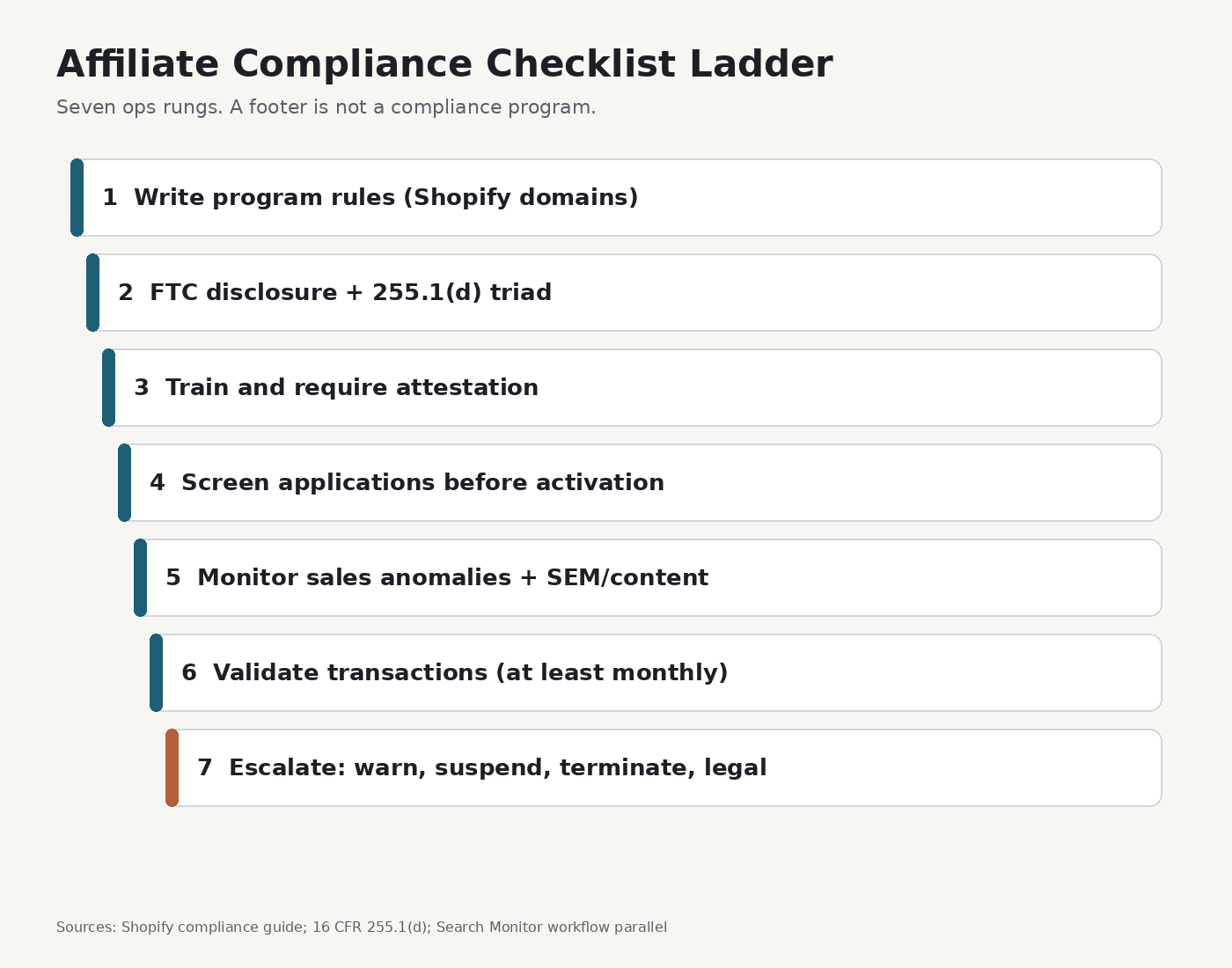
Source: Editorial Affiliate Compliance Checklist Ladder. Rule domains, violations, and escalation from Shopify (Jul 18, 2026); FTC triad from 16 CFR §255.1(d); workflow parallel from The Search Monitor. Accessed 2026-10-22.
An affiliate marketing compliance checklist works as seven rungs you can assign to a person and a calendar. Open with the payable promise of the program, then put cameras on every surface where partners can break trust.
Shopify says every business using affiliate marketing should create in-depth brand guidelines covering disclosure language and placement, banned advertising practices, self-referral and self-purchase limits, link and cookie rules, customer-data handling, and content standards for social, reviews, and video (Shopify).
| Rule domain (Shopify) | What to specify |
|---|---|
| Disclosure | Approved language, placement by surface, platform labels |
| Banned practices | Misleading claims, brand impersonation, malware |
| Self-dealing | Self-referrals and affiliate-made purchases |
| Tracking | Allowed link formats, cookie/attribution behavior |
| Data and privacy | What partners may collect or store |
| Content standards | Social, reviews, video, email quality bars |
Source: Shopify affiliate marketing compliance guide (Jul 18, 2026). Accessed 2026-10-22.
Also define claims, coupon, paid-search, and brand-asset rules in the same packet. Large brands often keep brand bidding in-house so affiliates do not compete with paid search (Shopify). Put that in writing or you will argue it later. For the full clause stack, use affiliate program terms of service.
Material connections, including commissions through tracked links, must be disclosed when they would affect how a significant minority weighs the endorsement and the audience would not reasonably expect the connection (§ 255.5; FTC FAQ). Clear and conspicuous means hard to miss on the same surface as the endorsement. Depth lives on the disclosure rules spoke.
On this checklist, copy the advertiser duties into ops language:
Channel extras still apply: CAN-SPAM for U.S. email; TikTok Paid Partnership toggles alongside spoken disclosure (Shopify).
A guidebook alone is a starting point. Shopify recommends hands-on training for new partners, refreshers when policies change, and at minimum an attestation that the affiliate read the compliance guide (Shopify). Train disclosure placement by format, restricted channels, privacy expectations for publisher sites, and the correction process with urgency tiers.
The Search Monitor’s workflow puts compliance training after onboarding and before sensitive pre-approvals (The Search Monitor). Treat attestation as a gate before the first live link.
IAB Australia’s 2025 affiliate program compliance guide tells advertisers to screen applications thoroughly: confirm sites load, content relevance, accurate categorization, traffic and audience signals, and that declared promotional methods match program terms (IAB Australia).
Reject or hold applicants who will not name traffic sources, who only promise “brand bidding SEO,” or who refuse a test disclosure. Activation without screening is how cookie stuffers and lookalike domains enter with a smile.
Policies without cameras fail. Shopify quotes Impact.com cofounder Todd Crawford on reviewing anomalous behavior: higher return rates, conversion rates that are oddly low or high, and partner materials sampled more often for newer affiliates (Shopify).
| Violation pattern (Shopify) | What it looks like | Checklist camera |
|---|---|---|
| Cookie stuffing | Tracking cookie set without a real referral role | Redirect/ hop review; sudden attribution spikes |
| Undisclosed endorsements | Paid or gifted push without clear disclosure | Surface sampling; disclosure pass/fail |
| Paid search abuse | Affiliate ads competing on brand terms | SEM monitoring (rules monitoring) |
| Unauthorized coupons | Private or fake codes on aggregators | Code inventory vs public pages |
| Fake traffic | Bots or pay-for-click inflation | Traffic quality + CVR sanity checks |
| Brand impersonation | Lookalike domains | Domain and redirect audits |
Source: Shopify (Jul 18, 2026). Cookie-stuffing severity example in the same guide: the 2013 San Jose case where Brian Andrew Dunning pleaded guilty to defrauding eBay for about $5.2 million in commissions via cookie stuffing through free web apps. Accessed 2026-10-22.
SEM and page compliance are their own stack. Use affiliate rules monitoring when the job is brand-term ads and landing-page claims. Use affiliate fraud and how to detect it when the job is tactic taxonomy. Do not buy one tool and expect all three jobs.
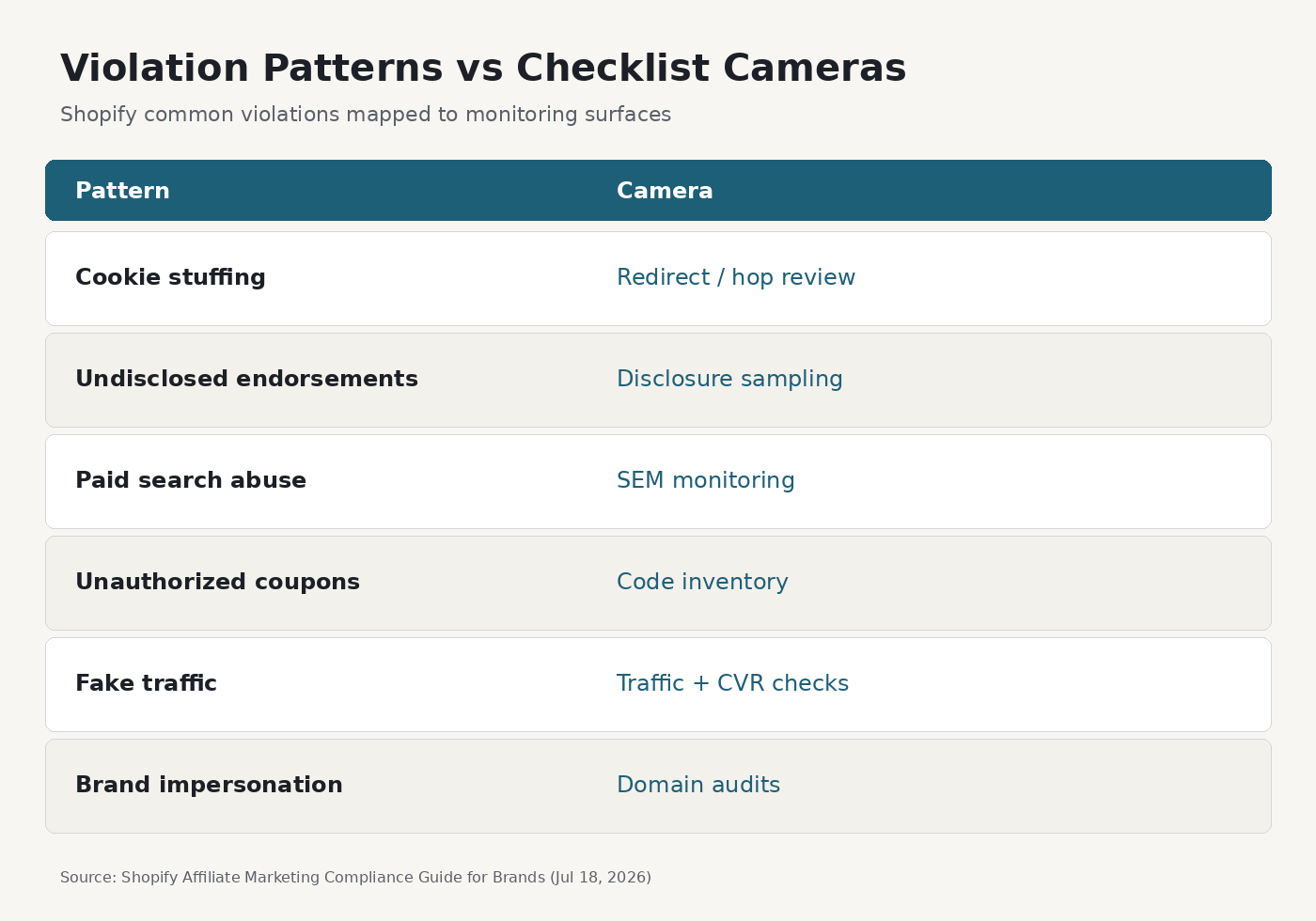
Source: Shopify Affiliate Marketing Compliance Guide for Brands (Jul 18, 2026). https://www.shopify.com/blog/affiliate-marketing-compliance Accessed 2026-10-22.
IAB Australia recommends validating all transactions against your own order database on a recurring schedule, at least monthly, so fraudulent or invalid transactions are caught (IAB Australia). High void rates, odd geos, and order values that do not match your catalog deserve a ticket, not a shrug.
Network dashboards are helpful. Your order system is the source of truth. If a commission cannot be matched to a real order under your rules, it does not clear.
Shopify’s simple escalation road map:
Todd’s line is the operator standard: consequences should be even and methodical (Shopify). The Search Monitor adds archiving of violations, communications, and enforcement actions so you can show a paper trail (The Search Monitor).
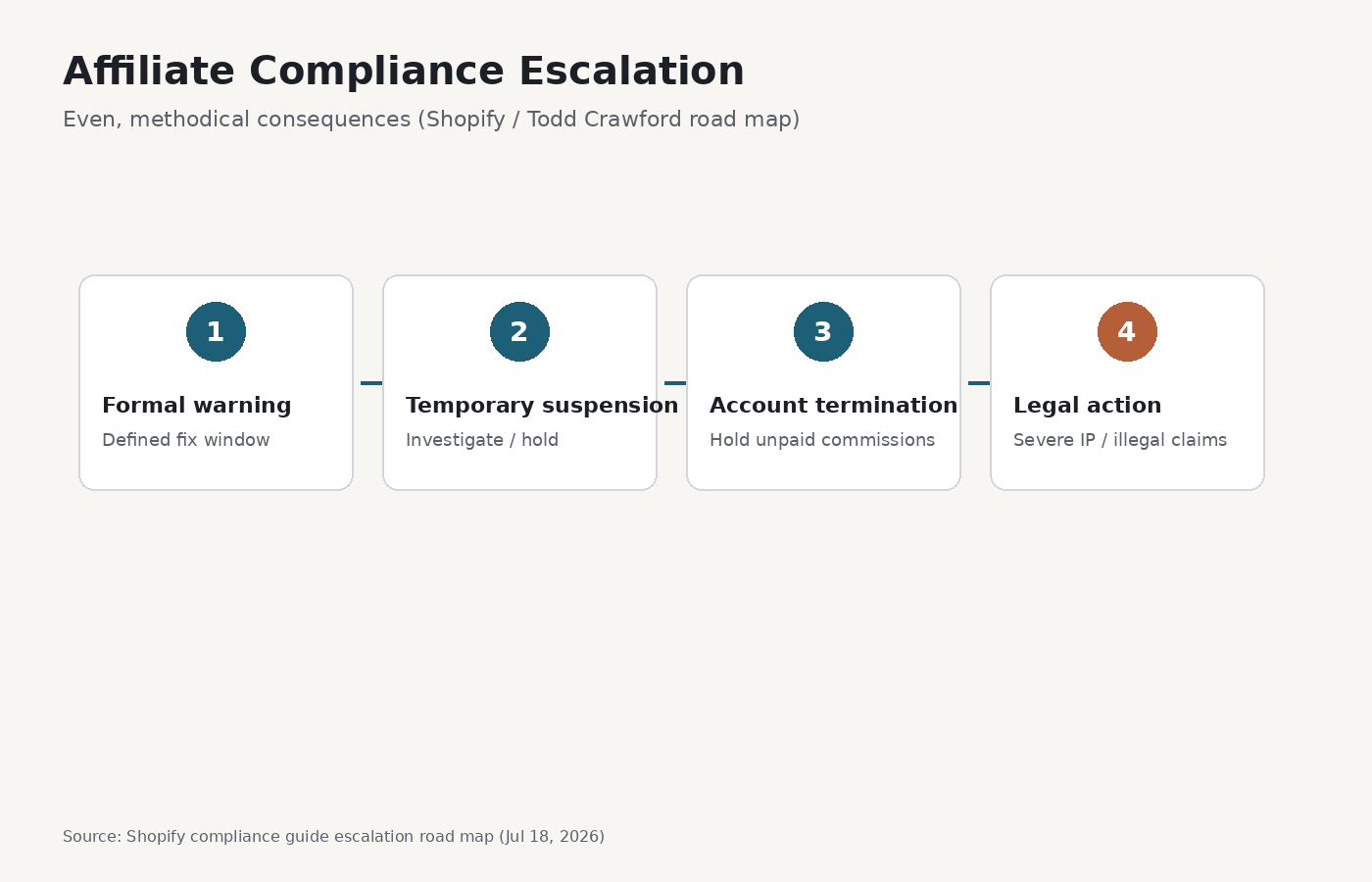
Source: Shopify Affiliate Marketing Compliance Guide for Brands (Jul 18, 2026), escalation road map attributed to Todd Crawford guidance in that article. https://www.shopify.com/blog/affiliate-marketing-compliance Accessed 2026-10-22.
Q: What belongs on an affiliate marketing compliance checklist? A: Program rules, FTC disclosure duties and the advertiser triad, training and attestation, application screening, ongoing sales and surface monitoring, recurring transaction validation, and a published enforcement ladder. Disclosure text alone is not the checklist.
Q: Is affiliate marketing compliance the same as FTC disclosure? A: No. Disclosure is required when commissions or other material connections would affect how people weigh an endorsement. Compliance also covers program terms, fraud patterns, paid-search and coupon rules, privacy, monitoring, and enforcement.
Q: How often should brands monitor affiliates? A: Shopify’s cited operator guidance points to regular anomaly review (for example about an hour or two weekly once alerts exist) and more frequent sampling for newer partners. IAB Australia also calls for transaction validation at least monthly against your order database.
Q: What are the most common affiliate compliance violations? A: Shopify highlights cookie stuffing, undisclosed endorsements, paid-search abuse, unauthorized coupon distribution, fake traffic, and brand impersonation. Severity examples include large cookie-stuffing fraud cases such as the about $5.2 million eBay-related matter described in that guide.
Q: What should happen when an affiliate breaks the rules? A: Follow a written ladder: formal warning with a fix window, then suspension, then termination with commission holds as terms allow, and legal action for severe cases. Improvised one-off favors teach partners that rules are optional.
An affiliate marketing compliance checklist is how you stop confusing a disclosure footer with a program. Write the rules, encode FTC duties, train, screen, monitor, validate, and enforce. Quote labeled sources. Refuse fake compliance percentages. When distribution itself should run through co-branded creator storefronts with a clear revenue split on every sale, start at feat..
GoAffPro pricing: Hobby Free, Premium $49, Business from $99. No sales %, vs UpPromote.
Refersion pricing: Launch $39+3%, Growth $199+2%. Affiliate-sales fees, crossover math, vs UpPromote.
UpPromote pricing: Free, Growth $29.99+2%, Pro $89.99+1.5%. Performance fees, crossover math, vs ReferralCandy.