GoAffPro Pricing Explained
GoAffPro pricing: Hobby Free, Premium $49, Business from $99. No sales %, vs UpPromote.
Affiliate rules monitoring turns TOS into crawl + evidence + enforce. BrandVerity ~$799/mo, Search Monitor from $800/mo + crawl fees.

TL;DR: Affiliate rules monitoring is the merchant job of turning program TOS into crawl frequency, screenshots, and enforcement. Public sticker floors sit near $799–$800/month (BrandVerity via third-party listing; The Search Monitor from $800/mo plus keyword crawl fees). Rules you cannot monitor are theater. There is no public “% of programs violated” census.
Most affiliate programs publish a beautiful prohibited-promotions list and then hope. Hope is not an ops system. Affiliate rules monitoring is the boring, expensive, necessary layer that proves whether partners obey brand bidding, trademark-plus (TM+), coupon, creative, and landing-page rules—and gives you evidence when they do not.
If you already read affiliate program terms of service, affiliate brand bidding on brand terms, or affiliate fraud and how to detect it, this page is the missing middle: not the clause list and not the fraud catalog, but the monitoring stack that makes either useful.
Key takeaways:
Affiliate rules monitoring is the continuous process of checking whether publishers’ paid-search ads, creatives, and landing pages match the promotional rules in your affiliate agreement—and logging evidence when they do not.
It is not a one-time TOS review. It is not “we spot-check Instagram once a quarter.” It is a defined keyword set, crawl frequency, geo and device coverage, pass/fail rules on ad copy and landing pages, alert routing, and an enforcement path that can void commissions or terminate a partner.
Operators on r/PPC already name the category by vendor: BrandVerity for brand-term alerts, The Search Monitor when budget allows daily keyword share and ad-copy intelligence (r/PPC brand terms; r/PPC competitor tools). That language is the market. Your job is to map those tools to the rule surfaces you actually wrote.
Programs that skip monitoring train partners to test the fence. The first bid on your brand term that goes unanswered becomes the case study for the next partner.
| Audience | What monitoring answers | What it does not answer |
|---|---|---|
| Affiliate manager | Are partners obeying SEM and page rules this week? | Industry-wide violation share (no public dataset) |
| Paid-search lead | Who is bidding my brand / TM+ terms? | Whether every bid is incremental sales |
| Legal / brand | Do we have screenshots and crawl logs for enforcement? | A substitute for FTC disclosure training |
| CFO | What does the monitoring layer cost at 100–200 keywords? | Exact ROI without your own before/after CPC |
Affiliate rules monitoring works by encoding your program policy as crawl targets—keywords, geos, devices, landing URLs—then comparing live ads and pages against pass/fail rules and routing evidence into enforcement. The tool is a camera. The stack is the operating system.
Name the layer before you buy a logo.
| Layer | Job | Typical owner | Buy or build |
|---|---|---|---|
| 1. Written rules | Allowed / banned SEM, TM+, coupons, creatives, disclosures; consequences | Program + legal | Build (see affiliate program TOS) |
| 2. Network levers | Cap commissions, lock creatives, flag partners, pause payouts | Affiliate platform | Use what you already pay for |
| 3. Third-party crawl | SERP ads + landing pages at frequency; decloak hijack hops | Compliance / SEM | BrandVerity, The Search Monitor, peers |
| 4. Evidence → enforce | Screenshot, redirect chain, email template, void / terminate | Affiliate manager | Process + CRM |
| 5. Paid-search coordination | Negative lists, brand CPC watch, TM+ allow-list | SEM team | Weekly ritual (PMA) |
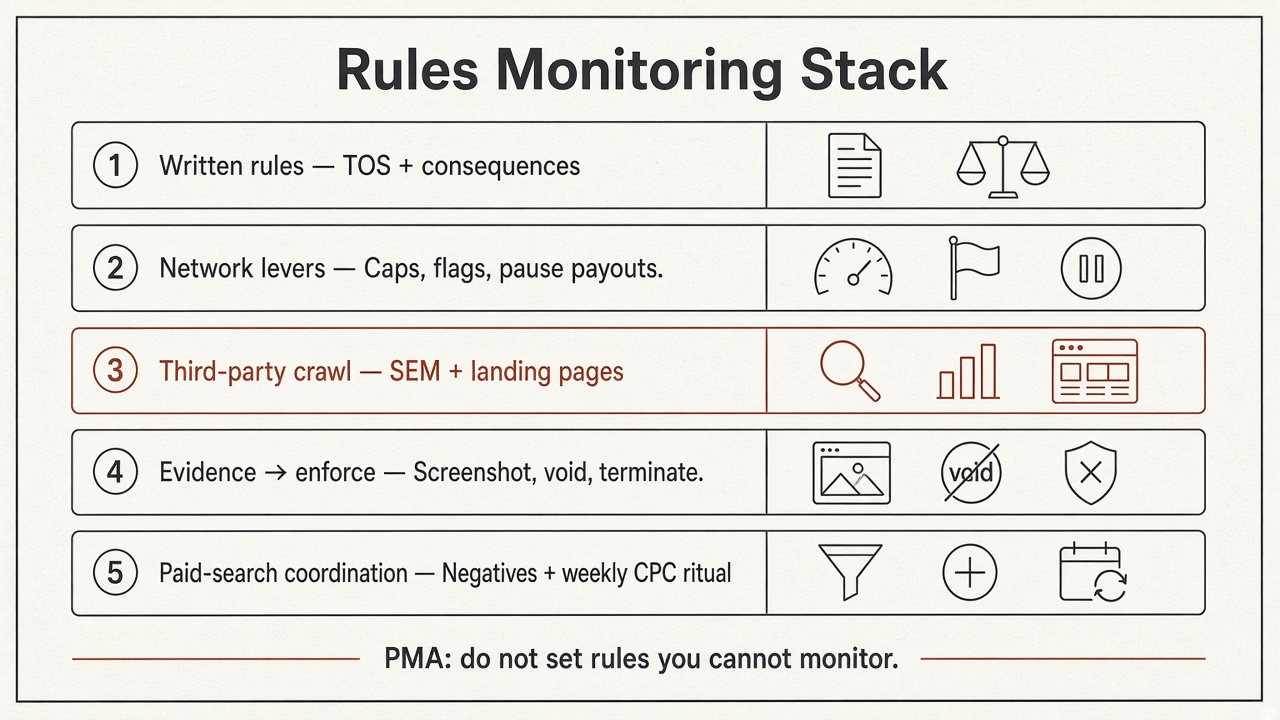
Source: feat. editorial framework synthesizing PMA Trademark+ Bidding (2023) and vendor compliance product surfaces. https://thepma.org/wp-content/uploads/2023/08/PMA-Trademark-plus-bidding_2023.pdf · https://www.thesearchmonitor.com/products/affiliate-compliance/
Layer 3 is where public stickers appear. Layer 1 without Layer 3 is a PDF. Layer 3 without Layer 4 is a dashboard hobby.
Vendors converge on the same violation classes even when product names differ:
If a partner shows reviewers a clean page and buyers a different offer, that is a cloak job—route to the de-cloaking checklist. If the SERP ad itself violates your SEM policy, that is rules monitoring. Keep the tickets separate.
Quotable stickers first. Official BrandVerity dollars are not on the pricing page; treat Spotsaas as third-party.
| Vendor / plan signal | Public sticker or tier | Cadence / package | Source honesty |
|---|---|---|---|
| The Search Monitor (Brand Protection / SEM Insights) | Starts @ $800/month + keyword crawling fees | Keyword packages start @ 100 keywords/month | Vendor pricing page |
| The Search Monitor Affiliate Compliance | Packaged with platform; SEM + Content options | SmartCrawler + email enforcement | Vendor product page |
| BrandVerity Professional | Official $: quote-only; Spotsaas entry ~$799/mo | 100 keywords, 6×/day | Official tiers + third-party $ |
| BrandVerity Premium | Official $: quote-only | 200 keywords, 12×/day | Official pricing page |
| BrandVerity Enterprise | Official $: quote-only | Thousands of keywords, up to 288×/day | Official pricing page |
| Europcar (vendor case) | — | Brand Protection + geo | 64% brand CPC decrease (single case) |
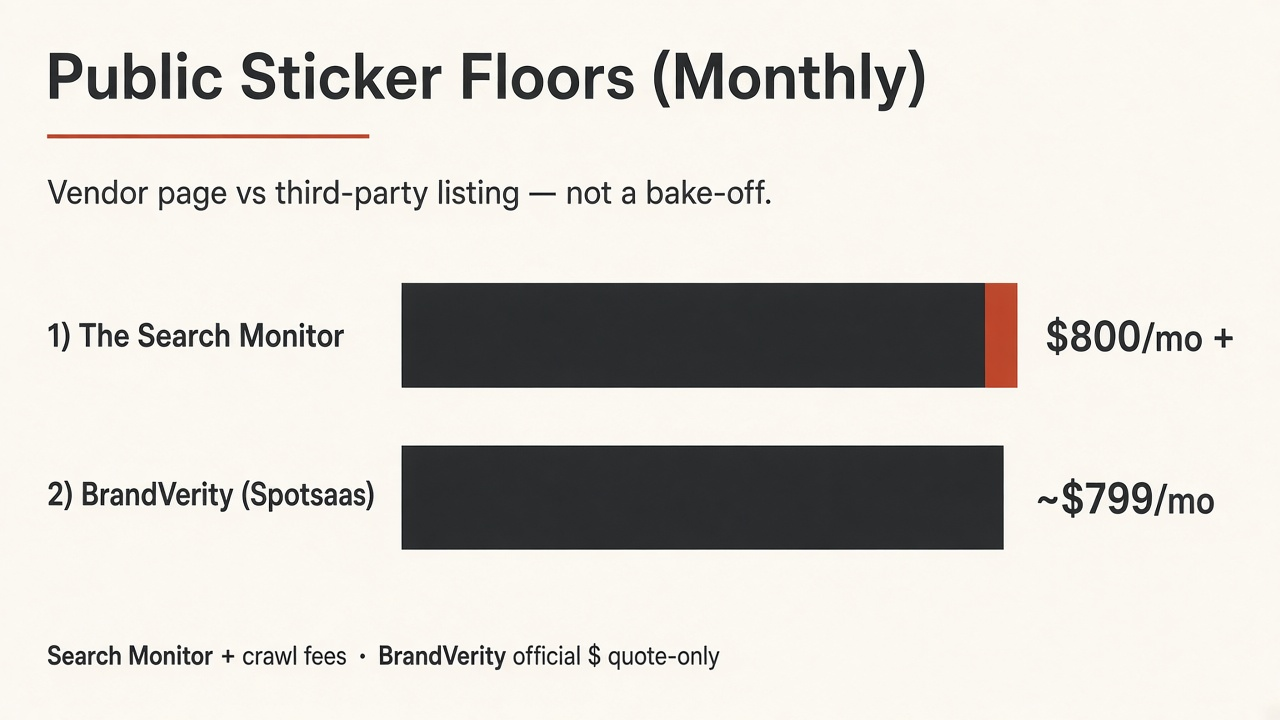
Source: The Search Monitor Pricing (2026); Spotsaas BrandVerity vs Red Marker entry listing (accessed 2026-10-11). https://www.thesearchmonitor.com/pricing/ · https://www.spotsaas.com/compare/brandverity-vs-red-marker
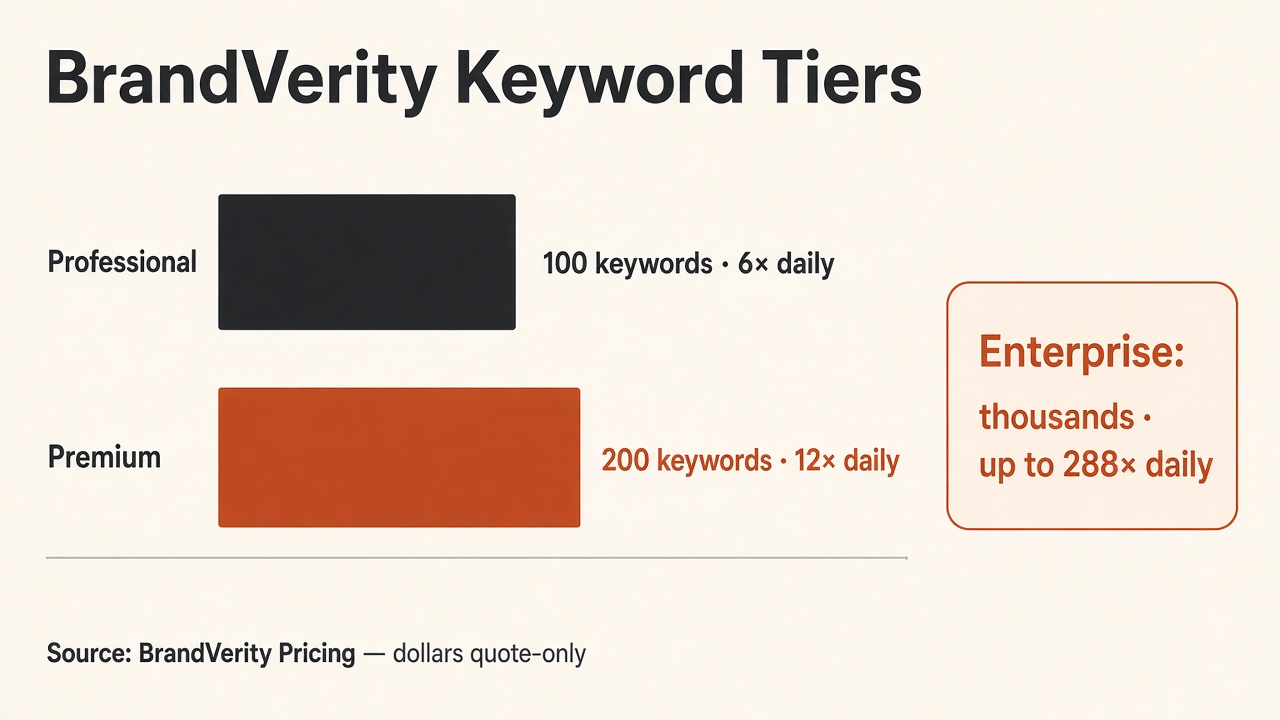
Source: BrandVerity Pricing page (accessed 2026-10-11). https://www.brandverity.com/pricing/
Expect quotes above the floor once you add geos, languages, shopping ads, and higher crawl frequency. The Search Monitor’s “30–50% of ad cost” Brand Protection marketing range is vendor copy, not a multi-brand census—prefer the labeled Europcar 64% case when you need a number (The Search Monitor).
Both sit in Layer 3. Pick by workflow, not Reddit vibes alone.
| Job | Lean BrandVerity | Lean The Search Monitor |
|---|---|---|
| Affiliate accountability + takedown email templates | Strong product positioning (BrandVerity PPC) | Email enforcement on Affiliate Compliance |
| Decloak hijack hops in SEM | Affiliate detection / crawl | SmartCrawler named for hijackers |
| Competitive SEM insights beyond affiliates | Secondary | SEM Insights / Lighthouse packages from $800 |
| Official public $ sticker | No (use Spotsaas ~$799 as third-party only) | Yes ($800 + crawl fees) |
| Keyword cadence transparency | 6× / 12× / up to 288× published | Custom crawl frequency; packages from 100 kw |
Community signal: r/PPC names both for brand-term alerts; one commenter called Search Monitor the best tool “if you can afford it” (r/PPC). That is anecdote, not a bake-off. Run a paid pilot on your brand keyword set before you annualize either contract.
Q: What is affiliate rules monitoring? A: It is the continuous check that publishers’ paid-search ads and landing pages match your affiliate program rules, with crawl logs and screenshots for enforcement. It sits between writing TOS and investigating fraud tactics.
Q: How much does affiliate rules monitoring cost? A: Public floors sit near $799–$800 per month. The Search Monitor starts at $800/month plus keyword crawling fees. BrandVerity’s site is quote-only; Spotsaas lists entry around $799/month. Expect more with geos, shopping, and higher crawl frequency.
Q: What is the difference between BrandVerity and The Search Monitor? A: Both monitor paid-search compliance. BrandVerity publishes keyword counts and daily frequencies (100 at 6×, 200 at 12×) and emphasizes affiliate detection plus takedown workflows. The Search Monitor publishes an $800 floor, Affiliate Compliance with SmartCrawler, and broader SEM Insights packages. Pilot on your keyword set.
Q: Does affiliate rules monitoring replace de-cloaking? A: No. Rules monitoring watches whether ads and pages obey your contract. De-cloaking proves a URL serves different content to reviewers versus buyers. Hijack cloaks can touch both queues—route each ticket by surface.
Q: Is there a public dataset for how often affiliates break SEM rules? A: No. There is no reliable public census of violation rates across programs. Use your own crawl alerts, labeled vendor case studies (such as Europcar’s 64% brand CPC claim), and refuse industry-wide percentages without a named methodology.
Affiliate rules monitoring is how you stop hoping partners read the TOS. Encode the fail states, crawl them on a published cadence, keep evidence, and enforce—then sit next to paid search every week. Public stickers start near $799–$800/month; the expensive mistake is the free PDF with zero cameras. When distribution itself should run through co-branded creator storefronts with clear split economics—not only SEM compliance on classic links—start at feat..
GoAffPro pricing: Hobby Free, Premium $49, Business from $99. No sales %, vs UpPromote.
Refersion pricing: Launch $39+3%, Growth $199+2%. Affiliate-sales fees, crossover math, vs UpPromote.
UpPromote pricing: Free, Growth $29.99+2%, Pro $89.99+1.5%. Performance fees, crossover math, vs ReferralCandy.