Ad Revenue at 20K Followers: Merit Gates Compared
At 20K followers, compare YouTube, TikTok, and Twitch ad-revenue gates versus commission storefronts. Official thresholds only. No invented RPM.
Amazon storefront earnings use Standard Table 1 offsite and lower Onsite Table A rates. Bound $100 sales; Amazon publishes no average.

TL;DR: Amazon storefront earnings are not one number. Traffic you send to
amazon.com/shop/...pays Standard Table 1 rates. Content Amazon hosts from that storefront pays separate, usually lower Onsite Table A rates. Amazon publishes those tables, a 24-hour cart cookie, and payout floors. It does not publish an average storefront income.
Creators ask about amazon storefront earnings as if Amazon publishes a paycheck median. It does not. The public stack is two commission meters, a short attribution clock, and payout floors. Treat Reddit dollar stories as anecdotes, not a census.
no public dataset.Amazon storefront earnings are the commission income tied to an Amazon Influencer Program shop URL and the content on it, measured on Amazon’s offsite and onsite rate cards under the Associates Operating Agreement.
The Influencer Program is an extension of Associates: eligible creators get a personalized storefront with a custom URL, useful when hyperlinking is awkward (About Amazon). Associates alone does not give you that shop page. Program seat detail lives in Amazon Influencers vs Amazon Associates.
Earnings are not “storefront magic.” They are Qualifying Revenue × the rate for the meter that attributed the purchase, after cookie, delivery, and payment rules clear. Full category depth for driven traffic is in Amazon Associates commission rates by category. This page owns the bound stack for the storefront job.
Creators and merchants both misuse the phrase “storefront income.” One side wants a lifestyle number. The other wants to know whether Amazon’s shop URL is a real distribution surface. The honest answer is narrower and more useful.
onamz). Mixing that with your driven-traffic Store ID hides which surface paid (Onsite help).Amazon storefront earnings clear through a bound ladder: name the meter (offsite or onsite), apply that table’s rate to Qualifying Revenue, then pass the 24-hour cart clock and payout floors. Amazon publishes those bounds. It does not publish a median monthly paycheck for storefront creators.
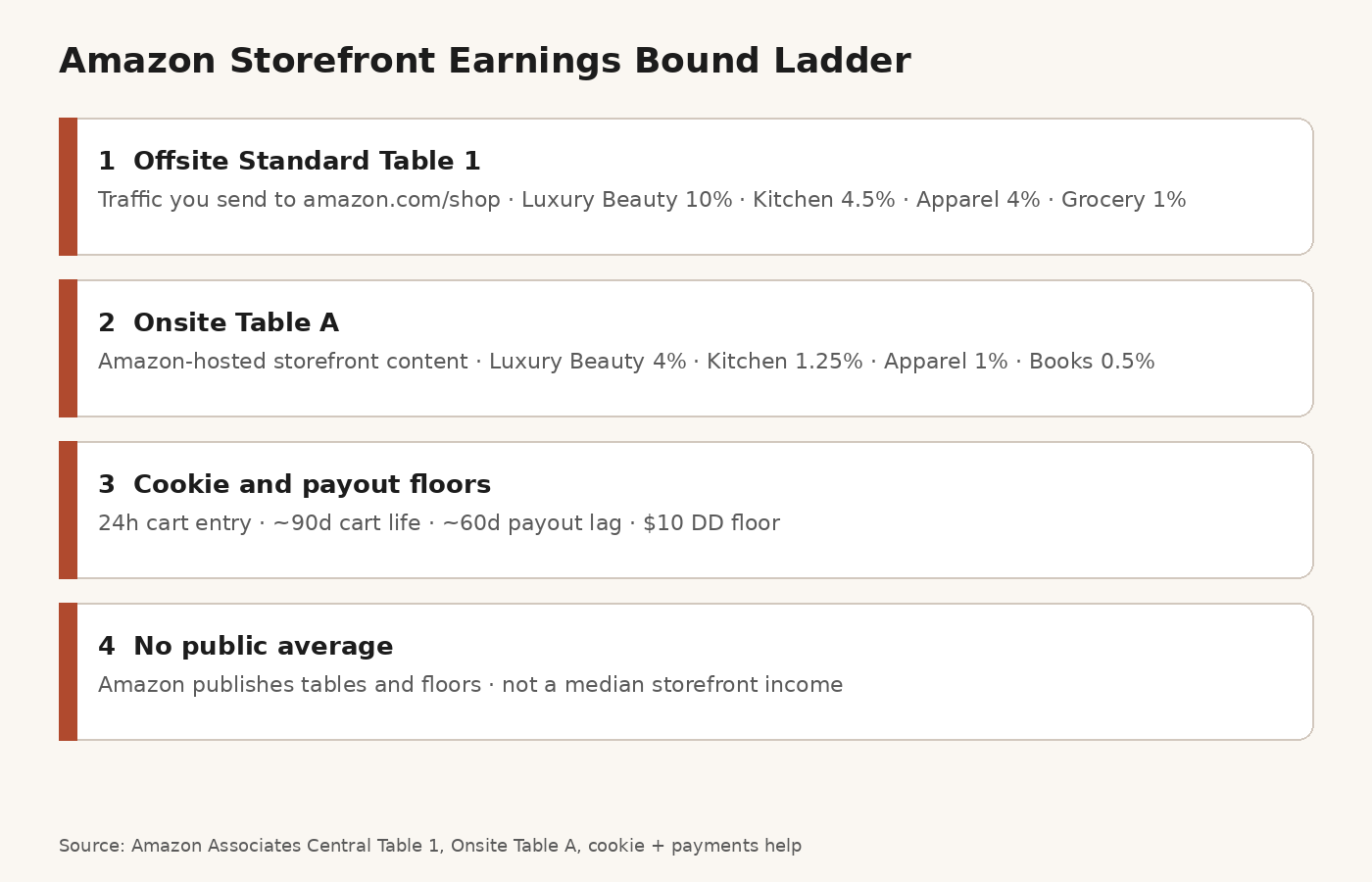
Source: Editorial framework from Amazon Associates Central Onsite Earnings help, Onsite Commission Income Table A, Standard Commission Income Statement Table 1, cookie help, and payments help. https://affiliate-program.amazon.com/help/node/topic/GV7VUCCSS8MQFSQT
no public dataset).Use labeled arithmetic only. These figures assume $100 Qualifying Revenue in one category and ignore bounties, returns, and Creator Ads Table B.
| Category | Offsite Standard (Table 1) | Onsite Table A | Offsite $ on $100 | Onsite $ on $100 |
|---|---|---|---|---|
| Luxury Beauty | 10.00% | 4.00% | $10.00 | $4.00 |
| Kitchen | 4.50% | 1.25% | $4.50 | $1.25 |
| Physical books | 4.50% | 0.50% | $4.50 | $0.50 |
| Apparel | 4.00% | 1.00% | $4.00 | $1.00 |
| Home / furniture / pets | 3.00% | 3.00% | $3.00 | $3.00 |
| Grocery | 1.00% | 0.50% | $1.00 | $0.50 |
| Gift cards (excluded) | 0.00% | 0.00% | $0.00 | $0.00 |
Source: Amazon Table 1; Onsite Table A. Arithmetic is labeled revenue × published rate.
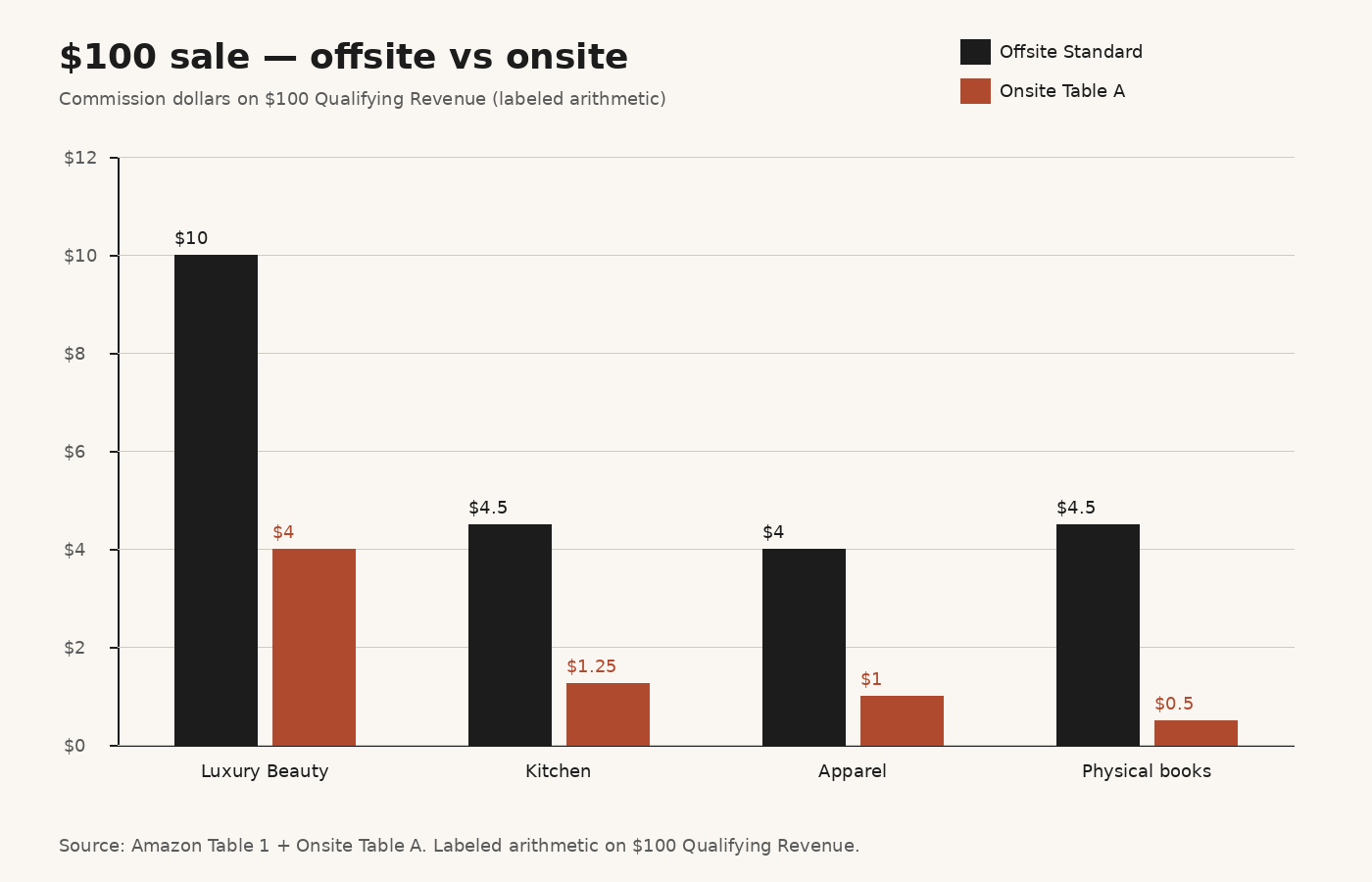
Source: Amazon Associates Central Standard Commission Income Statement Table 1 and Onsite Commission Income Table A. https://affiliate-program.amazon.com/help/node/topic/GRXPHT8U84RAYDXZ ; https://affiliate-program.amazon.com/help/node/topic/G4ARBJC7Z2NK48CA.
Home / furniture / pets is the rare line where Table A matches Table 1 at 3%. Most creator favorites (Kitchen, apparel, books) pay less when Amazon hosts the click than when you drive it.
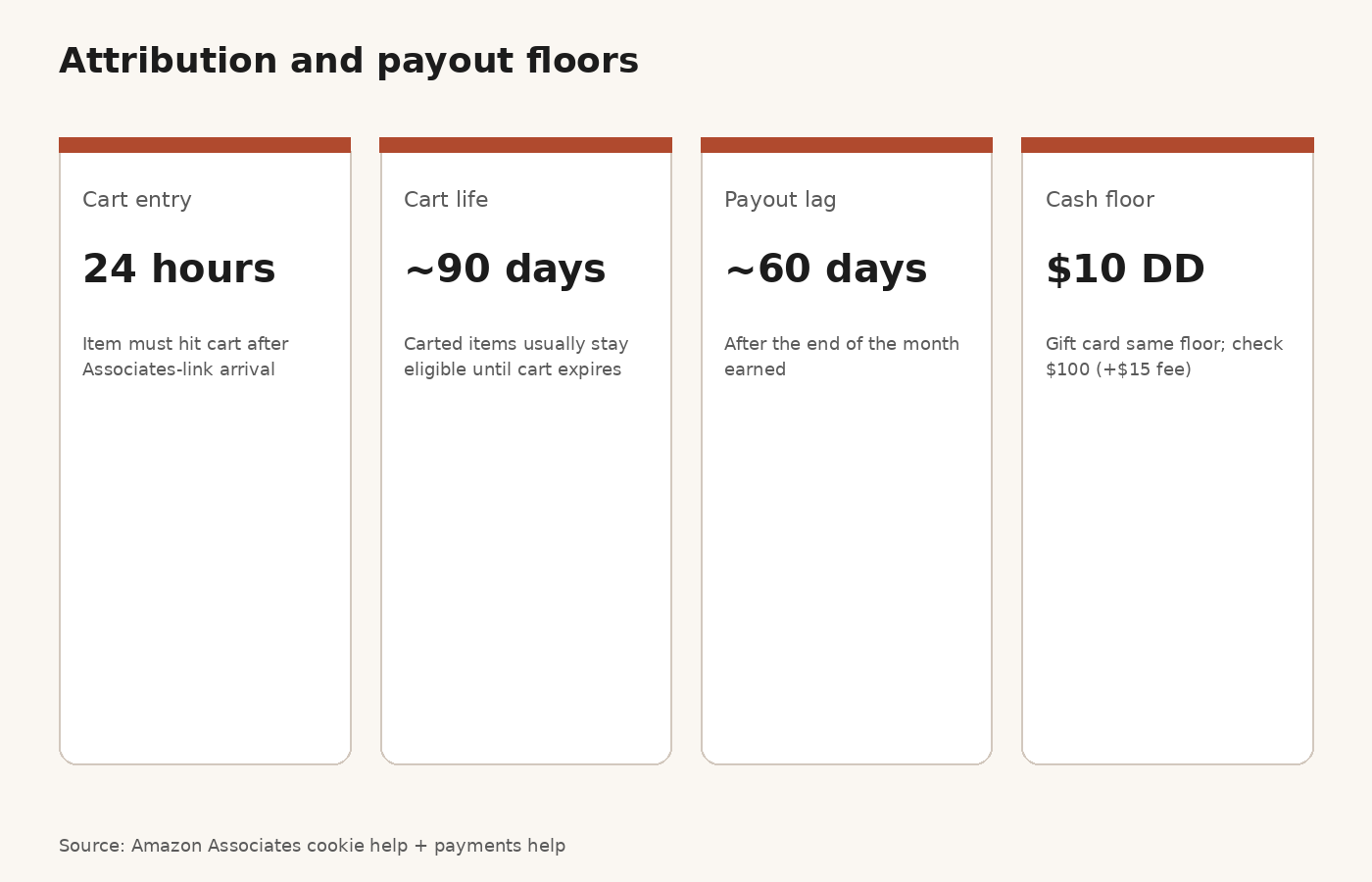
Source: Amazon Associates Central cookie help and payments help. https://affiliate-program.amazon.com/help/node/topic/G9SMD8TQHFJ7728F ; https://affiliate-program.amazon.com/help/node/topic/G63DR893K4DH55XZ.
| Floor | Published rule |
|---|---|
| Cart entry | Qualifying item in Shopping Cart within 24 hours of Associates-link arrival |
| Cart life | Carted items usually remain eligible until cart expires (~90 days) |
| Payout lag | About 60 days after the end of the month earned |
| Cash floors | $10 DD / gift card; $100 check ($15 fee) |
| Join clock (Associates) | Often 3 qualifying sales in 180 days; personal orders out |
Window detail: affiliate cookie duration and attribution windows.
Effective April 14, 2026, Amazon narrowed onsite commission scope to Direct Qualifying Purchases of the same ASIN variant as the linked product detail page (or featured product in qualifying digital video). Paid or boosted ads linking to Amazon sit in an expanded disqualification zone. Re-read the Operating Agreement compare page before you buy reach into Amazon links (OA compare).
High-confidence community language matches Amazon’s product design: the storefront is a destination for traffic you already have, Idea Lists without a traffic source are premature, and offsite focus often beats hoping Amazon surfaces storefront videos. Low-confidence pieces are the dollar ranges. Threads quote $11 months and $5,000 months in the same breath. Those are anecdotes. They do not become a niche average because a blog rounds them.
Amazon’s shop URL monetizes Amazon’s catalog at Amazon’s rates. If you need buyers to purchase a merchant’s product you do not stock, with a co-branded page and an automatic revenue split, that is the feat. marketplace job: browse feat. marketplace. Do not invent feat. fees or earnings here.
onamz onsite IDs are separate scorecards.Q: How much can you make from an Amazon storefront? A: Amazon publishes category rates and attribution rules, not a median storefront income. Bound a sale instead: on $100 Qualifying Revenue, offsite Standard Table 1 pays from $0 (gift cards) to $10 (Luxury Beauty at 10%). Onsite Table A is usually lower on the same category. There is no public average monthly figure.
Q: Do Amazon storefront commission rates differ from Associates rates? A: For traffic you send to Amazon, including your storefront, you use the same Standard Commission Income Table 1 as Associates. Onsite placements use a separate Onsite Table A (and Creator Ads Table B where applicable). The program badge does not create a third offsite table.
Q: Is onsite or offsite better for Amazon Influencer earnings? A: Offsite usually pays a higher percentage on the same category. Onsite can add volume when Amazon surfaces your content to shoppers already browsing. Report them on separate Store IDs. Do not average the two rates into one fake blended commission.
Q: Why is my Amazon storefront not earning? A: Common causes: no external traffic to the shop URL, category mix stuck in 1% or 0% lines, cart entry outside 24 hours, onsite content not selected, missing tax/payment on the Onsite Store ID, or unpaid returns wiping Qualifying Revenue. Amazon does not guarantee organic storefront discovery.
Q: Does Amazon publish average storefront earnings by niche?
A: No. That is a no public dataset gap. Secondary blogs and Reddit threads that state a typical monthly income are not Amazon primary sources. Use Table 1, Table A, cookie help, and payout help instead.
Amazon storefront earnings are a bound stack: Standard Table 1 when you drive the click, Onsite Table A when Amazon hosts the click, short cookie math, slow payout floors, and an honest blank where an average would be. If you need a co-branded page to sell products outside Amazon’s catalog, start on the feat. marketplace.
At 20K followers, compare YouTube, TikTok, and Twitch ad-revenue gates versus commission storefronts. Official thresholds only. No invented RPM.
How to start an online store selling other people's products: Store-or-Not Ladder, Shopify floors, affiliate vs dropship seats.
No fee to join an Amazon Influencer storefront. Associates alone has no shop page. Compare gates, Table 1 pay, and paid bio tools.