GoAffPro Pricing Explained
GoAffPro pricing: Hobby Free, Premium $49, Business from $99. No sales %, vs UpPromote.
Judge affiliate platform reliability with status pages, published SLAs, and component splits. PartnerStack 99.50%; refuse invented uptime crowns.

TL;DR: The most reliable affiliate marketing systems are the ones that publish audit surfaces: a status page with components, a named SLA figure when it exists, and clear downtime definitions. PartnerStack states a 99.50% monthly Availability Service Level. Everflow states a 0.1% monthly Target Downtime. There is no public cross-vendor uptime crown. Treat “most reliable” as a Reliability Seat Ladder, not a logo contest.
Operators do not ask for another soft “best networks” roundup when they type most reliable affiliate marketing systems. They want uptime proof, support proof, and a way to tell marketing copy from a meter they can subscribe to.
That job sits next to best affiliate marketing tools (four-layer stack) and how to track affiliate sales (attribution surfaces). Here the question is narrower: which reliability seats are public, what numbers vendors actually publish, and when a green dashboard still fails you because tracking or your own site tag is the broken piece.
Key takeaways:
Affiliate system reliability is the publicly auditable chance that the tracking, login, reporting, and support surfaces you depend on stay available under a named meter.
It is not a review-site “stable” badge. It is not a sales call promise that “we never go down.” It is the combination of a status page you can subscribe to, a downtime definition you can quote, and, when the vendor is brave enough, an SLA figure with a credit path.
Most listicles reverse that order. They crown a network, then wave at “enterprise grade” without linking a status URL. That is branding. Reliability work starts with the meter.
For merchants, reliability means clicks still attribute and partners still get paid when something breaks. For affiliates, reliability means you can prove a gap between your click logs and their portal before you burn another week of traffic. For both seats, affiliate fraud and how to detect it is adjacent but different: fraud is adversarial traffic; uptime is whether the pipe itself answered.
Uptime failures do not look dramatic in a pitch deck. They look like silent commission loss, angry partners, and a support thread that starts three days late.
Why the meter matters:
If you cannot name the status URL and the downtime definition in one sentence, you are not buying reliability. You are buying hope.
The most reliable affiliate marketing systems are the ones that let you climb a Reliability Seat Ladder with documents, not adjectives. Open with this: demand a status page, then a component split, then a published SLA if one exists, then credit math, then prove whether tracking survived the last dashboard outage. Refuse any ranking that invents a cross-vendor uptime percentage.
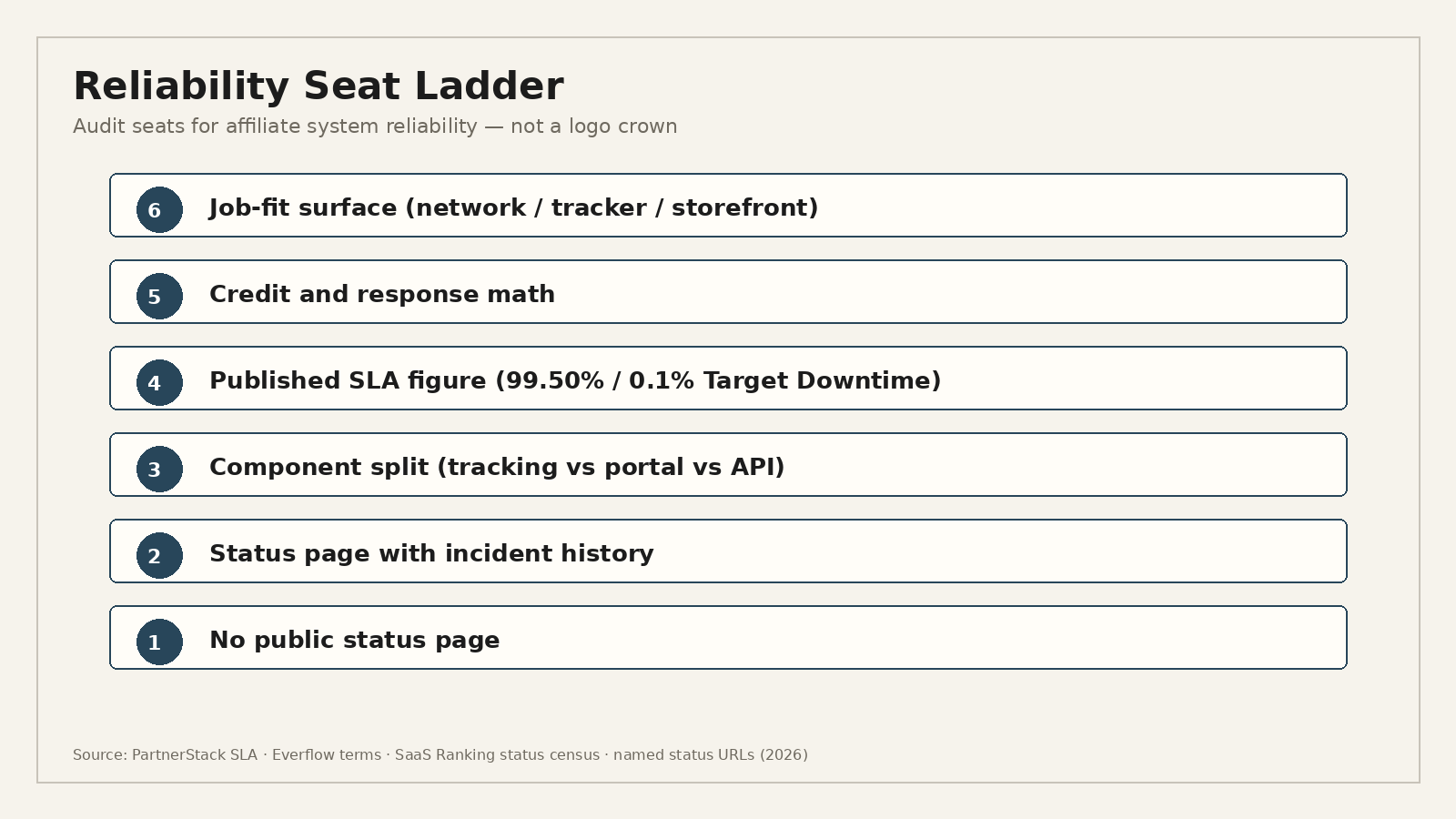
Source: feat. Reliability Seat Ladder synthesis from PartnerStack SLA, Everflow terms, SaaS Ranking status-page census, and named status URLs (2026).
| Seat | What you can audit | Example proof |
|---|---|---|
| 1. No public status | Support inbox only | CJ: no public status page found at SaaS Ranking’s checked addresses (census) |
| 2. Status page + history | Incidents you can subscribe to | Awin status.awin.com; impact.com status.impact.com; Everflow status.everflow.io |
| 3. Component split | Tracking vs app vs API vs reporting | Rewardful and Tapfiliate list tracking separately from portals (Rewardful, Tapfiliate); Impact documents Tracking Uptime as its own metric (help) |
| 4. Published SLA figure | Named % or Target Downtime | PartnerStack 99.50% monthly Availability (SLA); Everflow 0.1% monthly Target Downtime (terms) |
| 5. Credit + response math | What you get when the meter fails | PartnerStack: 10% Monthly Fee credit after two consecutive miss months; Severity 0 response in 30 minutes (SLA) |
| 6. Job-fit surface | Whether uptime is even the right buy | Multi-network publisher dashboard vs in-house tracker vs co-branded storefront (affiliate software vs storefront) |
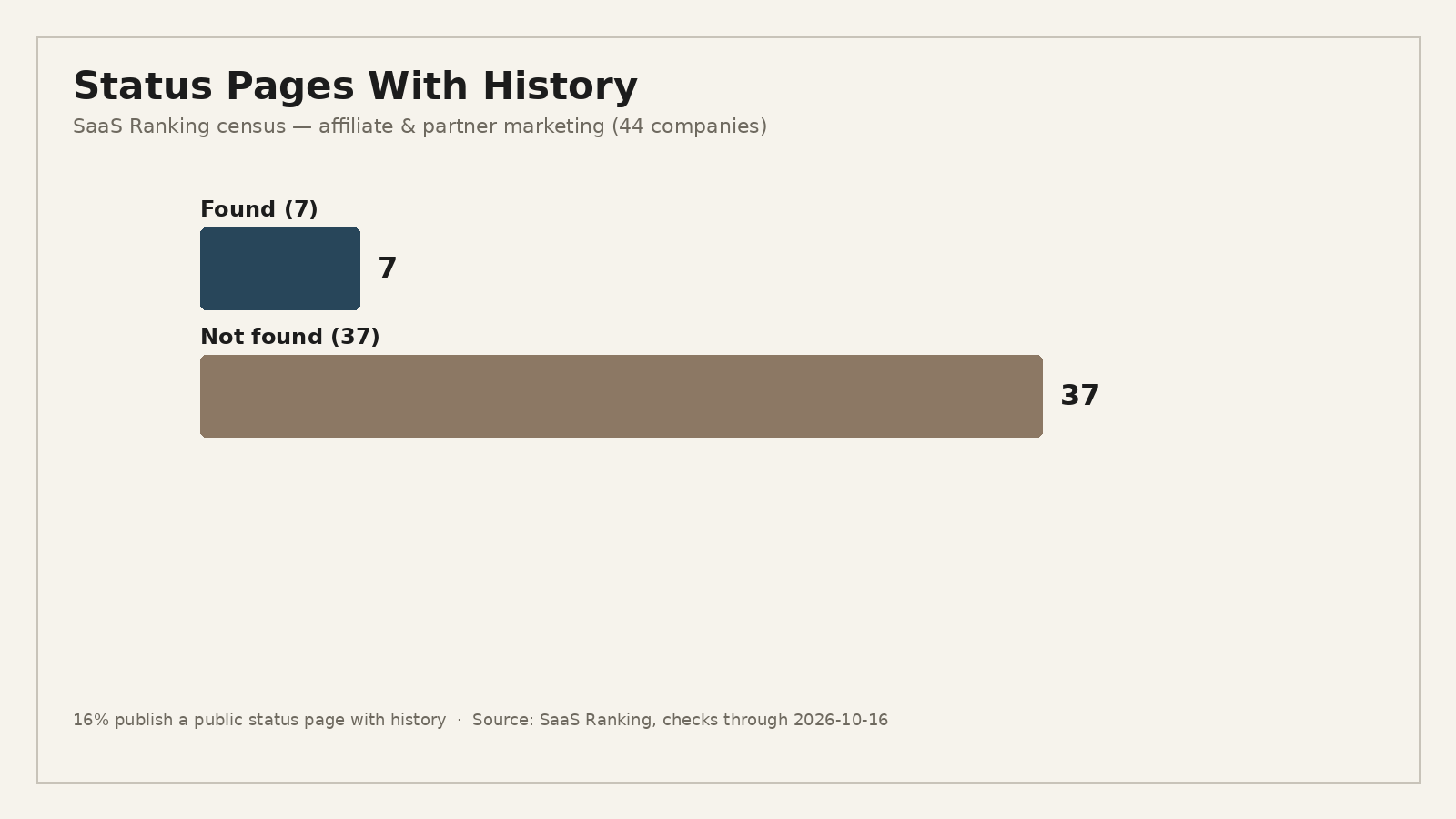
Source: SaaS Ranking, Status page with history in Affiliate and partner marketing, checks through 2026-10-16. https://saas-ranking.com/criteria/status-page/affiliate-marketing
SaaS Ranking’s published list (checked mid-October 2026) named Awin, Everflow, impact.com, LeadDyno, Post Affiliate Pro, ReferralCandy, and Refersion as vendors with a status page that includes history. Primary URLs for the large partnership clouds:
| Vendor | Status URL | What to watch |
|---|---|---|
| impact.com | https://status.impact.com/ | Web portal, web tracking, API, tracking uptime metrics (help) |
| Awin | https://status.awin.com/ | Network components; SaaS Ranking found no public SLA figure at checked legal URLs |
| Everflow | https://status.everflow.io/ | Web app, API, click/impression processing, conversion processing, JS SDK |
| PartnerStack | https://status.partnerstack.com/ | Partner/Vendor dashboards, Link Service, Reporting Service |
| Rewardful | https://status.rewardful.com/ | Merchant portal, affiliate portals, tracking script/API, custom domains |
| Tapfiliate | https://status.tapfiliate.com/ | API, webapp, tracking servers, tracking script, assets |
Rewardful’s public 90-day strip (accessed 2026-10-16) showed several components at 100.000% and Custom domains at 99.980%. That is a rolling component view, not a contractual SLA crown over PartnerStack or Everflow. Quote the page you opened and the date. Do not mash rolling uptime into an SLA table.
| Vendor | Published meter | Credit / catch |
|---|---|---|
| PartnerStack | 99.50% Availability Service Level per calendar month | 10% of Monthly Fee if missed for two or more consecutive months; Downtime = cannot log in; excludes scheduled maintenance (SLA) |
| Everflow | Target Downtime 0.1% of total time in a calendar month (excused downtime excluded) | Service credit = 2× (Target Downtime − Downtime %), capped at fees for that month; written request within 30 days (terms) |
| Awin (public legal URLs checked by SaaS Ranking) | No public uptime SLA figure found | Status page exists; ask in contract for measurement window and credits (SaaS Ranking) |
| CJ (SaaS Ranking census) | No public status page found at checked addresses | Support center / phone path; treat uptime as contract-negotiated, not homepage-proven (census) |
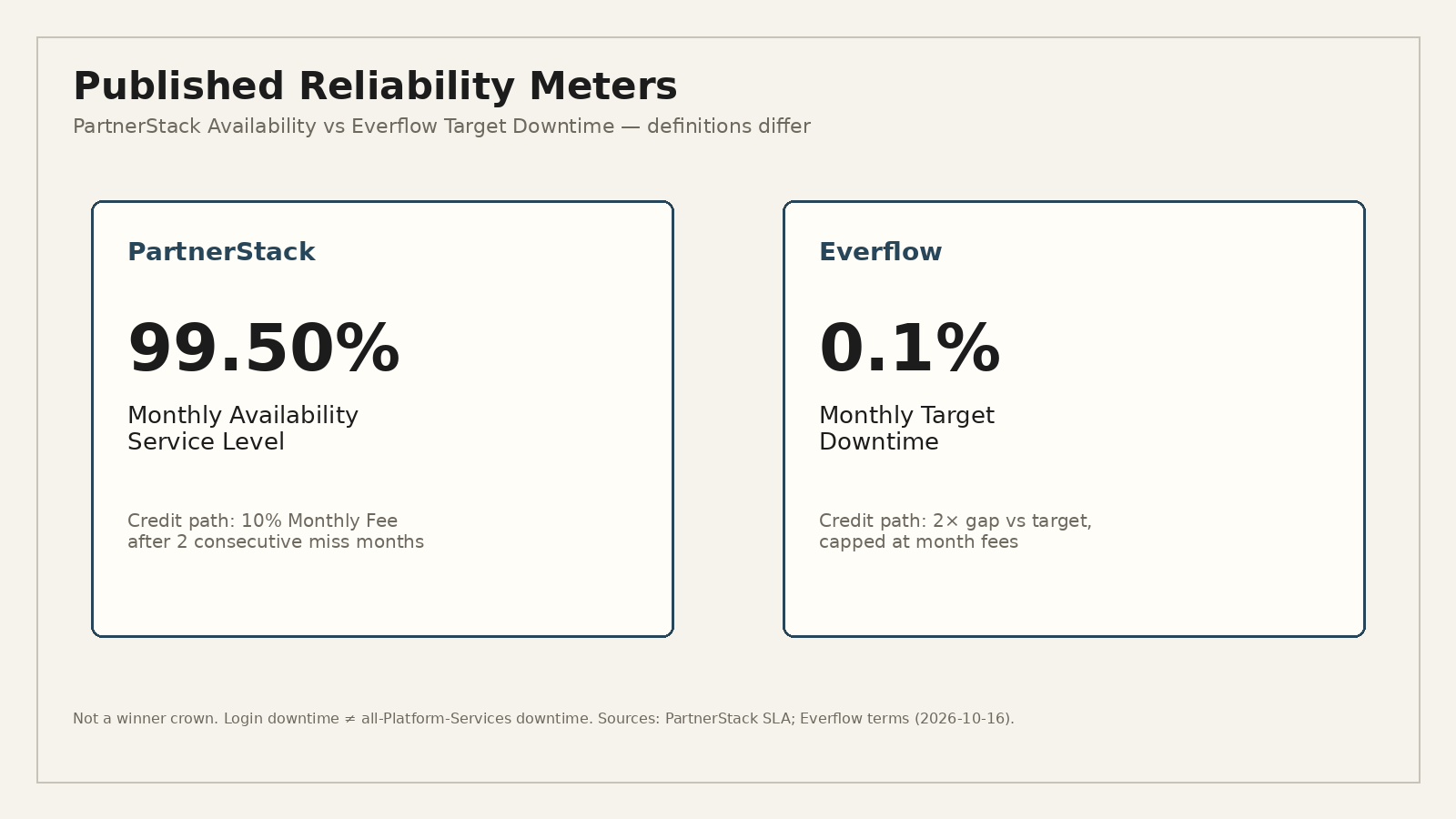
Source: PartnerStack Service Level Agreement; Everflow Service Terms. Accessed 2026-10-16.
Read the denominator. PartnerStack’s Downtime is login inability. Everflow’s Downtime is when all Platform Services cease to function. Those are not identical sentences. Anyone who converts both into a fake “who is more reliable” percentage without matching definitions is doing marketing math.
On May 28, 2026, PartnerStack investigated an outage affecting the Public API, Vendor Dashboard, and Partner Dashboard, and stated that link redirects remain fully operational (incident). That single sentence is worth more than a year of “enterprise reliability” adjectives.
If you only watch whether you can log in, you will mis-score the night. If you only watch whether a marketing site loads, you will miss API and reporting failures. Subscribe to components. Map them to your job: redirects and postbacks for live traffic, portals for ops, API for automations.
Tapfiliate’s split between Tracking Servers / Tracking Script and Webapp / API is the same lesson in product architecture (status). Impact’s help center calls out Tracking Uptime as its own chart (help). Build your runbook around those labels.
Network status can be green while your program is dark. Moonpull’s tracking-fix guide, citing Prussakov, treats merchant site revamps that drop affiliate tags as a frequent downtime scenario, and recommends Acknowledge, Apologise, Act when untracked traffic is proven (Moonpull).
That failure mode belongs in affiliate rules monitoring and your QA checklist, not in a vendor uptime leaderboard. If you conflate them, you will fire the wrong team.
feat. is built for a different job than CJ, Impact, Awin, PartnerStack, Rewardful, or Tapfiliate. Merchants list products. Affiliates sell through co-branded storefronts feat. generates. Buyers check out on that surface. Reliability for that job is checkout and split correctness on a storefront, not multi-network click aggregation.
Compare seats honestly:
Do not ask feat. for a CJ uptime certificate. Do not ask a network status page to generate a co-branded storefront. Wrong seat, wrong meter. For network-vs-software job fit, see affiliate network vs affiliate software.
Q: What are the most reliable affiliate marketing systems? A: Systems that publish a status page with components and, when available, a named SLA figure. PartnerStack states 99.50% monthly Availability. Everflow states 0.1% monthly Target Downtime. There is no public cross-vendor uptime ranking that crowns one winner.
Q: Does a 99.9% uptime claim mean a network is most stable? A: Only if you can cite the contract language, the downtime definition, and the measurement window. Marketing pages that say “enterprise reliability” without a status URL or SLA figure are not meters.
Q: Is PartnerStack more reliable than Impact or Awin? A: Not from a single public percentage. PartnerStack publishes a 99.50% Availability SLA. Impact and Awin publish status pages with component history. Match definitions before you compare, and refuse invented crowns.
Q: What should I do when affiliate tracking looks broken? A: Pause scaled traffic, compare your independent click logs to the portal, check the vendor status page by component, and verify merchant tags if the network is green. Ask for a written compensation plan before you resume spend.
Q: Is feat. an affiliate network uptime monitor? A: No. feat. is a marketplace for co-branded storefront selling with an automatic revenue split. Use network or tracker status pages for multi-network uptime. Use feat. when the job is distribution through a storefront, not dashboard aggregation.
Most reliable affiliate marketing systems are the ones that survive a document audit: status URL, component split, SLA figure when it exists, credit path, and a clear line between platform downtime and merchant tag failure. PartnerStack’s 99.50% Availability Service Level and Everflow’s 0.1% Target Downtime are real published meters. SaaS Ranking’s 7-of-44 status-page census shows how rare even the first rung still is. There is no honest universal uptime crown.
If your job is getting other people to sell through a co-branded storefront instead of another affiliate login, start at feat..
GoAffPro pricing: Hobby Free, Premium $49, Business from $99. No sales %, vs UpPromote.
Refersion pricing: Launch $39+3%, Growth $199+2%. Affiliate-sales fees, crossover math, vs UpPromote.
UpPromote pricing: Free, Growth $29.99+2%, Pro $89.99+1.5%. Performance fees, crossover math, vs ReferralCandy.