Influencer Agency Expensive, Results Flatlined
Diagnose a flatlined influencer agency: fee markups, vanity KPIs, one-off treadmill, missing owned seats, and when to add storefront distribution.
Whitelisted ads means creator-handle paid. Map slang to Meta Partnership Ads and TikTok Spark Ads, separate usage rights, price the window.

TL;DR: Whitelisted ads is industry slang for paid ads that run from a creator’s identity with their permission. Meta’s product name is Partnership Ads. TikTok’s is Spark Ads. That seat is not the same as licensing creative for brand-handle ads. Name the product, the rights window, and the spend cap before you sign.
Briefs say “whitelist us.” Creators hear “boost my post.” Finance asks why the invoice has a second line after the post fee. Three rooms, three words, one confusion.
Whitelisted ads is the colloquial name for creator-handle paid media. The platforms already renamed the products. Meta calls them Partnership Ads. TikTok calls them Spark Ads. Deep mechanics and rights surfaces live in whitelisting and Spark Ads explained. This page owns the naming ladder for people who typed the slang into search.
Whitelisted ads are paid social ads that a brand runs from a creator’s account or post identity after the creator grants permission, so the ad header and social proof stay tied to the creator rather than only to the brand page.
That is the definition searchers want when they type the slang. Brandwise and other operator guides decode the same map: whitelisting or allowlisting is the industry word; Partnership Ads is Meta’s product; Spark Ads is TikTok’s product; dark posts are ads that do not sit on the profile feed; usage rights are a different contract for brand-handle delivery (Brandwise; Sponsee).
Whitelisted ads are not affiliate commission. Affiliates get paid for tracked outcomes. Whitelisting is a paid-media rights product with a media budget on top. Keep that fork next to affiliate vs influencer marketing and influencer contract terms explained.
Names decide what you buy. If the brief says “whitelist” and the SOW only lists “usage,” you underbought the seat or overpaid for the wrong one.
Whitelisted ads work when you climb a naming ladder from slang to platform product to rights seat to contract line, then check performance with labeled samples instead of a fake fee percentage.
| Ladder rung | Question | Output |
|---|---|---|
| Slang | What did the brief say? | Whitelisted ads / whitelisting / allowlisting / paid whitelist |
| Fork | Whose handle runs the ad? | Creator-handle paid vs brand-handle usage rights |
| Meta product | What is the Facebook/Instagram ticket? | Partnership Ads (was branded content ads) |
| TikTok product | What is the TikTok ticket? | Spark Ads + post authorization code |
| Contract | What is paid besides the post? | Window, spend cap, comment control, revoke path |
| Performance context | What labeled lift exists? | Meta 19%/13%; AdLiftr Spark vs In-Feed (samples) |
Source: Editorial Whitelisted Ads Naming Ladder synthesizing Meta Help, TikTok Ads Help, Brandwise/Sponsee naming maps, Cheerful/Collabstr pricing hygiene.
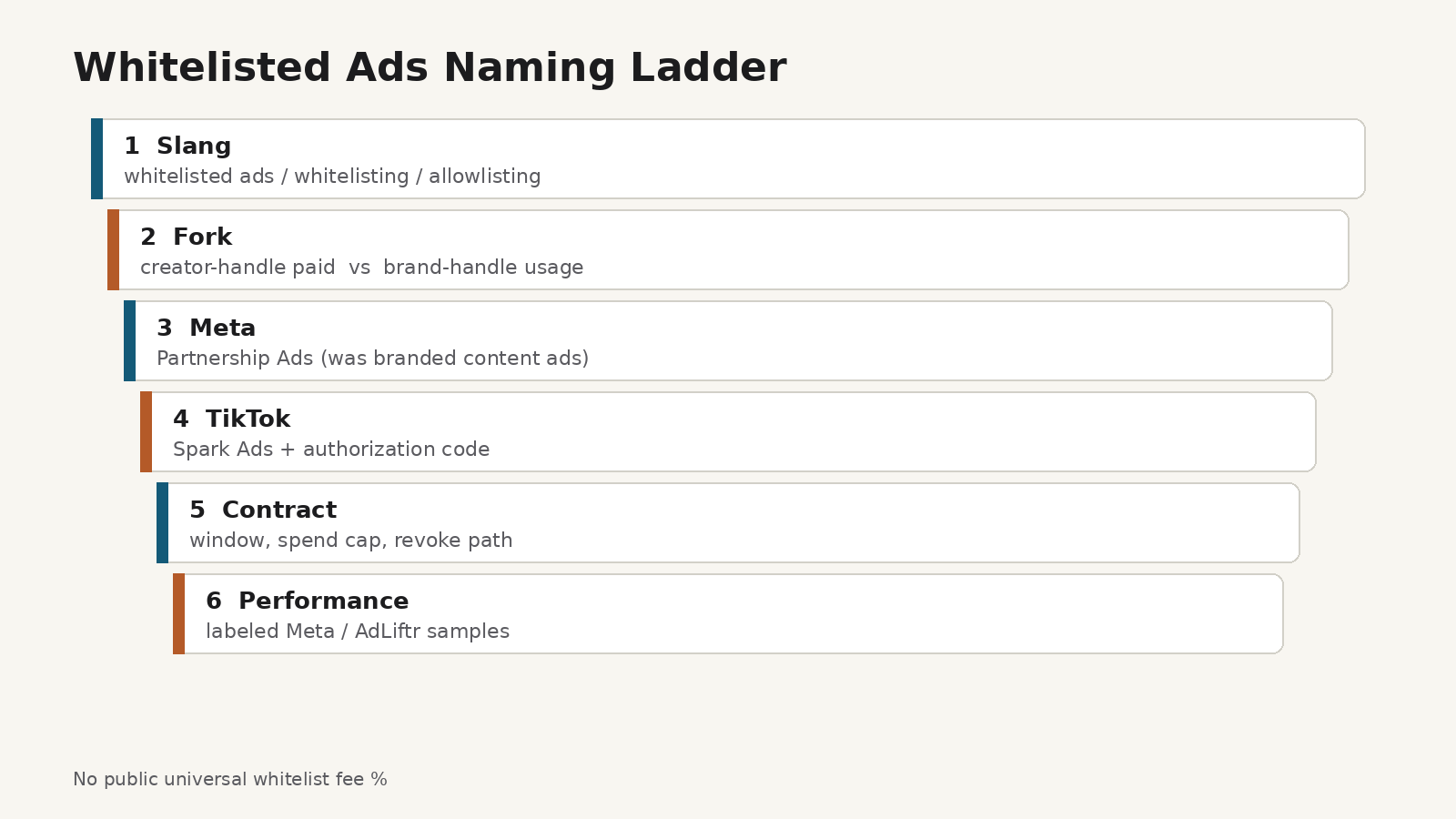
Source: Editorial framework from Meta Partnership Ads Help, TikTok Spark Ads Help, and operator naming guides (accessed 2026-10-24).
Start with the sentence in the brief. If it says whitelist, allowlist, or “run ads from your account,” you are in creator-handle paid. If it says usage, license, cutdown, or “we will run it from our page,” you are in brand-handle licensing.
| Seat | Who appears as the ad identity | Typical ask | Common mistake |
|---|---|---|---|
| Whitelisted ads (Partnership / Spark) | Creator (often with brand in header on Meta) | Permission, code, or partnership tool access | Calling usage “whitelisting” |
| Usage rights / licensing | Brand page or brand ad account | License window, territories, edits | Assuming comments stay on the creator |
Sources: Brandwise naming table; Sponsee grant explainer.
Meta’s help center is blunt: branded content ads are now called partnership ads. Advertisers run ads with creators and other partners. Partner and/or advertiser accounts show in the header. The ads use signals from both accounts (Meta Help).
Creators can allow partners to boost eligible posts, stories, or reels into Partnership Ads, or to build ads from approved content in Ads Manager (Meta creator specs). For setup depth, objectives, and the three-surface rights stack, use the whitelist and Spark hub.
Meta’s published lift for adding Partnership Ads to BAU is about 19% lower CPA and 13% higher CTR on average (Meta news). A related Meta A/B note covers roughly 2,400 advertisers in a mid-June 2025 test window for the 19% cost-per-result figure (Meta post). Treat that as a labeled Meta sample, not your niche guarantee.
| Metric vs BAU baseline | Relative change (Meta, labeled) |
|---|---|
| CPA | ~19% lower |
| CTR | ~13% higher |
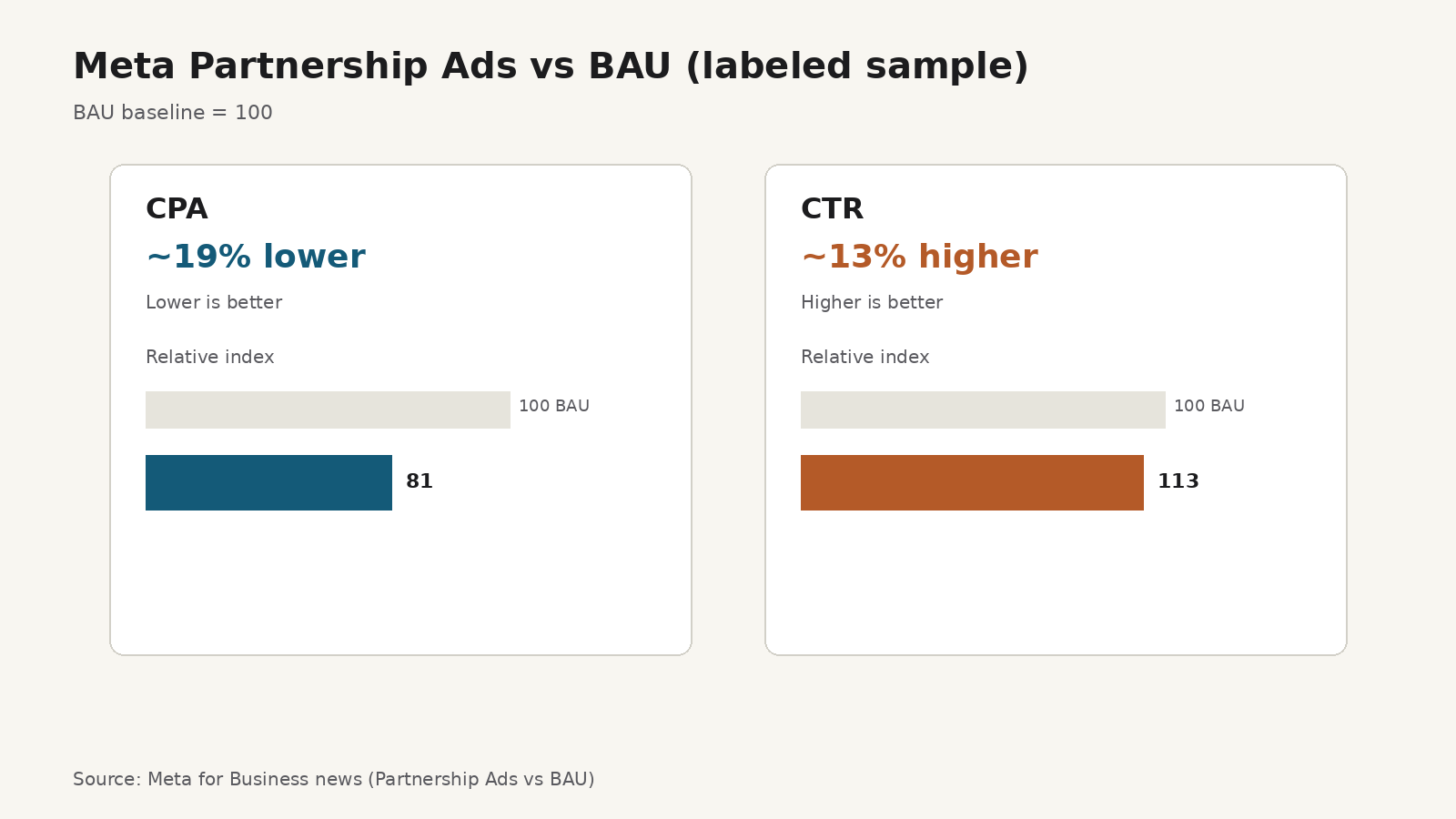
Source: Meta for Business, AI-powered tools to scale creator and brand partnerships (accessed 2026-10-24). https://www.facebook.com/business/news/new-ai-powered-tools-to-scale-creator-and-brand-partnerships
TikTok’s help center defines Spark Ads as a native format that uses organic TikTok posts in advertising. You can spark your own posts or creator posts with authorization. Views, comments, shares, likes, and follows from the boost attribute to the organic post (TikTok Ads Help).
Ops constraints that show up in every real deal: 10-minute max video length for sparkable posts; each Ads Manager account supports up to 10,000 Spark Ads; a video must be un-authorized before the organic account can delete it (TikTok Ads Help). Authorization duration is customizable; creator UI flows commonly expose 7 / 30 / 60 / 365 day windows for a post-specific code (label as platform UI options, not a statute).
AdLiftr’s 2026 TikTok cost sample (3,127 campaigns, 548 advertisers, Feb 1-May 28, 2026, $18.7M spend) reports Spark median CTR 1.62% versus standard In-Feed 0.84%, and DTC e-commerce median CPA $12.40 versus $17.20. Within-advertiser controls still favored Spark (~1.5× CTR, ~1.25× CPA) with selection bias noted (AdLiftr).
| Format (AdLiftr medians) | CTR | DTC CPA |
|---|---|---|
| Spark Ads | 1.62% | $12.40 |
| Standard In-Feed | 0.84% | $17.20 |
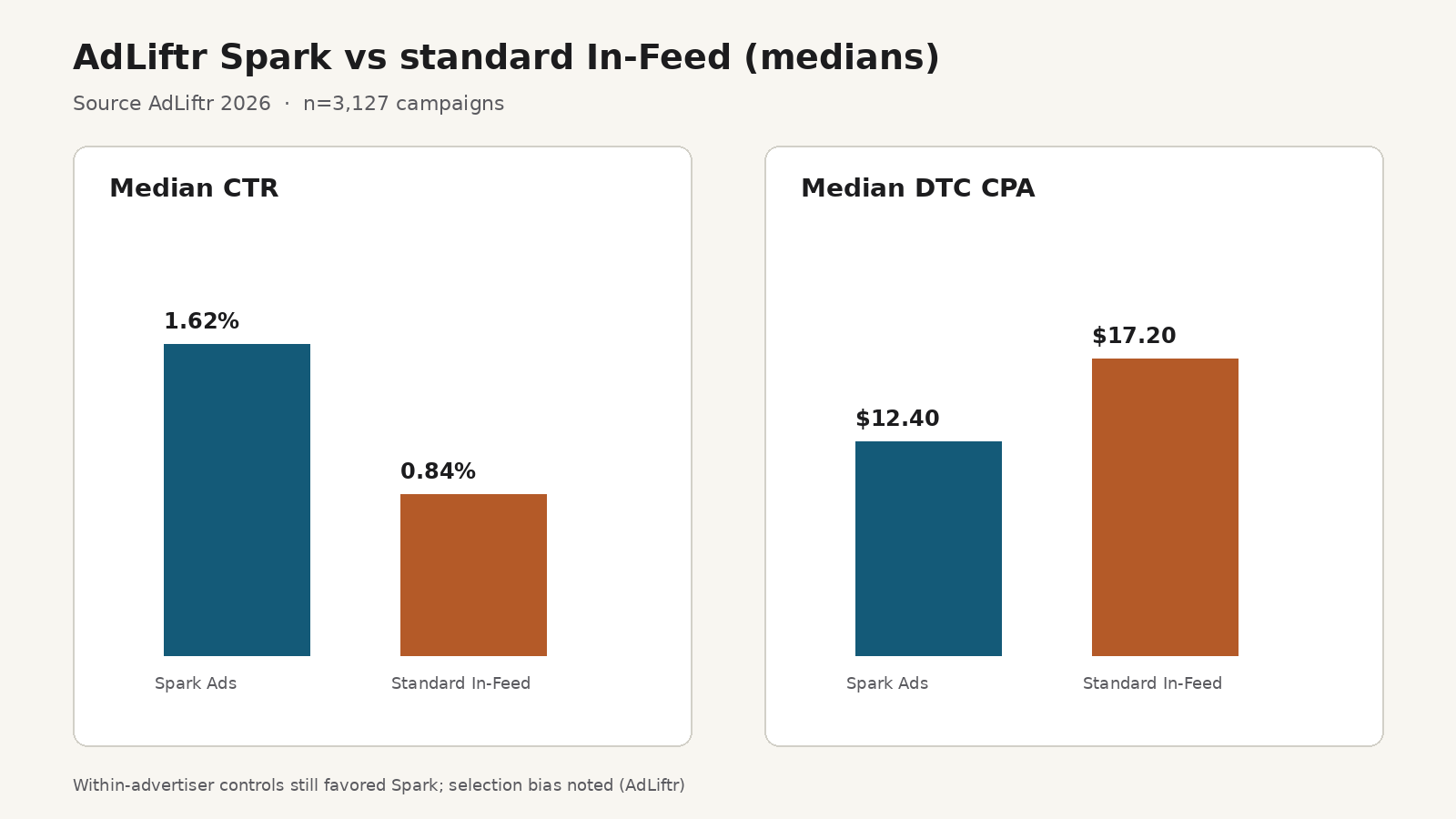
Source: AdLiftr, TikTok Ads Cost Benchmarks 2026 (May 30, 2026). https://adliftr.com/blog/tiktok-ads-cost-benchmarks-2026
Do not paste secondary agency claims of “142% engagement” without a primary TikTok link. Prefer the AdLiftr labeled sample and the official Spark definition above.
Whitelisted ads die in the invoice when the post fee is the only number. Write:
Cheerful’s rate research keeps usage, whitelisting, and exclusivity out of format ask medians so teams do not treat them as free (Cheerful). Collabstr’s ~39.91% figure is a usage-rights cost increase in its sample, useful as a reminder that rights are priced, not as a whitelist formula (Collabstr). There is still no public dataset for one universal whitelist fee percentage. Rate cards for the post itself live in influencer marketing rates by follower count and platform.
Use Meta and AdLiftr as context meters after the name is correct. Pair them with your own holdout or geo test when spend is material. Whitelisting also sits next to influencer marketing vs paid ads and how brands calculate influencer marketing ROI: the media buy is paid ads; the creator seat is the rights product; ROI needs both lines.
If you sell through affiliates or a creator storefront, do not confuse a tracked commission link with a Spark code. One pays for outcomes. The other buys distribution from a face.
Q: What are whitelisted ads? A: Whitelisted ads are paid ads a brand runs from a creator’s identity after the creator grants permission. Meta’s product name is Partnership Ads. TikTok’s is Spark Ads. The slang is industry language, not the button label inside Ads Manager.
Q: Are whitelisted ads the same as usage rights? A: No. Usage rights let the brand run creator creative from the brand’s own ad account. Whitelisted ads keep the creator’s identity in the paid unit. Price them as separate seats. Collabstr’s about 39.91% usage uplift is about licensing, not a whitelist formula.
Q: What is the difference between Partnership Ads and Spark Ads? A: Partnership Ads are Meta’s Instagram and Facebook product for ads with partners in the header. Spark Ads are TikTok’s product for advertising with authorized organic posts. Both sit under the colloquial umbrella of whitelisted ads.
Q: How long does TikTok Spark authorization last? A: TikTok lets advertisers customize authorization duration. Creator flows commonly offer 7, 30, 60, or 365 day windows for a post-specific code. Put the end date in the contract. Un-authorize before deleting the organic video.
Q: Is there a standard fee for whitelisted ads? A: No. There is no public dataset for a universal whitelist fee as a percent of the post fee. Cheerful treats whitelisting as a line item outside format medians. Negotiate window and spend cap, then test performance with labeled baselines.
Whitelisted ads is slang for creator-handle paid. Climb the Naming Ladder from that phrase to Partnership Ads or Spark Ads, separate usage rights, write the window and spend cap, and only then use Meta or AdLiftr samples as context. For the full rights stack and setup detail, keep the whitelisting and Spark Ads hub open beside this spoke.
Browse products creators can sell through co-branded storefronts on feat.: https://www.feat.press/marketplace
Diagnose a flatlined influencer agency: fee markups, vanity KPIs, one-off treadmill, missing owned seats, and when to add storefront distribution.
Influencer attribution vs paid media is a confidence ladder: IAB n=453 (platform 55%, MTA 25%, MMM 29%), Google lift + MMM. Not a fake reliability %.
Most marketers see under half of gifted creators post. Plan stock loss as majority silent inventory, then cut ghosts with opt-in and prune rules.