Whitelisted Ads Explained (Naming Ladder)
Whitelisted ads means creator-handle paid. Map slang to Meta Partnership Ads and TikTok Spark Ads, separate usage rights, price the window.
Diagnose a flatlined influencer agency: fee markups, vanity KPIs, one-off treadmill, missing owned seats, and when to add storefront distribution.

TL;DR: When your influencer agency is expensive and results have flatlined, diagnose the seat before you fire the channel. Stack fee shape (retainer plus 15%–30% creator markups), meter mismatch versus paid media, one-off roster treadmill, and missing owned seats. There is no public census that proves every agency underperforms by a fixed percentage.
Founders do not type influencer agency expensive results flatlined when the creative is merely imperfect. They type it when the invoice is loud and attributed sales stopped moving.
This page is a diagnosis ladder for that stuck month. It sits next to how to negotiate contract terms with an affiliate marketing agency (clauses before you sign), long-term ambassador programs vs one-off posts (program shape), and influencer marketing attribution vs paid media (meter mismatch). Different jobs. Same pain if you skip them.
Key takeaways:
An influencer agency flatline is the pattern where agency fees and creator spend keep clearing while attributed pipeline, incremental sales, or agreed KPIs stop climbing.
It is not the same as a bad week of CPM. It is a multi-cycle stall: retainers renew, reports arrive, posts ship, and the business line stays flat. The wrong diagnosis is “influencers do not work.” The right diagnosis is which seat broke: fee shape, meter, roster design, ownership, or distribution surface.
Affiliate program management agencies are a cousin, not a twin. Their fee guides often sit near $3,500–$10,000+/mo or 5%–15% of affiliate-driven revenue (Hamster Garage). If your “influencer agency” is also running affiliates, you may be paying two fee shapes for one partner graph. Separate the contracts before you separate the people.
Expensive agencies flatline for structural reasons. Creative quality is real. Structure is usually louder.
Why the pattern shows up:
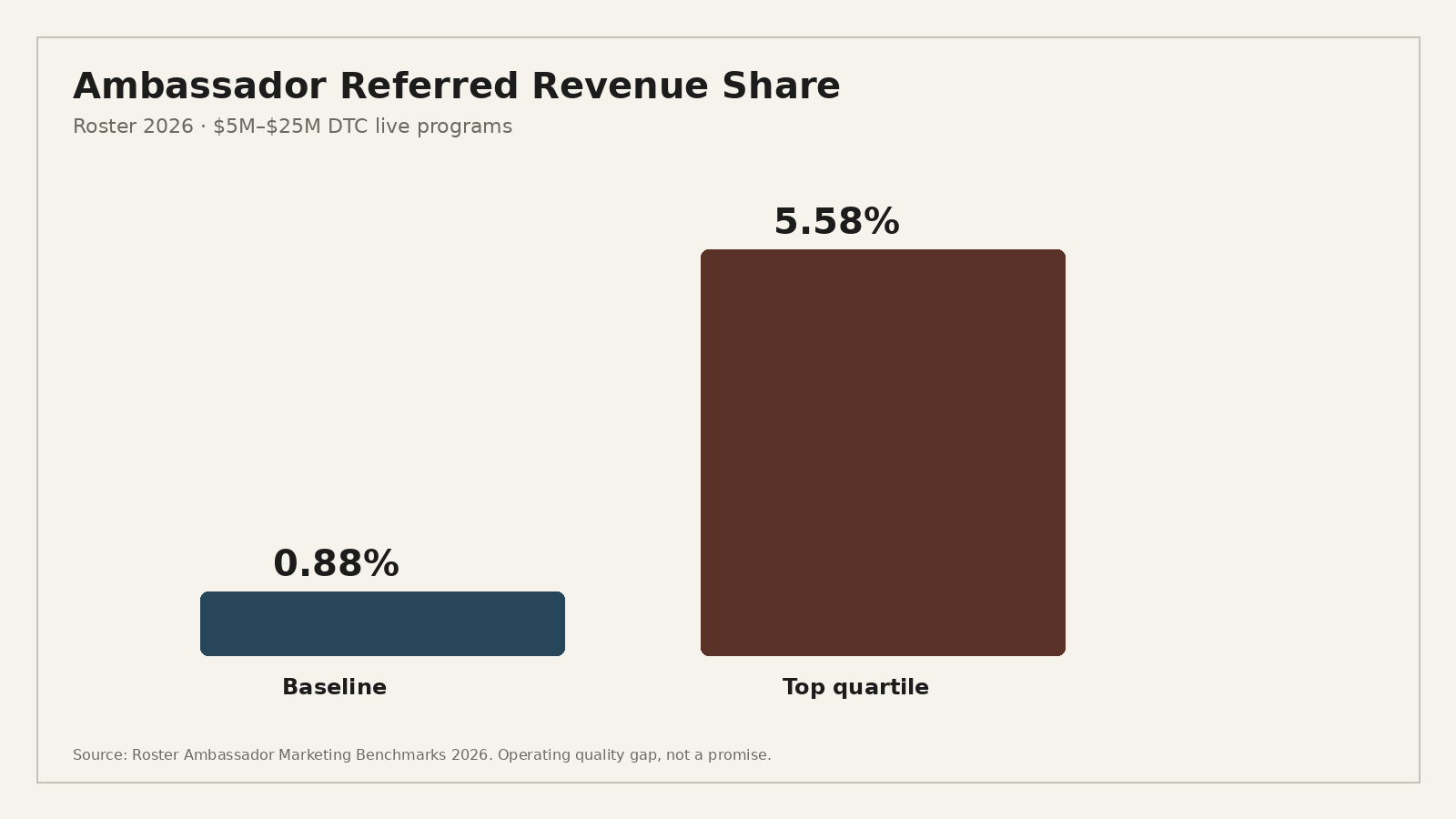
Source: Roster Ambassador Marketing Benchmarks 2026 (live programs, Feb–Jul 2026), $5M–$25M DTC band. https://www.getroster.com/ambassador-marketing-benchmarks/
Diagnosing a flatlined influencer agency means climbing an Agency Flatline Diagnosis Ladder before you rewrite the brand story. Open with this: name the fee stack, the KPI meter, the roster shape, who owns the seats, whether you ever ran a lift test, and whether you have an owned selling surface beyond posts.
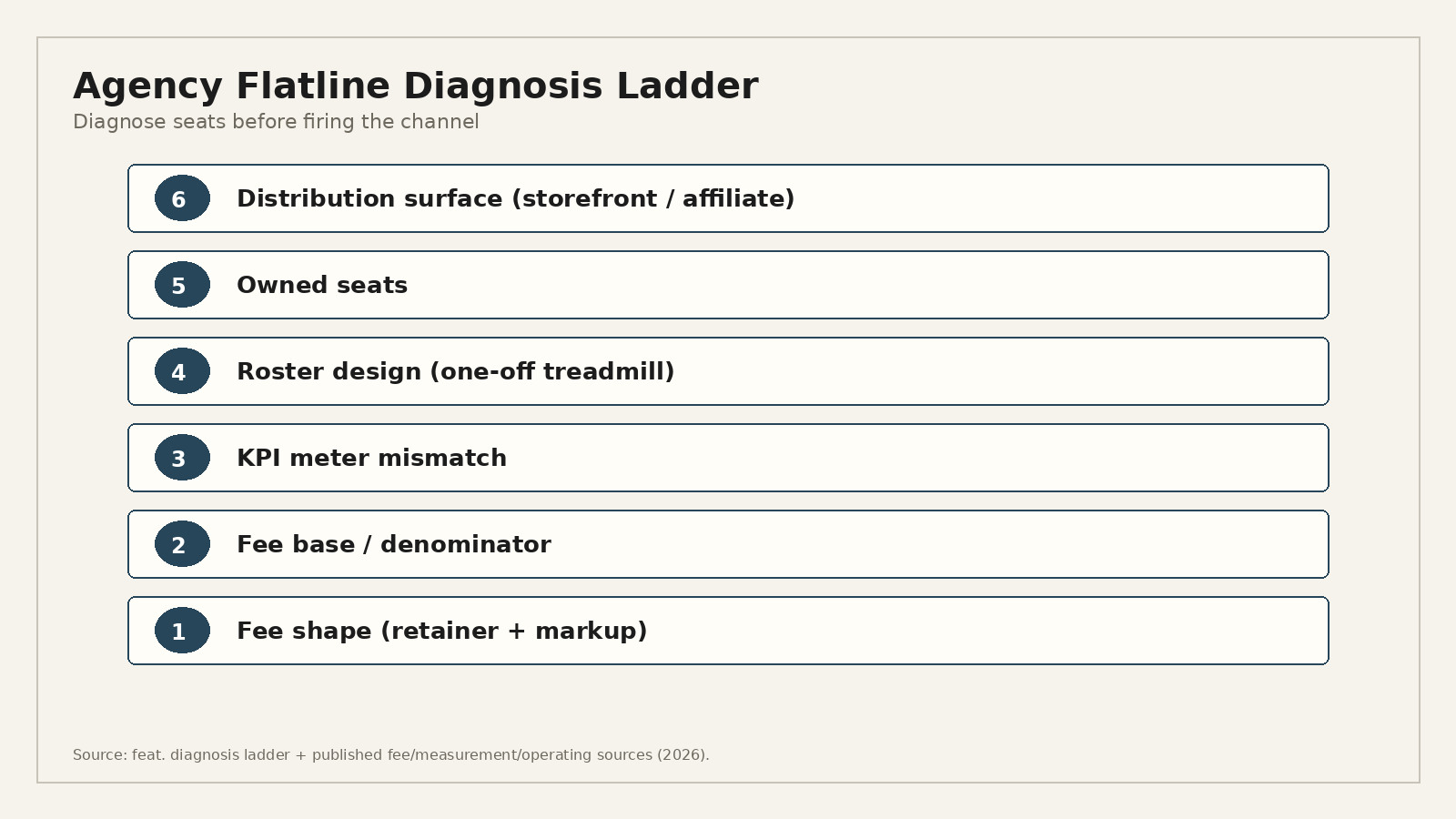
Source: feat. Agency Flatline Diagnosis Ladder synthesizing published agency fee guides, IAB measurement mix, Roster/Vamp operating gaps, and Google incrementality guidance (2026).
| Seat | Question to force | Flatline signal |
|---|---|---|
| 1. Fee shape | Retainer only, markup %, or both? | Invoice rises with creator spend while sales stay flat |
| 2. Fee base / denominator | % of what? Creator fees, media, GMV, commissions? | Percentage looks “cheap” until the base is named |
| 3. KPI meter | Platform ROAS, codes/UTMs, MTA, MMM, lift? | Creators lose every board slide against Meta last-click |
| 4. Roster design | One-offs vs 3+ depth vs ambassadors? | New creators every month, no compounding recall |
| 5. Owned seats | Brand holds platform and partner logins? | Exit means rebuilding the graph from screenshots |
| 6. Distribution surface | Posts only, or affiliate/storefront sell paths? | Attention without a place to buy |
Write the all-in monthly cost as:
retainer + (creator fees × markup %) + usage/whitelisting add-ons
Market guides repeatedly land retainers near $3,000–$25,000+/mo and markups near 15%–30% of managed creator fees (InfluencerFee; Social Cloud). Treat those as guides, not a feat. survey.
If the agency also touches affiliate economics, borrow the fee-base discipline from affiliate program management: a 10% fee on $500k GMV is $50k; the same 10% on $50k of commissions is $5k (Elevarus framing + arithmetic). Wrong denominators make good ops look predatory and bad ops look affordable.
IAB’s 2025 creator survey shows the industry still grades creators with paid-media habits: 55% lean on ad platform reporting, while MTA (25%) and MMM (29%) stay minority tools for creator KPIs (IAB). If your agency report is “impressions and engagement” while finance only trusts last-click ROAS, the flatline is a translation failure.
Google’s own guidance is to combine attribution, incrementality, and MMM, and it cut many Conversion Lift spend floors from about $100,000 toward $5,000 (Google Ads Help). Run one causal check before you fire the agency for failing a meter it was never contracted to beat.
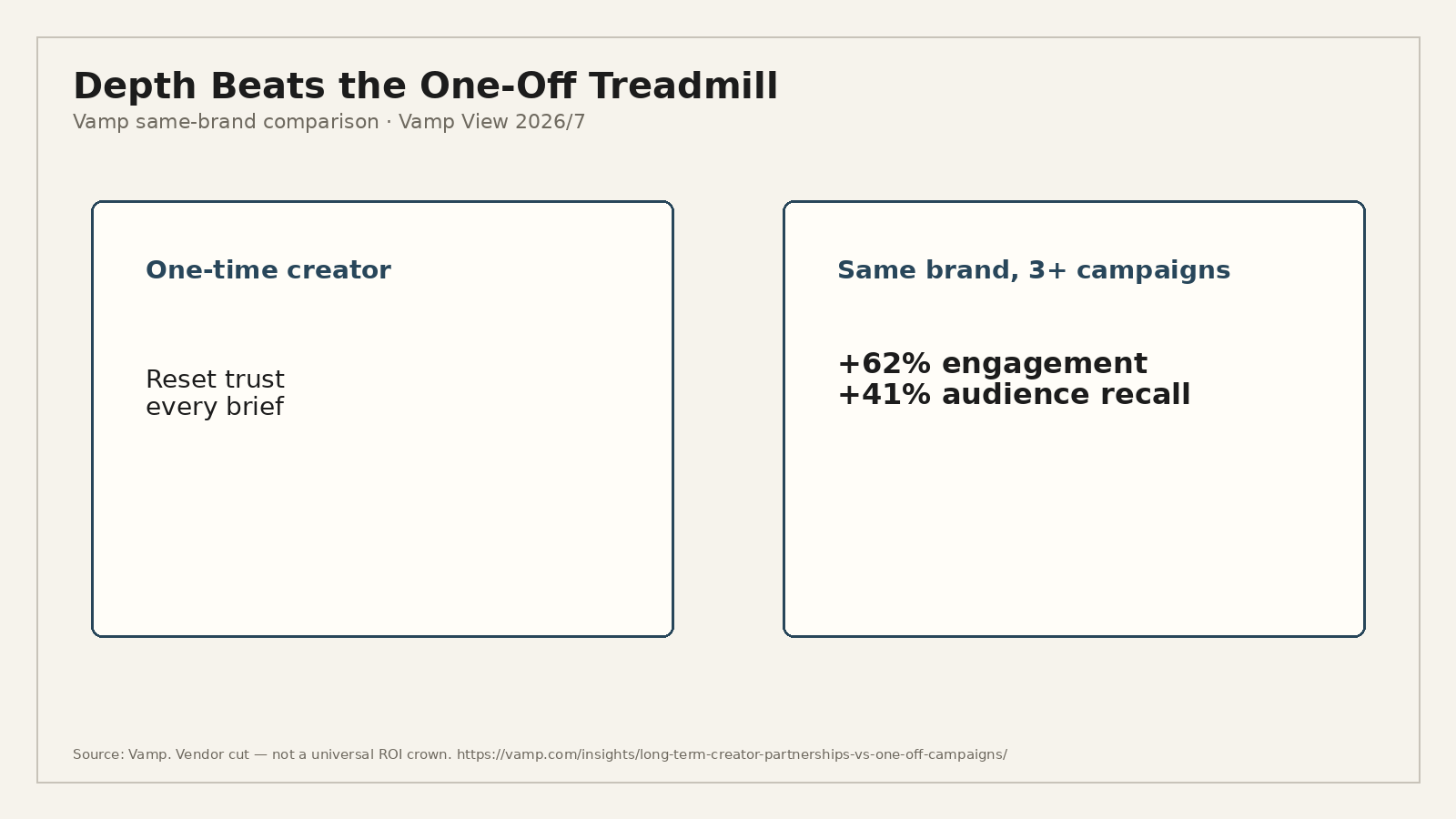
Source: Vamp, Long-term creator partnerships vs one-off campaigns (Vamp View 2026/7). https://vamp.com/insights/long-term-creator-partnerships-vs-one-off-campaigns/
If the SOW pays for net-new creators every cycle, you are buying a reset button. Vamp’s cut credits 62% higher engagement and 41% higher recall when the same brand works a creator 3+ times versus once (Vamp). Roster’s ambassador data shows the operating prize inside a size band: 0.88% vs 5.58% referred revenue share (Roster). Convert winners into long-term ambassadors instead of re-tendering trust.
If the agency holds the only brand login on the creator CRM, the seeding sheet, or the affiliate network, you do not have a program. You have a hostage. Put brand-owned seats in the MSA/SOW the same way you would for an affiliate management shop (agency contract ladder). Flat results plus no export path is how expensive becomes existential.
A post is attention. A sale needs a surface. If creators only point at a homepage, you are asking last-click to remember a feeling. Give partners tracked codes, affiliate links, or co-branded storefronts. That is the feat. job: merchants list, affiliates sell through co-branded storefronts, revenue splits on sale (feat.). An agency can still recruit. Someone still has to own the sell path.
Q: Why is my influencer agency expensive if results have flatlined? A: Often because retainer and creator-fee markups (commonly guided near 15%–30%) stack while KPIs still chase vanity or last-click ROAS. Rebuild the all-in invoice and the contracted deliverable count before you blame creative alone.
Q: What retainer range should I expect for an influencer marketing agency? A: 2026 market guides commonly cite about $3,000–$25,000+ per month depending on scope, sometimes plus a percentage markup on creator fees. Confirm what the sticker buys: execution logistics versus strategy and reporting.
Q: Are flat results proof that influencer marketing does not work? A: No. Flat results often mean meter mismatch, one-off roster design, or missing owned seats. IAB data shows many brands still lean on ad platform reporting for creator KPIs. Compare seats before you cut the channel.
Q: Should I switch to ambassadors if one-off campaigns stalled? A: Often yes for compounding. Vamp reports higher engagement and recall for creators used three or more times by the same brand versus once. Roster shows wide operating gaps inside the same DTC revenue band. Convert proven creators; do not only add strangers.
Q: Can feat. replace my influencer agency? A: No. feat. is a marketplace for co-branded storefront selling with an automatic revenue split. Agencies can still recruit and brief. feat. helps when the missing seat is a place for partners to sell, not another retainer.
An influencer agency that feels expensive while results flatline is usually a diagnosis problem: fee stacks, wrong meters, one-off treadmills, hostage seats, or no sell surface. Use the Agency Flatline Diagnosis Ladder before you torch the channel or sign a louder MSA. Depth beats novelty. Owned seats beat screenshots. Causal checks beat board-slide ROAS fights.
If the missing piece is co-branded distribution rather than another briefing deck, start at feat..
Whitelisted ads means creator-handle paid. Map slang to Meta Partnership Ads and TikTok Spark Ads, separate usage rights, price the window.
Influencer attribution vs paid media is a confidence ladder: IAB n=453 (platform 55%, MTA 25%, MMM 29%), Google lift + MMM. Not a fake reliability %.
Most marketers see under half of gifted creators post. Plan stock loss as majority silent inventory, then cut ghosts with opt-in and prune rules.