Digital Marketing Benchmarks by Industry
Digital marketing benchmarks by industry: WordStream 2026 search CTR 6.64%, CPC $5.42, CVR 8.18%; then LP, Shopify, and email meters. Refuse mashups.
Combining MMM, MTA, and platform data beats a single method when each layer keeps its job and incrementality calibrates the stack. EMARKETER ranks inside.

TL;DR: Yes. Combining MMM, MTA, and platform data is more reliable than picking a single method when each layer keeps a different job and incrementality tests calibrate the stack. EMARKETER × TransUnion (July 2025, n=196) found 27.6% of US marketers name MMM most reliable versus 19.4% for MTA. Averaging three dashboards into one fake truth is not triangulation.
Operators ask whether combining MMM, MTA, and platform data is actually more reliable than picking a single method because one dashboard always feels cleaner than three disagreeing ones. Clean is not the same as true.
This page answers the combine-versus-single question. Deep definitions live in attribution models compared, marketing mix modeling basics, and incrementality testing explained. Here the job is reliability of the stack, not another model encyclopedia.
Key takeaways:
Combining MMM, MTA, and platform data means running those meters as a triangulation stack with explicit jobs, then using experiments to calibrate where the meters disagree.
It is not exporting three CSVs and averaging ROAS. Platform-reported ROAS is an interested-party closer score. Multi-touch attribution (MTA) splits credit across tracked touchpoints when paths exist. Marketing mix modeling (MMM) estimates channel contribution from aggregate spend and controls over time. Incrementality testing estimates what would have happened without the spend.
If you treat those four sentences as synonyms, combining will make you louder, not smarter. If you keep the jobs separate, combining is how modern measurement survives privacy loss. Google’s Think with Google measurement playbook frames the same move: compare tools, then introduce calibration so experiments inform MMM and, in places, attribution (Modern Measurement playbook).
A single method feels decisive. It also hides the failure mode of that method.
Why triangulation wins on reliability:
CalibrationBuilder exists to turn incrementality experiment results into ROI priors for paid media channels (Meridian docs). Meta’s Robyn documents calibration against geo, lift, MTA, and similar ground truth (Robyn). Tooling assumes triangulation.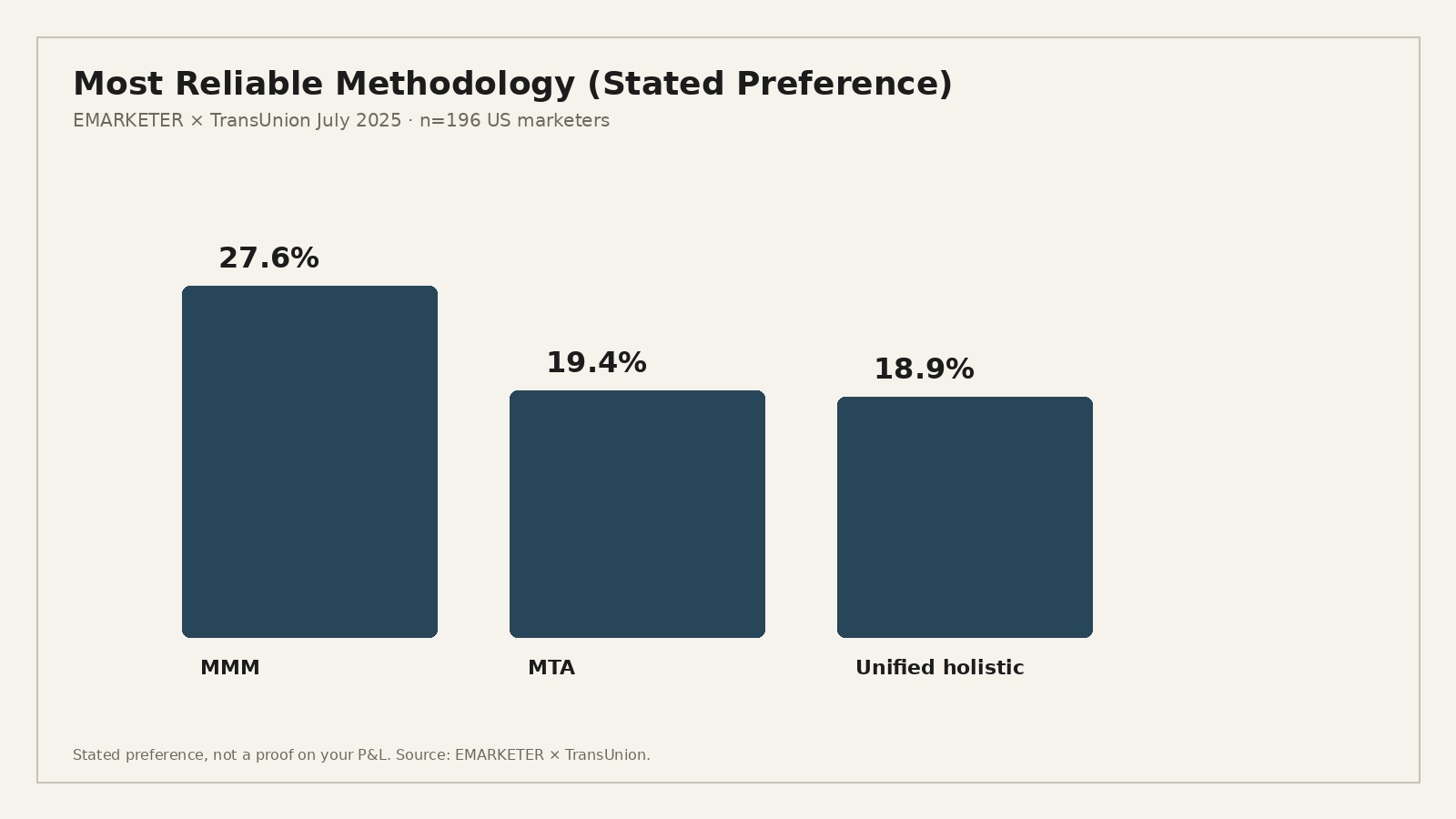
Source: EMARKETER × TransUnion, Marketing Measurement Confidence survey (July 2025, n=196 US marketers). https://www.emarketer.com/content/nearly-half-of-us-marketers-plan-invest-mmm-over-next-year
Combining MMM, MTA, and platform data works as a Measurement Triangulation Ladder: keep each layer on its clock, refuse to let platform ROAS set quarterly budget alone, and force disagreements into an experiment. Open with this: reliability rises when you stack jobs and calibrate, not when you pick a favorite logo.
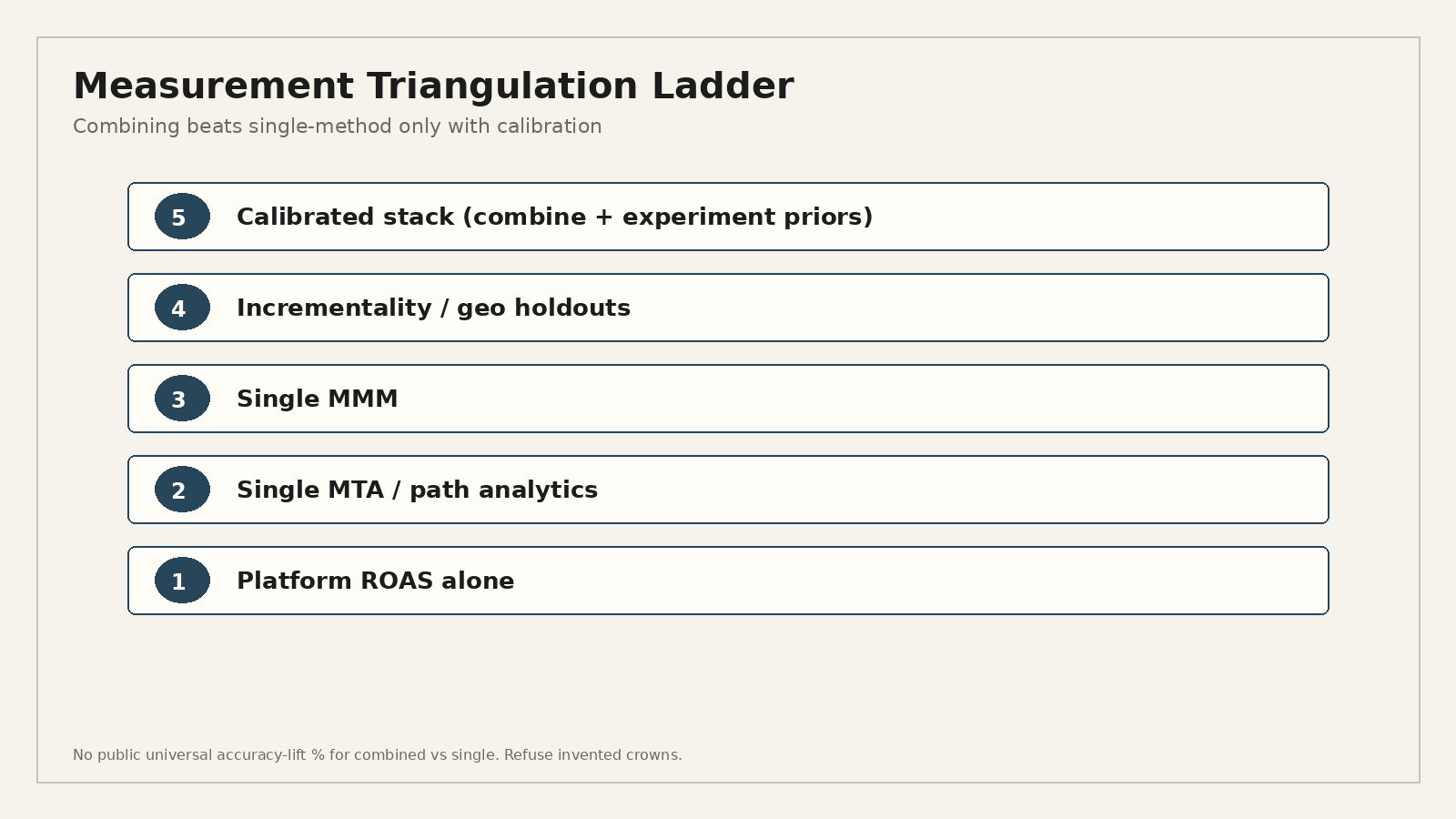
Source: feat. Measurement Triangulation Ladder; calibration path from Google Meridian and Think with Google Modern Measurement playbook (2026).
| Seat | What you trust it for | Failure if used alone |
|---|---|---|
| 1. Platform ROAS / platform data | Daily bids, creative tests inside one walled garden | Over-credits the closer; interested-party meter |
| 2. MTA / first-party path analytics | Directionality across tracked digital journeys | Missing dark social, consent gaps, offline |
| 3. MMM | Next-quarter media mix from aggregates | Too slow for in-flight creative; needs variation |
| 4. Incrementality / geo holdouts | Causal lift and iROAS for calibration | Sparse coverage if you never schedule tests |
| 5. Calibrated stack | Budget moves after experiments update priors | Still requires human judgment on conflicts |
| Decision | Primary meter | Secondary check | Do not use alone |
|---|---|---|---|
| Which ad wins today inside one platform? | Platform data | Holdout when stakes are high | MMM |
| How should credit split on a tracked path? | MTA / path analytics | Survey / branded search lift | Raw platform ROAS on long journeys |
| How should next quarter’s budget move? | MMM | Incrementality calibration | Unvalidated platform ROAS |
| Did this channel cause incremental sales? | Incrementality test | Calibrated MMM | Unvalidated MTA fractions |
| Did a partner or creator introduce the buyer? | Partner tracking + contract | Lift on branded search | Pure last-click that erases the introducer |
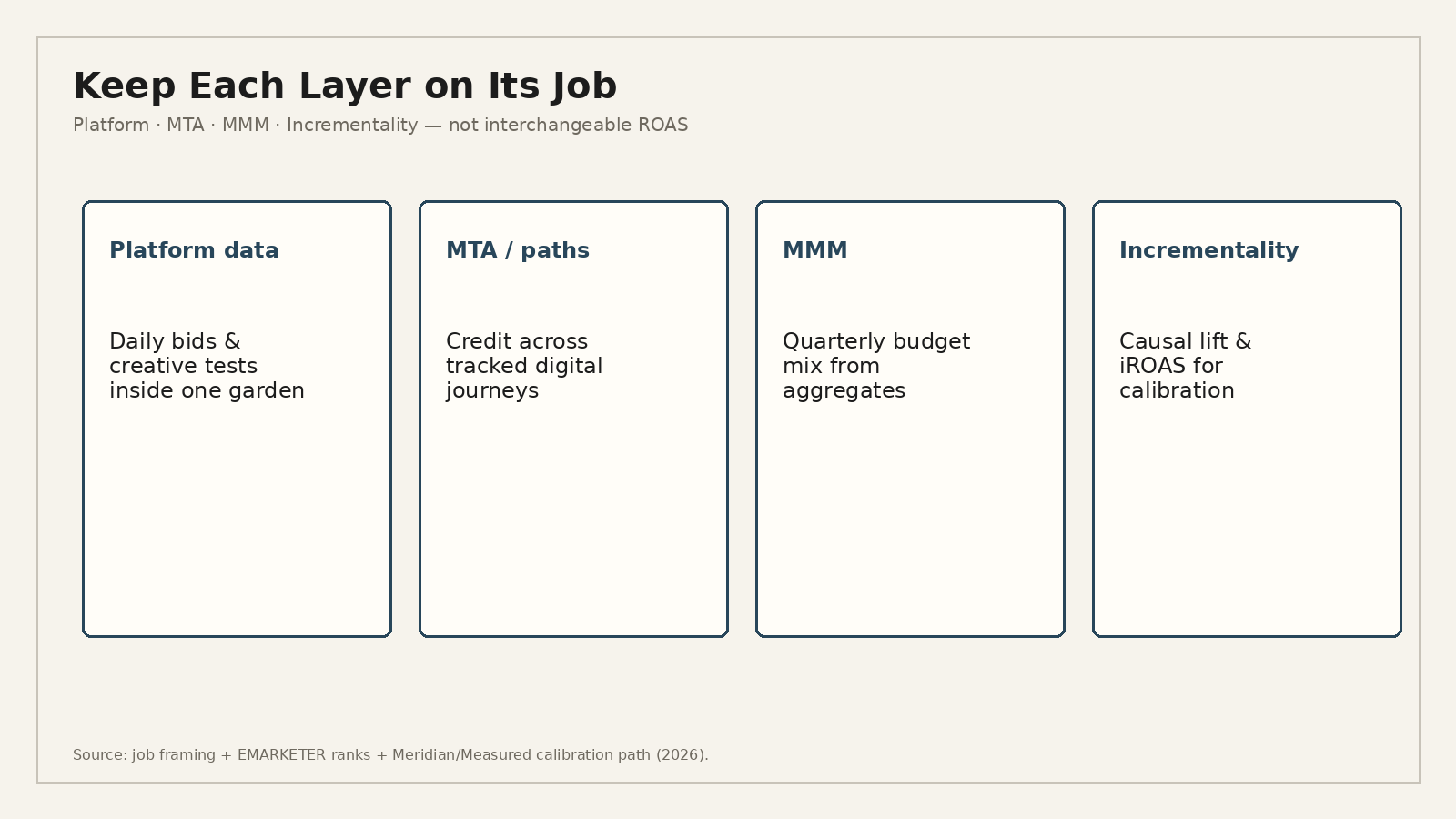
Source: Job framing synthesized for this article; reliability ranks from EMARKETER × TransUnion July 2025; calibration from Google Meridian and Measured formulas.
More reliable means fewer silent false certainties. It does not mean a published national accuracy score for combined stacks. Label that gap: no public dataset crowns “combined measurement is X% more accurate than single-method.” Anyone selling that percentage without your holdouts is selling comfort.
Google’s incrementality guidance is explicit about job split: MMM helps evaluate cross-channel performance but can lack the speed and granularity needed to prove channel profitability, which is where incrementality testing complements the stack (Google Think). That is the official argument for combining, not for deleting MMM.
Without calibration, combining is three opinions in a spreadsheet. With calibration, disagreements become priors.
Practical calibration moves:
Think with Google’s Modern Measurement playbook calls out the same sequence: compare tools, then calibrate continuously across as many channels as you can represent (playbook PDF). Continuous is the word. One heroic geo test per year is theater.
If creators and affiliates move demand, your stack still needs a partner seat. Platform last-click will quietly underpay introducers. MMM can include partner spend as a treatment when weekly costs are clean. Incrementality can test whether cutting partner budget actually destroys sales. Contract rules still decide who gets paid (how to track affiliate sales).
feat. is not an MMM vendor. It is a co-branded storefront marketplace where merchants list and affiliates sell with a revenue split. Use the triangulation ladder for media measurement. Use feat. when the job is distribution through a storefront, not another attribution login.
Q: Is combining MMM, MTA, and platform data more reliable than picking a single method? A: Yes, when each layer keeps a different job and incrementality calibrates disagreements. Combining without calibration is just louder noise. There is no public universal accuracy lift percentage for combined stacks.
Q: What did EMARKETER find about MMM versus MTA reliability? A: In the July 2025 EMARKETER × TransUnion survey of 196 US marketers, 27.6% named MMM the most reliable methodology versus 19.4% for MTA and 18.9% for unified holistic solutions. That is stated preference, not a proof on your dataset.
Q: Should platform ROAS be ignored if you have MMM? A: No. Platform data still guides in-flight bids and creative tests inside a walled garden. It should not be the only input for quarterly cross-channel budget.
Q: How do you calibrate MMM with experiments? A: Run geo or user lift tests, compute incrementality percent and iROAS, then update MMM priors. Google Meridian documents tooling that turns experiment results into ROI priors for paid media channels.
Q: Does feat. replace MMM or MTA software? A: No. feat. is a marketplace for co-branded storefront selling with an automatic revenue split. Keep MMM, MTA, and platform meters for media measurement. Use feat. when the job is getting partners to sell through a storefront.
Combining MMM, MTA, and platform data is more reliable than a single method when you triangulate jobs and calibrate with incrementality. EMARKETER’s 27.6% versus 19.4% reliability split shows the market already refuses one religion. TransUnion’s stalled confidence numbers explain why. Meridian and Robyn assume calibration. Averaging dashboards without experiments is not a stack.
If your growth problem is distribution through partners rather than another measurement login, start at feat..
Digital marketing benchmarks by industry: WordStream 2026 search CTR 6.64%, CPC $5.42, CVR 8.18%; then LP, Shopify, and email meters. Refuse mashups.
Marketing mix modeling basics: time-series channel impact with adstock and saturation. Use Meridian or Robyn, calibrate with lift tests, not last-click.
Incrementality testing explained: lift formulas, Google iROAS, geo vs user holdouts, and how to calibrate MMM.