Combining MMM, MTA, and Platform Data
Combining MMM, MTA, and platform data beats a single method when each layer keeps its job and incrementality calibrates the stack. EMARKETER ranks inside.
Digital marketing benchmarks by industry: WordStream 2026 search CTR 6.64%, CPC $5.42, CVR 8.18%; then LP, Shopify, and email meters. Refuse mashups.

TL;DR: Digital marketing benchmarks by industry are a meter choice first, then an industry row inside a dated source. WordStream’s 2026 search averages are CTR 6.64%, CPC $5.42, CVR 8.18%, CPL $66.69. Do not mash those with Unbounce LP visits, Littledata Shopify sessions, or MailerLite email opens, and do not treat a “2021” query suffix as a 2021-only truth.
Most “digital marketing benchmarks by industry” posts paste one table and call it planning. Sometimes it is a WordStream search row. Sometimes it is a 2021 HubSpot-era graphic. Sometimes it is an ecommerce session rate wearing a PPC label. Operators then wonder why a “good” 7% and a “good” 1.4% both appear in the same Slack thread.
If you need digital marketing benchmarks by industry, finish the meter question first. Pair this with marketing funnel benchmarks by stage and industry, SaaS PPC landing page conversion rates, Shopify conversion rate benchmarks, and email marketing benchmarks by industry.
Digital marketing benchmarks by industry are published reference ranges for channel metrics (CTR, CPC, conversion rate, CPL, open rate, session conversion, and similar), segmented by vertical inside a named, dated sample.
That definition already kills the slide that says “the average digital marketing conversion rate is X%” with no channel, no denominator, and no year. A WordStream search conversion is conversions ÷ ad clicks. An Unbounce landing-page rate is conversions ÷ visits. A Littledata Shopify rate is orders ÷ sessions. A MailerLite open rate is opens ÷ delivered emails inside an ESP sample. Same word, “conversion” or “benchmark,” different machines.
Search interest still appends years (“2021,” “2024”) because people copy old filenames. Use the year to find a fresh primary table, not to freeze your planning on a stale PDF.
They matter because the wrong meter burns the wrong week of work.
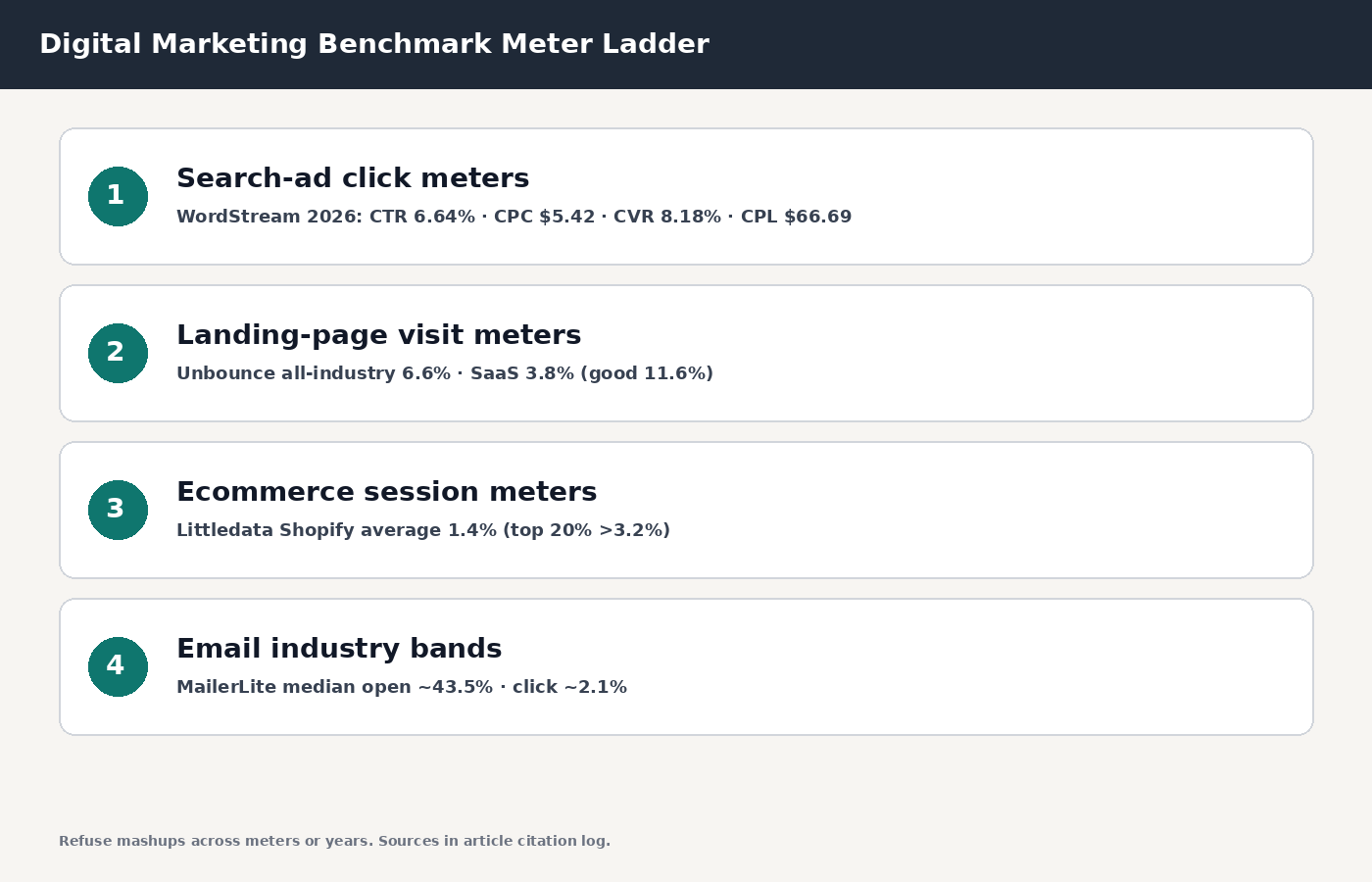
Source: Editorial Digital Marketing Benchmark Meter Ladder. Search figures from WordStream / LocaliQ 2026; LP from Unbounce; ecommerce from Littledata; email from MailerLite. Accessed 2026-10-21.
Digital marketing benchmarks by industry work as a meter ladder. Name the channel instrument, pull the industry row from a dated primary source, then compare your account to that row, not to a mashed “internet average.”
| Meter | Denominator | Dated industry source (examples) | Wrong use |
|---|---|---|---|
| Search-ad click | Conversions ÷ ad clicks (plus CTR, CPC, CPL) | WordStream / LocaliQ 2026: overall CTR 6.64%, CPC $5.42, CVR 8.18%, CPL $66.69 | Judging a Shopify session rate against search CVR |
| Landing-page visit | Conversions ÷ LP visits | Unbounce all-industry 6.6%; SaaS 3.8% | Treating LP median as Google Ads CVR |
| Ecommerce session | Orders ÷ sessions | Littledata Shopify average 1.4% | Calling 1.4% a failed search account |
| Email industry band | Opens / clicks ÷ delivered (ESP sample) | MailerLite median open ~43.5%, click ~2.1% | Using open rate as paid-search CTR |
Sources: WordStream; Unbounce; Littledata; MailerLite.
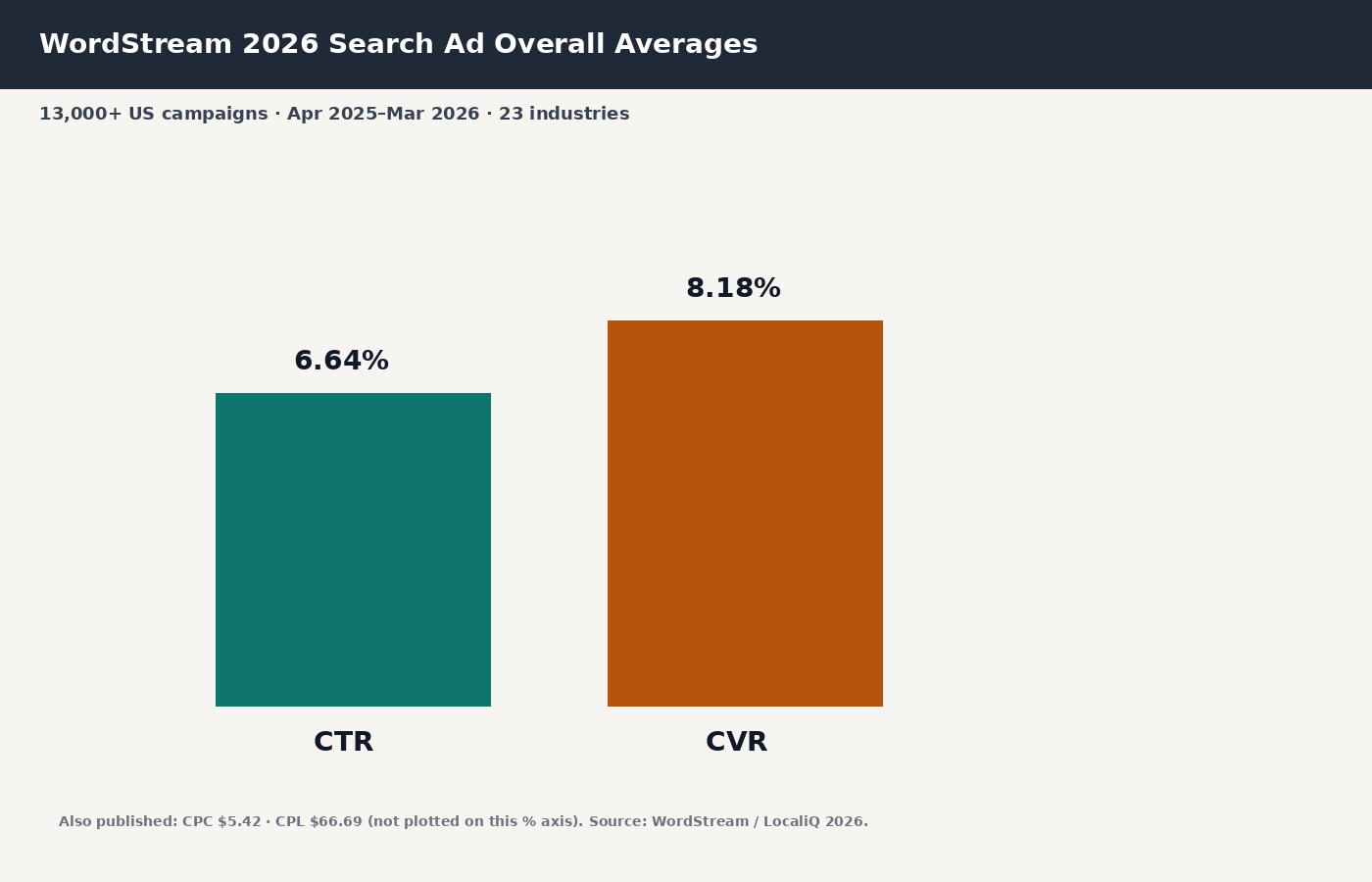
Source: WordStream / LocaliQ Search Advertising Benchmarks 2026 (13,000+ US campaigns, Apr 2025-Mar 2026). Also published: CPC $5.42, CPL $66.69. https://www.wordstream.com/ppc-benchmarks Accessed 2026-10-21.
Hire this meter when the question is Google or Microsoft search performance. Overall 2026 averages: CTR 6.64%, CPC $5.42, CVR 8.18%, CPL $66.69 (WordStream). For context, the 2025 report averaged CTR 6.66%, CPC $5.26, CVR 7.52%, CPL $70.11, and the 2024 report averaged CTR 6.42%, CPC $4.66, CVR 6.96% on the same WordStream hub (WordStream).
Industry spread is the planning object:
| Metric | High industry (2026) | Low industry (2026) |
|---|---|---|
| CTR | Arts & Entertainment 12.75% | Automotive Repair 5.56% |
| CPC | Attorneys & Legal $9.87 | Arts & Entertainment $1.63 |
| Conversion rate | Animals & Pets 16.22% | Finance & Insurance 2.64% |
| CPL | Attorneys & Legal $131.63 | Arts & Entertainment $26.84 |
Source: WordStream 2026 PDF. WordStream also notes conversion rate rose for 87% of industries and that CPC has more than doubled since 2016 ($2.32 to $5.42).
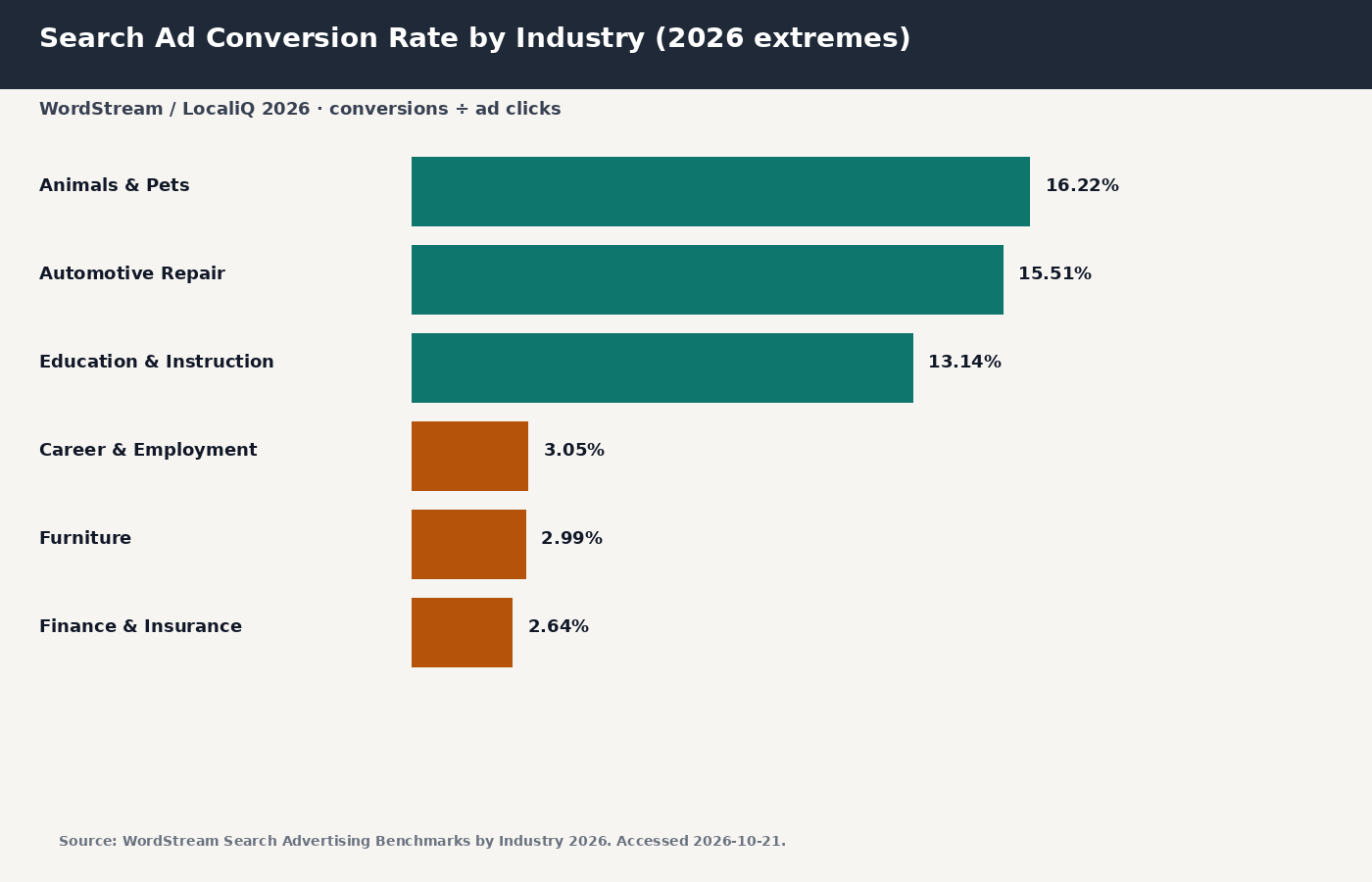
Source: WordStream / LocaliQ Search Advertising Benchmarks by Industry 2026. https://www.wordstream.com/wp-content/uploads/2026/05/ws-guide-2026-google-ads-benchmarks.pdf Accessed 2026-10-21.
Hire this meter when the page is a dedicated campaign landing page and the denominator is visits, not ad clicks. Unbounce’s Conversion Benchmark Report puts the all-industry median near 6.6% across roughly 41,000 pages. SaaS sits near 3.8%, with a top-quartile “good” floor near 11.6% (Unbounce; good-rate page). A page can beat Unbounce’s SaaS median and still miss WordStream’s Business Services-class ad CVR if click quality is weak. That is meter disagreement, not a paradox.
Hire this meter when the question is storewide purchase conversion. Littledata’s Shopify average is 1.4% of sessions, with top 20% above 3.2% and top 10% above 4.7%; mobile averages 1.2% and desktop 1.9% (Littledata). Shopify’s own education line still calls a universal ecommerce conversion benchmark a fallacy and points teams at category context (Shopify). Reddit operators split “good” rates by traffic type for the same reason: branded search and cold blog SEO are not one patient (r/ShopifyeCommerce; r/shopify_growth).
Hire this meter for inbox KPIs, not paid search. MailerLite’s 2026 industry table puts median open near 43.5% and click near 2.1%, with ecommerce open 32.67% / click 1.07%, and opens spanning travel 30.10% to religion 55.71% (MailerLite). Do not paste an email open rate next to a WordStream CTR and call both “engagement benchmarks.”
Q: What are digital marketing benchmarks by industry in 2026? A: They are dated, channel-specific ranges. For search ads, WordStream’s 2026 US panel averages CTR 6.64%, CPC $5.42, CVR 8.18%, and CPL $66.69, with wide industry spreads. LP, Shopify, and email use different denominators and different sources.
Q: What is a good Google Ads conversion rate by industry? A: Use the industry row in a search-ad study, not a storewide ecommerce average. WordStream 2026 puts Animals & Pets near 16.22% and Finance & Insurance near 2.64% on a conversions-÷-clicks meter. “Good” is relative to that row and your offer quality.
Q: Are 2021 digital marketing benchmarks still useful? A: Only as history. Search interest still appends “2021,” but CPC, CPL, and privacy conditions moved. Prefer WordStream’s 2026 search tables, current Unbounce LP medians, current Shopify panels, and current ESP email bands over a 2021 collage.
Q: Why do WordStream and Unbounce conversion rates disagree? A: Different denominators. WordStream reports conversions ÷ ad clicks inside search campaigns. Unbounce reports conversions ÷ landing-page visits. A healthy page can look weak if you score it on the wrong meter.
Q: Is there one best digital marketing benchmark by industry? A: No. There is no public dataset that correctly merges search CTR, LP visits, Shopify sessions, and email opens into one industry percentage. Pick the meter that matches the job, then read that source’s industry row.
Digital marketing benchmarks by industry are a meter ladder, not a nostalgia PDF. Start with WordStream’s 2026 search averages when the job is paid search, then step to Unbounce, Littledata, or MailerLite when the denominator changes. Refuse mashups and refuse undated crowns.
If you want creators selling your catalog through co-branded storefronts while you keep reading the right channel meters, start at feat..
Combining MMM, MTA, and platform data beats a single method when each layer keeps its job and incrementality calibrates the stack. EMARKETER ranks inside.
Marketing mix modeling basics: time-series channel impact with adstock and saturation. Use Meridian or Robyn, calibrate with lift tests, not last-click.
Incrementality testing explained: lift formulas, Google iROAS, geo vs user holdouts, and how to calibrate MMM.