Go-to-Market Strategy Frameworks Compared
Go-to-market strategy frameworks compared: PLG, SLG, product-led sales, and partner motions, with Bain's ~2x PLG growth finding and when hybrids win.
Feature marketing starts from product attributes. Use the Feature-Benefit Ladder, HubSpot saturated vs niche fork, and skip feature-only affiliate kits.

TL;DR: Feature marketing starts from product attributes (what it is or does). It only converts when each feature climbs to a buyer benefit. Default benefits-heavy, lead features when the category is saturated, and never ship affiliate or storefront kits that stop at a bullet list.
Most “feature marketing” failures are unfinished sentences. The page lists specs. The creator caption repeats the SKU. The affiliate brief dumps a table. Nobody answers why a stranger should care.
Feature marketing is useful when you treat attributes as the first rung, not the whole ladder. HubSpot’s rule of thumb is still the cleanest: benefits are what compel purchase, and features need an explicit bridge to those benefits (HubSpot). Shopify draws the same line for commerce teams: features are objective attributes; benefits are how a customer’s life improves (Shopify).
Feature marketing is messaging that starts from product or service attributes: what the offer is, includes, or does, often in measurable terms.
HubSpot defines features as what the product or service does and which attributes set it apart, and benefits as why those features matter to the audience (HubSpot). Shopify defines features as objective attributes and benefits as the positive outcomes customers can expect (Shopify).
That is different from beat marketing, which is a cadence and POV habit across channels. Feature marketing is the sentence-level craft on a product page, ad, or creator storefront. It is also different from dumping every capability into a comparison chart and calling the job done.
If you sell through affiliates or a creator storefront, feature marketing is the quality of the offer language partners inherit. A feature-only kit forces every seller to invent the benefit on the fly.
Buyers do not purchase attributes in isolation. They purchase a change in cost, time, risk, status, or comfort. HubSpot states that benefits are what compel consumers to purchase, so a benefits-heavy approach is typically better for marketing messages (HubSpot).
Feature marketing works by climbing each attribute up a Feature-Benefit Ladder, then choosing which rung leads on each surface.
| Ladder rung | Question | Output |
|---|---|---|
| Feature | What is it / what does it do? | Measurable attribute |
| Functional benefit | So what can the buyer do? | Practical change |
| Outcome benefit | Why does life or work improve? | Emotional or business result |
| Surface fit | Where does this line run? | PDP, comparison, social, ad, partner kit |
| Kit rule | Can a partner sell this cold? | Feature + benefit pair required |
Source: Editorial Feature-Benefit Ladder synthesizing HubSpot (2023) and Shopify (2025); practitioner “So what?” step from copywriting forums.
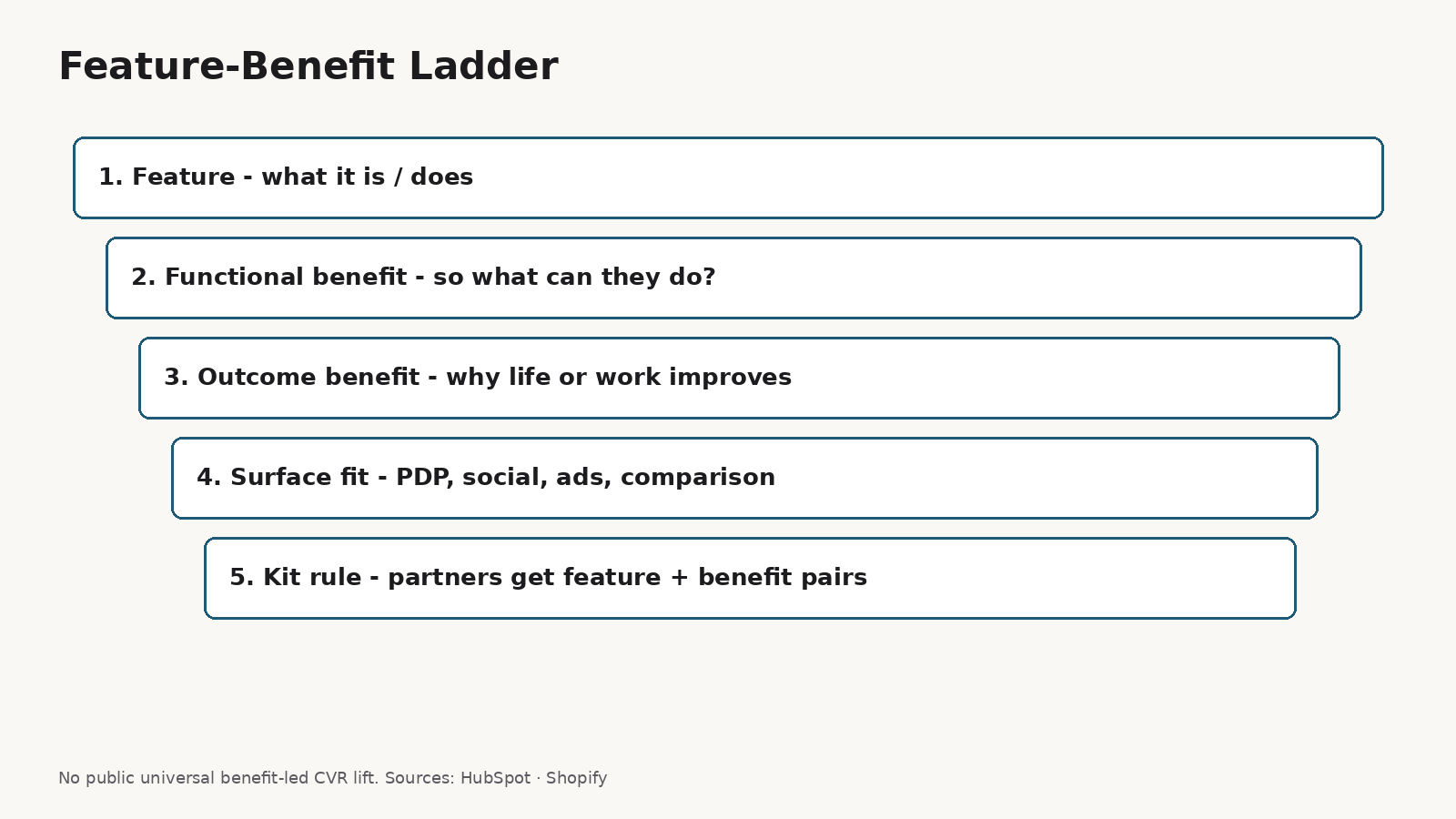
Source: Editorial framework from HubSpot and Shopify definitions. https://blog.hubspot.com/marketing/features-vs-benefits-messaging-ht · https://www.shopify.com/blog/features-vs-benefits
Shopify’s teaching example is concrete: Elavi Protein Brownies list features such as 11 grams of protein and sweetening with dates instead of table sugar, then treat benefits as the next layer that answers why that matters to the buyer (Shopify). Copywriters on Reddit compress the same move as “write the feature, ask So what?” (r/copywriting).
| Feature (labeled example) | Functional benefit | Outcome benefit |
|---|---|---|
| 11g protein per brownie (Elavi via Shopify) | Higher protein snack vs typical treat | Stay fuller / hit protein goals without a separate shake |
| Date-sweetened, not table sugar (Elavi via Shopify) | Different sweetener profile | Fits a cleaner-snack story the buyer already wants |
| 3X points per $1 at 7,000+ Marriott locations (HubSpot’s Marriott example) | Faster rewards accrual | Vacation views / free nights feel nearer |
Source: Shopify Elavi case (2025); HubSpot Marriott creative example (updated 2023). Labeled teaching rows, not category averages.
| Market condition | Lead with | Why |
|---|---|---|
| Saturated (many lookalikes) | Differentiating features | Buyers already know the category benefits; they need your unique attributes (HubSpot) |
| Niche or unfamiliar | Benefits | Buyers need the “why care” before they parse specs (HubSpot) |
| Always | Feature + benefit bridge | HubSpot: if you highlight features, make the benefit explicit (HubSpot) |
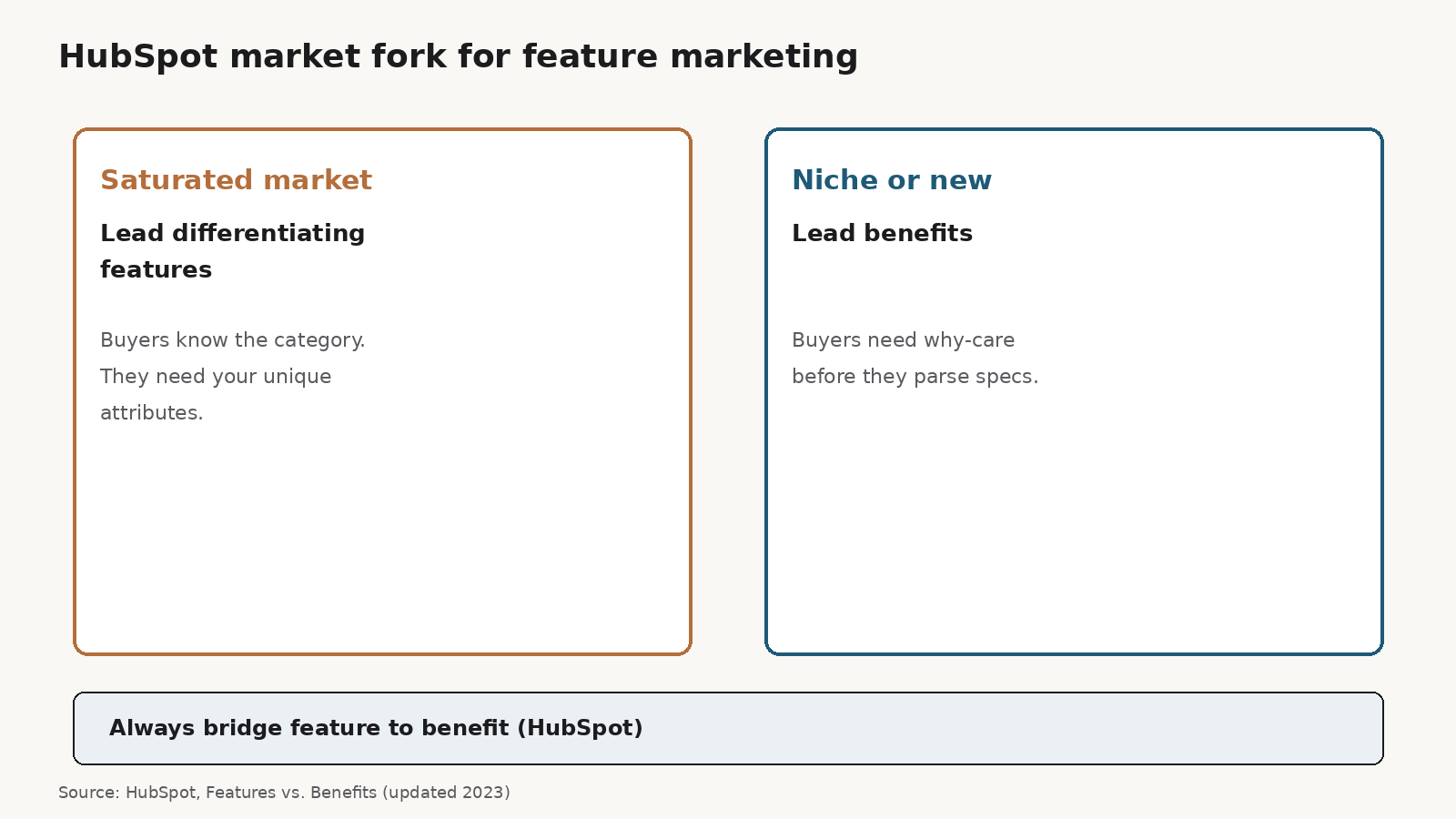
Source: HubSpot, Features vs. Benefits (updated Aug 16, 2023). https://blog.hubspot.com/marketing/features-vs-benefits-messaging-ht
Shopify’s playbook is a surface decision matrix, not a single slogan (Shopify):
| Surface | Lead | Support |
|---|---|---|
| Side-by-side comparison | Features | One-line benefit under the winning row |
| Product page | Feature + benefit pairs | Specs as proof, outcomes as headlines |
| Social | Benefits + proof | Features in caption details or stickers |
| Ads | Benefits + visuals | Features as secondary lines |
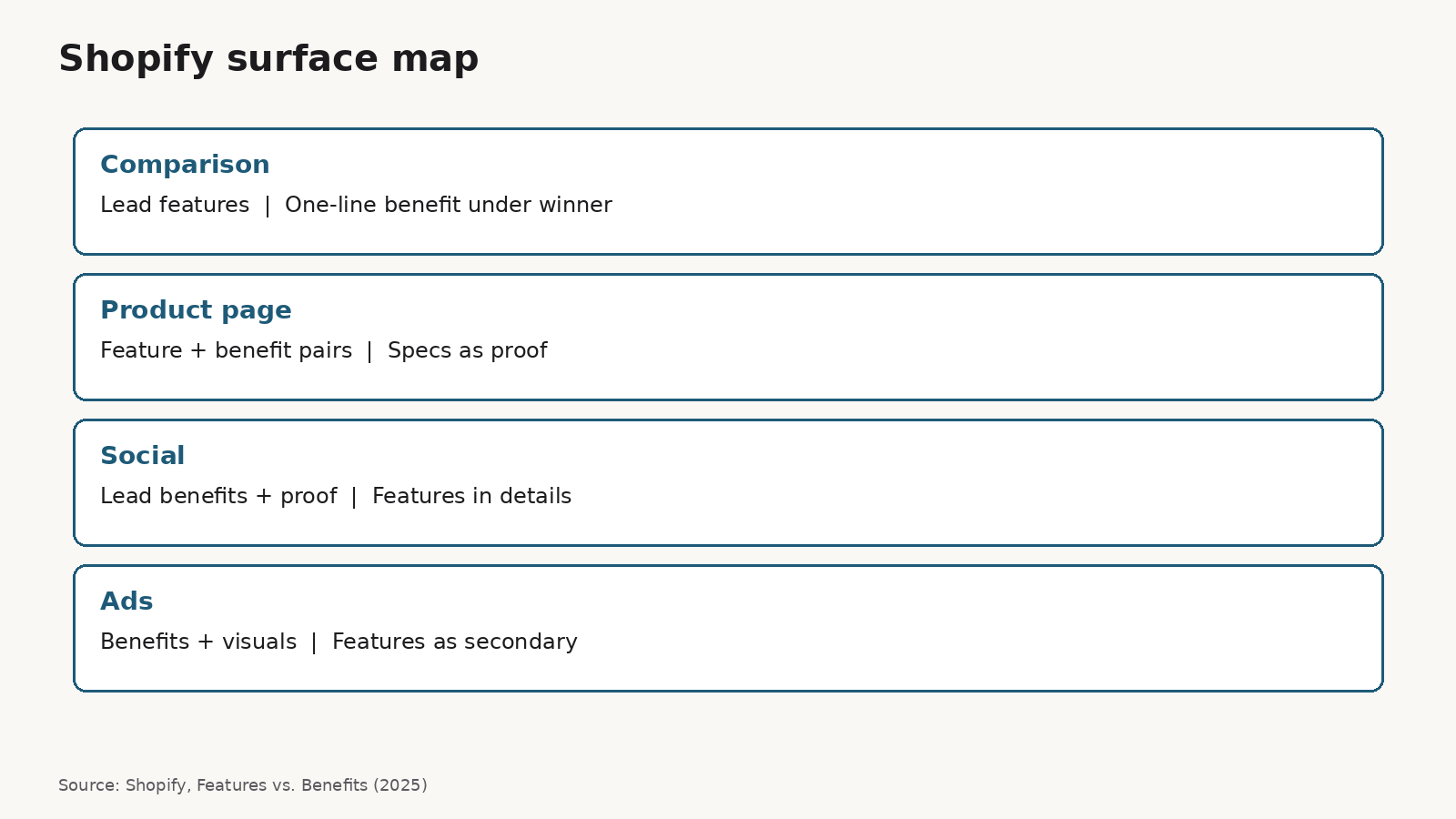
Source: Shopify, Features vs. Benefits (Oct 10, 2025). https://www.shopify.com/blog/features-vs-benefits
That matrix also fits a digital product funnel: tripwires and core offers still need the same ladder, just with fewer words at the top of the funnel.
If a merchant hands creators a feature dump, every caption becomes a second draft of the same unfinished sentence. Ship kits as rows: feature | functional benefit | outcome | proof link | disclosure reminder. Co-branded storefronts inherit the same pairs on the listing. Feature marketing here is ops, not poetry.
A practical QA pass before you publish a kit: read only the benefit column out loud. If a creator could post that column with a tracked link and a clear disclosure, the ladder worked. If they still need you on a Zoom to explain why the SKU matters, the feature column never climbed. Merchants who recruit affiliates after a feature-only launch usually rediscover this the hard way when partners ask for “the one-liner” that should have been in the brief.
It is not a promise that benefit-led pages lift conversion by a fixed percent. That lift has no public dataset as a universal number. It is not permission to hide material facts. Specs that affect safety, price, or eligibility still belong on the page. It is not beat marketing: cadence without clear offer language still fails.
Q: What is feature marketing? A: Feature marketing is messaging that starts from product or service attributes: what the offer is, includes, or does. It works when each feature climbs to a functional benefit and an outcome benefit instead of stopping at the spec sheet.
Q: What is the difference between features and benefits? A: Features are objective attributes or capabilities. Benefits are why those attributes matter to the buyer’s life or work. HubSpot and Shopify both use that split; HubSpot adds that benefits are what typically compel purchase.
Q: Should marketing always lead with benefits? A: Usually yes for awareness and social, per HubSpot’s benefits-heavy default. In saturated markets, lead the features that make you different, then bridge to benefits. In niche or unfamiliar categories, lead benefits so buyers know why to care.
Q: How should affiliates and creator storefronts use feature marketing? A: Give partners feature-benefit pairs, not feature dumps. Creators sell outcomes in short form; if the kit stops at attributes, they invent or omit the sale. Pair each claim with proof and required disclosure language.
Q: Does benefit-led copy guarantee higher conversion rates? A: No. There is no public dataset for a universal conversion lift from benefit-led versus feature-led pages. Use the ladder to clarify the offer, then test on your surfaces. Refuse invented average lifts.
Feature marketing is attribute-first messaging that still owes the buyer a benefit. Climb feature to functional benefit to outcome, pick HubSpot’s saturated versus niche lead, follow Shopify’s surface map, and never ship partner kits that stop at bullets.
List a product with clear offer language for creators to sell on feat.: https://www.feat.press
Go-to-market strategy frameworks compared: PLG, SLG, product-led sales, and partner motions, with Bain's ~2x PLG growth finding and when hybrids win.
GoAffPro pricing: Hobby Free, Premium $49, Business from $99. No sales %, vs UpPromote.
GrowSurf pricing: Startup $179, Business $449. Participant tiers, Affiliate Free+$3%, vs ReferralCandy.