GoAffPro Pricing Explained
GoAffPro pricing: Hobby Free, Premium $49, Business from $99. No sales %, vs UpPromote.
How to qualify affiliates with a Qualify Ladder: LinkJolt 83% manual review, PartnerStack 43% vs 3%, Rewardful 1.28% sale activation.

TL;DR: How to qualify affiliates means running a Qualify Ladder before you hand out tracking links. Screen the application, review by hand (LinkJolt finds 83% of campaigns do), prefer pre-vetted partners (PartnerStack 43% earn vs 3% outside the Network), then watch the first sales. Most approved partners never sell.
Auto-approve feels like growth. Your partner count climbs. Your Slack channel fills with “welcome” macros. Attributed revenue stays flat. That is not a recruitment problem. That is a qualification failure.
How to qualify affiliates is the gate between a signup form and a tracking link. Recruiting decides who you invite. Fraud detection decides who you claw back later. Qualification decides who gets in. Sourcing order lives on how to recruit affiliates for your product. Post-sale tactics live on affiliate fraud and how to detect it. Go-live locks live on how to start an affiliate program for your business. This page owns the approve-or-decline ladder.
Affiliate qualification is the merchant decision to approve, decline, or hold an applicant before they receive a tracking link and before commissions can become payable on their traffic.
It is membership control, not commission bookkeeping. On LinkJolt, affiliate approval and commission approval are separate steps. Pending affiliates do not see a tracking link until you approve membership (LinkJolt). That split matters. You can still review every payout even after a partner is live. Qualification is the earlier filter that decides whether they get the link at all.
It is also not the same job as recruiting. Recruiting builds a shortlist and sends invites. Qualification scores the people who apply or accept. Keep the Warm-to-Cold sourcing ladder on the recruit spoke. Keep cookie stuffing, bot clicks, and last-click hijacks on the fraud spoke. Qualify is the middle door.
Qualifying affiliates matters because most enrollments never earn, auto-approve multiplies dormancy and brand risk, and a short vetted roster beats a fat empty one.
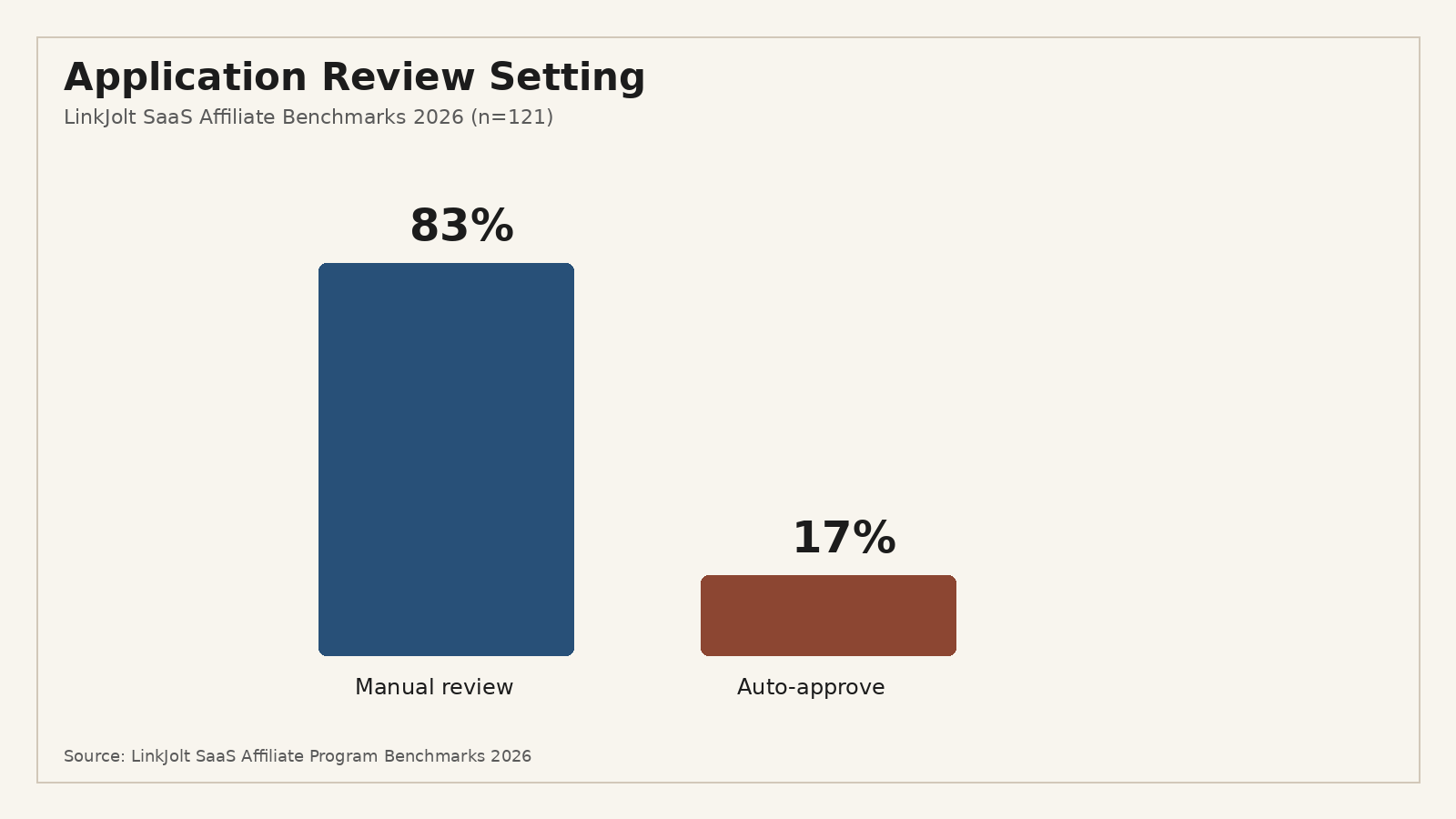
Source: LinkJolt SaaS Affiliate Program Benchmarks 2026 (121 campaigns). https://www.linkjolt.io/saas-affiliate-benchmarks
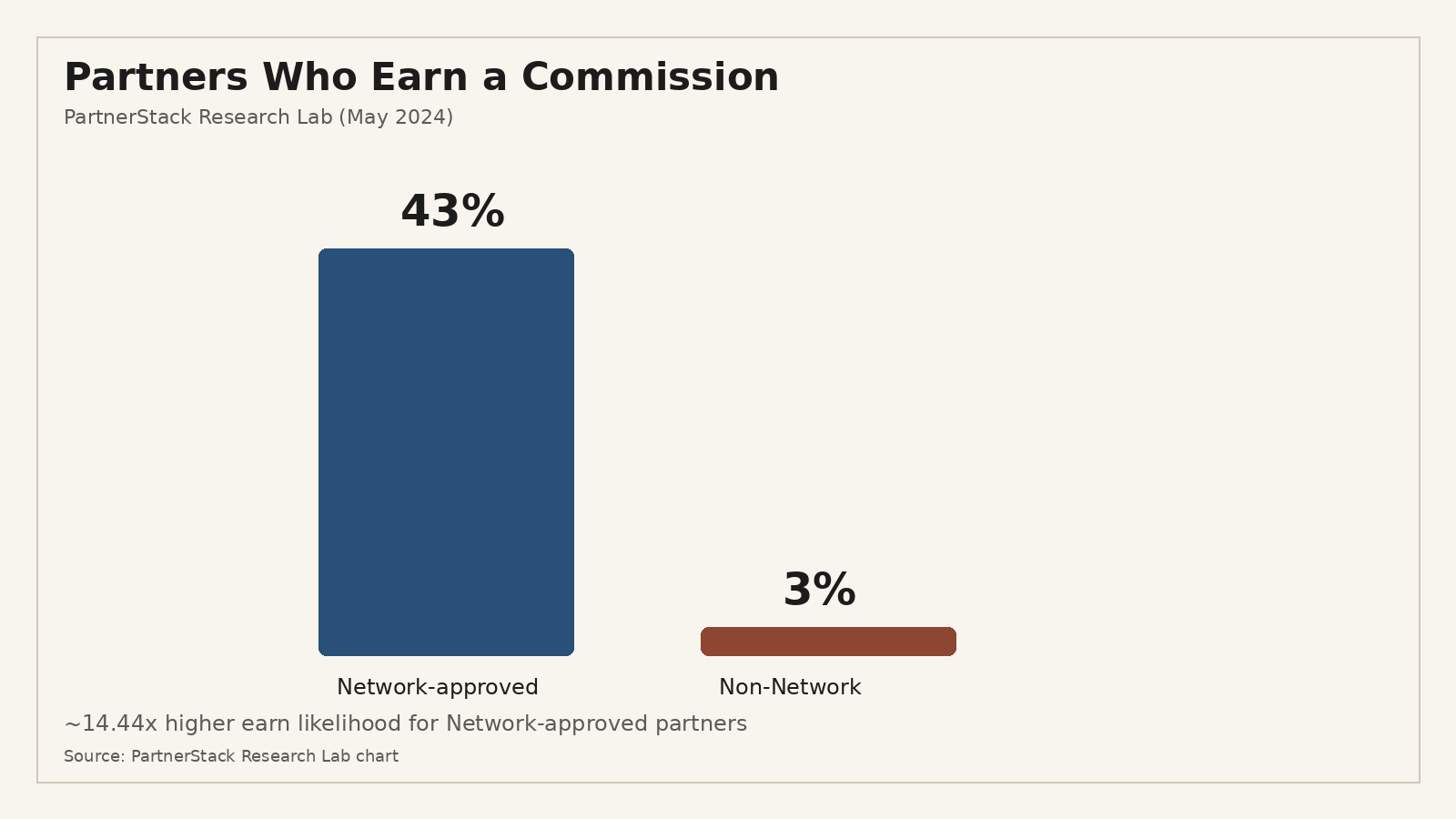
Source: PartnerStack Research Lab chart on Network-approved partners earning commissions vs non-Network partners (May 2024). https://partnerstack.com/resources/research-lab/charts/partnerstack-network-approved-partners-are-far-more-likely-to-earn-a-commission-compared-to-non-network-partners
How to qualify affiliates works as a Qualify Ladder. Screen the application against published checks. Review by hand as the default. Prefer partners who already cleared a network or profile gate. Approve only when audience fit beats roster vanity. Watch the first sales before you treat the partner as trusted. Skip a rung and you import dormancy or fraud into the same queue.
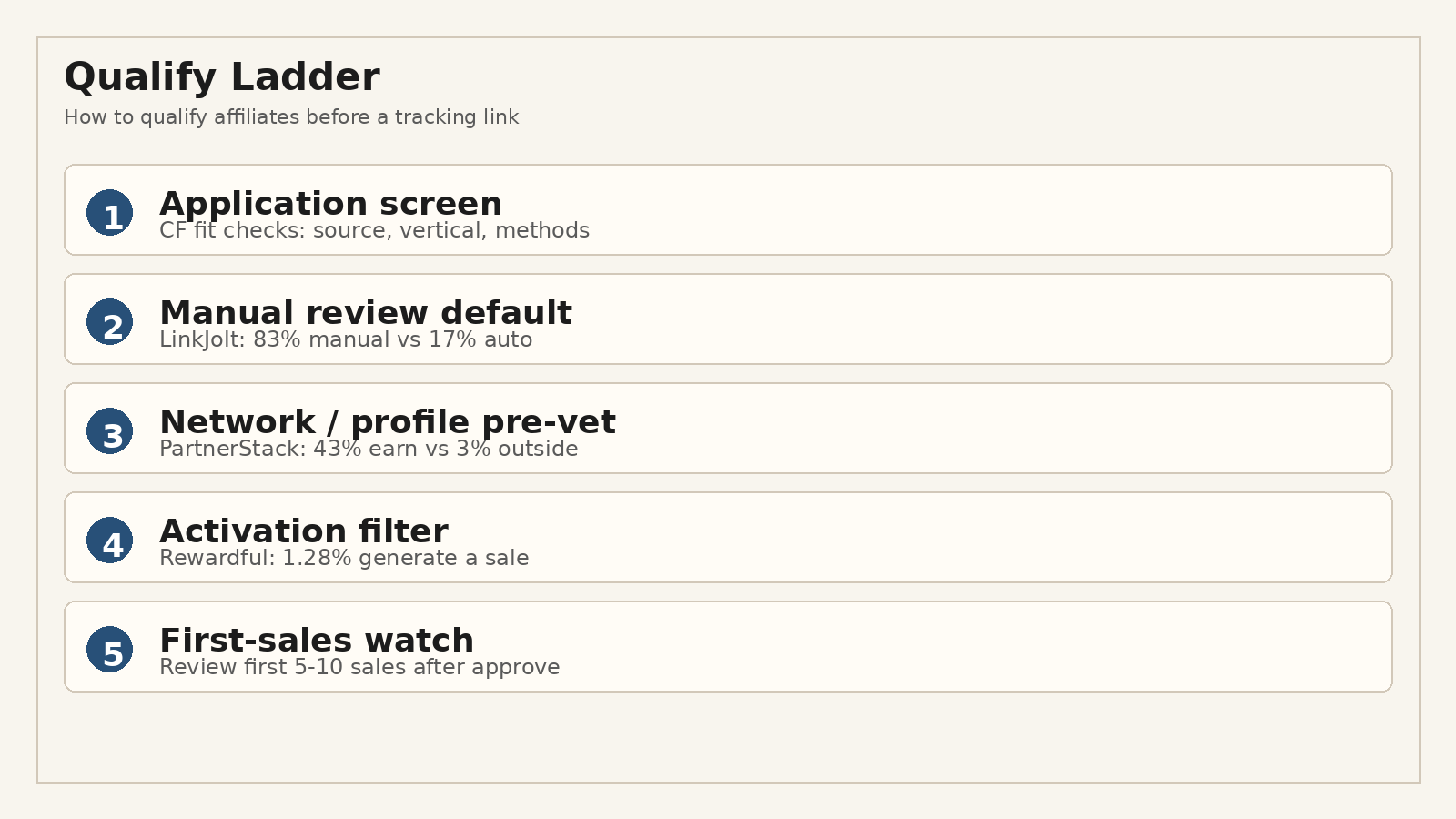
Source: Editorial Qualify Ladder; LinkJolt 83%/17% (n=121), PartnerStack 43% vs 3%, Rewardful 1.28%/7.6% (n=2,847), Commission Factory screening help, Matt McWilliams approve/decline criteria. https://www.linkjolt.io/saas-affiliate-benchmarks · https://partnerstack.com/resources/research-lab/charts/partnerstack-network-approved-partners-are-far-more-likely-to-earn-a-commission-compared-to-non-network-partners · https://www.rewardful.com/articles/state-of-saas-affiliate-programs-report
Start with the questions Commission Factory tells advertisers to ask: Does the traffic source resolve? Does the content match your vertical? Is the category accurate? Do they have traffic or a following? Is the promotion method permitted under your terms (Commission Factory)? A no on any line is decline or clarify, not auto-approve. Trademarked brands in the URL, nonsensical site descriptions, and brand-misaligned content are listed as extra red flags on the same page.
Cadence matters. Commission Factory recommends screening at least twice per week, or once at a minimum, and rejects as well as accepts so applicants are not left pending (Commission Factory). Pending limbo is how good partners go promote someone else.
Treat manual membership approval as the operating baseline. LinkJolt reports 83% of campaigns review every application by hand against 17% that auto-approve (LinkJolt). Their fraud playbook frames that same split as operators preferring a few hours of review over paying fabricated cohorts later (LinkJolt).
If your stack can auto-approve, keep commission approval manual. LinkJolt never auto-approves commissions; every tracked sale lands pending until you clear it (LinkJolt). Membership auto-approve without payout review is how spam becomes payroll.
When you recruit from a marketplace or network, prefer partners who already cleared that network’s gate. PartnerStack reports Network-approved partners earn commissions at 43% versus 3% for non-Network partners (PartnerStack). That is not a promise that Network partners will sell for you. It is evidence that a prior quality gate correlates with earners.
PartnerStack also says partners who complete their Network profile are 75% more likely to be accepted into programs, with Network applications typically reviewed within 5 business days (PartnerStack). Incomplete profiles are a soft decline signal even before you open the site.
Score applicants against the activation reality you already publish to yourself. Rewardful finds 7.6% of affiliates generate a referral and 1.28% generate a sale across 2,847 programs (Rewardful). Approving a coupon scraper, a dead domain, or a “I’ll promote later” applicant does not move those meters. Ask for a first-promotion plan in the application: which URL, which audience, which asset, which week. No plan is a hold, not a yes.
| Qualify signal | Prefer | Decline or hold |
|---|---|---|
| Traffic source | Resolves; matches declared channel | Broken URL; empty social; “TBD” |
| Content fit | Same buyer language as your offer | Off-vertical, scrape farm, trademark-in-domain |
| Method | Content, email, allowed social | Undisclosed media buy, brand+coupon SEM you ban |
| Network / profile | Network-approved or complete profile | Empty profile; brand-new account with no history |
| First-sale plan | Named surface + date | “Will promote soon” with no asset |
Approval is not trust. Matt McWilliams advises reviewing the first 5 to 10 sales for abnormal conversion rates, refund spikes, and credit-card fraud patterns before you treat a new partner as routine (Matt McWilliams). He also scores roughly 10 criteria and treats failing four or more as an automatic decline, while preferring outreach over silent rejection when the application is thin (Matt McWilliams). Pair that watch with your affiliate rules monitoring cadence and the fraud checklist on affiliate fraud and how to detect it.
Q: How do you qualify affiliates for an affiliate program? A: Run a Qualify Ladder: screen the application for traffic fit and permitted methods, review membership by hand, prefer network or profile pre-vet when available, approve only with a first-promotion plan, then watch the first 5 to 10 sales. LinkJolt finds 83% of campaigns already review manually.
Q: Should I auto-approve affiliate applications? A: Default to no. LinkJolt’s 121-campaign sample shows 83% manual review versus 17% auto-approve. If you auto-approve a trusted invite list, keep commission approval manual so payouts still clear a human gate.
Q: What criteria should I use to screen affiliate applications? A: Start with Commission Factory’s checks: resolving traffic source, vertical fit, accurate category, real traffic or following, and permitted methods. Add trademark-in-URL, brand-value mismatch, and missing promotion plans as decline or hold signals.
Q: How long should affiliate application review take? A: Commission Factory recommends screening at least weekly (ideally twice). PartnerStack’s Network team typically reviews Network applications within 5 business days. Publish your own SLA in the application so partners know when they will hear back.
Q: Does approving more affiliates increase sales? A: Not by itself. Rewardful finds only 1.28% of affiliates generate a sale across 2,847 programs. PartnerStack’s 43% versus 3% earn-rate gap shows pre-vetting correlates with earners. Qualify for sellers, not headcount.
How to qualify affiliates is a ladder, not a vibe check. Screen the form, review by hand, prefer pre-vetted partners, approve for a first promotion, then watch early sales. The citation stack is blunt: 83% manual review, 43% versus 3% earn rates after a network gate, and 1.28% who ever sell. Keep the empty 98.72% out of your roster.
If you want partners selling through co-branded storefronts instead of a bare tracking link, list your product on feat. and let affiliates claim a storefront seat.
GoAffPro pricing: Hobby Free, Premium $49, Business from $99. No sales %, vs UpPromote.
Refersion pricing: Launch $39+3%, Growth $199+2%. Affiliate-sales fees, crossover math, vs UpPromote.
UpPromote pricing: Free, Growth $29.99+2%, Pro $89.99+1.5%. Performance fees, crossover math, vs ReferralCandy.