Discord vs Slack for Merchant Communities
Discord vs Slack for merchant communities: Chat Seat Ladder—seat math, 90-day Slack Free history, Stage AMAs, Nitro Basic $2.99 vs Pro $8.75.
Merchant community vs newsletter for marketplace retention: Peer Room vs Broadcast, Hivebrite events 76.9%, Slack Free 90-day history vs Discord Nitro $2.99.

TL;DR: Merchant community vs newsletter for marketplace retention is a Peer Room vs Broadcast choice. A Discord or Slack peer room (storefront examples, AMAs, async help) builds stickiness peers create for each other. A monthly newsletter alone is a one-way blast—useful for announcements, weak as the only retention layer when opens are MPP-noisy and peers never meet.
Operators type merchant community vs newsletter when the marketplace already has listed builders and a blog. The temptation is to ship a monthly digest, call it “community,” and move on. That is Broadcast dressed as belonging. Retention for merchants who list products and approve affiliates lives in Peer Rooms—places where peers show storefront patterns, run AMAs, and answer “how did you recruit that creator?” without waiting for the next send.
This spoke sits next to community-led growth benchmarks (measurement honesty) and the email marketing guide (when email is the right pipe). It is not a buyer Discord sell on a listing. It is the merchant champion layer for a two-sided sell marketplace.
Merchant community vs newsletter is the choice between a peer room—usually Discord or Slack—where listed merchants teach each other, and a one-way email (or blog-repurposed) broadcast the platform sends on a calendar.
It is not “email bad, Discord good.” Email still wins for transactional proofs: first listing, first affiliate approval, each sale. Those triggers belong in lifecycle automation, as the email marketing guide maps. The mistake is treating a monthly roundup as the retention program while merchants never see each other’s storefronts.
On a marketplace like feat.—builders list, affiliates sell through co-branded storefronts, revenue splits on each sale—the merchant is the scarce side you cannot replace with another cold outreach blast. A peer room is where champions form. A newsletter is where you announce the next office hours. Use both. Rank the peer room first when the job is stickiness.
Merchant community vs newsletter matters because marketplace churn often looks like “quiet listings,” not angry tickets. Merchants stop approving affiliates, stop refreshing creative, and stop answering creators. A broadcast can remind them you exist. A peer room shows them someone like them is still selling.
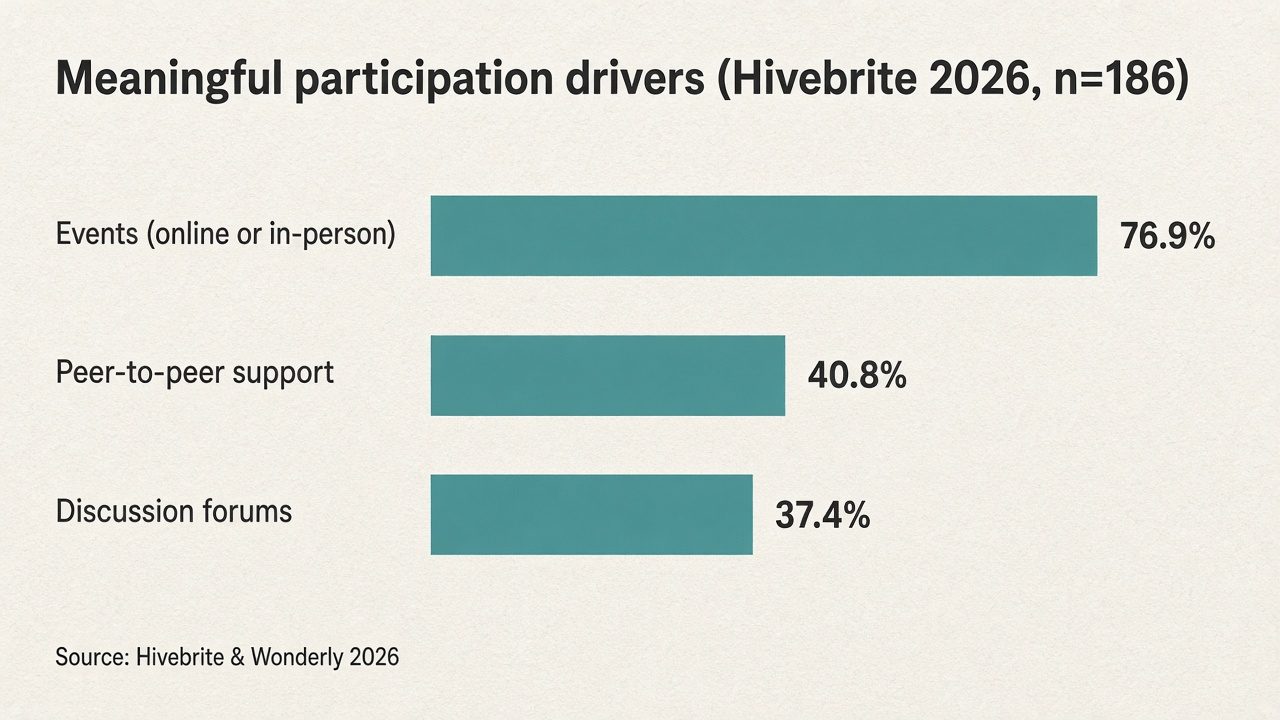
Source: Hivebrite and Wonderly, The Community Growth & Benchmark Report 2026 (n=186). https://go.hivebrite.com/hubfs/guides/community-growth-benchmark-report-2026.pdf
Merchant community vs newsletter works as a two-surface stack: Peer Room for rituals that create belonging, Broadcast for sparse announcements that point back into the room. Collapse both into one monthly email and you get polite opens with no peer learning.
| Surface | Job | Cadence | Proof of life | Failure mode |
|---|---|---|---|---|
| Peer Room (Discord / Slack) | Merchants teach merchants | Always-on + scheduled AMAs | Threads, voice, storefront examples | Empty channels, no host |
| Broadcast (newsletter / blog digest) | Platform → merchant one-way | Weekly or monthly | Clicks to room / docs | MPP opens, no reply path |
| Lifecycle email | Transactional state changes | Event-triggered | Listing / approval / sale | Mistaken for “community” |
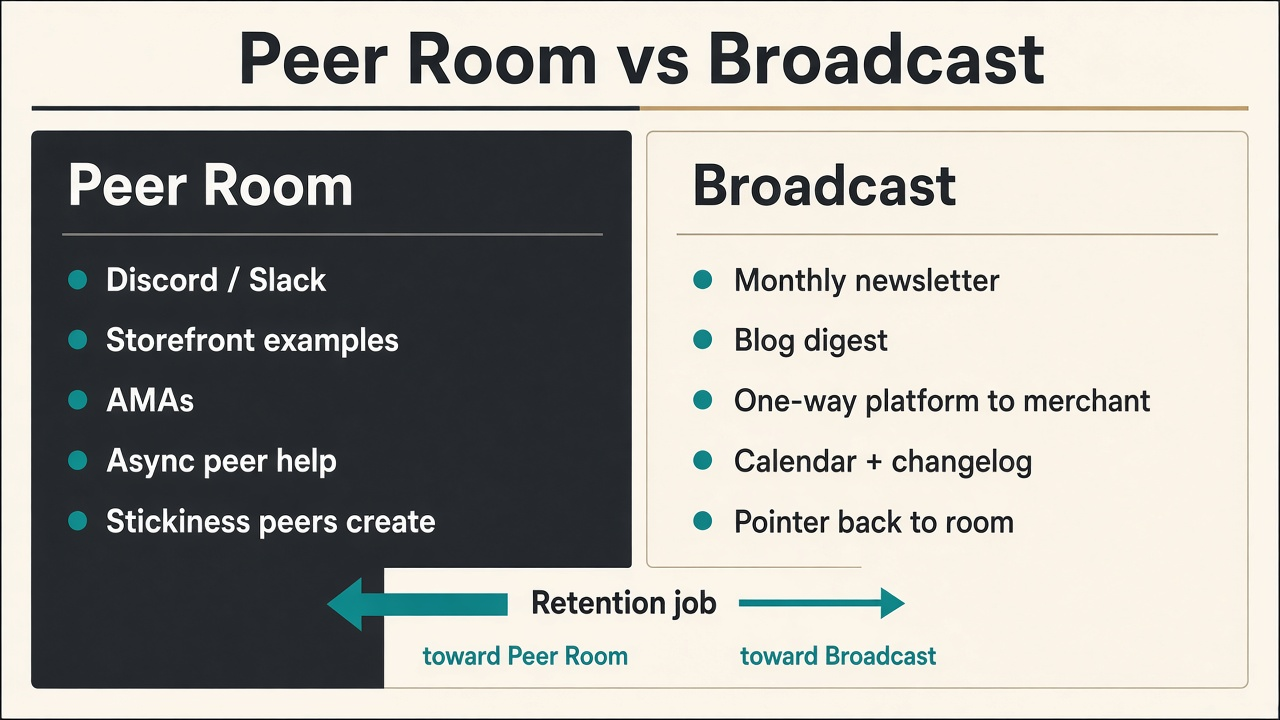
Source: feat. editorial framework (Peer Room vs Broadcast); participation drivers from Hivebrite 2026. https://go.hivebrite.com/hubfs/guides/community-growth-benchmark-report-2026.pdf
Put the work only peers can do:
Keep the newsletter thin on purpose:
If every issue is five blog posts pasted into Mailchimp, you chose Broadcast because it was easy to staff—not because merchants asked for it.
| Constraint | Slack Free | Slack Pro (monthly) | Discord Nitro Basic |
|---|---|---|---|
| Platform bill model | $0 workspace | $8.75/user/month | $2.99/month personal |
| Message history | 90 days | Unlimited (paid) | Server history not gated by Nitro |
| App integrations (Free Slack) | Up to 10 | Full Pro set | Server bots (community-shaped) |
| Best fit for merchant peer room | Tiny pilot only | When you need workplace SSO/integrations | When members fund their own Nitro and you host a free server |
Sources: Slack Pricing (US, accessed 2026-10-13); Discord Nitro (accessed 2026-10-13). Annual Slack discounts and Business+ tiers exist—re-check the vendor page before you model a 200-seat bill. Discord Nitro is not a per-seat community plan; it is a personal upgrade. Never invent feat. community fees.
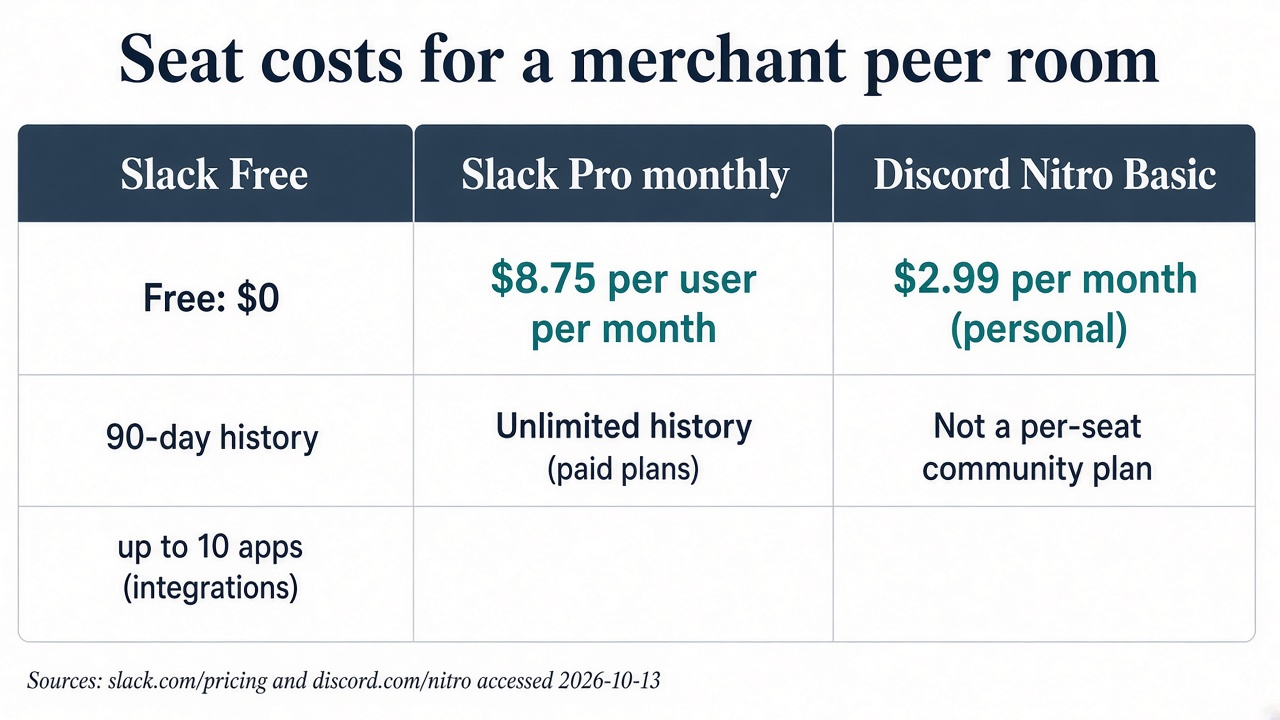
Source: Slack Pricing (https://slack.com/pricing) and Discord Nitro (https://discord.com/nitro), accessed 2026-10-13.
CMX finds only 24% of community teams can confidently quantify value; CRM-connected teams rate themselves “extremely successful” at 24% versus 11.5% when systems are disconnected (CMX). For a marketplace merchant room, track:
There is no public dataset for a single cross-marketplace retention lift of “community vs newsletter.” Label any internal cohort study as proprietary. Do not paste creator-blog churn percentages that lack a primary census.
Q: What is merchant community vs newsletter for marketplace retention? A: It is the Peer Room vs Broadcast choice: a Discord or Slack space where listed merchants teach each other versus a one-way email digest. Use lifecycle email for transactional triggers; use the peer room for stickiness.
Q: Should a marketplace replace its newsletter with Discord? A: No. Keep Broadcast thin for calendars and changelogs, and put storefront examples and AMAs in the Peer Room. Hivebrite still ranks events as the top participation driver at 76.9% (Hivebrite).
Q: Is Slack or Discord better for a merchant peer community? A: Discord usually wins on free server scale and voice; Slack wins when you need workplace integrations and can pay $8.75/user/month on Pro (Slack; Discord). Pick for governance and seat math, not vibes.
Q: How do you measure merchant community ROI without inventing numbers? A: Compare members vs non-members on approvals, storefront refreshes, and active listings. CMX finds only 24% of teams can confidently quantify community value today (CMX).
Q: Does a high newsletter open rate mean merchants are retained? A: No. Apple Mail Privacy Protection can inflate opens; plan on clicks into the Peer Room and commercial deltas instead (Apple).
Merchant community vs newsletter is not a branding preference. It is whether you fund a Peer Room where champions form or a Broadcast that only reminds merchants you have a blog. Staff the room. Keep the newsletter as the pointer. When you are ready to list products and let people sell them for you, start on feat..
Discord vs Slack for merchant communities: Chat Seat Ladder—seat math, 90-day Slack Free history, Stage AMAs, Nitro Basic $2.99 vs Pro $8.75.
How to run merchant AMAs: Champion AMA Ladder—invite, storefront teardown, Discord Stage Q&A, clips—plus Hivebrite events at 76.9%.
Community-led growth benchmarks: Hivebrite's confidence-vs-evidence gap, events at 76.9% of participation, and CMX's 24% who can quantify value.