Whitelisted Ads Explained (Naming Ladder)
Whitelisted ads means creator-handle paid. Map slang to Meta Partnership Ads and TikTok Spark Ads, separate usage rights, price the window.
Creator whitelisting for TikTok (Spark Ads) and Meta (Partnership Ads): rights stack, ~19% lower CPA on Meta, and when creator-handle paid beats brand UGC.

TL;DR: Creator whitelisting for TikTok and Meta is permission to run paid ads from a creator’s identity, not just reuse their file. Meta calls the product Partnership Ads. TikTok calls it Spark Ads. Meta reports about 19% lower CPA and 13% higher CTR when Partnership Ads are added to business-as-usual campaigns. Price the right separately from the organic post fee.
Most briefs still say “whitelist the post” as if it were a checkbox after the Reel goes live. That sentence hides three different products, two platform tools, and a fee line that often decides whether the campaign makes money.
Creator whitelisting for TikTok and Meta means separating the creative fee from the paid identity right. Creator-handle ads sit between organic influencer posts and brand-handle paid social. They are why influencer marketing vs paid ads is a false binary for many DTC teams.
Key takeaways:
Whitelisting is the permission a creator grants a brand (or agency) to run paid social ads that use the creator’s identity or authorized organic post, so the ad is delivered from the creator side of the relationship rather than only from the brand’s page.
Spark Ads is TikTok’s product name for that pattern: you promote an organic TikTok post, with authorization when the post is not yours, and keep native engagement behaviors tied to the post (TikTok Ads Help). Partnership Ads is Meta’s product name on Instagram and Facebook. Meta’s help center states that branded content ads are now called partnership ads, and that ads can feature partner and advertiser accounts in the header while leveraging signals from both (Meta Help).
Three surfaces get collapsed into one slang word:
| Surface | What you buy | Identity in the ad | Typical right |
|---|---|---|---|
| Organic creator post | Publish fee for a feed/Reel/TikTok | Creator, organic | Organic posting only |
| Brand-handle paid UGC | License to run the file from your ad account | Brand | Usage rights (duration, channels) |
| Creator-handle paid (whitelist) | License + platform authorization | Creator (or dual) | Partnership Ads / Spark Ads window |
If you only licensed the file for brand-handle ads, you did not whitelist. If you got a Spark code or Partnership Ads permission, you did. Practitioner threads treat usage, exclusivity, and whitelisting as most of the economic value after the base fee (r/influencermarketing). Cheerful’s format rate tables exclude usage, whitelisting, and exclusivity on purpose so those lines stay itemised (Cheerful).
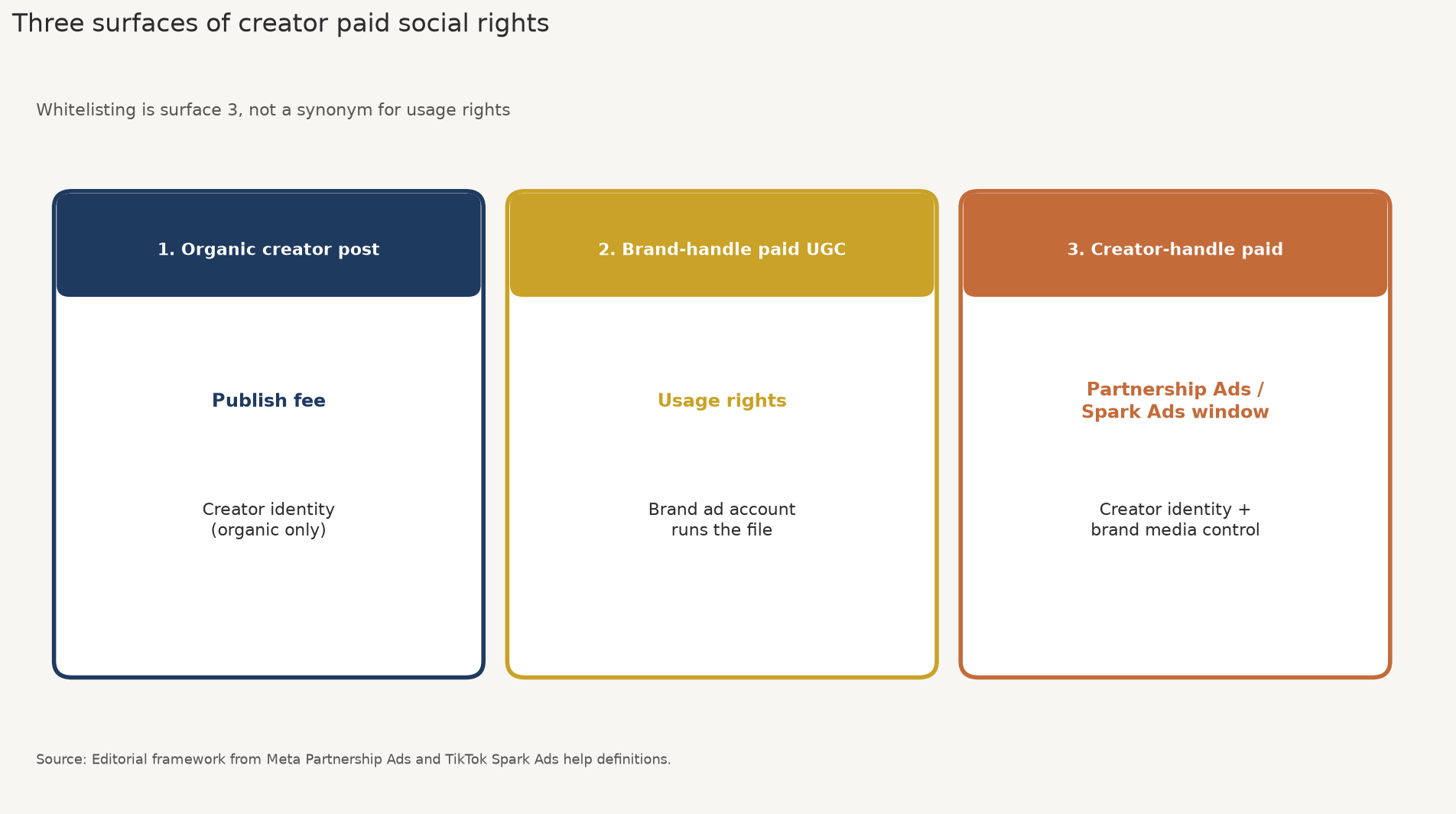
Source: Editorial framework summarizing Meta Partnership Ads and TikTok Spark Ads product definitions. https://www.facebook.com/business/help/342728904797642 · https://ads.tiktok.com/help/article/spark-ads
Creator spend is no longer a side bet. IAB projects U.S. creator economy ad spend at about $37 billion in 2025, up 26% year over year from $29.5 billion, roughly four times overall media growth (IAB). Amplifying the posts you already paid for is how that spend turns into a media channel instead of a one-week spike.
Why the distinction earns a page:
Creator-handle paid social works by pairing a commercial license with a platform authorization, then buying auction media against that authorized post. Meta and TikTok use different UIs. The job is the same: keep the creator identity in the ad unit while the brand controls targeting and spend.
Partnership Ads let advertisers run ads with creators (or other businesses) so partner and/or advertiser accounts appear in the ad header and the system can use signals from both accounts (Meta Help). Meta’s December 2025 tooling push around the Partnership Ads Hub is about discovery and scale, not a new definition of the format (Meta news).
Published Meta performance claims to cite carefully:
| Claim | Figure | Source note |
|---|---|---|
| CPA / cost per result | ~19% lower vs BAU | Meta news average for adding Partnership Ads to BAU; Facebook post cites ~2,400-advertiser A/B, Jun 14-21, 2025, link clicks and offsite conversions |
| CTR | ~13% higher vs BAU | Meta news average (same Partnership Ads vs BAU framing) |
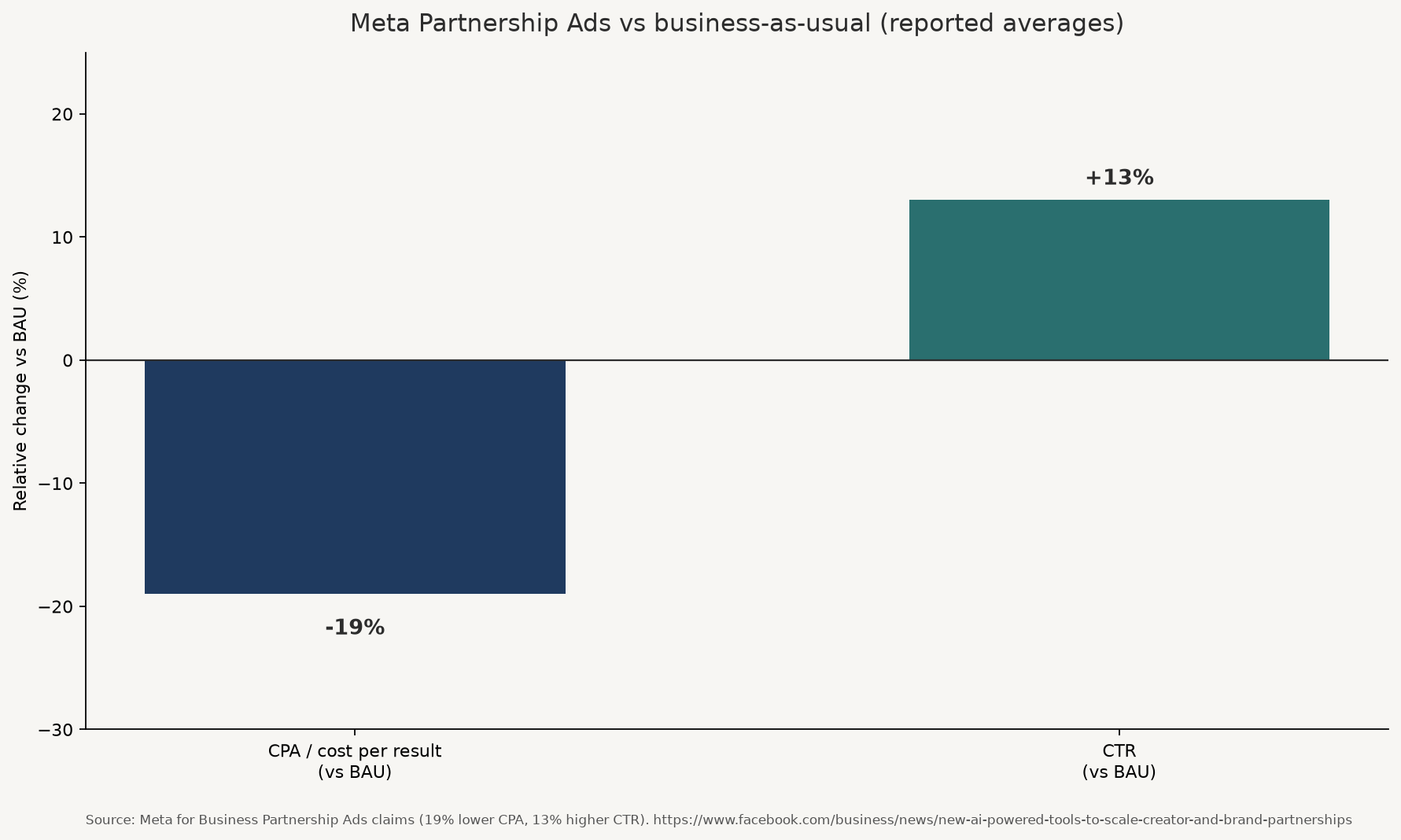
Source: Meta for Business, Partnership Ads performance claims. https://www.facebook.com/business/news/new-ai-powered-tools-to-scale-creator-and-brand-partnerships · methodology window also summarized in Meta’s public post on the ~2,400-advertiser A/B (Jun 14-21, 2025).
Those are Meta-reported averages across their tests, not a guarantee for your account. Retargeting audiences where the brand handle is already trusted often show a smaller identity gap. Still, if your creative tests never include creator-handle variants, you are not measuring the format Meta is selling.
Setup, in plain language: the creator authorizes the branded/partnership content relationship for the eligible post; the brand builds the ad in Ads Manager as a Partnership Ad against that authorization; media spend, destination URL, and optimization event stay under the advertiser. Revocation and active-ad closeout belong in the SOW. If a creator can kill new ads while old ones keep spending, your contract should say who pauses what within 24 hours.
Spark Ads promote an organic TikTok post as an ad. You can spark your own posts or a creator’s posts with their authorization. TikTok’s help center emphasizes native behaviors (profile, follow, sound) and that engagement from the boost can attribute to the organic post (TikTok About Spark Ads).
Creator authorization is post-level. In practice, creators enable ad settings on a video, choose an authorization duration (commonly 7, 30, 60, or 365 days in the current UI), generate a code, and send it to the advertiser. Brands redeem codes in Ads Manager (Creative library / Spark Ads posts) and then build campaigns that use the authorized post. Codes do not transfer to every video from that creator. Duets and stitches can require codes from both creators.
Operator evidence for Spark versus standard In-Feed comes from AdLiftr’s mid-market sample (3,127 campaigns, 548 advertisers, February 1 to May 28, 2026, $18.7M spend). Medians:
| Metric | Spark Ads | Standard In-Feed | Advantage |
|---|---|---|---|
| Median CTR | 1.62% | 0.84% | 1.92× |
| Median CPC | $0.47 | $0.78 | 1.66× cheaper |
| Median CPM | $6.20 | $7.40 | 1.19× cheaper |
| Median CPA (DTC e-com) | $12.40 | $17.20 | ~28% lower (1.39×) |
| Median video completion | 28.4% | 16.1% | 1.76× |
Source: AdLiftr, TikTok Ads Cost 2026 (May 30, 2026). Self-selecting sample; AdLiftr notes within-advertiser controls still favor Spark (~1.5× CTR, ~1.25× CPA).
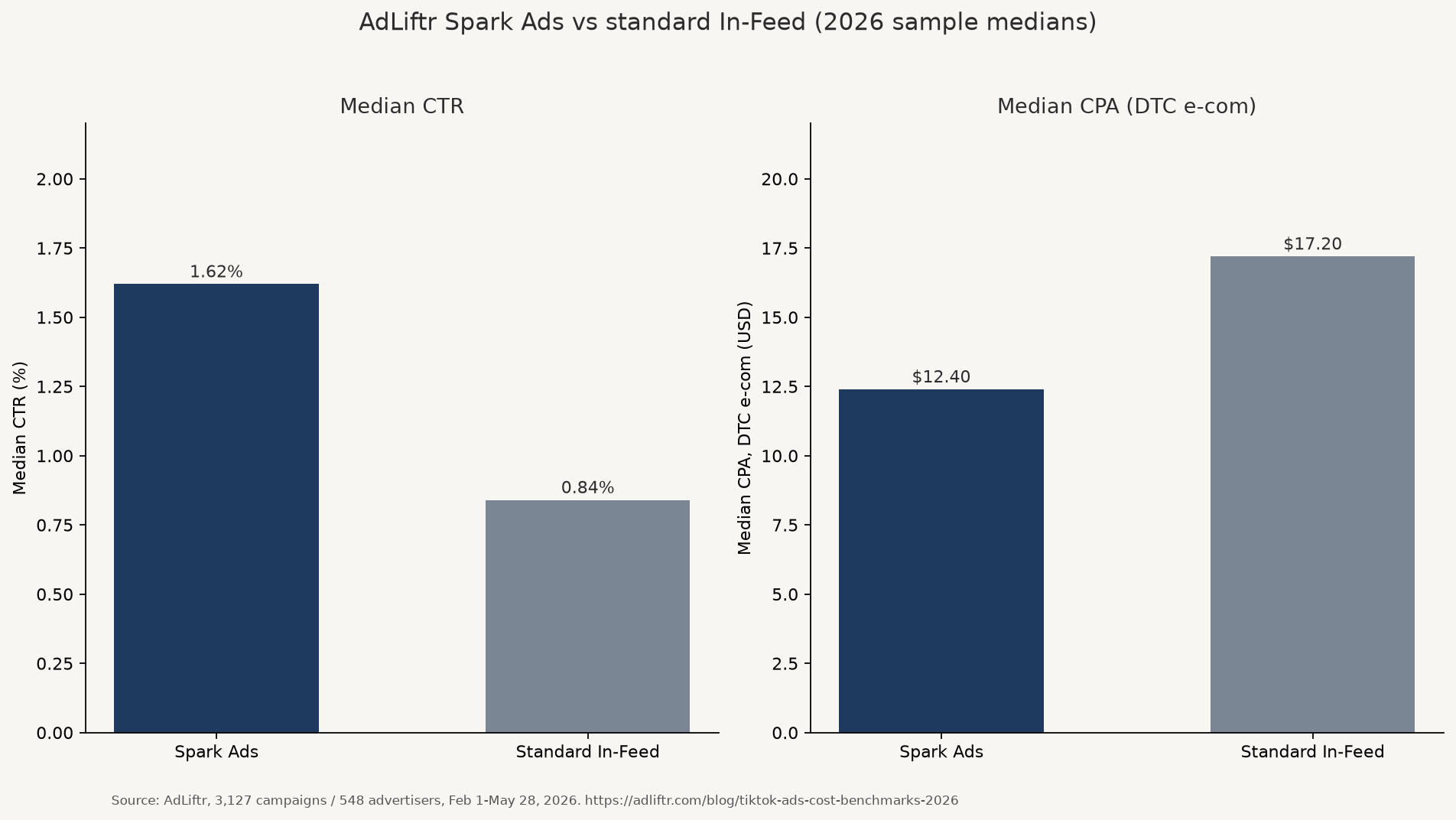
Source: AdLiftr, 2026. https://adliftr.com/blog/tiktok-ads-cost-benchmarks-2026
Do not merge AdLiftr’s CPA dollars with Meta’s 19% relative lift into one fake “industry CPA.” Different platforms, different samples, different baselines.
| Constraint | Prefer brand-handle UGC | Prefer creator-handle (Partnership / Spark) | Prefer organic-only |
|---|---|---|---|
| Goal | Cheap creative volume for testing | Lower CPA / higher CTR with identity | Awareness seeding, no media yet |
| Rights budget | Usage license only | Usage + whitelist fee + media | Post fee only |
| Creator ops capacity | Low (file delivery) | Medium-high (codes, renewals) | Low |
| Proof needed | Static product demo | Social proof + comments matter | Authenticity without spend |
| Risk | Weaker trust signal | Revocation, expiry, spend caps | No auction scale |
Vet engagement before you buy either paid surface (how to vet an influencer’s real engagement). A Spark code on a padded audience just buys expensive bots.
Q: What is creator whitelisting for TikTok? A: Creator whitelisting for TikTok is permission to boost a creator’s (or authorized) organic post as a Spark Ad so paid delivery keeps the creator identity. Meta’s equivalent is Partnership Ads (formerly branded content ads). People still say “whitelist” for both products. It is a commercial right, not just a file reuse license.
Q: Do Spark Ads really perform better than standard TikTok in-feed ads? A: In AdLiftr’s 2026 sample of 3,127 campaigns, Spark Ads showed roughly 1.92× median CTR and about 28% lower median DTC e-com CPA than standard In-Feed. AdLiftr also notes selection bias and still finds a within-advertiser advantage. Treat it as strong operator evidence, not a TikTok-wide guarantee.
Q: How much extra do brands pay for whitelisting rights? A: There is no single public tariff. Collabstr’s 2025 marketplace data associates content usage rights with about a 40% cost increase. Cheerful’s negotiation benchmarks keep usage and whitelisting off the base deliverable median so you price them as separate lines. Negotiate window, spend cap, and exclusivity explicitly.
Q: How long should a Spark Ads authorization last? A: Match the code duration to the paid flight plus a buffer for learning and creative winners. TikTok’s UI commonly offers 7, 30, 60, or 365 days. A seven-day code under a month-long test usually forces a mid-flight scramble.
Q: Is brand-handle UGC the same as whitelisting? A: No. Brand-handle UGC is a usage license to run the creator’s file from your ad account. Whitelisting or Spark/Partnership authorization runs paid media with the creator’s identity (or dual branding) and needs platform permission on top of the license.
Whitelisting and Spark Ads are the paid identity layer on top of creator content. Meta Partnership Ads and TikTok Spark Ads are the runnable products. Meta’s published averages and AdLiftr’s Spark versus In-Feed medians both point the same direction: creator-handle delivery is often worth testing against brand-handle baselines, as long as rights, windows, and media sit on separate lines in the model.
If you built a product and want creators selling it with tracked splits alongside paid amplification, start at feat..
Whitelisted ads means creator-handle paid. Map slang to Meta Partnership Ads and TikTok Spark Ads, separate usage rights, price the window.
Diagnose a flatlined influencer agency: fee markups, vanity KPIs, one-off treadmill, missing owned seats, and when to add storefront distribution.
Influencer attribution vs paid media is a confidence ladder: IAB n=453 (platform 55%, MTA 25%, MMM 29%), Google lift + MMM. Not a fake reliability %.