AddShoppers vs Omnisend (Cart Email Seat)
AddShoppers vs Omnisend for cart emails: AddShoppers redirects to Minty. Buy Omnisend's live cart automation with published Free/$16/$59 seats.
Browse abandonment email subject lines: Klaviyo’s 52.79% open sample, why coupons and timers underperform, and a curiosity-before-coupon test ladder.

TL;DR: Browse abandonment email subject lines win on short curiosity first. Klaviyo’s 2018 sample of 1,000+ browse emails averaged 52.79% opens and $2.88 RPR; “Did you see something you liked?” hit 56.82%. Product names (−21%), explicit discounts (~−18%), and timers (−27%) underperformed that sample—so stop pasting cart coupon subjects onto earlier intent.
Most “best browse abandonment email subject lines” lists are cart copy with the word browse swapped in. That is how you train window shoppers to wait for a percentage before they even add to cart.
Browse abandonment email subject lines are the first line of an earlier job. The shopper looked. They did not commit. Your subject has to earn a second look without sounding like a final notice. Flow-level dollars still live in browse abandonment email benchmarks—Omnisend’s Page viewed row earns $0.76 per email at 8.53% CTR while Abandoned cart earns $3.59 at 4.13% CTR (Omnisend). This page is the subject-line spoke.
Key takeaways:
% or $.Browse abandonment email subject lines are the inbox headlines on automated messages sent after a visitor views a product or category page without adding to cart or checking out.
They are not abandoned-cart subject lines. Cart subjects can afford more specificity and more urgency because intent is higher. Browse subjects open a curiosity loop about a glance, not a half-written order. Confuse the two and you either creep people out with the SKU they barely touched or burn margin teaching them that every PDP view unlocks a deal.
ESP labels differ—“Page viewed” in Omnisend, “browse abandonment” in Klaviyo—but the subject job stays the same: earn the open without pretending the shopper already committed. If your team still debates whether browse “works,” separate the subject test from the flow economics. A weak subject can make a healthy Page viewed automation look dead in the inbox before the product card ever loads.
Subject lines decide whether your browse flow even gets a fair test. Filters and product feeds matter after the open. The open is the gate.
| Metric lens | What it answers | Best source here |
|---|---|---|
| Subject open rates by tactic | Which headline patterns opened | Klaviyo 2018 subject study (dated) |
| Flow CTR / $/email | Whether browse pays after the open | Omnisend 2025 Page viewed table |
| RPR ladder | Browse vs cart vs campaign dollars | Klaviyo RPR article |
| Universal 2026 subject median | — | no public dataset |
Browse subject lines work by matching early intent: short, conversational, “you”-forward copy that invites a second look. They fail when they import cart weapons—SKU callouts, hard discounts, and countdown clocks—before the shopper has shown purchase pressure.
Run subjects in this order. Graduate only when the lower rung stops moving CTR/RPR.
| Rung | Subject job | Klaviyo sample signal | Example starters |
|---|---|---|---|
| 1. Curiosity / question | Earn the open | ? averaged 56.19% opens; top line 56.82% |
“Did you see something you liked?” / “Still thinking about it?” |
| 2. Soft recognition | Acknowledge the visit without SKU | “We saw you checking us out” 58.55% | “Thanks for stopping by!” |
| 3. Teased value | Hint help without % / $ |
Hard discounts ~−18% vs avg | “Deals that make us proud.” / “Shop now. Save big.” |
| 4. Named offer / timer | Only after rungs 1–3 lose | Timers −27%; product names −21% | Test last, never first |
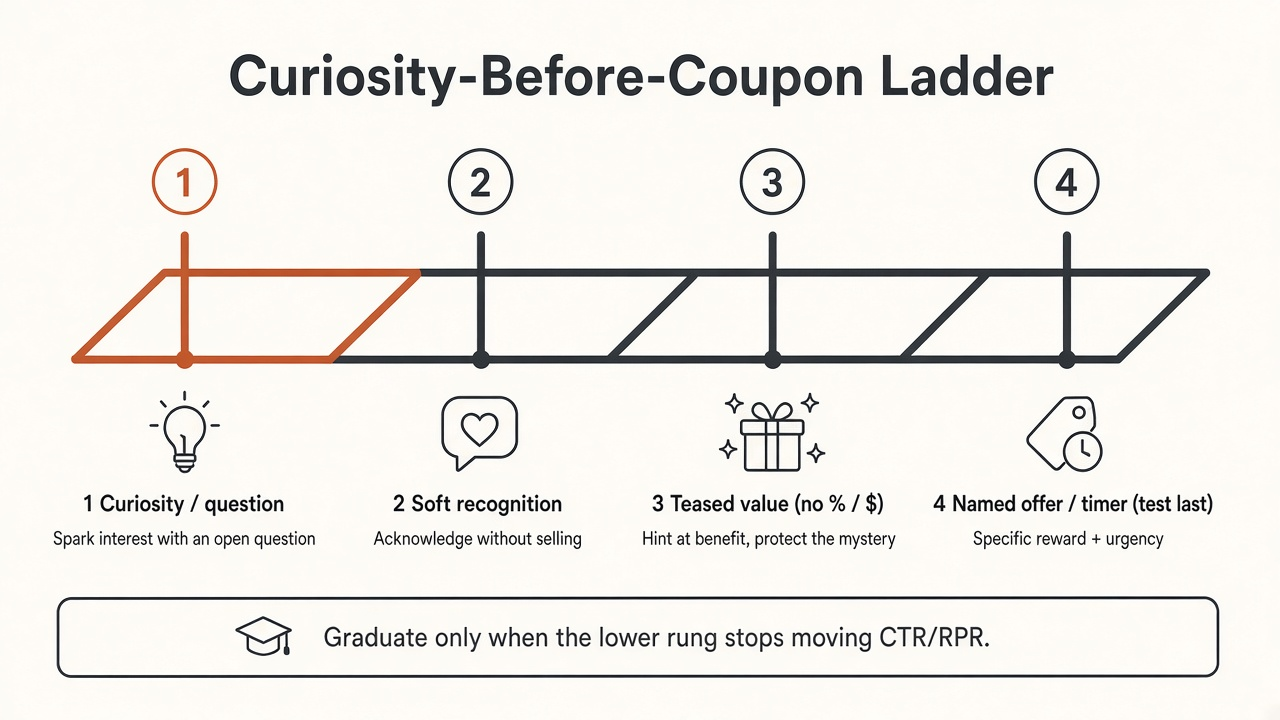
Source: feat. editorial ladder from Klaviyo browse abandonment subject-line analysis (Feb 2018). https://www.klaviyo.com/blog/browse-abandonment-subject-lines
Phil Weltman’s Klaviyo analysis (published February 14, 2018) covered more than 1,000 browse abandonment emails sent to more than 1 million people (Klaviyo):
| Signal | Result |
|---|---|
| Average open rate | 52.79% |
| Average click rate | 10.87% |
| Revenue per recipient | $2.88 |
| Open lift vs traditional emails (stated) | 62.9% higher |
| “Did you see something you liked?” | 56.82% open (~7% above sample avg) |
| “We saw you checking us out” | 58.55% open |
| “Recommend just for you” | 53.82% open |
| ≤40 characters vs longer | about 10% higher performance |
| Question mark subjects | 56.19% open |
| Period / exclamation | 48.50% / 48.00% |
Treat every cell as a 2018 ESP sample, not a 2026 universal median. Re-benchmark in your account.
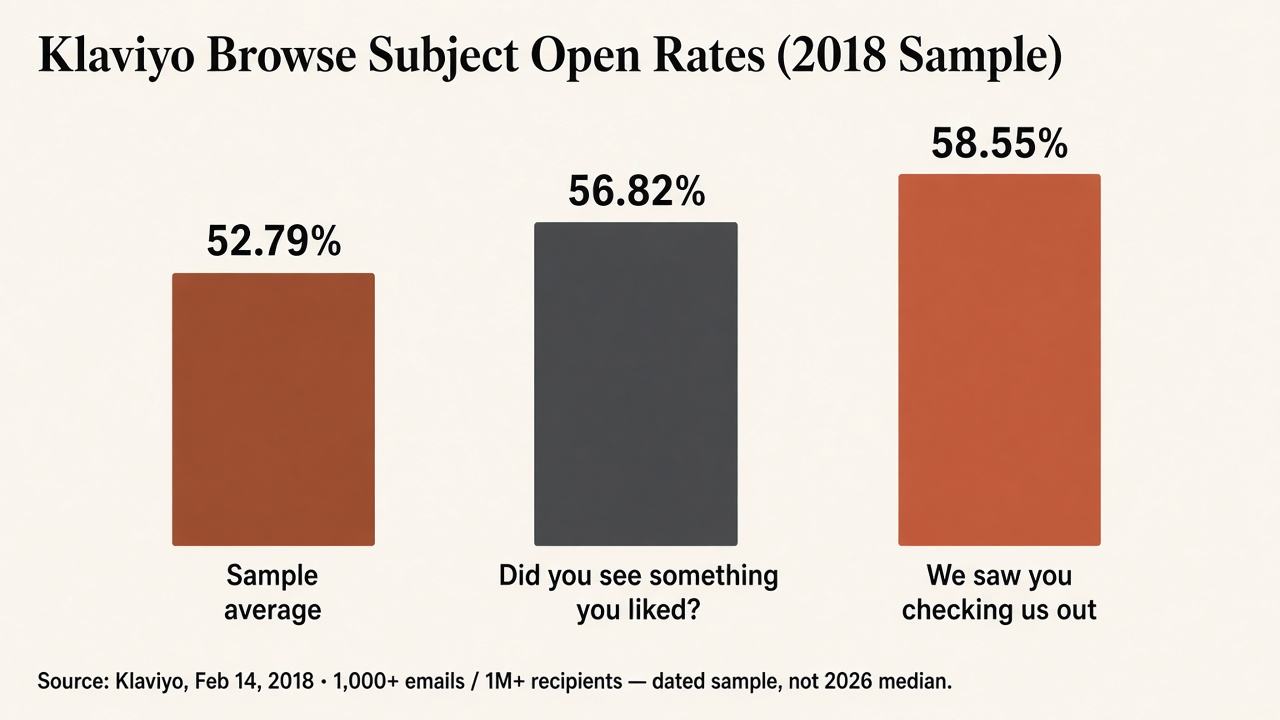
Source: Klaviyo, “20 examples of browse abandonment subject lines,” Feb 14, 2018. https://www.klaviyo.com/blog/browse-abandonment-subject-lines
Klaviyo’s same cut scored three tactics that operators still default to (Klaviyo):
| Tactic | Result vs sample average | Why it bites on browse |
|---|---|---|
| Product name in subject | 21% below average | Feels invasive when intent is a glance |
Explicit discount (%, $, “FREE”) |
almost 18% below average | Longer lines + spammy characters + trains coupon waiting |
| Time pressure / countdown | 27% below average; one “Final notice…. (4 hours left)” <15% open | Early intent rejects pressure |
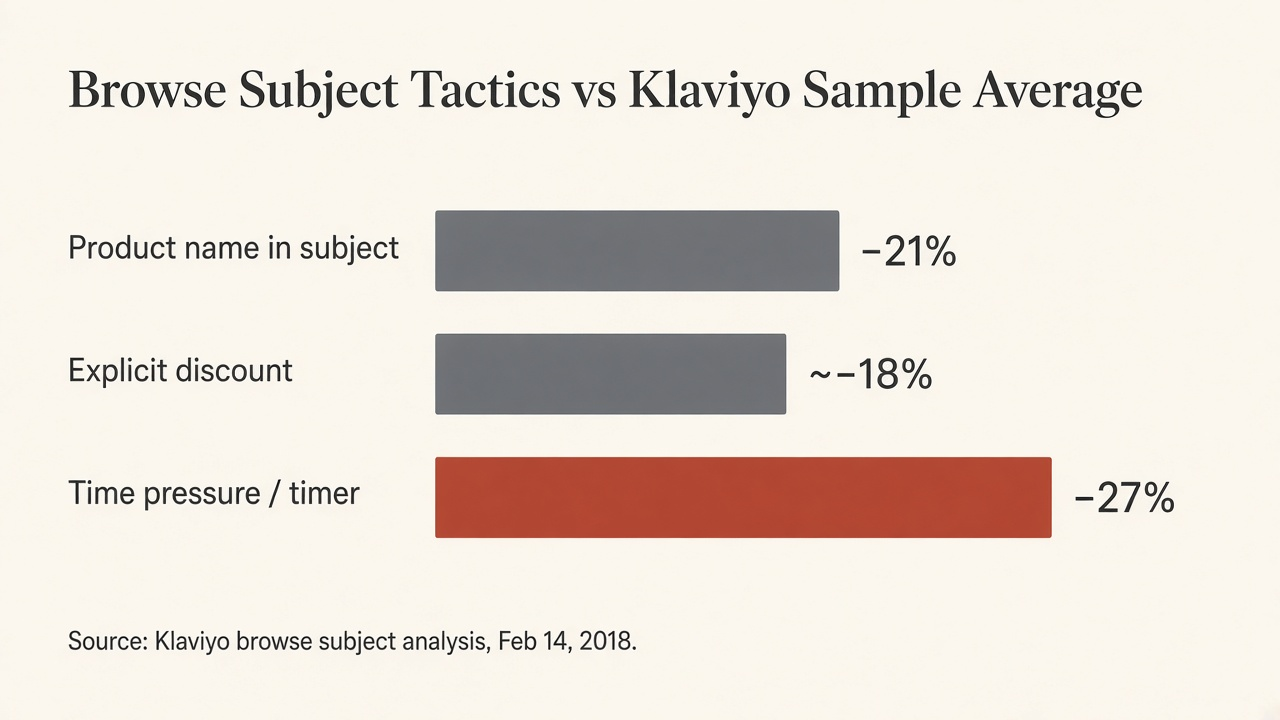
Source: Klaviyo browse abandonment subject-line analysis, Feb 14, 2018. https://www.klaviyo.com/blog/browse-abandonment-subject-lines
Tease value without the digits if you must discount: “Deals that make us proud.” Reveal the offer after the open. Keep the body honest—FTC disclosure still applies when affiliates or creators send commercial mail, and material connections belong where the endorsement lives.
Punctuation is a lever, not a personality. In the same Klaviyo cut, question marks averaged 56.19% opens while periods and exclamation points sat near 48.5% and 48.0% (Klaviyo). One honest question beats three exclamation points that trip spam filters. MediaPost summarized the same study for operators who want the myth list without the ESP login (MediaPost).
Omnisend’s 2026 example roundups still cluster subjects into curiosity, flattery, FOMO, and social proof (Omnisend). Use those as creative seeds. Score them against your CTR and RPR—not against a tip-list vibe. If FOMO subjects win in your account after a clean holdout, keep them. Just do not pretend Klaviyo’s 2018 timer penalty never existed.
% / $ out of the subject until curiosity loses.Q: What are the best browse abandonment email subject lines? A: Start with short curiosity lines such as “Did you see something you liked?” or “Still thinking about it?” In Klaviyo’s 2018 sample, the former opened at 56.82%. Re-test in your ESP—there is no public 2026 universal median.
Q: How long should a browse abandonment subject line be? A: Klaviyo found subjects with 40 characters or fewer performed about 10% better than longer ones and recommended everyday language around 30 characters or less so mobile inboxes do not truncate the hook.
Q: Should browse subject lines include the product name? A: Usually not first. In Klaviyo’s sample, product personalization in the subject opened 21% below average. Save SKU specificity for the body or for true cart abandonment.
Q: Do discount subject lines work for browse abandonment?
A: Explicit discount subjects underperformed by almost 18% versus that sample’s average. Tease value without % or $ in the subject, then show the offer after the open—and only after curiosity tests stall.
Q: How is a browse subject different from a cart subject? A: Browse targets a page view without a cart; cart targets items already staged for checkout. Browse favors curiosity; cart can carry more urgency and product detail. Measure them on different dollar expectations (Omnisend Page viewed $0.76 vs cart $3.59 per email).
Browse abandonment email subject lines are a curiosity job. Lead with short questions, date Klaviyo’s 2018 open-rate sample honestly, and keep coupons and countdown clocks for later rungs—or for cart. Pair subjects with the filters and dollar ladder in the benchmarks spoke. When your own holdout says otherwise, keep the winner—but bring the dated deltas into the meeting so nobody ships “Final notice” on a page view by default.
If product discovery happens through creators, give them a storefront worth returning to at feat..
AddShoppers vs Omnisend for cart emails: AddShoppers redirects to Minty. Buy Omnisend's live cart automation with published Free/$16/$59 seats.
GetResponse double opt-in is off by default. Enable the list confirmation toggle, match form surfaces, and remember DOI alone is not GDPR compliance.
Mailing CPM is cost per 1,000 list recipients. Use Carroway size-band medians ($62.50→$7.77) and placement types—not one fake “good CPM.”