AddShoppers vs Omnisend (Cart Email Seat)
AddShoppers vs Omnisend for cart emails: AddShoppers redirects to Minty. Buy Omnisend's live cart automation with published Free/$16/$59 seats.
Mailing CPM is cost per 1,000 list recipients. Use Carroway size-band medians ($62.50→$7.77) and placement types—not one fake “good CPM.”

TL;DR: Mailing CPM is what you pay (or charge) per 1,000 list recipients for one mailing. Carroway’s Sep 2026 rate-card scrape puts the median main-slot CPM near $23.62, falling from $62.50 under 5,000 subscribers to $7.77 at 100,000+. Name the denominator before you quote a number.
People search mailing cpm when a media kit says “$25 CPM” and finance asks what that means in dollars. The confusion is not the acronym. It is the unit. Mailing CPM only works when you know whether the thousand is subscribers, sends, or opens—and whether the slot is a main sponsorship or a dedicated blast.
This page owns mailing CPM as a unit-definition and conversion job. Niche marketplace ladders live in newsletter sponsorship CPM benchmarks. Flat dollars by list size live in newsletter sponsorship rates by subscriber count. CPC planning lives in newsletter ad CTR and CPC planning benchmarks. Buy seats on Paved live in Paved pricing for advertisers.
Key takeaways:
Mailing CPM is the cost per one thousand mailing-list recipients for a sponsored placement in (or as) an email send, usually computed from list size: (fee ÷ subscribers) × 1,000.
In newsletter and list advertising, “impression” almost always means a subscriber (or a planned send), not a display ad view (beehiiv; Paved). That is why a mailing CPM can look “high” next to display CPMs and still be cheap for a B2B buyer who only wants that list.
Operators already speak in thousands. On r/Newsletters, creators quote “$35 per thousands subs”; on r/beehiiv, local publishers cite “$30–$35 per thousand subscribers” (r/Newsletters; r/beehiiv). Hyper-local threads also trade $50–$75 top-spot CPM anecdotes (r/Newsletters). Those are vernacular anchors. The citable ladders below are labeled samples.
A wrong denominator turns a fair deal into a bad model. Price on opens after Mail Privacy Protection and you inflate the “audience.” Price a dedicated solo at a main-slot CPM and you undercharge by roughly half on Carroway’s medians. Ignore size-band compression and a 3,000-subscriber local list looks “expensive” next to a 200,000-subscriber lifestyle list that is actually cheaper per thousand and still a different product.
Why the unit fight shows up in every IO:
Mailing CPM works as a Mailing CPM Denominator Ladder. Climb only after you lock the thousand you are buying.
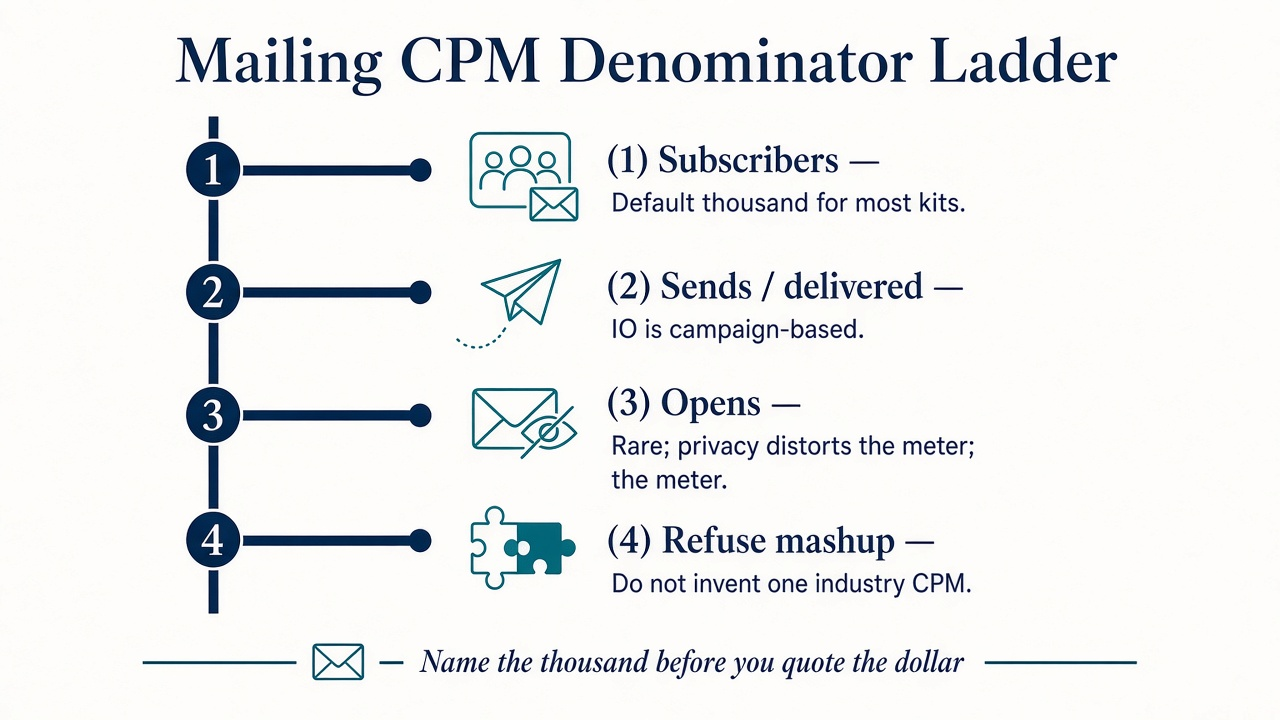
Source: Editorial Mailing CPM Denominator Ladder from beehiiv CPM formula and Carroway/Paved pricing practice. https://www.beehiiv.com/blog/newsletter-sponsorship-cost · https://carrowayresearch.com/reports/newsletter-sponsorship-rates
| Denominator | What the thousand means | When to use it |
|---|---|---|
| Subscribers | Active list size on the media kit | Default for most newsletter CPMs |
| Sends / delivered | Messages accepted by ISPs for that campaign | When the IO is send-based, not roster-based |
| Opens | Measured opens (pixel or proxy) | Rare for rate cards; MPP distorts the meter |
Default to subscribers unless the IO says otherwise. beehiiv’s worked example uses subscriber count: 10,000 × $25 CPM → $250 (beehiiv).
If a publisher prices on opens (“$70 CPM on opens”), rewrite the IO in subscriber CPM before you compare it to Carroway or Paved stickers. Otherwise you are negotiating two different products with the same three-letter label.
| Flat fee | List size | Implied mailing CPM |
|---|---|---|
| $150 | 2,400 | $62.50 |
| $320 | 10,000 | $32.00 |
| $500 | 20,000 | $25.00 |
| $900 | 70,000 | $12.86 |
| $1,497 | 173,000 | $8.65 |
Directional arithmetic on round list sizes near Carroway band medians. Not a Carroway invoice census. https://carrowayresearch.com/reports/newsletter-sponsorship-rates
Carroway read 1,055 newsletter advertise pages on 29 September 2026 and kept prices for one placement in one issue. Among 302 main-slot prices with a stated list size, median CPM is $23.62. By band (Carroway Research):
| List-size band | Median main-slot CPM | Median main-slot $ |
|---|---|---|
| Under 5,000 | $62.50 | $149 |
| 5,000–19,999 | $37.50 | $320 |
| 20,000–49,999 | $19.01 | $500 |
| 50,000–99,999 | $11.25 | $900 |
| 100,000 or more | $7.77 | $1,497 |
Small lists ask about 8× the per-thousand price of 100k+ lists in that sample. Large lists still clear larger checks. Unit CPM and invoice dollars move in opposite directions—that is the trap buyers miss when they sort media kits by “cheapest CPM” alone.
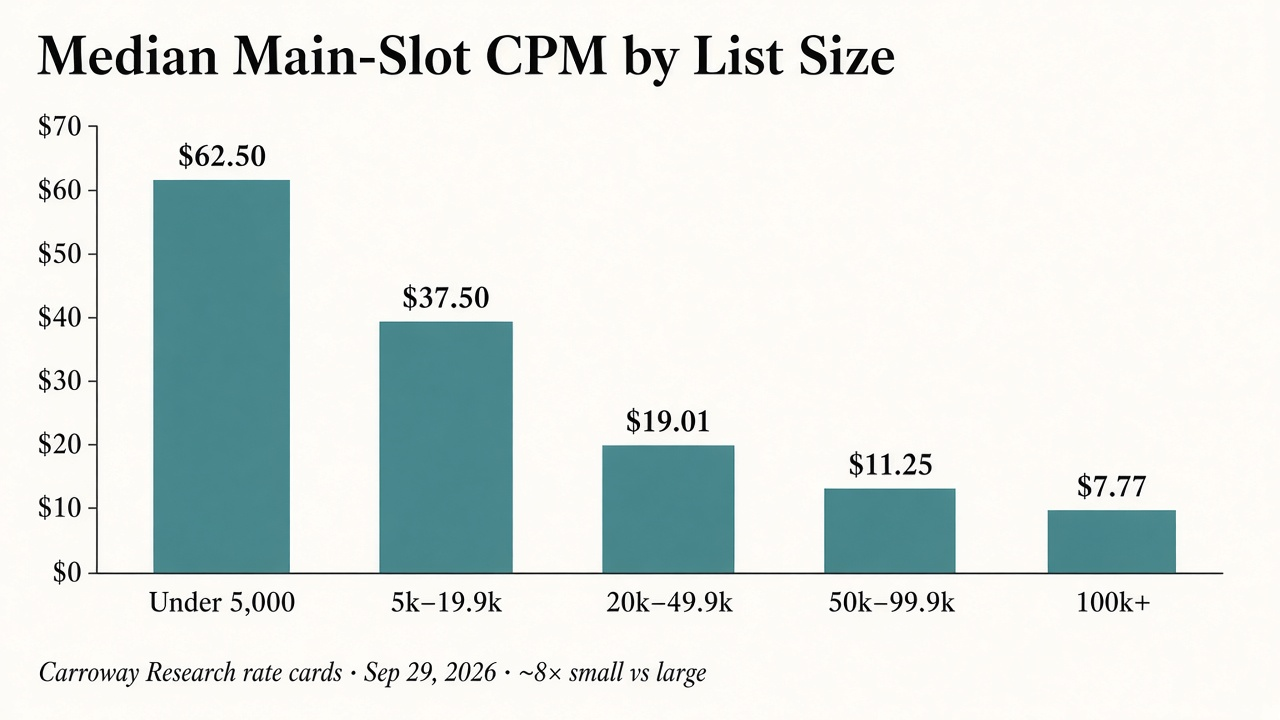
Source: Carroway Research, newsletter sponsorship rate cards read 2026-09-29. https://carrowayresearch.com/reports/newsletter-sponsorship-rates
| Placement | Median price | Median CPM (where list stated) |
|---|---|---|
| Main slot (top of one issue) | $399 | $23.62 |
| Other slot inside one issue | $200 | $19.64 |
| Classified / text ad | $100 | $10.31 |
| Dedicated send (whole email) | $800 | $59.41 |
Source: Carroway Research placement table, 2026-09-29. https://carrowayresearch.com/reports/newsletter-sponsorship-rates
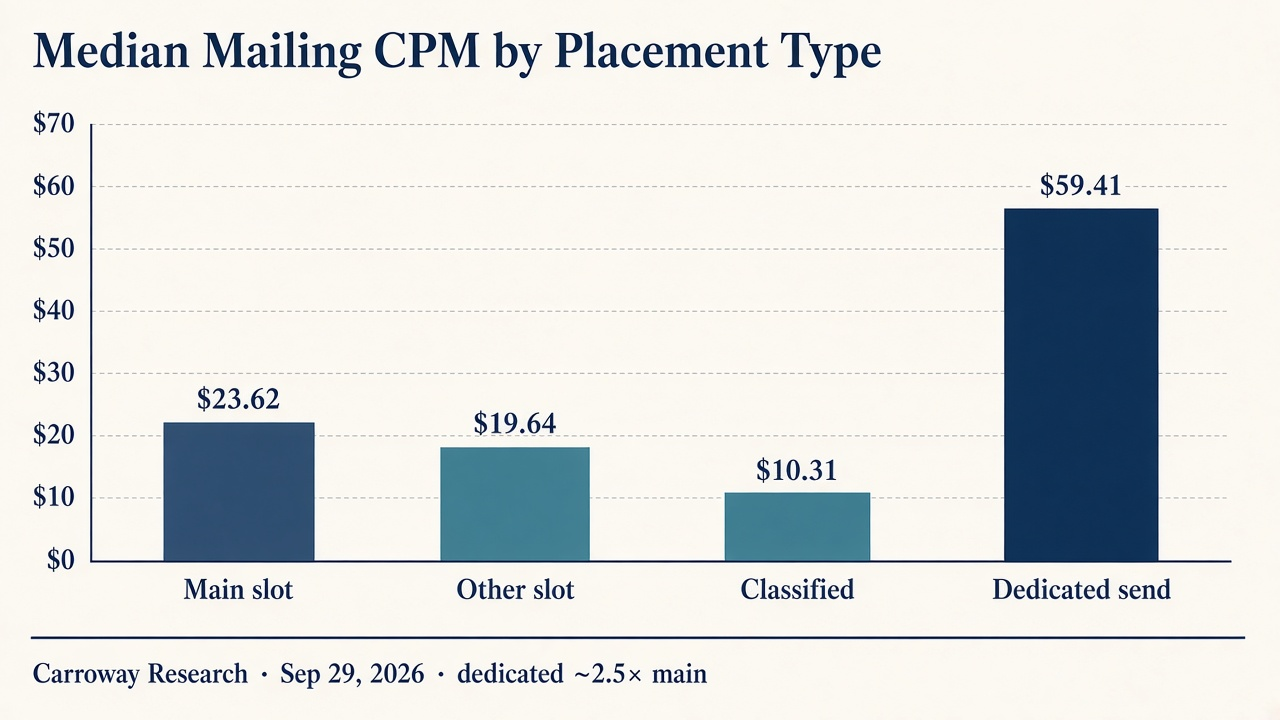
Source: Carroway Research, 2026-09-29. Dedicated ~2.5× main-slot median CPM. https://carrowayresearch.com/reports/newsletter-sponsorship-rates
There is no public dataset that publishes one official global “good mailing CPM” covering every niche and placement. A board slide that averages those rails into one number is fiction.
Keep samples labeled in the IO: “Carroway main-slot median,” “Paved rebooked premium,” or “beehiiv planning band.” If the seller cannot name the sample, treat the number as a negotiation opener, not a benchmark.
Q: What is mailing CPM? A: Mailing CPM is cost per 1,000 list recipients for a sponsored mailing, usually (fee ÷ subscribers) × 1,000. A 10,000-subscriber list at $25 CPM costs $250 for that placement under that math.
Q: What is a good mailing CPM? A: There is no single good number. Carroway’s Sep 2026 main-slot median is about $23.62, with size bands from $62.50 under 5,000 subscribers to $7.77 at 100,000+. Match band, placement, and niche—not a fake universal sticker.
Q: How do I convert a flat sponsorship fee to mailing CPM? A: Divide the fee by subscriber count, then multiply by 1,000. Example: $500 ÷ 20,000 × 1,000 = $25 CPM.
Q: Is mailing CPM the same as newsletter sponsorship CPM benchmarks? A: No. This page owns the unit, size-band compression, and placement-type CPMs. Newsletter sponsorship CPM benchmarks owns Paved’s category ladder (for example HR vs Lifestyle).
Q: Should I price mailing CPM on opens? A: Prefer subscribers unless the IO is explicitly open-based. Open pixels are distorted by privacy proxies, and rate-card samples like Carroway are built on list size, not opens.
Mailing CPM is a Denominator Ladder before it is a benchmark. Lock subscribers versus sends versus opens, read Carroway’s size-band and placement medians, and leave niche category ladders on their own page. If what you need is creators selling an existing product through co-branded storefronts—not a list IO—list on feat.: https://www.feat.press.
AddShoppers vs Omnisend for cart emails: AddShoppers redirects to Minty. Buy Omnisend's live cart automation with published Free/$16/$59 seats.
GetResponse double opt-in is off by default. Enable the list confirmation toggle, match form surfaces, and remember DOI alone is not GDPR compliance.
Optimal cart abandonment email timing: Omnisend 30–60 min, Klaviyo 2–4h (4h default), Mailchimp 1h/1d/3d—test RPR, refuse a golden minute.