GoAffPro Pricing Explained
GoAffPro pricing: Hobby Free, Premium $49, Business from $99. No sales %, vs UpPromote.
Education affiliates rarely get open brand bidding. Chegg/Coursera/Udemy ban it; Course Hero needs written TM+ consent; Google blocks essay-mill ads.

TL;DR: Education affiliate programs that “allow” brand bidding are almost never an open directory. Google can block essay-mill style offers first. Chegg, Coursera, and Udemy default to no trademark PPC. Course Hero’s rare path is written consent for brand+discount keywords—not a free brand-SERP free-for-all.
Searchers asking whether education affiliate programs brand bidding allowed usually want a loophole: buy “Chegg,” “Course Hero,” or “Coursera,” skim last-click commission, skip content. That loophole is why edtech SEM schedules look like security policies—and why Google’s honesty rules sit upstream of any network T&Cs.
This page is the education twin of finance affiliate programs that allow trademark bidding. Merchant-side policy lives on affiliate brand bidding on brand terms. Monitoring ops sit on affiliate rules monitoring. Here the job is narrower: read what major education offers actually publish about brand and TM+ PPC.
Key takeaways:
affiliates@coursehero.com (Adpump CourseHero).Education affiliate brand bidding is when a partner buys paid-search ads on an edtech or academic brand name—or brand-plus modifiers such as coupon, free, or login—and routes that click through an affiliate tracking link for commission.
PMA’s vocabulary still applies. Trademark / brand bidding targets the brand alone. Trademark plus (TM+) adds a second word (PMA). Education adds two extra filters retail rarely needs: (1) Google may disallow the underlying offer category when it enables academic dishonesty, and (2) study-help and course brands treat brand SERP as owned demand, not affiliate inventory.
Google Ads letting a trademark through as a keyword is not program approval. Google generally does not block trademarks as keywords; it may restrict trademarks in ad text after an owner complaint (Google). Your advertiser’s SEM schedule is the gate that pays or voids the commission.
Open brand bidding fails three screens before a commission ever clears.
| Gate | Fail state | What “pass” looks like |
|---|---|---|
| 1. Google category | Essay-mill / academic-dishonesty offer blocked | Legitimate course, tutoring, or study tools that comply with Google Ads |
| 2. Brand / TM PPC | Chegg / Coursera / Udemy-style ban | Non-brand keywords only |
| 3. TM+ coupon exception | Bidding brand+discount without consent | Written approval from the affiliate team (Course Hero pattern) |
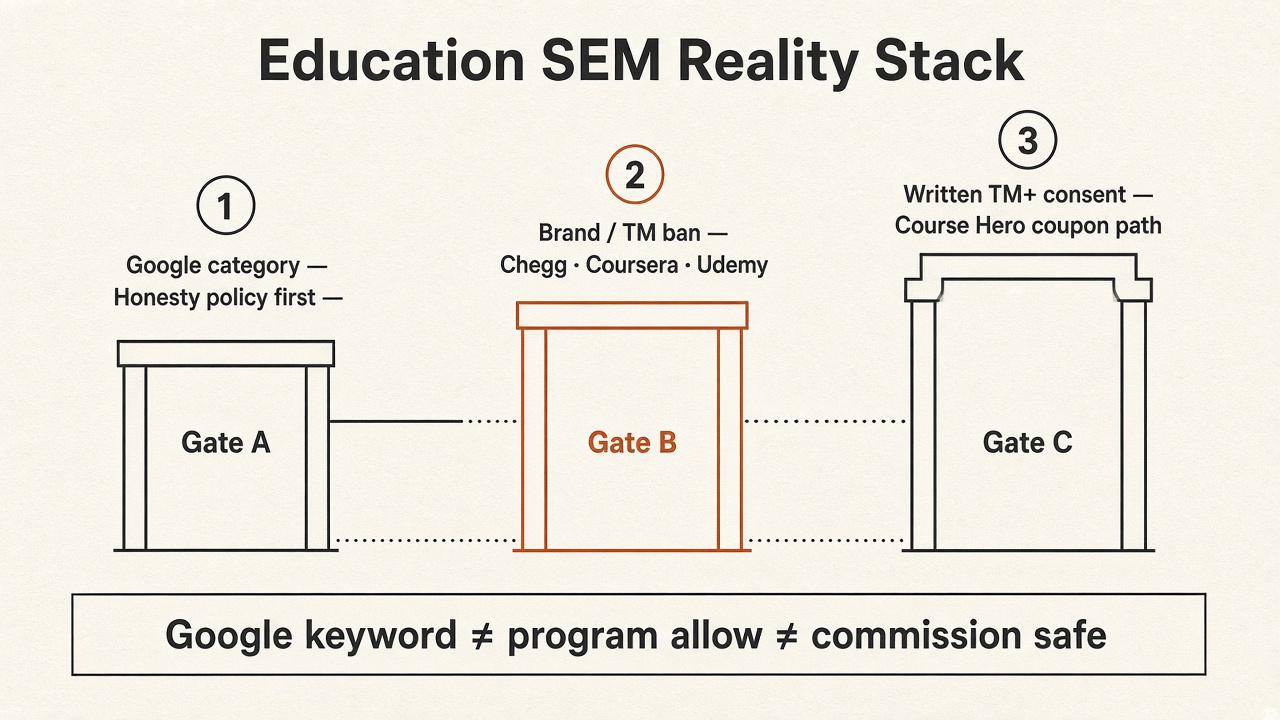
Source: feat. editorial framework synthesizing Google Ads Enabling dishonest behavior (2026), PMA Trademark+ (2023), and edtech offer terms via Adpump/FMTC. https://support.google.com/adspolicy/answer/6016086?hl=en · https://thepma.org/wp-content/uploads/2023/08/PMA-Trademark-plus-bidding_2023.pdf
Education brand bidding rules work as layered contracts: Google decides whether the offer may advertise at all; the advertiser’s SEM schedule decides which keywords and display URLs affiliates may buy; written exceptions—if any—cover narrow TM+ coupon cases with email proof.
Quotable table first. These are network-listed restrictions, not a feat. survey.
| Program (source) | Exact brand / trademark PPC | Brand + discount (TM+) | Extra SEM notes |
|---|---|---|---|
| Chegg (Adpump) | Banned — no bidding Chegg terms, variations, misspellings | Coupon/deal Chegg terms must be negative-matched | Chegg / variations banned in display URL (Adpump) |
| Course Hero (Adpump) | Banned — no bidding Course Hero / Coursehero / misspellings | Brand+discount concatenations need written consent (affiliates@coursehero.com) |
No trademarks in domains/metatags directing elsewhere (Adpump) |
| Coursera (Adpump) | Banned — trademark bidding strictly prohibited | Brand keywords/variations in paid search prohibited | Direct linking from paid search via affiliate links prohibited (Adpump) |
| Udemy (FMTC) | No trademark bidding | No Trademark+ bidding | PPC Bidding Allowed = No (FMTC) |
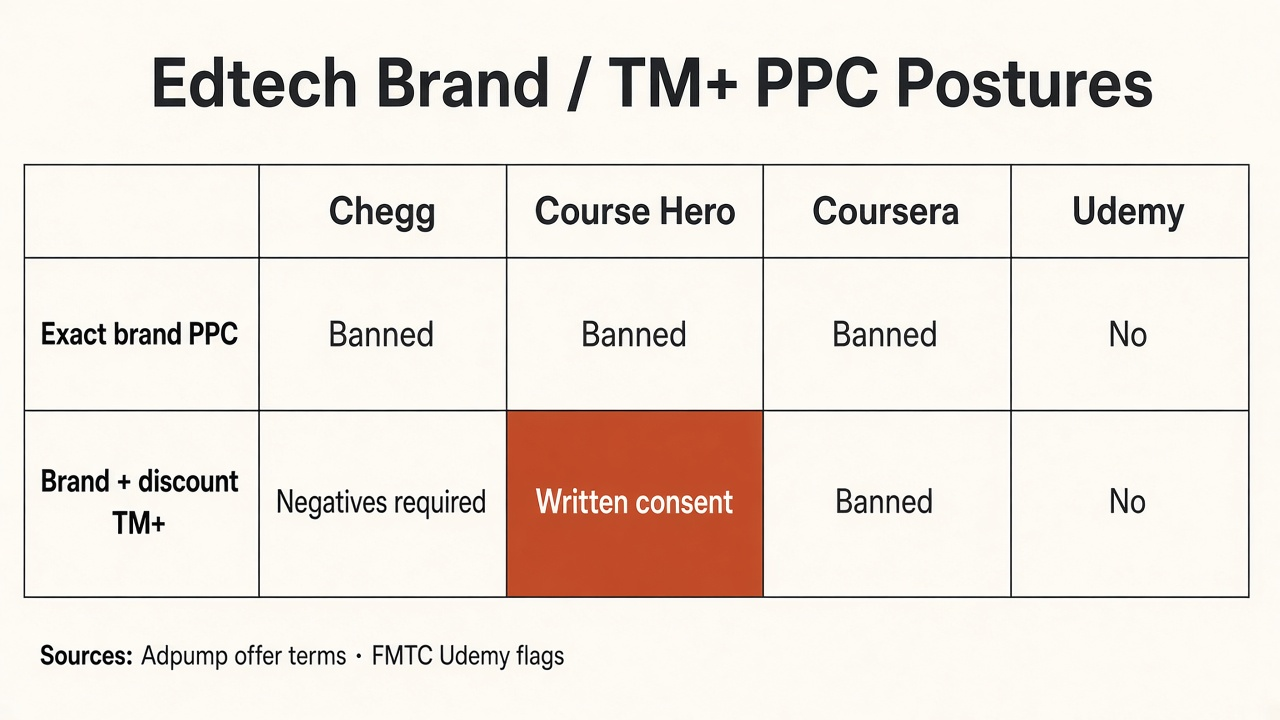
Source: Adpump Chegg_WW, CourseHero, Coursera_WW offer terms; FMTC Udemy directory (accessed 2026-10-11). https://adpump.com/en/wmOffers/view/13490/chegg-ww · https://adpump.com/en/wmOffers/view/16275/coursehero-au-ca-nz-gb-us · https://adpump.com/en/wmOffers/view/18644/coursera-ww-star-cpa · https://account.fmtc.co/cp/program_directory/details/m/19278
Course Hero is the only row with a documented “ask permission” TM+ coupon path. That is still not “brand bidding allowed.” Exact brand terms stay banned. If you cannot produce the consent email, assume void.
| Your offer / tactic | Realistic SEM lane | Brand bidding? |
|---|---|---|
| Essay / thesis / “do my homework” generator | Often blocked by Google honesty policy | Irrelevant—fix the offer first (Google) |
| Chegg / Coursera / Udemy style program | Non-brand content, review, comparison SEO/SEM | No per published flags |
| Course Hero coupon TM+ | Only after written affiliate-team consent | Exact brand still No; TM+ coupon maybe |
| Merchant building an education program | Public ban + negatives + monitoring (rules monitoring) | PMA: 1–2 exceptions max if any (PMA) |
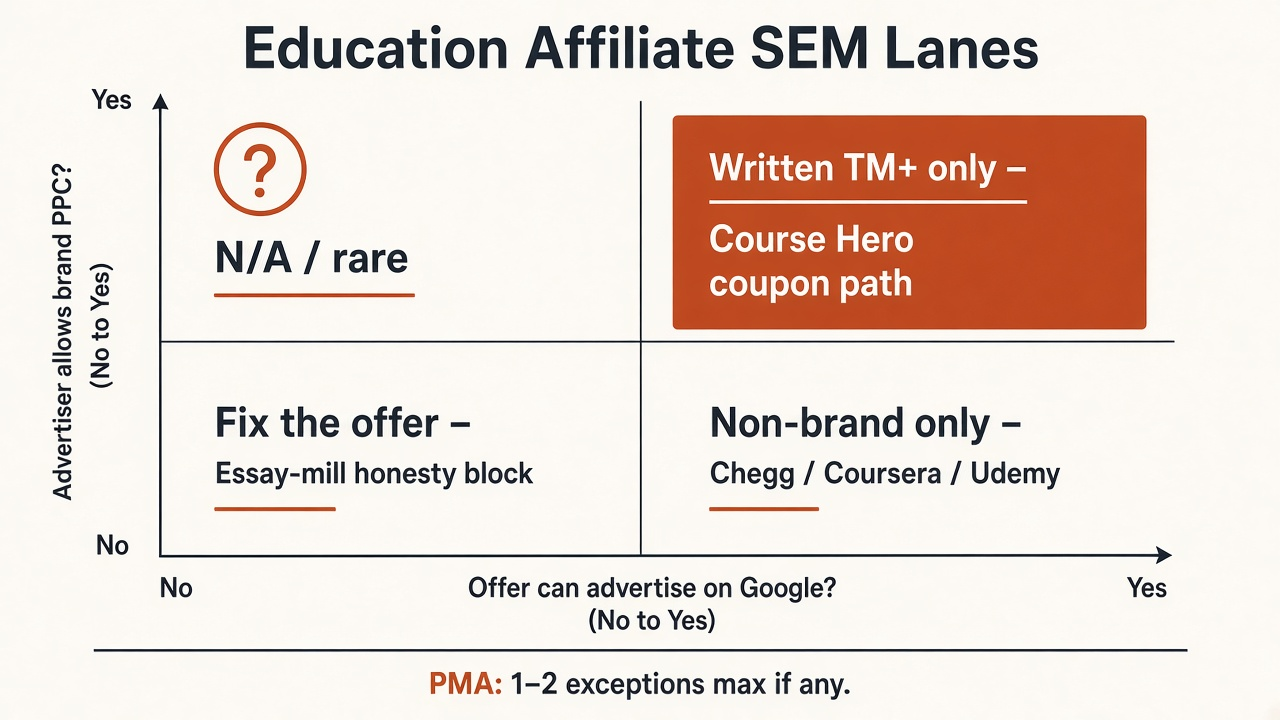
Source: feat. editorial matrix from Google Ads policy + Adpump/FMTC program flags + PMA Trademark+ (2023). URLs as in comparison table and https://support.google.com/adspolicy/answer/6016086?hl=en
Q: Do education affiliate programs allow brand bidding? A: Major published edtech flags default to no. Chegg, Coursera, and Udemy ban trademark PPC. Course Hero bans exact brand bidding and only allows brand+discount keywords with written consent. There is no reliable public census of open allow-lists.
Q: Can I bid on Chegg or Coursera as an affiliate? A: Not under the Adpump-listed Chegg and Coursera restrictions cited here. Chegg forbids Chegg terms and coupon variants; Coursera forbids trademark bidding and brand keywords in paid search. Always re-check the live network schedule before launch.
Q: What about Course Hero coupon keywords? A: Course Hero requires written consent from its affiliate team for brand-term-discount concatenations such as Course Hero coupon or deal. Exact trademark bidding remains prohibited. Without the email, treat the tactic as banned.
Q: Why do essay-writing affiliate trademark searches keep failing? A: Google Ads disallows services that enable academic dishonesty, including essay or thesis generators. Brand-bidding policy never saves an offer that cannot advertise. Pivot to compliant study tools and content lanes.
Q: Is Google’s trademark rule the same as an affiliate SEM schedule? A: No. Google may allow trademarks as keywords while still restricting trademarks in ad text after complaints. Affiliate programs add their own bans, negatives, and void rules. Commission safety follows the stricter of the two.
Education affiliate brand bidding is a three-gate problem: Google honesty, advertiser brand bans, and rare written TM+ coupon consent. Chegg, Coursera, and Udemy publish no; Course Hero’s exception is email-gated, not open. If your growth plan needs partners who sell through co-branded storefronts instead of brand-SERP interception, start at feat..
GoAffPro pricing: Hobby Free, Premium $49, Business from $99. No sales %, vs UpPromote.
Refersion pricing: Launch $39+3%, Growth $199+2%. Affiliate-sales fees, crossover math, vs UpPromote.
UpPromote pricing: Free, Growth $29.99+2%, Pro $89.99+1.5%. Performance fees, crossover math, vs ReferralCandy.