Discord vs Slack for Merchant Communities
Discord vs Slack for merchant communities: Chat Seat Ladder—seat math, 90-day Slack Free history, Stage AMAs, Nitro Basic $2.99 vs Pro $8.75.
How to run merchant AMAs: Champion AMA Ladder—invite, storefront teardown, Discord Stage Q&A, clips—plus Hivebrite events at 76.9%.

TL;DR: A merchant AMA marketplace play works when you climb the Champion AMA Ladder: invite criteria → storefront teardown → moderated Stage Q&A → clips into Broadcast. Hivebrite finds events drive meaningful participation for 76.9%. Do not invent attendance or revenue lift. Discord Stage is the default surface for voice AMAs.
Operators search merchant AMA marketplace after they already opened a Discord or Slack and watched it go quiet. An Ask Me Anything with a high-performing merchant is the ritual that turns a Peer Room into retention—if you run it as a ladder, not an open mic. Pair this ops page with merchant community vs newsletter (Peer Room vs Broadcast) and community-led growth benchmarks (how you prove the room worked).
A merchant AMA in an affiliate marketplace is a timed, moderated session where a listed merchant answers peer questions about storefronts, affiliate approvals, and selling—then the platform clips the useful answers into Broadcast.
It is not a celebrity influencer interview. It is not a sales webinar for buyers. On a two-sided sell marketplace—builders list, affiliates promote through co-branded storefronts, buyers purchase—the scarce side is the merchant who keeps listing and approving. The AMA is peer teaching for that side. If your “AMA” is the CEO reading a blog post, you built Broadcast with a microphone.
Merchant AMAs matter because Hivebrite’s sample still puts events at the top of meaningful participation—76.9%—ahead of peer-to-peer support and forums (Hivebrite). A Stage AMA is an event with a peer on stage. A newsletter mentioning “community” is not.
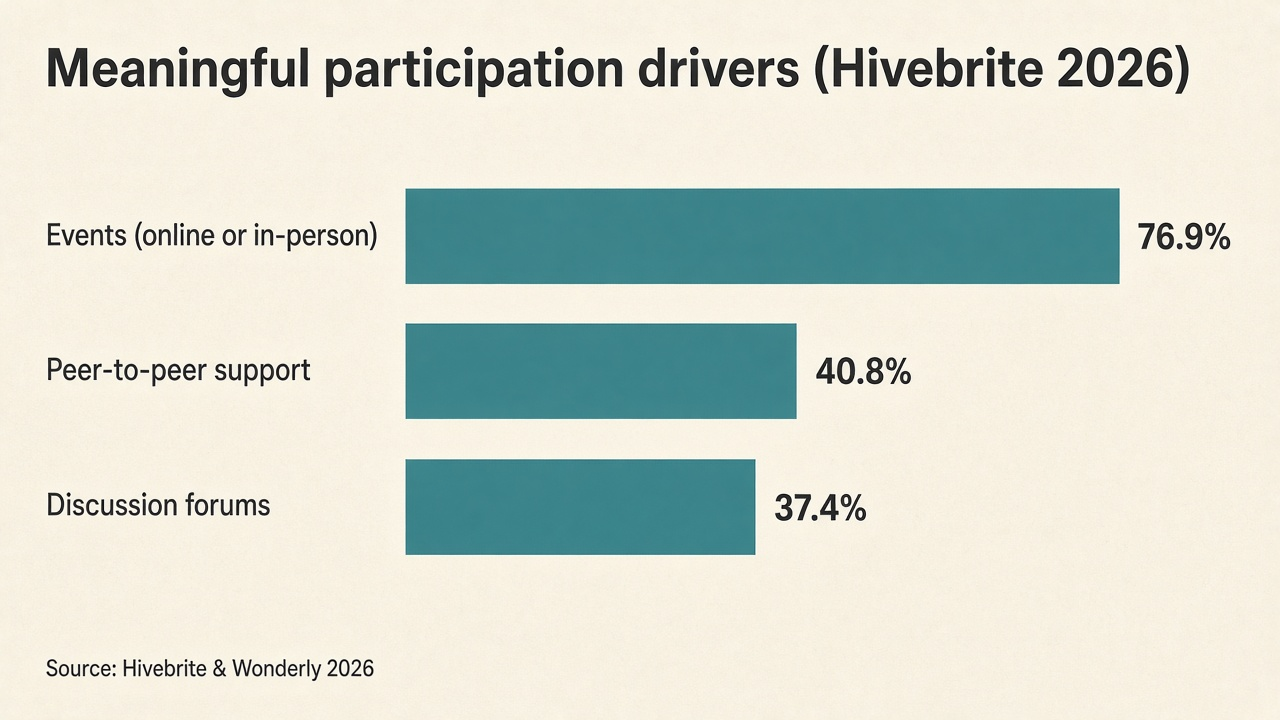
Source: Hivebrite and Wonderly, The Community Growth & Benchmark Report 2026 (n=186). https://go.hivebrite.com/hubfs/guides/community-growth-benchmark-report-2026.pdf
Merchant AMAs work as a four-rung Champion AMA Ladder. Skip a rung and you get either a no-show stage or a great conversation nobody outside the Stage hears.
| Rung | Job | Output |
|---|---|---|
| 1. Invite criteria | Pick merchants who sold and will teach | Named guest + topic |
| 2. Storefront teardown | Show a real co-branded or listing surface | 10–15 min walkthrough |
| 3. Moderated Q&A | Stage + questions channel | Answered peer questions |
| 4. Clip to Broadcast | Thin newsletter / announcements | 3 clips + deep link back to room |
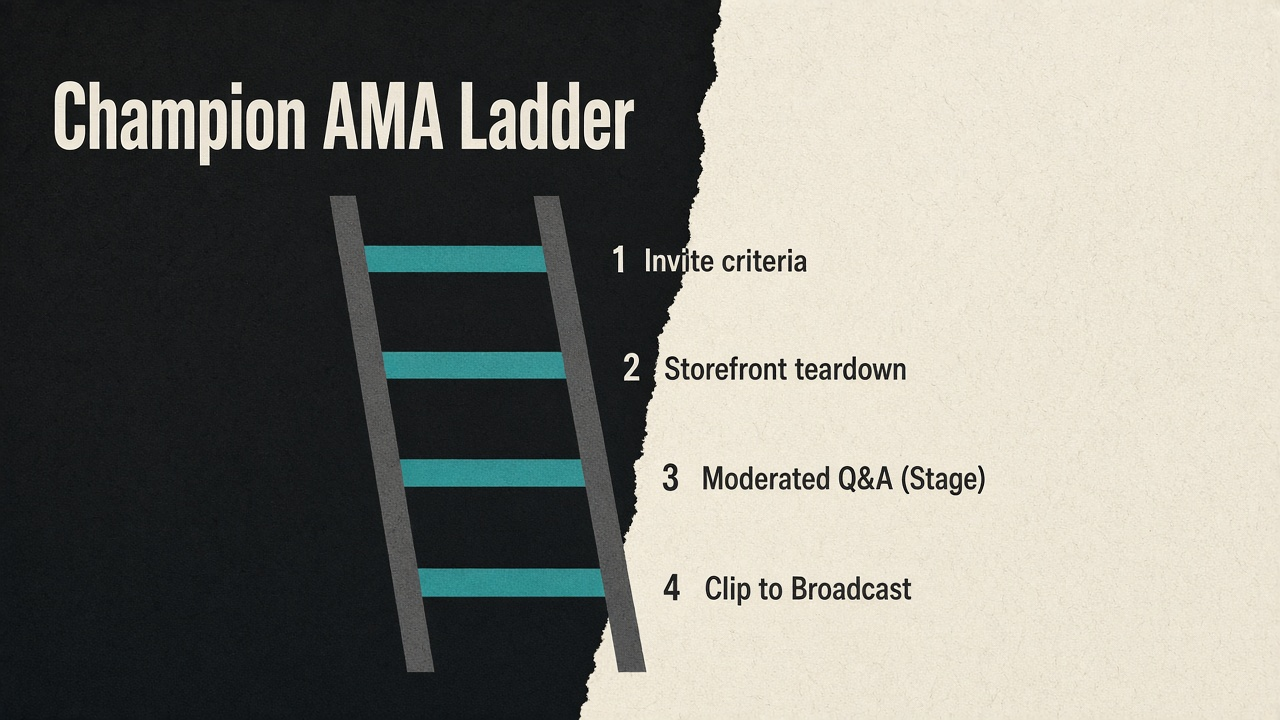
Source: feat. editorial Champion AMA Ladder; Stage mechanics from Discord (https://discord.com/blog/run-an-ama-townhall-via-stage-channel).
Discord’s own guide says Stage channels are built for AMAs and townhalls: assign Stage moderators, keep speakers on stage, let the audience raise hands, and optionally run a questions text channel. They recommend hiding related text channels until start so chat stays in sync (Discord). Best-practice guidance adds pre-collecting questions via a form or a Slow Mode text channel on event day (Discord).
Slack huddles can work for a tiny merchant cohort. When the room scales, Stage’s request-to-speak model beats an open voice channel. Seat-cost fork for the host surface lives in the queued Discord vs Slack spoke and the Peer Room vs Broadcast comparison.
Ask the guest to show:
No public dataset exists for “average teardown conversion lift.” Keep stories labeled as guest experience.
| Role | Owns | Failure if missing |
|---|---|---|
| Host (platform) | Agenda, timeboxes, recap | Guest rambles past teardown |
| Stage moderator | Raise-hand queue, mutes, chat | Open-mic chaos |
| Merchant speaker | Teardown + honest answers | Vague “just post more” advice |
| Scribe / clipper | Timestamps + three clips | AMA dies in the Stage archive |
Discord’s Stage model assumes moderators can elevate speakers and manage requests to speak (Discord). Budget two humans for anything larger than a private cohort: one on voice, one on queue and text. A single overloaded host will skip the teardown to chase chat—and the teardown is the product.
Run merchant AMAs on a sustainable calendar. Monthly is enough for most early marketplaces; weekly burns guests and staff. Alternate “storefront craft” topics with “affiliate ops” topics so the same three merchants are not answering the same discount question forever. Publish the calendar in Broadcast a week ahead, again the morning of, and fifteen minutes before Stage opens—then stop spamming. The Peer Room should feel invited, not paged.
Between AMAs, leave the teardown artifacts alive: pinned clip threads, a #storefront-examples channel, and a short FAQ wiki built from repeated answers. That is how peer-to-peer support (40.8% in Hivebrite’s participation cut) continues when nobody is live (Hivebrite).
| Metric | Definition | Trap |
|---|---|---|
| Live listeners | Peak concurrent on Stage | Vanity if lurkers never list |
| Questions answered | Count from form + Stage | Quantity without craft |
| Clip clicks | Broadcast → clip → room | Opens only (MPP noise) |
| Member delta | Approvals / storefront refreshes among attendees vs non-attendees in the following window | Claiming lift without a control group |
CMX’s 24% quantification rate is a warning label, not a dare to invent numbers (CMX). If you cannot compare members with non-members, say so and fix instrumentation before you pitch the AMA as a growth engine.
Set invite criteria in writing. Require a live listing, at least one tracked sale or meaningful approval activity, and willingness to share a storefront walkthrough. Reject vanity follower counts.
Book Stage + roles. Create a Discord Stage, assign Stage moderators and the merchant as speaker, and add a questions text channel (Discord).
Pre-collect questions. Use a short form before the event or a Slow Mode questions channel on the day (Discord).
Run teardown then Q&A. Open with a 10–15 minute storefront teardown, then moderated answers. Prefer written questions plus selective raise-hand; keep one mod on the queue.
Announce recording before you capture. Discord has no native Stage record button—use a disclosed local or bot recording and give an opt-out path. This is ops hygiene, not legal advice.
Clip within 48 hours. Publish three short clips plus a summary in announcements, and put the same three links in the next thin Broadcast newsletter so absentees land back in the Peer Room.
Close the loop with the guest. Send the merchant their clips, thank them in the Peer Room, and ask whether they will take a second AMA next quarter on a narrower topic. Champions who feel extracted once will not return.
Log the member delta. Within two weeks, compare affiliate approvals and storefront refreshes for merchants who attended versus those who only received Broadcast. If you lack that join, write no public dataset on the slide and fix the CRM link—do not invent a lift.
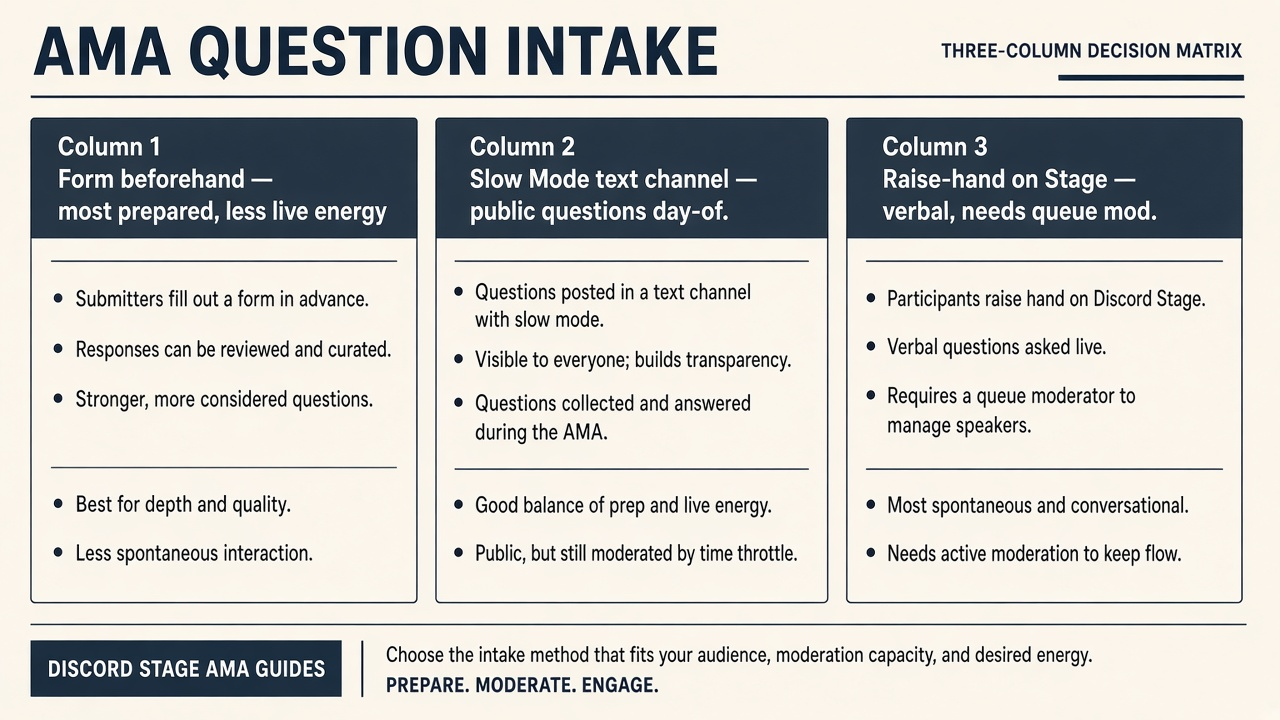
Source: Discord community best practices and Stage AMA guide (https://discord.com/blog/best-practices-for-starting-a-great-community-on-discord; https://discord.com/blog/run-an-ama-townhall-via-stage-channel).
Q: What is a merchant AMA in an affiliate marketplace? A: It is a moderated peer session where a listed merchant teaches storefront and affiliate lessons, then the platform clips answers for merchants who missed the live Stage. It is not a buyer webinar.
Q: How do you run merchant AMAs without inventing results? A: Follow the Champion AMA Ladder and measure member vs non-member approvals afterward. Hivebrite supports events as a participation driver at 76.9%; it does not publish a universal AMA revenue lift (Hivebrite).
Q: Should merchant AMAs use Discord Stage or Slack? A: Discord Stage is the documented AMA surface (moderators, raise-hand, questions channel) (Discord). Slack fits tiny cohorts; scale usually favors Stage.
Q: How long should a merchant AMA run? A: Plan a focused teardown plus Q&A in about 45–60 minutes of hosted time. Discord’s Stage guide stresses moderator control over open voice; keep one mod on the queue so the session does not drift.
Q: Do newsletter clips replace the live AMA? A: No. Clips are Broadcast pointers into the Peer Room. Retention still depends on peers meeting—see merchant community vs newsletter.
A merchant AMA marketplace ritual earns its keep when invite criteria, teardown, Stage moderation, and clips are one ladder. Staff the moderators. Clip the answers. Keep Broadcast thin. When you want merchants listing and affiliates selling through co-branded storefronts, start on feat..
Discord vs Slack for merchant communities: Chat Seat Ladder—seat math, 90-day Slack Free history, Stage AMAs, Nitro Basic $2.99 vs Pro $8.75.
Merchant community vs newsletter for marketplace retention: Peer Room vs Broadcast, Hivebrite events 76.9%, Slack Free 90-day history vs Discord Nitro $2.99.
Community-led growth benchmarks: Hivebrite's confidence-vs-evidence gap, events at 76.9% of participation, and CMX's 24% who can quantify value.