AddShoppers vs Omnisend (Cart Email Seat)
AddShoppers vs Omnisend for cart emails: AddShoppers redirects to Minty. Buy Omnisend's live cart automation with published Free/$16/$59 seats.
A newsletter ad network matches advertisers to opted-in email lists via marketplace bookings, programmatic matching, or ESP offer feeds—not the same as a direct insertion order.

TL;DR: A newsletter ad network matches advertisers to opted-in newsletter audiences through marketplace bookings, programmatic matching, or ESP-native offer feeds. It is remnant and scale infrastructure. It is not the same job as a handpicked direct insertion order with 100% share of voice.
Publishers hear “join a newsletter ad network” and picture free money in every send. Buyers hear the same phrase and picture cheap inbox reach. Both skip the surface. Networks fill calendars. They do not replace a sold-out media kit.
If you treat network CPC like a premium sponsorship, you will underprice your best slots—or overpay for matched inventory you never vetted.
Key takeaways:
A newsletter ad network is a platform that matches advertisers to placements inside opted-in email newsletters using marketplace bookings, programmatic targeting across many lists, or an ESP-native offer feed—so inventory can sell without a one-off sales call for every slot.
That definition excludes your own media kit. Direct sponsorships still matter. How to get newsletter sponsors and newsletter insertion orders own that rail. Networks sit beside it.
Paved’s advertiser help draws the fork clearly: Marketplace is browse-and-book with high control; Ad Network is matched distribution when you want scale without handpicking every list (Paved). beehiiv’s Ad Network is an offer feed for newsletters that send on beehiiv at Scale or above, non-exclusive, with beehiiv handling sourcing and reporting (beehiiv). Same category word. Different control and fee shape.
Networks matter because empty slots are a tax on every send. Remnant inventory—unbooked sponsorship dates—is real. Paved’s Remnant Inventory and Smart Pricing tools exist to discount those dates instead of shipping a blank commercial slot (Paved remnant; Smart Pricing).
Why operators care:
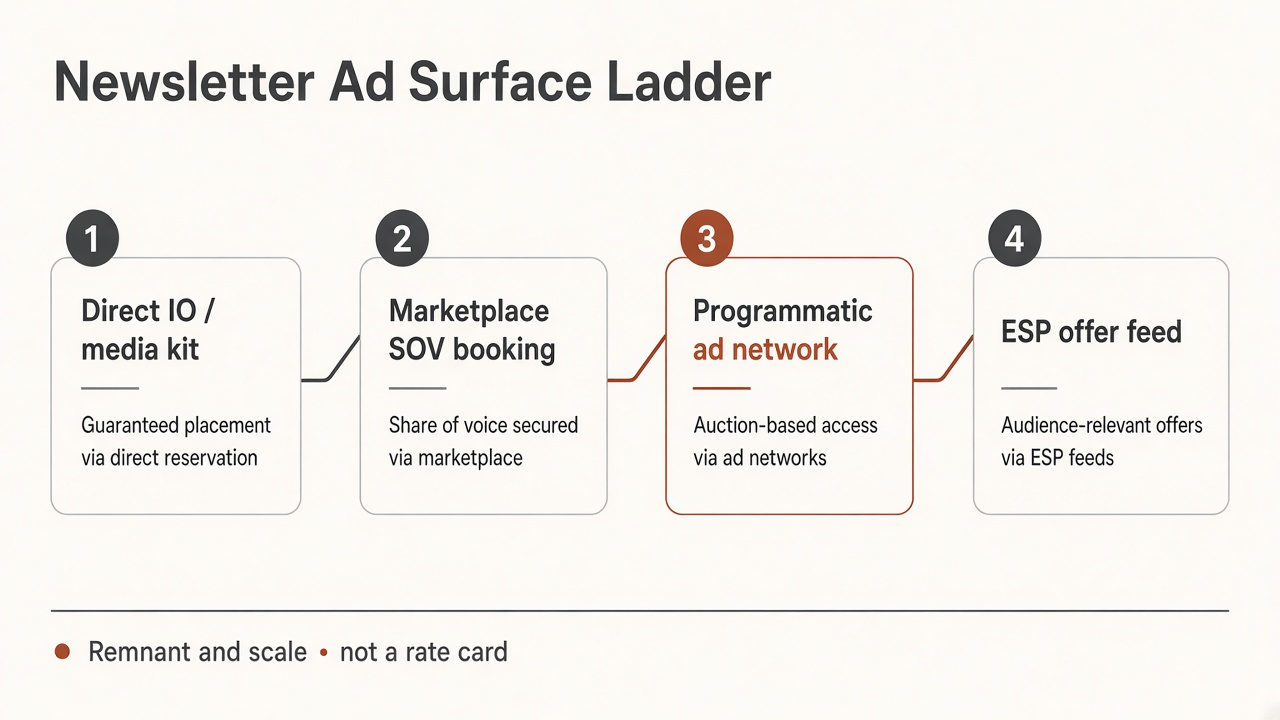
Source: Paved Marketplace vs Ad Network help; beehiiv Ad Network product page; editorial ladder. https://www.paved.com/help/articles/15463913-paved-marketplace-vs-ad-network-which-option-is-right-for-advertisers · https://www.beehiiv.com/ad-network
A newsletter ad network works by putting inventory on one of four surfaces, then clearing a fee or offer price when the placement runs. Open every decision with which surface you are on. Then argue about CPM.
| Surface | Who picks the list | Typical commercial shape | Best job |
|---|---|---|---|
| 1. Direct IO / media kit | Publisher + buyer | Flat fee, negotiated SOV | Premium brand fit, category exclusivity |
| 2. Marketplace booking | Buyer handpicks | Listed sponsorship; Paved Marketplace takes 30% of booking from publisher | Niche tests, tone control, 100% SOV day |
| 3. Programmatic ad network | Platform matches | Performance (e.g. CPC auction); Paved Ad Network 50% of performance earnings | Scale + remnant fill without per-list sales |
| 4. ESP offer feed | Publisher accepts offers | CPC/CPM payouts inside ESP (e.g. beehiiv Scale+) | Remnant on the same send stack you already use |
Sources: Paved Marketplace vs Ad Network; Paved pricing; beehiiv Ad Network; newsletter sponsorship rates by subscriber count.
Marketplace and Ad Network are not synonyms inside Paved. Marketplace is deliberate booking. Ad Network is matched distribution with native short-form units and unified reporting (Paved). Using both is normal: sell premium dates on Marketplace, drop a network snippet for unsold sends (Paved monetize).
Think in jobs, not logos. If a buyer needs to see the exact newsletter before they spend, they are on Marketplace. If they need matched reach across many lists this week, they are on Ad Network. If a publisher needs fill without rewriting an IO, they are on a network snippet or ESP offer feed. Mixing those jobs in one sentence is how “newsletter ad network” becomes a foggy synonym for “any paid inbox placement.”
Publishers who already sell sponsorship rates by size band should protect those numbers. Network CPC is a floor for empty dates, not a benchmark that rewrites a sold-out Friday. Buyers who only chase remnant discounts train the market to wait two weeks for Smart Pricing. That is a race to the bottom neither side wins for long.
| Scenario | Gross | Platform cut | Publisher take-home |
|---|---|---|---|
| Paved Marketplace booking | $1,000 | 30% | $700 |
| Paved Ad Network earnings | $1,000 | 50% | $500 |
| beehiiv Ad Network offer payout | $1,000 CPC/CPM offer | No Marketplace-style 30% booking cut on that offer dollar | $1,000 of that offer (advertiser gate is separate) |
Sources: Paved pricing; beehiiv Ad Network; editorial math. beehiiv brand campaigns still start at $15k on the advertiser side—detail on the comparison spoke (advertise FAQ via sibling).
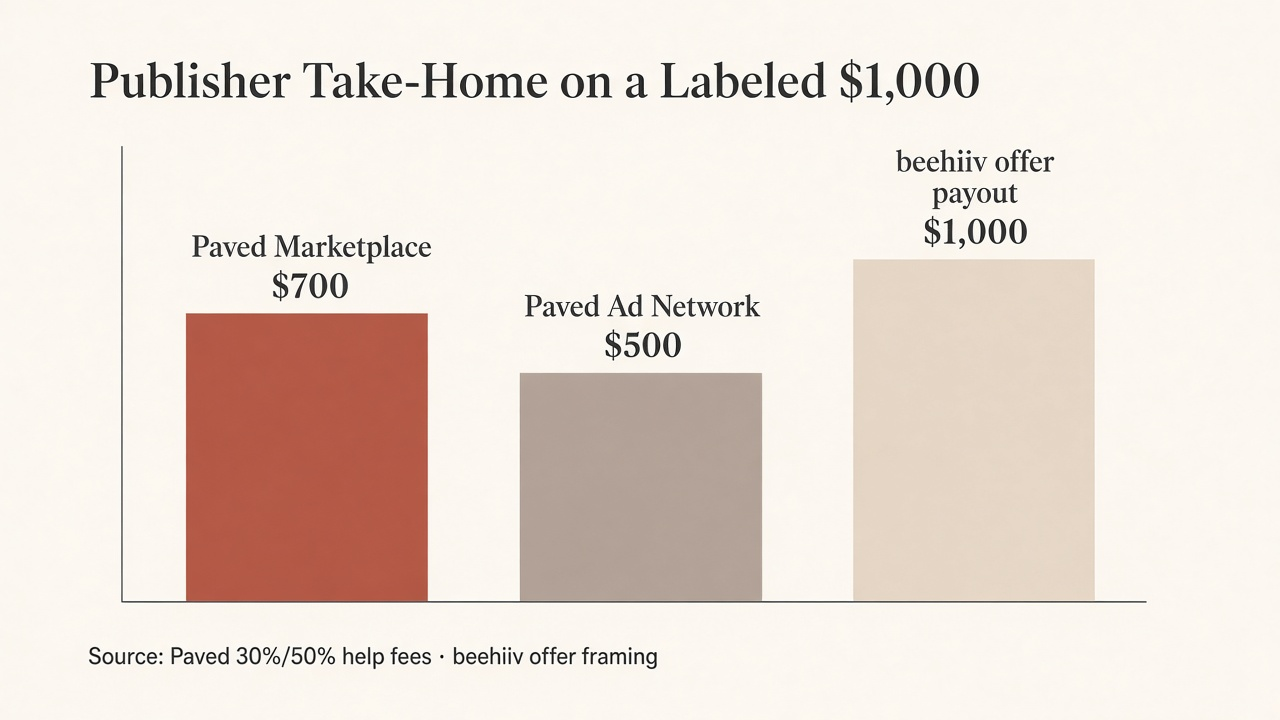
Source: Editorial math from Paved 30%/50% help-center fees and beehiiv offer payout framing. https://www.paved.com/help/articles/8124389-paved-s-pricing-for-publishers
Paved’s Ad Network runs an auction. Advertisers bid between $0.50 and $10 per click. Paved cites an average payout of $1.45 per click based on the last 30 days of network data (Paved). That is a network average, not your niche’s promise. Audience value moves the bid.
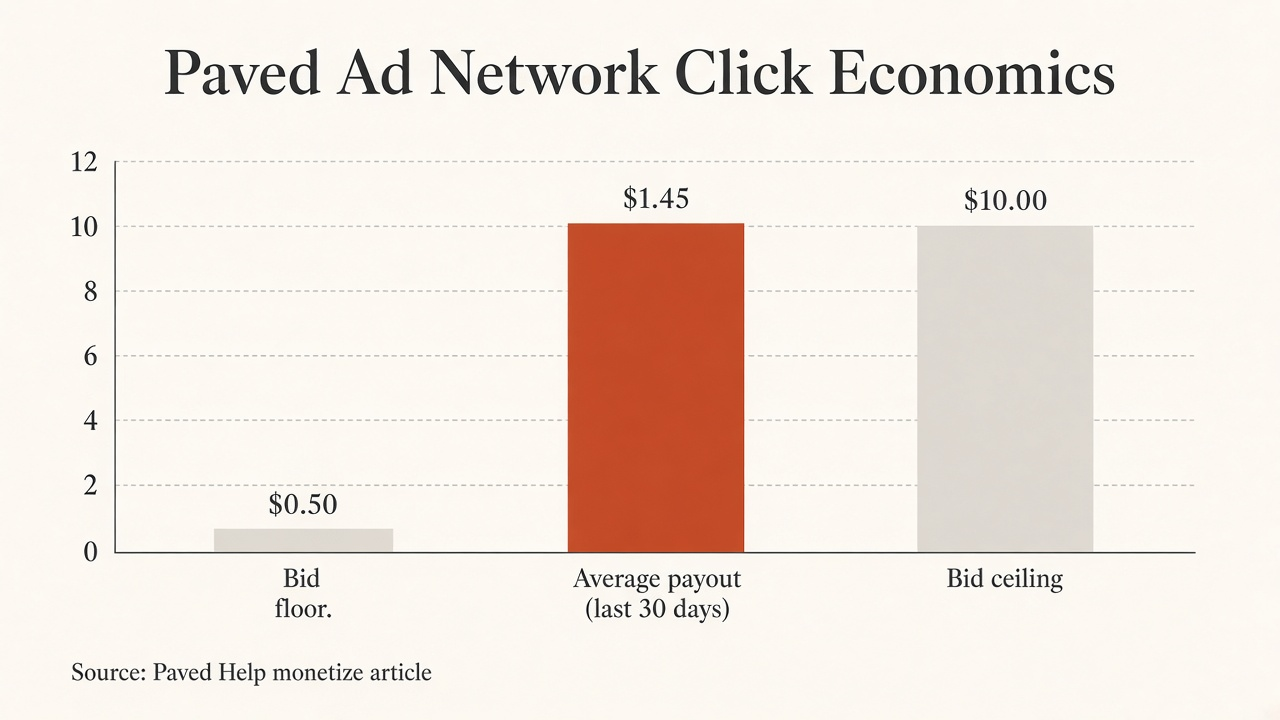
Source: Paved Help, How to Monetize Your Newsletter on Paved (accessed 2026-10-12). https://www.paved.com/help/articles/15656064-how-to-monetize-your-newsletter-on-paved
Remnant inventory is the unsold sponsored slot. Paved’s Remnant Inventory dashboard surfaces discounted dates for buyers (Paved). Smart Pricing auto-suggests a last-minute rate within two weeks of send if nothing books, staying above the publisher’s minimum; Paved claims 7x deal likelihood for users who enable it (Paved). Use remnant tools to protect fill. Do not train buyers that your best Friday is always on sale.
beehiiv’s acquisition note for Swapstack claims Swapstack facilitated over $2M in advertising spend—a vendor history claim, not a 2026 industry census (beehiiv). Useful as category proof that marketplace + network rails attracted capital. Useless as your eCPM forecast.
Q: What is a newsletter ad network? A: It is a platform that matches advertisers to placements in opted-in newsletters through marketplace bookings, programmatic matching, or an ESP offer feed. It is inventory infrastructure across many lists, not a single publisher’s rate card.
Q: How is a newsletter ad network different from a marketplace? A: On Paved, Marketplace means the buyer handpicks newsletters for a booked sponsorship day. The Ad Network matches ads across lists by targeting. Fees differ: Marketplace 30% of bookings vs Ad Network 50% of performance earnings for publishers.
Q: Is beehiiv’s Ad Network the same as Paved’s? A: No. beehiiv’s Ad Network is an offer feed for Scale publishers who send on beehiiv, paid on CPC/CPM offers, non-exclusive. Paved spans Marketplace bookings plus a programmatic network with published 30%/50% publisher cuts. Compare them on Paved vs beehiiv.
Q: How much do publishers keep on a $1,000 placement? A: On Paved’s published fees, Marketplace leaves $700 after 30%, and Ad Network leaves $500 after 50% of performance earnings. beehiiv offer dollars pay the stated CPC/CPM without that Marketplace booking cut—advertiser minimums are a separate gate.
Q: Should I only use a newsletter ad network and skip direct sponsors? A: No. Networks excel at remnant and scale. Direct IOs and media kits still price premium SOV. Most serious operators run both: sell the calendar when they can, fill gaps when they cannot. There is no public dataset for one blended eCPM that replaces that judgment.
A newsletter ad network is matching and remnant infrastructure for opted-in email—Marketplace SOV, programmatic CPC, or ESP offer feeds—not a synonym for “cheap sponsorship.” Climb the Newsletter Ad Surface Ladder, model the cut, and keep direct sales for dates that deserve a rate card. When the job is co-branded product selling with a revenue split, start at feat..
AddShoppers vs Omnisend for cart emails: AddShoppers redirects to Minty. Buy Omnisend's live cart automation with published Free/$16/$59 seats.
GetResponse double opt-in is off by default. Enable the list confirmation toggle, match form surfaces, and remember DOI alone is not GDPR compliance.
Mailing CPM is cost per 1,000 list recipients. Use Carroway size-band medians ($62.50→$7.77) and placement types—not one fake “good CPM.”