Peer Learning for Marketplace Merchants
Peer learning community for marketplace merchants: Rising-Tide Storefront Room—patterns, approve lessons, sale rituals—plus Hivebrite peer 40.8%.
How marketplace platforms build merchant champion communities: Tool User → Champion Ladder—triggers, Peer Room, AMA, proof—Hivebrite 76.9%.

TL;DR: A merchant champion community marketplace play climbs the Tool User → Champion Ladder: onboarding triggers → Peer Room → AMA → public proof. Hivebrite finds events drive meaningful participation for 76.9%. Do not invent cohort size or GMV. Email alone does not create champions.
Operators search merchant champion community marketplace after transactional emails fire and merchants still churn from listing. Champions are not a badge pack. They are listed builders who teach peers how storefronts, approvals, and sales work. This platform playbook sits on top of merchant community vs newsletter, peer learning, merchant AMAs, and Discord vs Slack.
A merchant champion community on a marketplace is a Peer Room where high-performing listed merchants teach storefront and affiliate craft, then get public proof for doing so—not a buyer Discord sold as a digital product.
Champions are not brand ambassadors paid for posts, and they are not affiliates who only promote. On a two-sided sell marketplace—merchants list, affiliates sell through co-branded storefronts, buyers purchase—the champion is the merchant who stays listed and raises the tide for peers. If your “champions” never taught a teardown, you named a loyalty tier, not a community.
Merchant champion communities matter because platforms already send emails for first listing, first affiliate approval, and each sale—and those triggers still leave merchants alone with the craft. Hivebrite’s sample puts events at 76.9% of meaningful participation drivers, with peer-to-peer support at 40.8% and forums at 37.4% (Hivebrite).
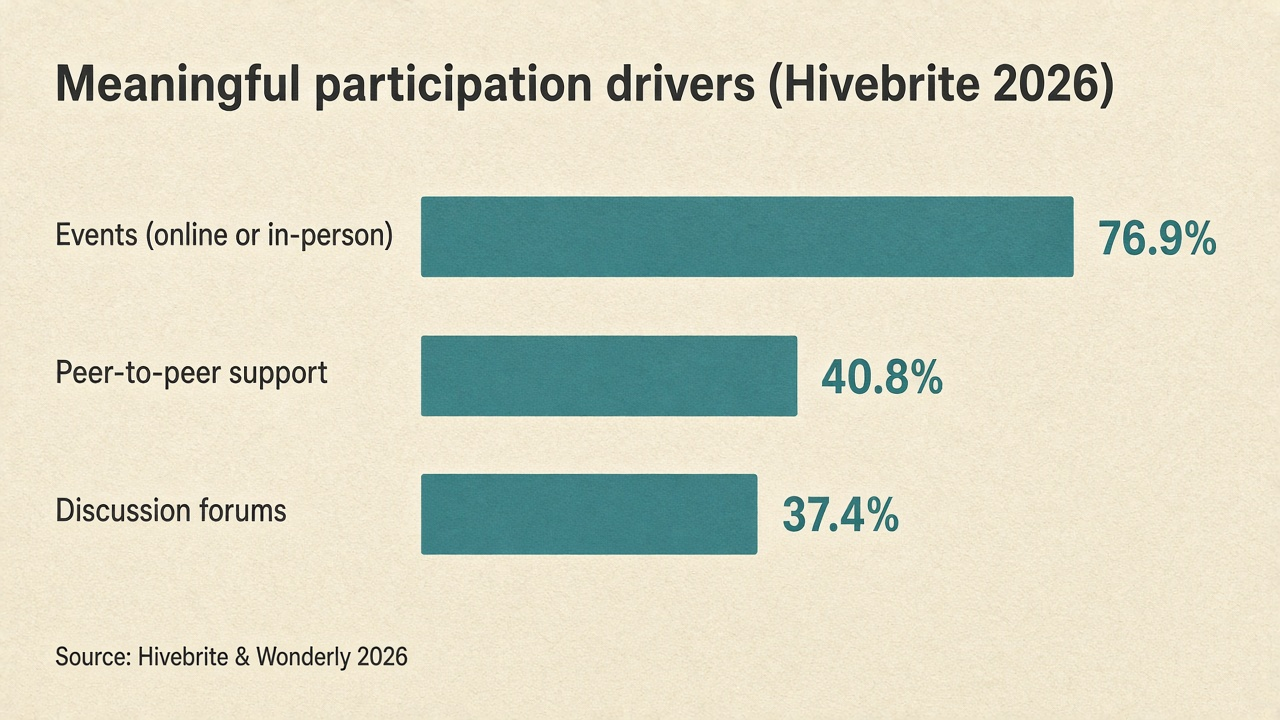
Source: Hivebrite and Wonderly, The Community Growth & Benchmark Report 2026 (n=186). https://go.hivebrite.com/hubfs/guides/community-growth-benchmark-report-2026.pdf
Platforms build merchant champions by handing tool users up a four-rung ladder. Skip a rung and you get either empty Discord roles or a newsletter that congratulates itself.
| Rung | Platform job | Merchant outcome |
|---|---|---|
| 1. Onboarding triggers | Email/in-product on first listing, first approval, each sale | Knows the next commercial action |
| 2. Peer Room | Invite into Rising-Tide storefront learning | Sees peers’ patterns and constraints |
| 3. AMA | Stage teardown + moderated Q&A | Teaches once; learns monthly |
| 4. Public proof | Named clips, spotlights, optional badge | Identity beyond the dashboard |
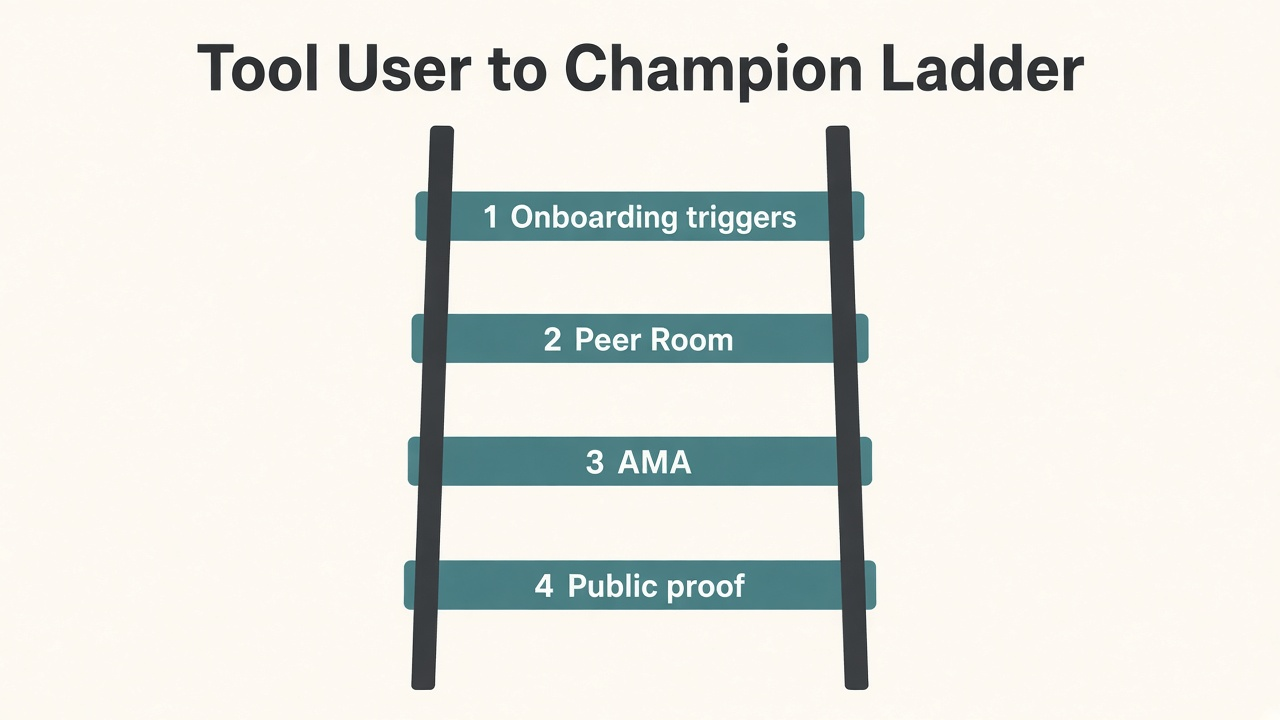
Source: feat. editorial Tool User → Champion Ladder; Hivebrite participation drivers; Discord Stage AMA guide.
Keep the emails. Change the last line. First listing → deep link to #storefront-examples. First affiliate approval → deep link to recruit/approve lessons (how to recruit affiliates). Each sale → invite to the next AMA calendar. Triggers without destinations are applause tracks.
Do not invent open-rate lifts. Measure click-through into the Peer Room and whether the merchant completed a commercial action in the following window.
Stand up the Rising-Tide Storefront Room: patterns → approve lessons → sale rituals (peer learning). Pick Discord or Slack with the Chat Seat Ladder (Discord vs Slack). Slack Free keeps 90 days of history; Pro is $8.75/user/month monthly (Slack). Discord Stage is the documented AMA surface (Discord).
Run the Champion AMA Ladder: invite criteria → storefront teardown → moderated Q&A → clips (how to run merchant AMAs). Hivebrite’s event weight (76.9%) is why this rung is not optional theater (Hivebrite).
Proof is clips, spotlights, and optional badges tied to teaching—not vanity follower counts. Publish three AMA clips in Broadcast with deep links back. Never invent revenue leaderboards from unpublished feat. GMV. If you lack a member-vs-non-member join, write no public dataset on the slide.
| Stage | Input | Output |
|---|---|---|
| Trigger | Listing / approval / sale event | Deep link into Peer Room |
| Peer Room | Pattern + approval threads | Merchant crafts next action |
| AMA | Champion + Stage mods | Teardown + answered questions |
| Proof | Clips + spotlight | Identity + inbound peer invites |
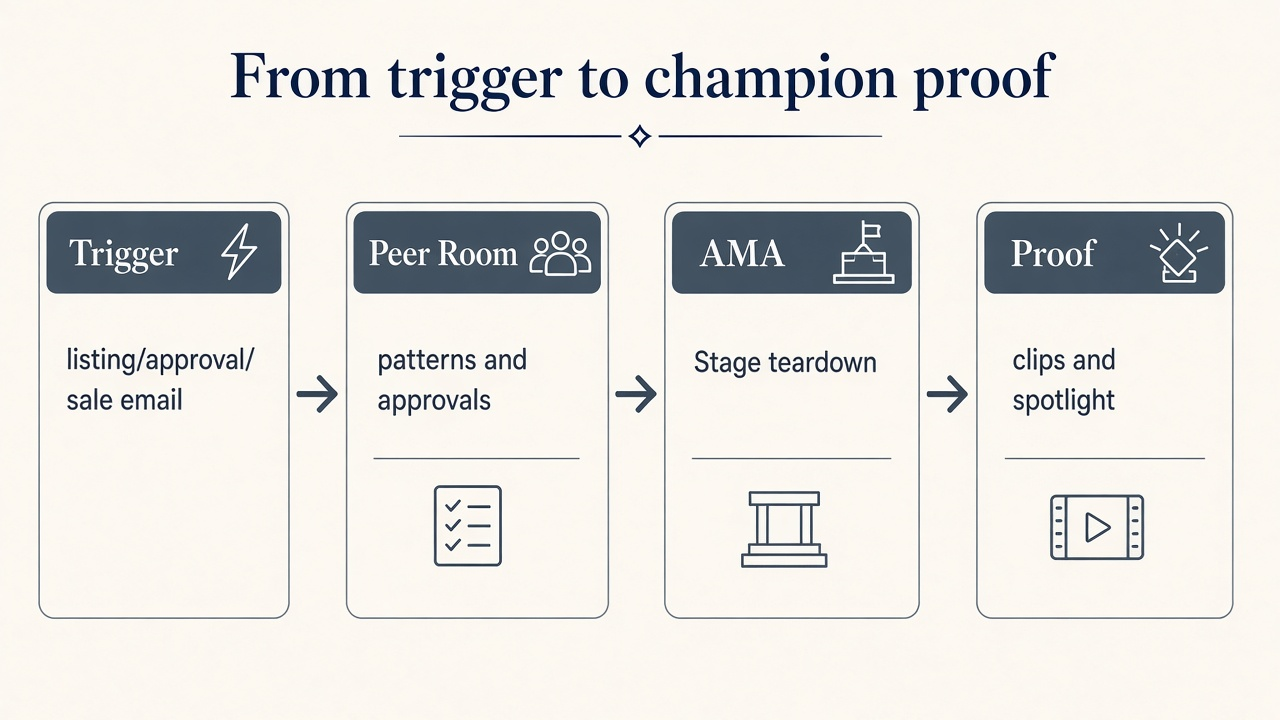
Source: feat. editorial Tool User → Champion Ladder; Stage mechanics from Discord (https://discord.com/blog/run-an-ama-townhall-via-stage-channel).
| Role | Owns | Failure if missing |
|---|---|---|
| Platform host | Ladder cadence, invites | Triggers orphan merchants |
| Stage moderator | Queue on AMA nights | Open-mic chaos |
| Champion merchant | Teardown honesty | Vague tip spam |
| Scribe | Clips within 48 hours | Proof never ships |
Budget two humans for live AMAs. One overloaded host will skip teardowns to chase chat—and teardowns are the product.
| Metric | Definition | Trap |
|---|---|---|
| Trigger→room CTR | Clicks from lifecycle mail into Peer Room | Opens under MPP noise |
| Pattern artifacts findable | Pins/wiki still reachable | Free Slack after 90 days |
| AMA completion | Teardown + moderated Q&A finished | Duration vanity |
| Member delta | Approvals / storefront refreshes: room members vs non-members | Inventing champion GMV lift |
CMX’s 24% quantification rate is the honesty check (CMX). Scorecard context: community-led growth benchmarks.
| Role | Paid for | Primary job on a sell marketplace |
|---|---|---|
| Affiliate | Commission on sales | Promote through storefronts |
| Brand ambassador | Often flat fee / product | Awareness content |
| Merchant champion | Recognition + optional perks | Teach peers who also list |
Do not collapse these into one Slack channel title. Affiliates need recruitment ops. Ambassadors need contracts. Champions need a Peer Room and a Stage.
Days 1–7: ship trigger deep links and open the Peer Room with invite criteria. Do not announce a “champion program” before anyone has taught. Days 8–14: first pattern drop and first Stage AMA with two staffed roles. Days 15–21: three clips in Broadcast and one spotlight that names what was taught, not a fake revenue rank. Days 22–30: compare member vs non-member approvals and storefront refreshes. If the join is missing, stop pitching ROI and fix instrumentation—CMX’s 24% quantification rate is your warning label (CMX).
Start with a small early cohort of merchants who already sold. Champions who feel extracted once will not return for a second AMA. Send them their clips, thank them in the room, and ask for a narrower topic next quarter. That is how identity sticks without inventing feat. cohort sizes.
Do not auto-badge every merchant who completes onboarding. Do not scrape “top GMV” into a public leaderboard without a reviewed dataset—and if that dataset is proprietary, say so only when you actually have it. Absent a labeled file, write no public dataset. Automate calendar reminders and clip posting checklists; keep invite criteria and Stage moderation human.
Q: What is a merchant champion community on a marketplace? A: It is a Peer Room where high-performing listed merchants teach storefront and affiliate craft and receive public proof for teaching. It is not a buyer membership community.
Q: How do marketplace platforms build merchant champion communities? A: Climb the Tool User → Champion Ladder: onboarding triggers → Peer Room → AMA → public proof. Hivebrite supports events as a participation driver at 76.9% (Hivebrite).
Q: Are merchant champions the same as brand ambassadors? A: No. Ambassadors are often paid for awareness posts; champions teach peers who also list and approve affiliates. Affiliates sell; champions raise the merchant side.
Q: Can lifecycle email replace a champion community? A: No. Email can trigger entry; craft and events live in the Peer Room. See merchant community vs newsletter.
Q: Is there a published champion conversion rate platforms should hit? A: No. There is no public dataset for a universal champion conversion % or GMV lift. Measure member vs non-member deltas; CMX finds only 24% of teams quantify community confidently (CMX).
Marketplace platforms build merchant champions when triggers hand off to a Peer Room, AMAs, and honest proof. Keep Broadcast thin. Staff the Stage. Measure member deltas. When you want merchants listing and affiliates selling through co-branded storefronts, start on feat..
Peer learning community for marketplace merchants: Rising-Tide Storefront Room—patterns, approve lessons, sale rituals—plus Hivebrite peer 40.8%.
Build a product distribution network on four rails—DTC, wholesale, commission sellers, co-branded storefronts. Densify before you scale; Lowe’s pays up to 20% on storefronts.
Create a startup partner program by picking one seat—affiliate, agency, reseller, or tech—then PartnerStack, a $49 tracker, or feat.