How Platforms Build Merchant Champions
How marketplace platforms build merchant champion communities: Tool User → Champion Ladder—triggers, Peer Room, AMA, proof—Hivebrite 76.9%.
Peer learning community for marketplace merchants: Rising-Tide Storefront Room—patterns, approve lessons, sale rituals—plus Hivebrite peer 40.8%.

TL;DR: A peer learning community marketplace merchants need is a Rising-Tide Storefront Room: share top storefront patterns → recruit/approve lessons → sale rituals. Hivebrite finds peer-to-peer support drives meaningful participation for 40.8% (events 76.9%). Do not invent retention lifts. Host tool is secondary—see Discord vs Slack.
Operators search peer learning community marketplace merchants after the affiliate roster grew and listings went quiet. A tip dump in Discord is not peer learning. A Rising-Tide Storefront Room is—merchants who sold teach the next cohort how storefronts, approvals, and sale rituals actually work. Pair this with merchant community vs newsletter, merchant AMAs, and Discord vs Slack.
A peer learning community for marketplace merchants is a moderated Peer Room where listed builders share storefront patterns, affiliate approval lessons, and sale rituals so peers stay listed and selling—not a buyer membership Discord.
It is not office hours with the CEO reading a blog. It is not a generic “creator community.” On a two-sided sell marketplace—merchants list, affiliates promote through co-branded storefronts, buyers purchase—the scarce asset is a merchant who keeps refreshing creative and approving partners. Peer learning is how that asset compounds without another tip email.
Peer learning matters because Hivebrite still ranks peer-to-peer support at 40.8% of meaningful participation drivers—behind events (76.9%) and ahead of forums (37.4%) (Hivebrite). A Rising-Tide Storefront Room is designed to feed all three: live rituals, peer help, and durable threads.
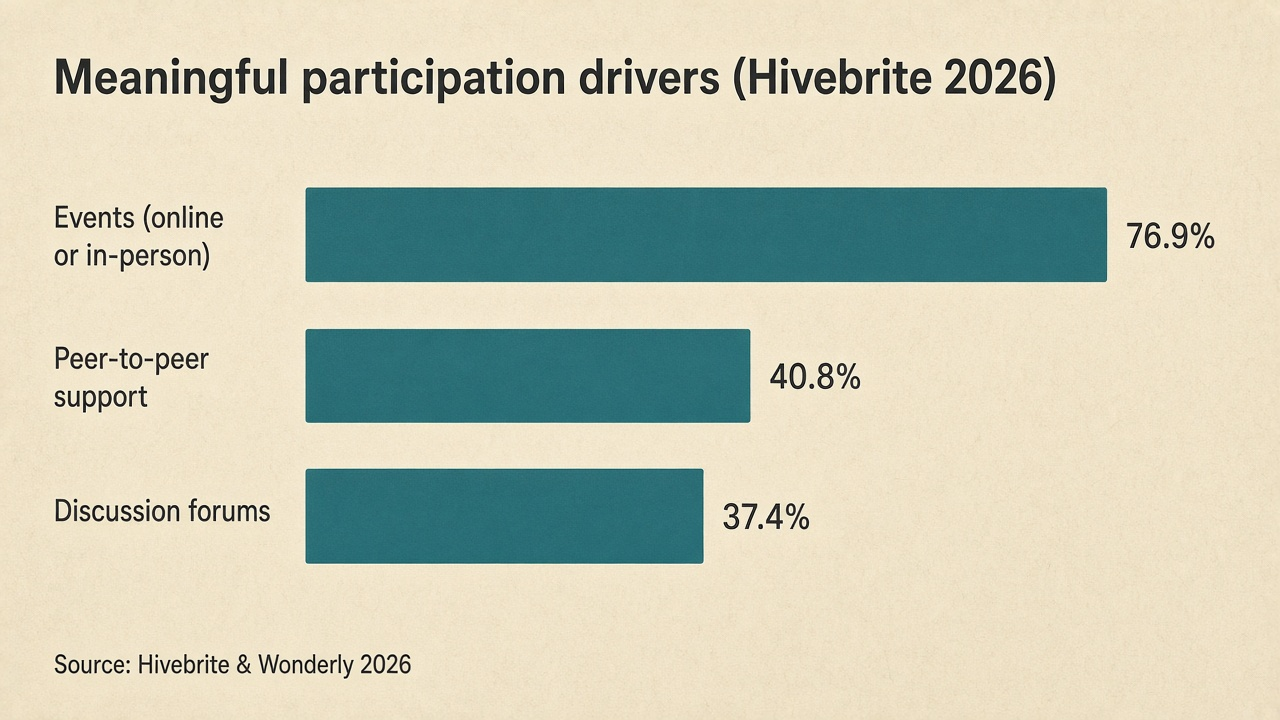
Source: Hivebrite and Wonderly, The Community Growth & Benchmark Report 2026 (n=186). https://go.hivebrite.com/hubfs/guides/community-growth-benchmark-report-2026.pdf
Peer learning for marketplace merchants works as a three-loop Rising-Tide Storefront Room. Skip a loop and you get either silent channels or vibes without commercial motion.
| Loop | Job | Artifact |
|---|---|---|
| 1. Storefront patterns | Show what a selling co-branded surface looks like | Teardown clips + pinned examples |
| 2. Recruit / approve lessons | Teach who to invite and who to reject | Approval FAQ + red-flag thread |
| 3. Sale rituals | Keep weekly motion after the first sale | Checklists, offer notes, AMA calendar |
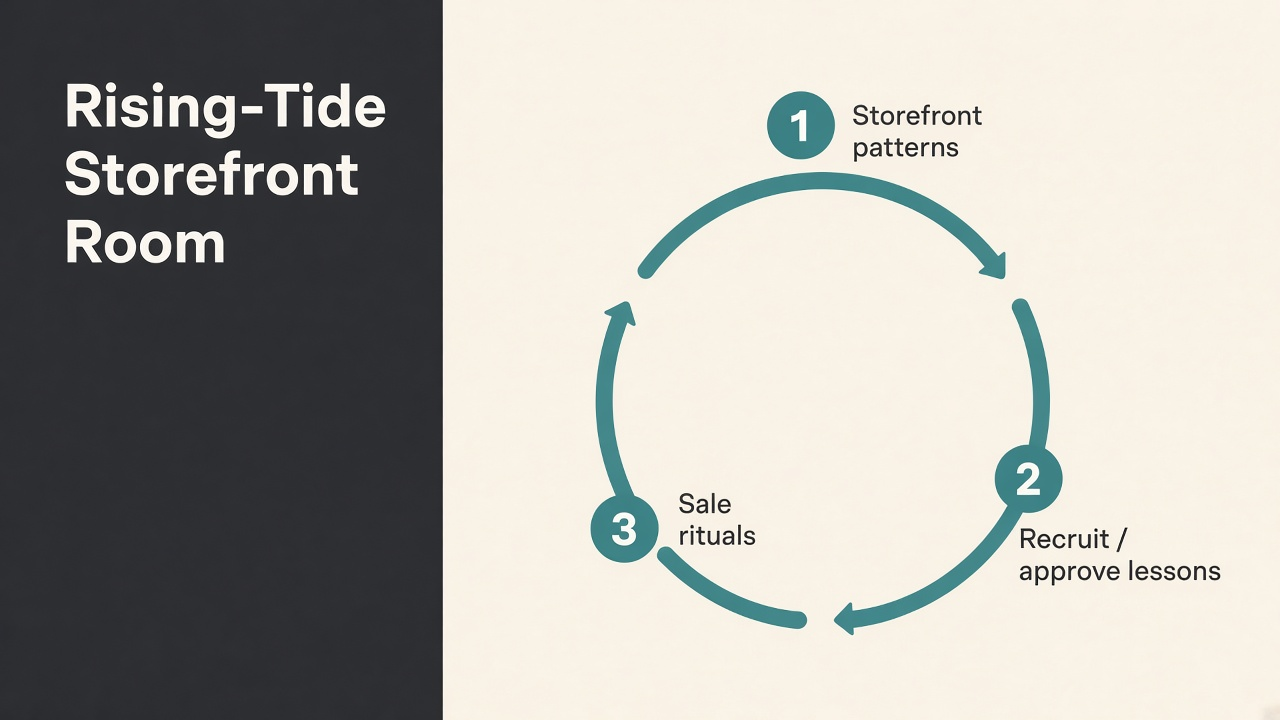
Source: feat. editorial Rising-Tide Storefront Room; participation drivers from Hivebrite 2026.
Ask champions to show structure, not screenshots of vanity metrics. How is the storefront surface organized for affiliates? What creative sits above the fold? Which deep links get used? Label guest stories as anecdotes. There is no public “average teardown lift” dataset.
Pin three living examples. Rotate them when a pattern stops converting. The room’s job is rising tide: the next merchant copies a working pattern instead of guessing in isolation.
Peers teach recruiting and rejecting faster than a help center. Tie lessons to how to recruit affiliates for your product: one-screen pitch, manual vet, week-one enablement. Publish a short “we reject for…” list so new merchants do not mistake volume for quality. That is how you avoid the flat-program trap.
After the first tracked sale, motion dies without ritual. Weekly: one creative refresh, one affiliate check-in, one offer note. Monthly: one Stage AMA on the Champion AMA Ladder. Clip answers into Broadcast within 48 hours so absentees land back in the Peer Room (how to run merchant AMAs).
Sale rituals are boring on purpose. The room is not chasing virality; it is keeping listed merchants from going dark between launches. When a merchant skips two weekly rituals, the host asks one private question—blockers on creative, approvals, or offer—before the listing looks abandoned in the marketplace grid.
| Cadence | Peer Room | Broadcast |
|---|---|---|
| Daily | Async Q&A in #affiliate-approvals / #storefront-examples |
None (avoid spam) |
| Weekly | One sale-ritual nudge + pin refresh | One thin link into the room |
| Monthly | Stage AMA + three clips | Newsletter with the same three deep links |
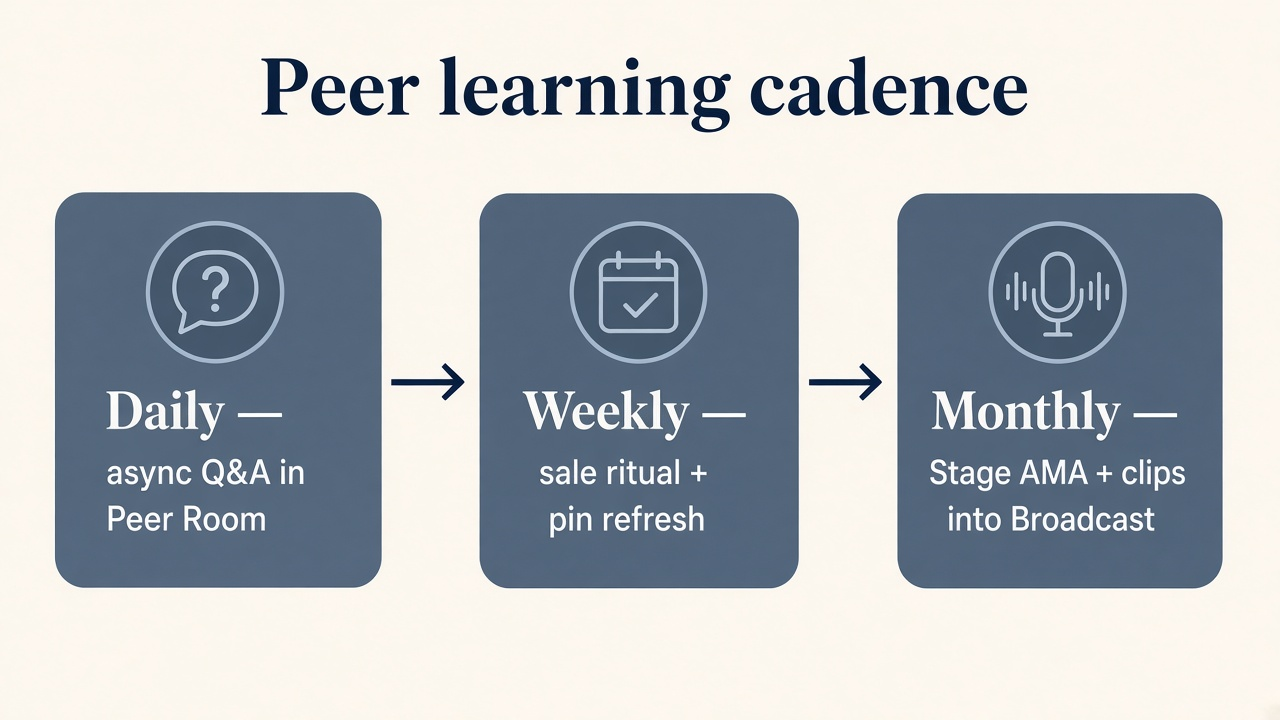
Source: feat. editorial cadence; Stage AMA mechanics from Discord (https://discord.com/blog/run-an-ama-townhall-via-stage-channel); Peer Room vs Broadcast from merchant-community-vs-newsletter.
Pick Discord or Slack with the Chat Seat Ladder—seat math, async depth, ritual surface, integration gravity—not vibes (Discord vs Slack for merchant communities). Slack Free keeps 90 days of history; Pro is $8.75/user/month monthly (Slack). Discord Stage is the documented AMA surface (Discord). The Rising-Tide loops stay the same on either host.
| Metric | Definition | Trap |
|---|---|---|
| Pattern artifacts findable | Pins / wiki older than a month still reachable | Free Slack after 90 days |
| Approval quality | Reject rate + sold-after-join among peers | Celebrating applications only |
| Member delta | Approvals / storefront refreshes: room members vs non-members | Inventing a peer-learning lift |
| AMA completion | Teardown + moderated Q&A finished | Open-mic duration |
CMX’s 24% quantification rate means most teams should fix the CRM join before they pitch ROI slides (CMX). For scorecard honesty, see community-led growth benchmarks.
| Role | Owns | Failure if missing |
|---|---|---|
| Host (platform) | Cadence, invites, recap | Room becomes a tip dump |
| Champion merchants | Patterns + honest constraints | Vague “post more” advice |
| Moderator | Queue, Slow Mode, pins | Noise buries teardowns |
| Scribe | Clips into Broadcast | AMA dies in the archive |
Budget two humans for anything larger than a private cohort. A single overloaded host will skip Loop 1 to chase chat—and patterns are the product.
Week one is invite criteria, not channel wallpaper. Require a live listing and at least one tracked sale or meaningful approval window before someone can post a teardown. Publish the Rising-Tide loops in #announcements so merchants know what “good” looks like. Create #storefront-examples, #affiliate-approvals, #ama-questions, and a Stage or huddle calendar slot. Hide or Slow Mode questions until the first AMA so the room does not fill with unscoped asks.
Week two is the first pattern drop. One champion walks a storefront for 10–15 minutes, then answers pre-collected questions. The scribe posts three clips and one “we reject for…” bullet within 48 hours. That single cycle proves the Peer Room is craft, not vibes. If nobody will teach, you do not have a community problem—you have a champion pipeline problem. Fix invites before you buy Slack Pro seats or Nitro cosmetics.
Between weeks, keep Broadcast thin: calendar, changelog, three deep links. Do not paste the teardown transcript into the newsletter. Absentees should click into the room. That is how peer-to-peer support (40.8% in Hivebrite’s cut) continues when nobody is live (Hivebrite).
Good pattern shares name constraints: brand-bidding rules, discount stacking limits, creative you will not approve. Peers need the fences as much as the wins. Refuse screenshots of competitor dashboards you do not own, unverified income claims, and “guaranteed” playbooks. Label every guest story as experience. If a merchant asks for a universal conversion benchmark you do not have, say no public dataset and point them to their own member-vs-non-member delta instead of inventing one.
Q: What is a peer learning community for marketplace merchants? A: It is a moderated Peer Room where listed builders share storefront patterns, approval lessons, and sale rituals so peers stay commercially active. It is not a buyer membership community.
Q: How does the Rising-Tide Storefront Room work? A: Three loops: share selling storefront patterns, teach recruit/approve lessons, run sale rituals plus monthly AMAs. Hivebrite supports peer-to-peer participation at 40.8% and events at 76.9% (Hivebrite).
Q: Is peer learning the same as an affiliate program? A: No. Affiliate programs recruit sellers; peer learning retains merchants who list and approve. You still need recruitment ops—see how to recruit affiliates for your product.
Q: Discord or Slack for a merchant peer learning room? A: Use the Chat Seat Ladder: Discord usually wins for Stage AMAs and free scale; Slack wins when workplace apps and paid history matter (Discord vs Slack).
Q: Can you promise a retention lift from peer learning? A: No. There is no public dataset for a universal marketplace peer-learning lift. Compare members vs non-members on approvals and storefront refreshes; CMX finds only 24% of teams quantify community confidently (CMX).
A peer learning community for marketplace merchants earns its keep when storefront patterns, approval lessons, and sale rituals rise together. Staff the moderators. Clip the AMAs. Keep Broadcast thin. When you want merchants listing and affiliates selling through co-branded storefronts, start on feat..
How marketplace platforms build merchant champion communities: Tool User → Champion Ladder—triggers, Peer Room, AMA, proof—Hivebrite 76.9%.
Build a product distribution network on four rails—DTC, wholesale, commission sellers, co-branded storefronts. Densify before you scale; Lowe’s pays up to 20% on storefronts.
Create a startup partner program by picking one seat—affiliate, agency, reseller, or tech—then PartnerStack, a $49 tracker, or feat.