AddShoppers vs Omnisend (Cart Email Seat)
AddShoppers vs Omnisend for cart emails: AddShoppers redirects to Minty. Buy Omnisend's live cart automation with published Free/$16/$59 seats.
Compare Klaviyo, Omnisend, and Mailchimp at the same list size. Normalize who counts on the bill, then read free caps, send meters, and published tiers.

TL;DR: Klaviyo vs Omnisend vs Mailchimp pricing only works after you normalize who counts on the bill. Mailchimp bills subscribed + unsubscribed + non-subscribed until you archive, clean, or delete. Omnisend excludes unsubscribed. Klaviyo bills active profiles. Same headcount, three invoices.
Founders paste how do Klaviyo’s pricing tiers compare to Omnisend and Mailchimp at the same list size into a spreadsheet and still misread the bill. The sticker is not the list. Each ESP counts a different person as “on plan.”
If you skip that fork, you will crown the cheapest logo while carrying ghosts Mailchimp still invoices—or overpay Klaviyo for depth you never configure.
Key takeaways:
Same-list ESP pricing means comparing Klaviyo, Omnisend, and Mailchimp after you fix a contact/profile headcount and state which statuses each vendor still bills—then reading free caps, send meters, and published plan stickers.
That one sentence is the definition. “Same list size” is a research method, not a marketing slogan.
On Reddit, ecommerce operators ask whether Klaviyo is “worth it” past ~25k contacts or whether Omnisend covers abandoned cart and post-purchase without the climb (r/Emailmarketing). Early DTC threads often call Klaviyo overkill under ~$30k/month when three flows do the work (r/Emailmarketing). Those debates go sideways when the spreadsheet treats Mailchimp’s contact total like Omnisend’s billable contacts.
Billing units matter because list growth compounds the wrong meter. You either overpay for depth you never open, or you underbuy tooling you will rebuild later.
Why founders get the three-way wrong:
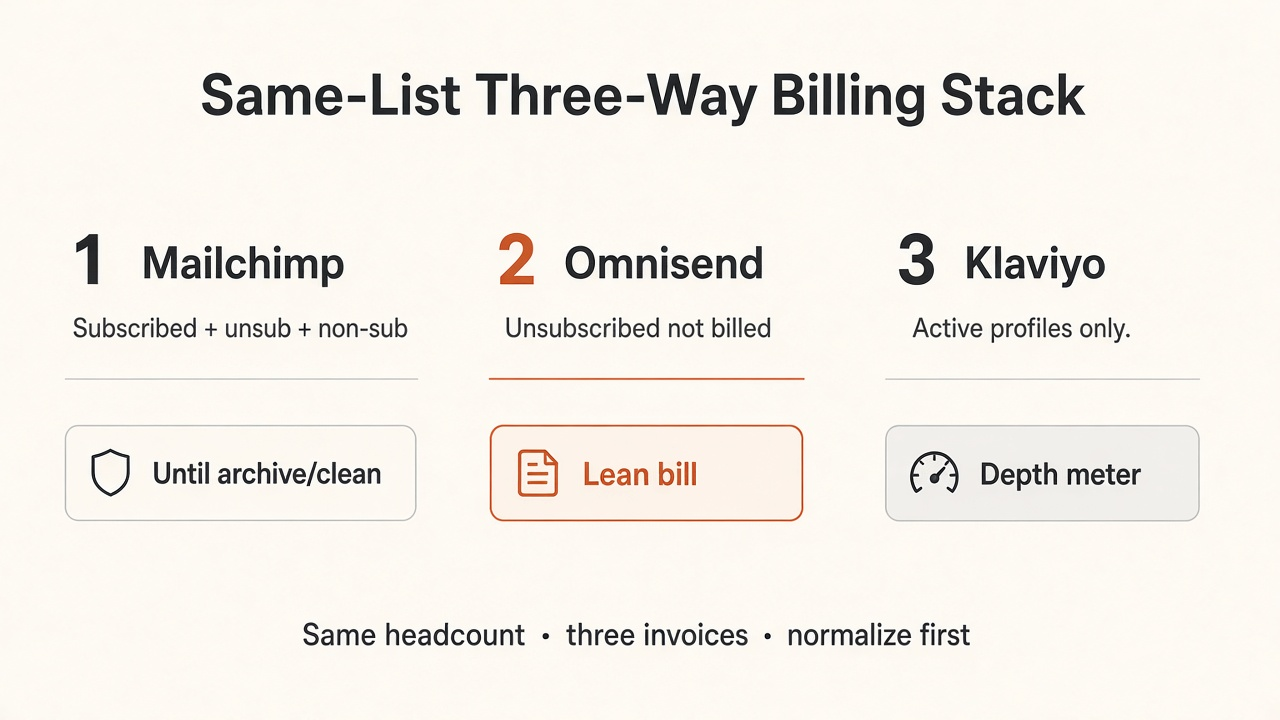
Source: Mailchimp Help pricing plans; Omnisend pricing billing note; Klaviyo Help billing. https://mailchimp.com/help/about-mailchimp-pricing-plans/ · https://www.omnisend.com/pricing/ · https://help.klaviyo.com/hc/en-us/articles/115000976672
Three-way pricing works as a stack: fix the headcount, map who still bills, read free caps, then compare published paid tiers and send meters. Skip a layer and you are comparing different products that share a contact number.
| Layer | Mailchimp | Omnisend | Klaviyo |
|---|---|---|---|
| Primary unit | Contact total across audiences | Billable contacts | Active / billable profiles |
| Unsubscribed | Still counted until archive/clean/delete | Not billed | Not active/billable once suppressed/unsubscribed |
| Non-subscribed / ghosts | Count toward contact total | Can bill if they received automations | Profiles eligible for marketing can count per plan rules |
| Hygiene lever | Archive, clean, delete, sunset | Sunset/suppress; unsubs leave the bill | Suppress inactive profiles to hold the tier |
Sources: Mailchimp Help; Omnisend pricing; Klaviyo Help.
| Meter | Mailchimp Free | Omnisend Free | Klaviyo Free |
|---|---|---|---|
| Contacts / profiles | 250 | 250 | 250 active profiles |
| Email sends / month | 500 (daily 250) | 500 | 500 |
| Exceed contact cap | Live/test sends held until upgrade or reduce | Upgrade path | Sending restricted until upgrade |
| Notable extra | Limited templates / 1 audience | Multichannel packaging on free (per Omnisend) | $5/mo mobile credit; email support 60 days |
Sources: Mailchimp Help; Omnisend; Klaviyo.
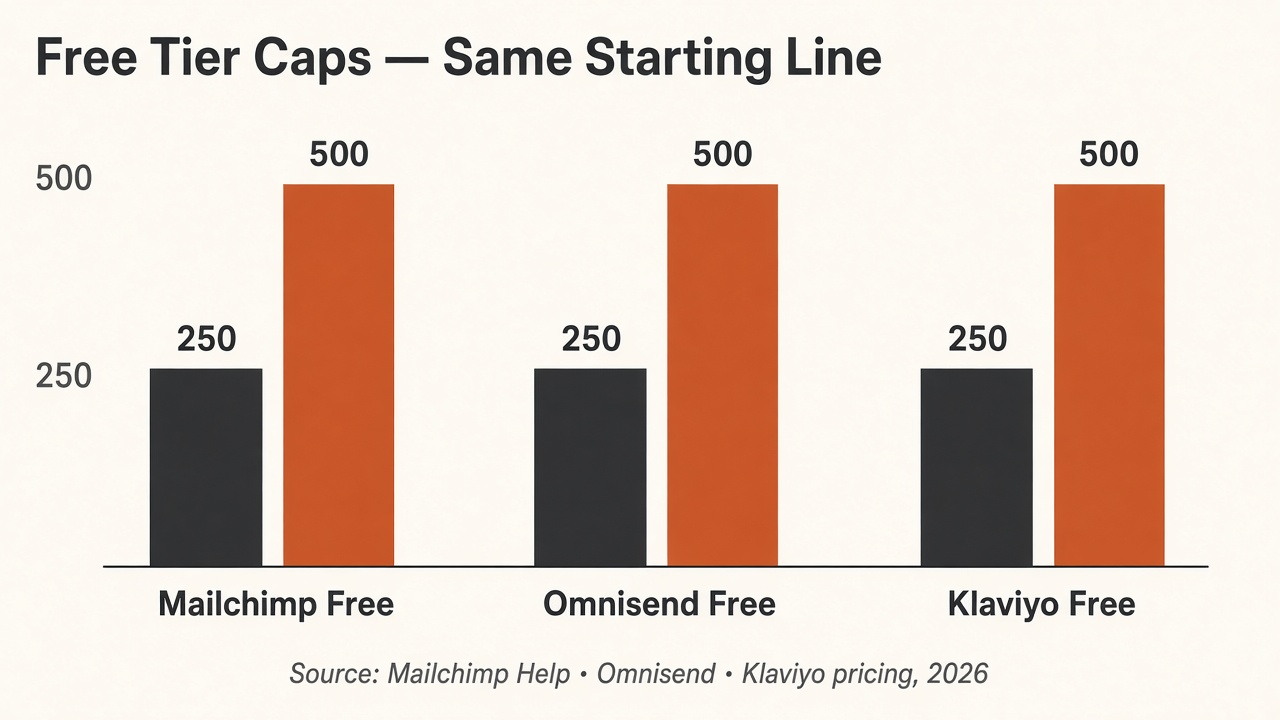
Source: Mailchimp Help; Omnisend pricing; Klaviyo pricing (accessed 2026-10-12). URLs as in table.
Quotable table first. Omnisend Standard vs Klaviyo Email dollars come from Omnisend’s vendor comparison (label it). Mailchimp mid-tier dollars are calculator-gated on the official UI—use starting anchors here, then verify the live calculator for your exact band.
| Fixed band (contacts/profiles) | Omnisend Standard (vendor table) | Klaviyo Email (vendor table) | Mailchimp (official anchors / meters) |
|---|---|---|---|
| 500 | $16 (6,000 sends) | $20 (5,000 sends) | Essentials from $13 / Standard from $20; Essentials 10× / Standard 12× sends |
| 2,500 | $44 (30,000) · Pro $59 unlimited | $60 (25,000) | Verify calculator; send = plan × contact limit |
| 5,000 | $81 (60,000) · Pro $90 | $100 (50,000) | Verify calculator; Standard 12× → 60,000 sends at 5,000 limit |
| 10,000 | $132 (120,000) · Pro $150 | $150 (100,000) | Premium base includes 10,000 contacts from $350; Standard calculator for non-Premium |
Sources: Omnisend vs Klaviyo; Mailchimp pricing; Mailchimp Help.
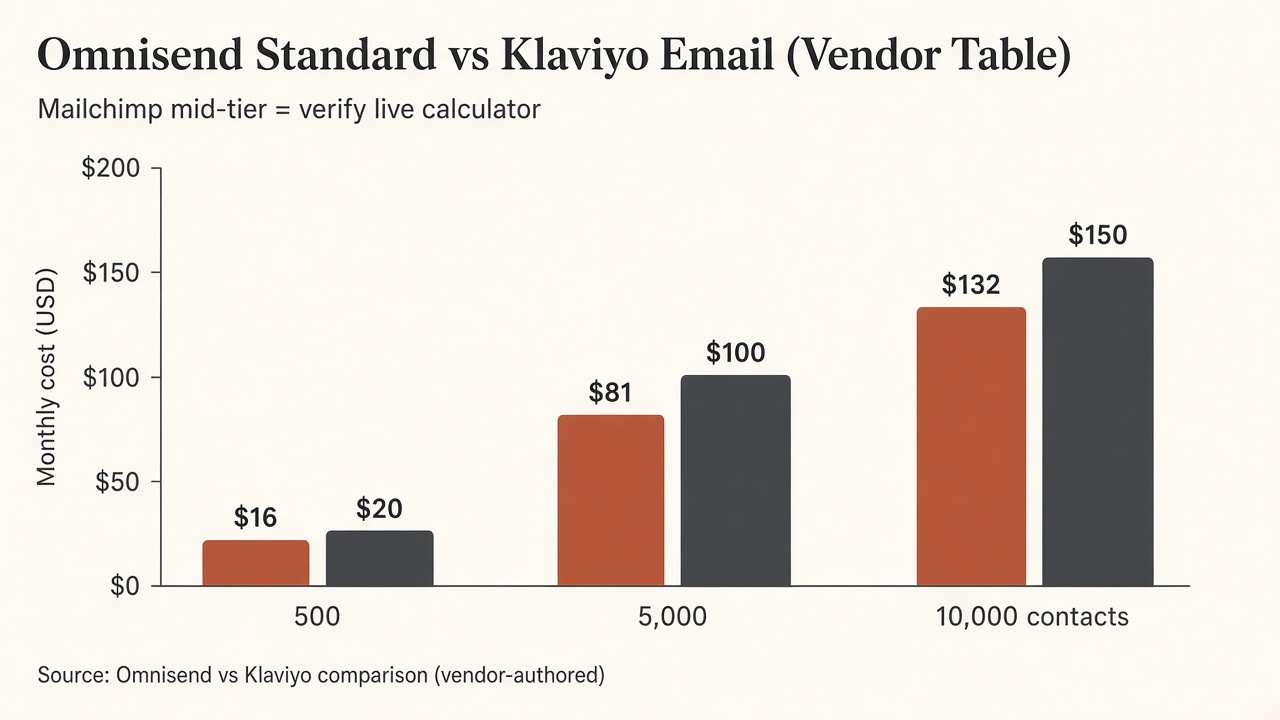
Source: Omnisend, Omnisend vs Klaviyo comparison (vendor-authored ladder). https://www.omnisend.com/blog/omnisend-vs-klaviyo/
Read the send columns. At 10,000, Omnisend Standard lists 120,000 sends versus Klaviyo’s 100,000 in that table while both land near $150. Price is not the whole product—SMS packaging, Shopify depth, and who still sits on the bill decide the real monthly total.
Treat Omnisend’s ladder as a labeled primary snapshot for Omnisend versus Klaviyo only. Mailchimp’s mid-tier dollars move with the official calculator and with whether your “5,000” tab still includes unsubscribed and non-subscribed contacts. If those ghosts are 20% of the file, Mailchimp is pricing a different list than the one you exported for Omnisend.
| Your job | Lean pick | Why |
|---|---|---|
| General ESP / infrequent campaigns | Mailchimp | Broad suite; watch unsub + non-subscribed inflation on the contact total |
| Ecommerce email + SMS on one lean bill | Omnisend | Published Standard ladder undercuts Klaviyo Email at many bands; unsubs leave the bill |
| Deep Shopify segmentation / predictive flows you will run weekly | Klaviyo | Active-profile pricing buys depth—only if you use it |
| List hygiene as a billing control | All three | Mailchimp: archive/clean; Omnisend/Klaviyo: suppress/sunset (sunset flow) |
Q: How do Klaviyo’s pricing tiers compare to Omnisend and Mailchimp at the same list size? A: First normalize who counts. Omnisend’s vendor table puts Standard below Klaviyo Email at many bands (for example $16 vs $20 at 500 and $81 vs $100 at 5,000). Mailchimp’s paid stickers are calculator-based; Essentials starts from $13 and Standard from $20, with 10×/12×/15× send multipliers. Re-check live prices before you sign.
Q: Which ESP is cheapest at 5,000 contacts? A: On Omnisend’s published ladder, Omnisend Standard at $81 undercuts Klaviyo Email at $100. Mailchimp Standard at that band requires the live calculator—do not invent a third-party census. Cheapest sticker still loses if Mailchimp’s contact total includes more statuses than your “5,000 subscribers” tab.
Q: Do unsubscribed contacts count toward pricing? A: Mailchimp: yes, until you archive, clean, or delete. Omnisend: pricing copy says unsubscribed aren’t billed. Klaviyo: suppressed/unsubscribed profiles are not active/billable. Cleaning the list is a billing control on every stack.
Q: Are the free plans the same? A: All three sit near 250 contacts/profiles and 500 emails per month. Differences matter: Mailchimp’s daily 250 send cap and send hold on overage; Klaviyo’s $5 mobile credit and 60-day email support window on free. Read the free-tier table before you “start free” as a strategy.
Q: Should every Shopify store default to Klaviyo? A: No. If you will not run deep predictive segmentation weekly, Omnisend’s lean multichannel packaging or a disciplined Mailchimp setup can be the clearer invoice. Migrate when complexity outgrows the tool—not because of logo FOMO. There is no public dataset proving one ESP always wins on revenue.
Klaviyo vs Omnisend vs Mailchimp pricing is a same-list billing problem before it is a feature contest. Climb the Same-List Three-Way Billing Stack—who counts, free caps, published tiers, job fit—then verify the live calculator. When the job is letting creators sell your product through a co-branded page with a revenue split, start at feat..
AddShoppers vs Omnisend for cart emails: AddShoppers redirects to Minty. Buy Omnisend's live cart automation with published Free/$16/$59 seats.
GetResponse double opt-in is off by default. Enable the list confirmation toggle, match form surfaces, and remember DOI alone is not GDPR compliance.
Mailing CPM is cost per 1,000 list recipients. Use Carroway size-band medians ($62.50→$7.77) and placement types—not one fake “good CPM.”