AddShoppers vs Omnisend (Cart Email Seat)
AddShoppers vs Omnisend for cart emails: AddShoppers redirects to Minty. Buy Omnisend's live cart automation with published Free/$16/$59 seats.
Grow a list without popups via the Formless List Growth Ladder: checkout consent, referral, conversational, utility, waitlist. Consent still required.

TL;DR: List growth without forms or popups means you stop treating interruptive overlays as the growth engine. Use the Formless List Growth Ladder: checkout marketing consent, referral, carefully labeled conversational capture, utility exchange, then community or waitlist. Consent is still required. There is no public four-way formless signup CVR census.
Operators hate the homepage popup and still need names. The search query is blunt: list growth without forms or popups. Most answers either smuggle the popup back in with a softer delay or invent a month-over-month growth rate. Neither helps.
Popup and form benchmarks live in email list growth benchmarks. Overlay tool ranking lives in HubSpot vs OptinMonster exit intent. Referral math lives in referral program benchmarks and structures. This page owns the formless capture ladder.
List growth without forms or popups is the practice of adding permissioned subscribers through seats that are not interruptive on-site overlays or classic multi-field signup boxes as the primary engine. The growth job moves to checkout consent, referral, conversational delivery, utility asks, and community or waitlist surfaces.
It is not permissionless email. Shopify’s help text is clear: send promotional content only to customers who agreed to receive marketing, including people who checked a box at checkout or signed in with an opt-in (Shopify Help). Omnisend’s sync docs make the failure mode obvious: a checkout email without the marketing box lands as a non-subscribed contact (Omnisend Help).
It is also not “never use a field.” A back-in-stock ask, a waitlist field, or a quiz results email is still a capture. The difference is job and timing. The visitor already raised a hand for a product, a drop, or a result. That is formless relative to a timed homepage takeover, not formless relative to consent law.
List growth without forms or popups matters because popup fatigue is real in operator language, interrupt volume is saturating, and brand or luxury seats often refuse discount overlays. You still need a scoreboard that respects consent.
List growth without forms or popups works as a five-rung Formless List Growth Ladder. Climb in order when you are killing overlays. Do not invent a single CVR champion across rungs. Measure each seat with its own denominator: checkout opt-in rate among completed orders, referral rate among purchases, conversational confirmed opt-ins, utility submits, waitlist joins.
| Rung | Seat | What you measure | Sourced anchor |
|---|---|---|---|
| 1 | Checkout / account marketing consent | % of checkouts with marketing email opted in | Shopify Marketing opt-in settings (Shopify Help) |
| 2 | Referral (friend-get-friend) | Referred purchases ÷ total purchases; also new emails from referred buyers who opt in | ReferralCandy ~2.35% global; software ~4.75% (ReferralCandy); Omnisend cites ~48% referral email open / ~30% better lead convert (Omnisend) |
| 3 | Conversational capture | Confirmed marketing opt-ins from chat, DM, or quiz-result delivery | no public dataset for matched conversational vs popup signup CVR; treat as high-intent VOC, not a census |
| 4 | Utility exchange | Back-in-stock, price-drop, guide, early-access submits with marketing permission | Operator VOC: intent over urgency (r/ShopifyPros); Omnisend form-type landing pages average 6.47% when a dedicated page is the surface (Omnisend) |
| 5 | Community / waitlist / co-selling | Waitlist joins; community members who grant marketing permission | Waitlist mechanics in waitlist growth strategies; creator distribution in audience into a distribution channel |
Source: Shopify Help (checkout Marketing opt-in); ReferralCandy referral rates; Omnisend popup, referral, and form-type articles; community VOC. No matched five-way signup CVR census.
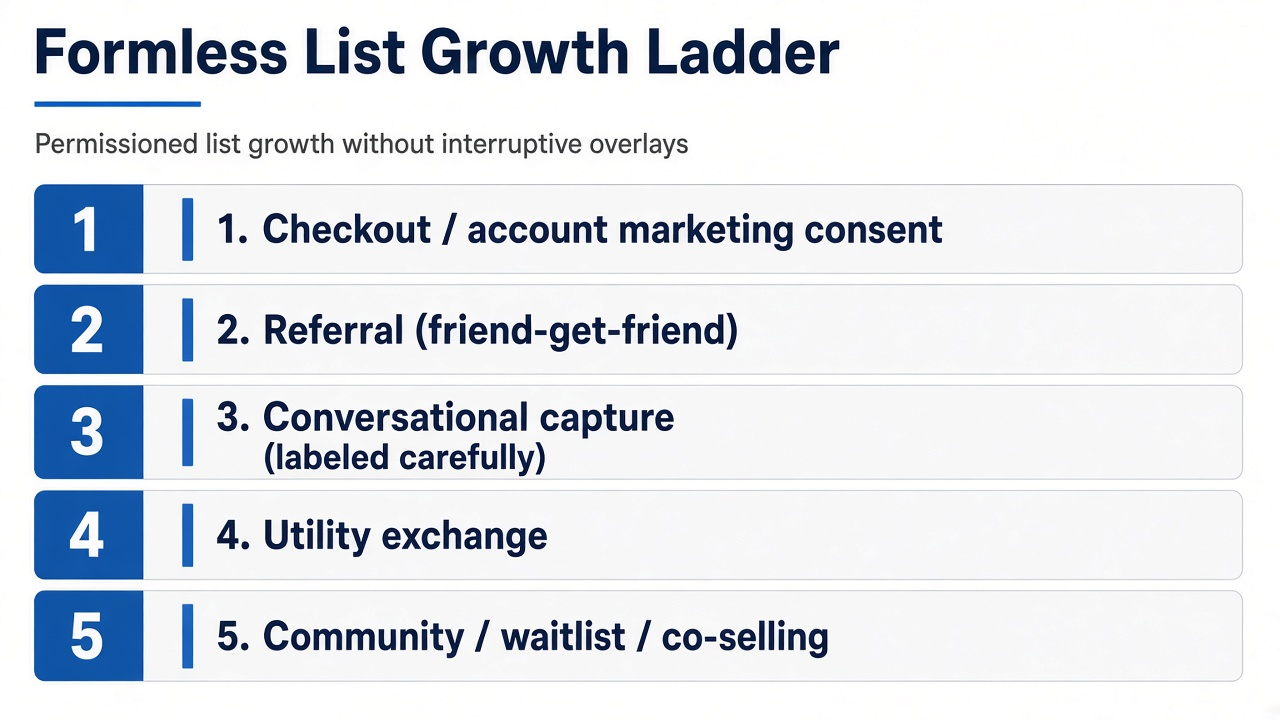
Source: Formless List Growth Ladder synthesized from Shopify Help, ReferralCandy, Omnisend, and operator VOC cited in this article. https://help.shopify.com/en/manual/checkout-settings/checkout-form-options · https://www.referralcandy.com/blog/referral-rates/ · https://www.omnisend.com/blog/referral-emails/
Operators who delete popups still need a reference cell. Omnisend’s 2025 popup display census is the honest interrupt baseline:
| Item | Figure |
|---|---|
| Displays | 1.24B (+54% YoY) |
| Emails collected | 26.4M |
| Average conversion | 2.1% (from 2.3%) |
| Average band | 1.5-3% |
Source: Omnisend email popup statistics.
That 2.1% is not a target for checkout opt-in. It is the pattern you are replacing. If your formless stack cannot replace a meaningful share of those captures with permissioned seats, you will feel the hole in welcome and lifecycle revenue.
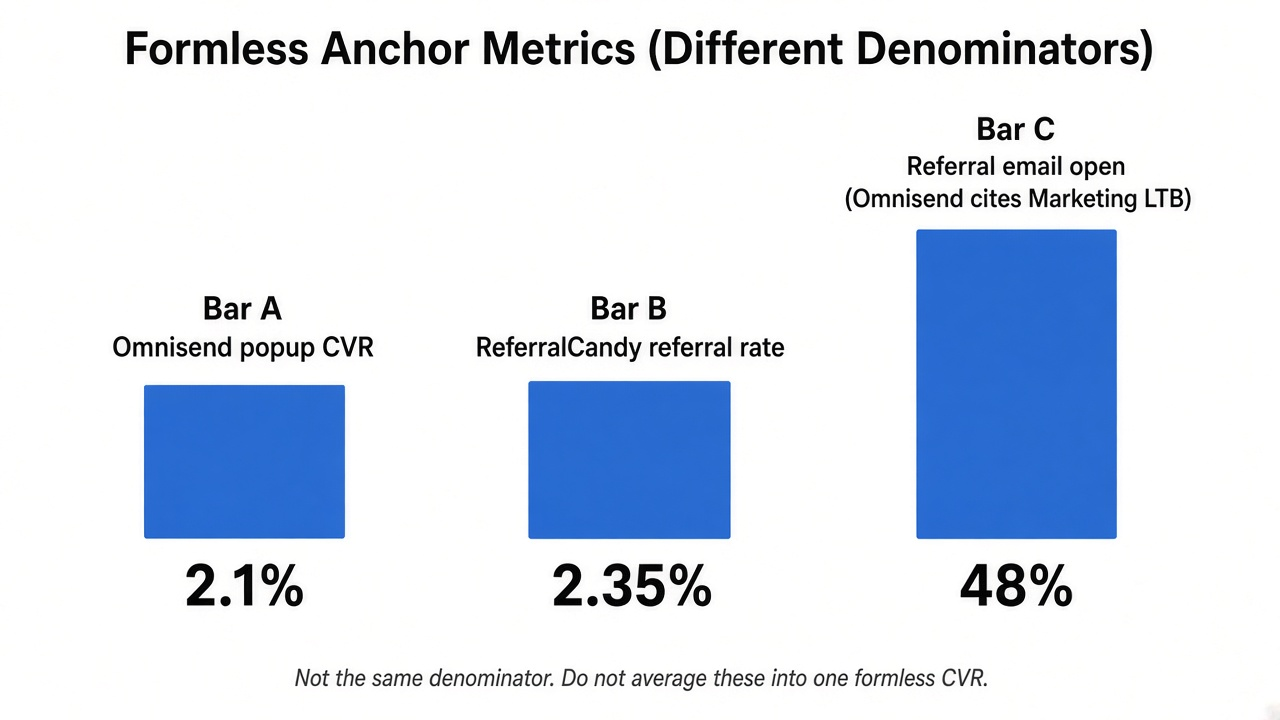
Source: Omnisend popup statistics (2.1%); ReferralCandy referral rates (2.35%); Omnisend referral emails citing Marketing LTB (~48% open). Metrics are not the same denominator. https://www.omnisend.com/blog/email-popup-statistics/ · https://www.referralcandy.com/blog/referral-rates/ · https://www.omnisend.com/blog/referral-emails/
Turn on the marketing consent checkbox where your platform allows it. On Shopify, Settings → Checkout → Marketing opt-in controls whether email consent appears at checkout, sign-in, or both. You can preselect email consent by region, but you remain responsible for local law. SMS marketing opt-in cannot be preselected (Shopify Help).
Keep order updates separate from marketing permission. Reddit operators repeat that line for a reason (r/ecommerce). A shipping email address is not a newsletter subscriber until the marketing box is checked or another lawful opt-in is recorded.
Referral is not only a CAC channel. Every referred buyer who opts in at checkout is a list addition you did not buy with a popup. Plan around ReferralCandy’s ~2.35% stable referral rate, not 20% screenshots (ReferralCandy). Use post-purchase referral emails when the subject names the reward; Omnisend’s article cites ~48% opens for referral emails via Marketing LTB and ~30% better conversion for referral leads (Omnisend).
Affiliate and co-selling distribution is a different job. When the ask is “sell my product through your audience,” send readers to affiliate vs referral marketing and how to turn your customers into a sales channel.
Chat widgets, Instagram DMs, and quiz-result emails can collect addresses after someone already asked for help or a result. ShopifyPros threads describe leading with guidance so the email ask is a next step, not an interruption (r/ShopifyPros).
Label this rung carefully. There is no public dataset in this research pass for a matched conversational-versus-popup signup conversion rate across stores. Do not promote ChatOnbo, Attribuly, or other identity vendors as the proof that formless beats overlays. If you use chat, log an explicit marketing opt-in before you add the person to promotional sends.
Back-in-stock, price-drop, size guides, and early-access lists convert because the visitor named a job. Omnisend’s separate form-type averages put landing pages at 6.47% signup versus popups at 3.77% and embedded forms at 1.28% (Omnisend). A dedicated utility page is still a form surface, but it is not a homepage interrupt. Prefer one field and a clear permission line.
Waitlists and communities grow lists when the drop or the room is the product. Mechanics and benchmarks for waitlists live in the waitlist growth strategies spoke. When the list is really an audience you want selling for you, co-branded storefronts beat another popup: readers can browse products on feat. marketplace.
| Constraint | First rung | Avoid |
|---|---|---|
| Has checkout volume | Checkout marketing opt-in | Buying a popup tool before the checkbox is on |
| High CAC and loyal buyers | Referral | Forecasting 20% referral rates |
| Brand forbids discount overlays | Utility plus waitlist | Aggressive timed popups |
| Support chat already busy | Conversational with logged consent | Scraping chat emails into marketing without opt-in |
| Need distribution not only subscribers | Community or co-selling | Treating affiliates as a free popup substitute |
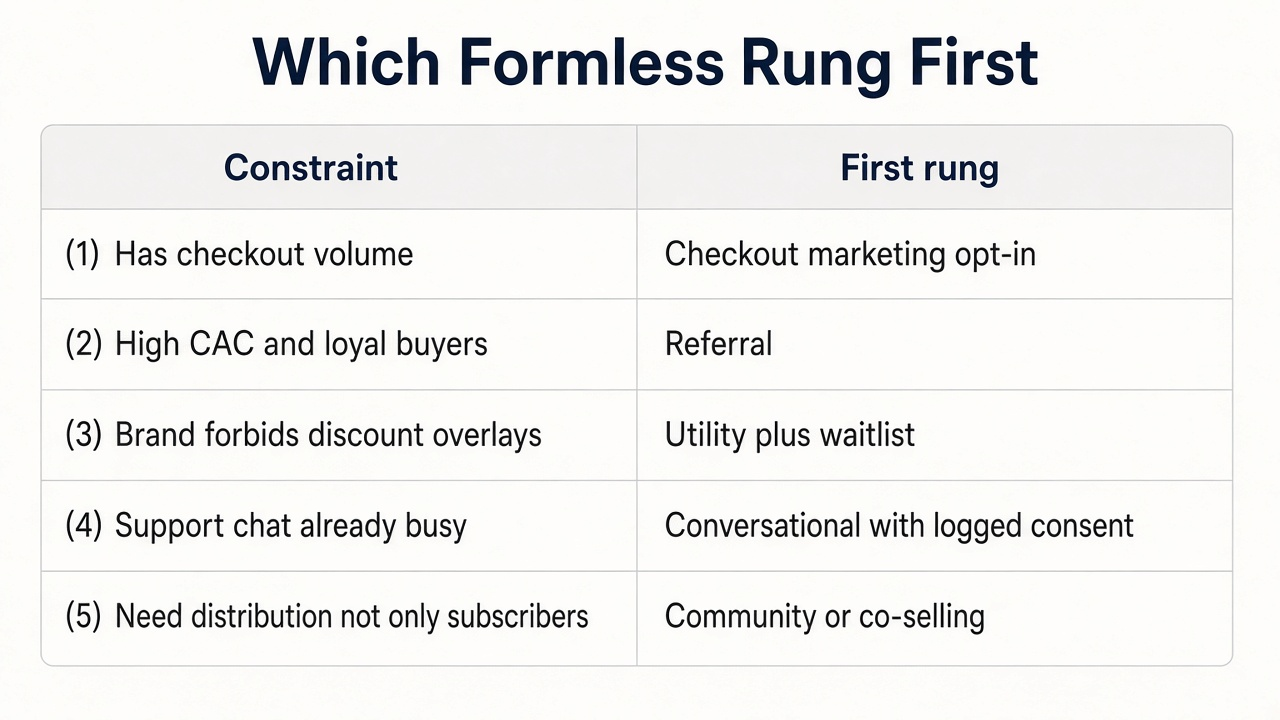
Source: Decision matrix synthesized from Shopify Help, ReferralCandy, Omnisend, and VOC threads cited above. https://help.shopify.com/en/manual/checkout-settings/checkout-form-options
Grow a list without popups by turning on permissioned seats in ladder order, then measuring each seat with its own denominator. Do not replace a popup with silent emailing of transactional addresses.
Q: What does list growth without forms or popups mean? A: It means growing a permissioned email or SMS list without relying on interruptive on-site overlays or classic multi-field signup boxes as the main engine. The usual seats are checkout marketing consent, referral, conversational capture with logged opt-in, utility exchange, and community or waitlist. Consent is still required.
Q: How do I grow an email list without popups? A: Turn on checkout and account marketing opt-ins first, then add referral and one utility seat such as back-in-stock or a guide page. Measure each seat separately. Do not email promotional campaigns to people who only left an address for shipping.
Q: Does checkout marketing opt-in replace a signup form? A: It replaces a large share of cold-visitor popup volume for stores with real checkout traffic, but only for buyers who check the marketing box. Shopify documents the Marketing opt-in control; contacts without that consent should stay non-subscribed for promotions.
Q: What referral benchmarks matter for list growth? A: ReferralCandy’s stable global referral rate near 2.35% of purchases (about 4.75% for software and digital goods) sets purchase expectations. Omnisend cites referral emails near a 48% open rate via Marketing LTB and about 30% better lead conversion. Those metrics are not the same as popup signup rate.
Q: Is there a public conversion-rate ranking of formless capture methods? A: No. This research pass found no public matched census ranking checkout, referral, chat, utility, and waitlist by list-signup conversion across stores. Treat vendor identity-resolution case studies as anecdotes, not a league table.
List growth without forms or popups is a seat problem, not a willpower problem. Use the Formless List Growth Ladder: checkout consent, referral, carefully labeled conversational capture, utility exchange, then community or waitlist. Keep Omnisend’s 2.1% interrupt census as the hole check, ReferralCandy’s 2.35% as the referral floor, and Shopify’s Marketing opt-in as the permission switch. If you want other people selling the product while your list grows, list it on feat. and let creators sell through co-branded storefronts.
AddShoppers vs Omnisend for cart emails: AddShoppers redirects to Minty. Buy Omnisend's live cart automation with published Free/$16/$59 seats.
GetResponse double opt-in is off by default. Enable the list confirmation toggle, match form surfaces, and remember DOI alone is not GDPR compliance.
Mailing CPM is cost per 1,000 list recipients. Use Carroway size-band medians ($62.50→$7.77) and placement types—not one fake “good CPM.”