AddShoppers vs Omnisend (Cart Email Seat)
AddShoppers vs Omnisend for cart emails: AddShoppers redirects to Minty. Buy Omnisend's live cart automation with published Free/$16/$59 seats.
Mailchimp vs Constant Contact vs Klaviyo for local shops: who counts, send meters, CT Lite/$12 vs Mailchimp Free/$13/$20 vs Klaviyo ecommerce depth.

TL;DR: Mailchimp vs Constant Contact vs Klaviyo for a local shop is a seat ladder, not a feature bake-off. Constant Contact starts at Lite $12 / Standard $35 / Premium $80 with 10× / 12× / 24× send meters. Mailchimp offers Free (250 contacts) then Essentials from $13 and Standard from $20 (10× / 12× / 15×). Klaviyo fits when ecommerce flows justify active-profile billing. There is no universal “best value” census.
Searchers type mailchimp vs constant contact vs klaviyo when a salon, cafe, clinic, or studio needs email that local staff will actually use. The long-tail adds “best value for a local shop.” Ecommerce three-ways that crown Omnisend or Klaviyo miss the phone-support and social-events seat Constant Contact sells. Pairwise Mailchimp vs Klaviyo pages skip Constant Contact entirely.
no public dataset. Refuse tip-list crowns.Related pages: Klaviyo vs Omnisend vs Mailchimp pricing (ecommerce Omnisend ladder), Mailchimp vs Klaviyo, and how Mailchimp calculates billable contacts.
Mailchimp vs Constant Contact vs Klaviyo is a three-way ESP comparison that asks which billing unit, send meter, and support surface fit a local shop’s list and staffing.
Constant Contact sells Lite, Standard, and Premium with live phone and chat on every plan, social posting, and events/payments tooling, priced by contacts and sends (10× / 12× / 24×) (Constant Contact Pricing). Mailchimp sells Free through Premium with contact-total billing that still includes unsubscribed and non-subscribed contacts until you archive, clean, or delete them (Mailchimp Help). Klaviyo sells active-profile email (and SMS packaging) built around ecommerce catalogs and flows (Klaviyo Pricing).
If your question is Omnisend versus Klaviyo at the same ecommerce list, use the Omnisend three-way spoke. This page owns the Constant Contact + local-shop job.
Local shops lose money when they buy ecommerce depth they will not staff or a Free plan that pauses sends the week the list crosses 250.
Mailchimp vs Constant Contact vs Klaviyo works as a five-rung local-shop seat ladder: normalize who counts, read send meters, decide if phone/social/events matter, take Mailchimp’s Free on-ramp only if the list stays small, and buy Klaviyo only when ecommerce flows are the job.
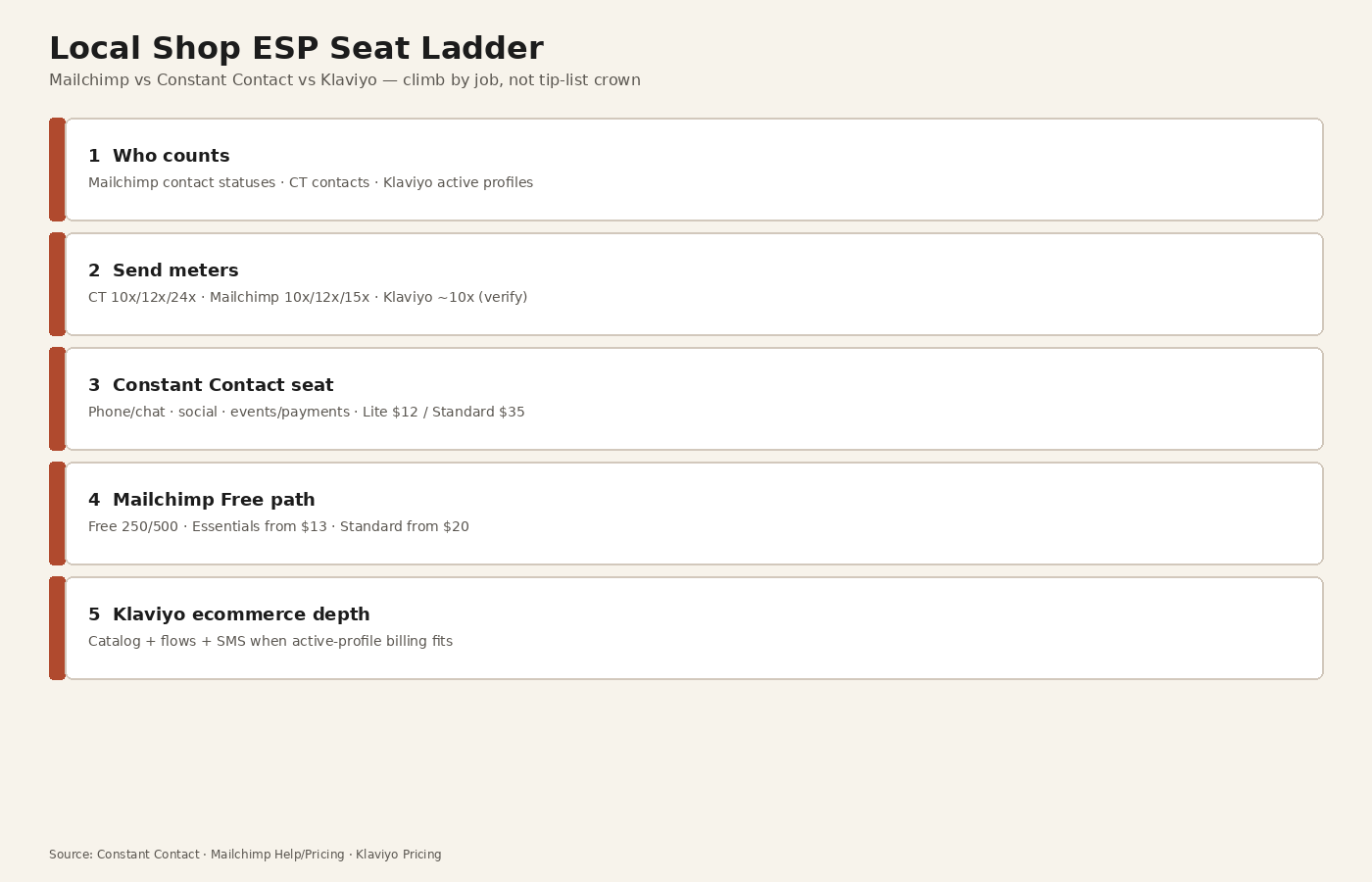
Source: Editorial framework from Constant Contact, Mailchimp, and Klaviyo pricing/help pages. https://www.constantcontact.com/pricing · https://mailchimp.com/help/about-mailchimp-pricing-plans/ · https://www.klaviyo.com/pricing
| Surface | Constant Contact | Mailchimp | Klaviyo |
|---|---|---|---|
| Entry paid / free | Lite from $12/mo (no free plan; trial) | Free $0 (250 / 500); Essentials from $13; Standard from $20 | Free $0 (250 active / 500 emails); Email paid from ~$20 at 500 (vendor snapshot) |
| Annual starting (CT) | Lite $10.20 / Standard $29.75 / Premium $68 prepaid | Verify live annual offers | Verify live |
| Send meter | 10× / 12× / 24× contacts | 10× / 12× / 15× contact limit | Commonly ~10× profiles (verify in-account) |
| Who counts | Contacts on list | Subscribed + unsubscribed + non-subscribed until hygiene | Active / billable profiles |
| Local-shop extras | Phone/chat; social; events/payments | Forms, basic automations by plan | Ecommerce flows, catalog, SMS packaging |
| Users (CT published) | Lite 1 / Standard 3 / Premium unlimited | Plan-dependent | Plan-dependent |
Source: Constant Contact Pricing; Mailchimp Help; Mailchimp Pricing; Klaviyo Pricing; Klaviyo $20 at 500 labeled from Omnisend’s vendor comparison.
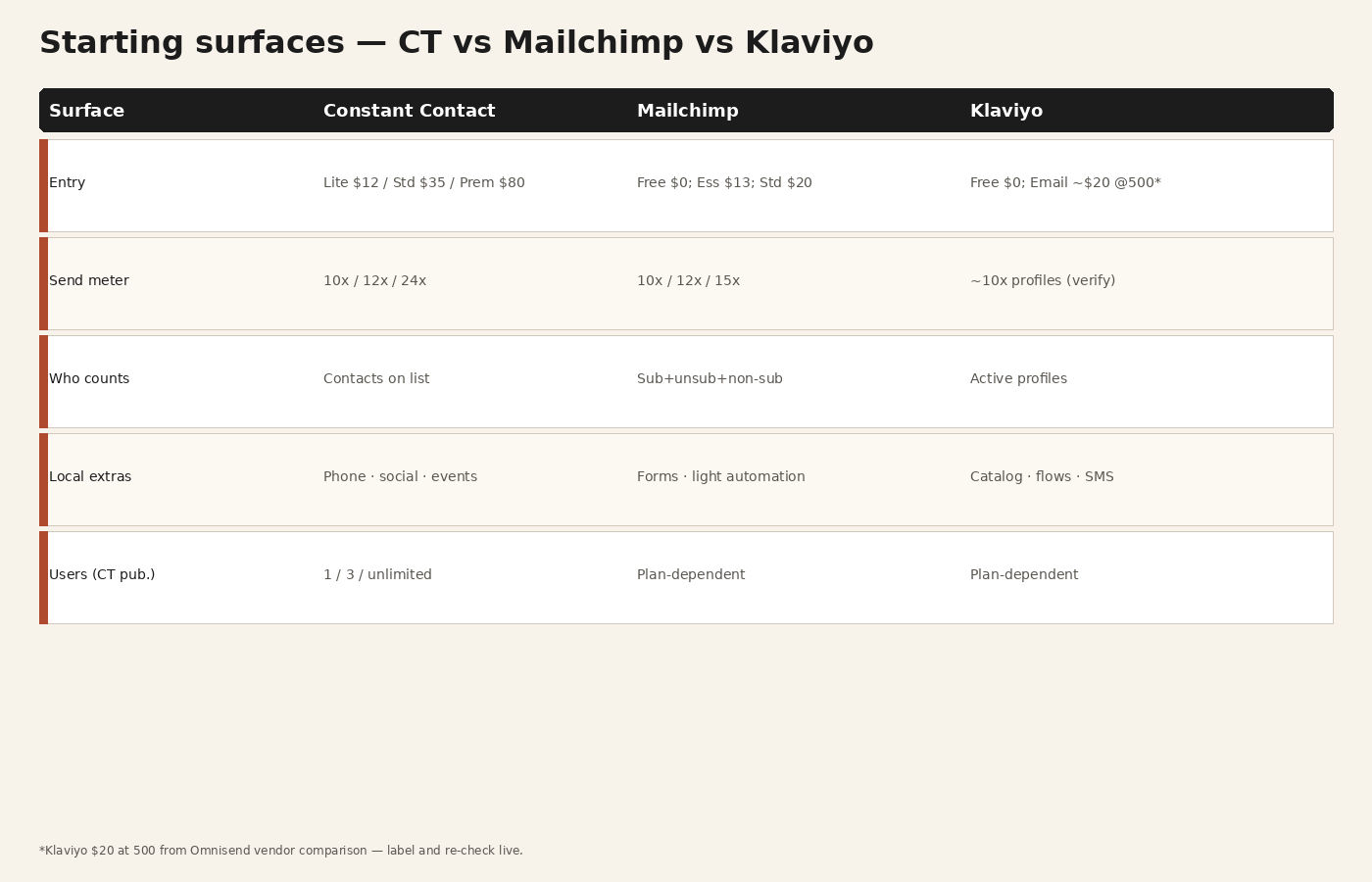
Source: Constant Contact Pricing; Mailchimp Help/Pricing; Klaviyo Pricing. https://www.constantcontact.com/pricing · https://mailchimp.com/help/about-mailchimp-pricing-plans/ · https://www.klaviyo.com/pricing
| Plan (entry band) | Published starting monthly |
|---|---|
| Constant Contact Lite | $12 |
| Constant Contact Standard | $35 |
| Constant Contact Premium | $80 |
| Mailchimp Essentials | from $13 (up to 500 contacts) |
| Mailchimp Standard | from $20 (up to 500 contacts) |
| Klaviyo Email (500 profiles, vendor snapshot) | $20 |
Source: Constant Contact Pricing; Mailchimp Pricing; Omnisend vs Klaviyo table for the Klaviyo $20 cell.
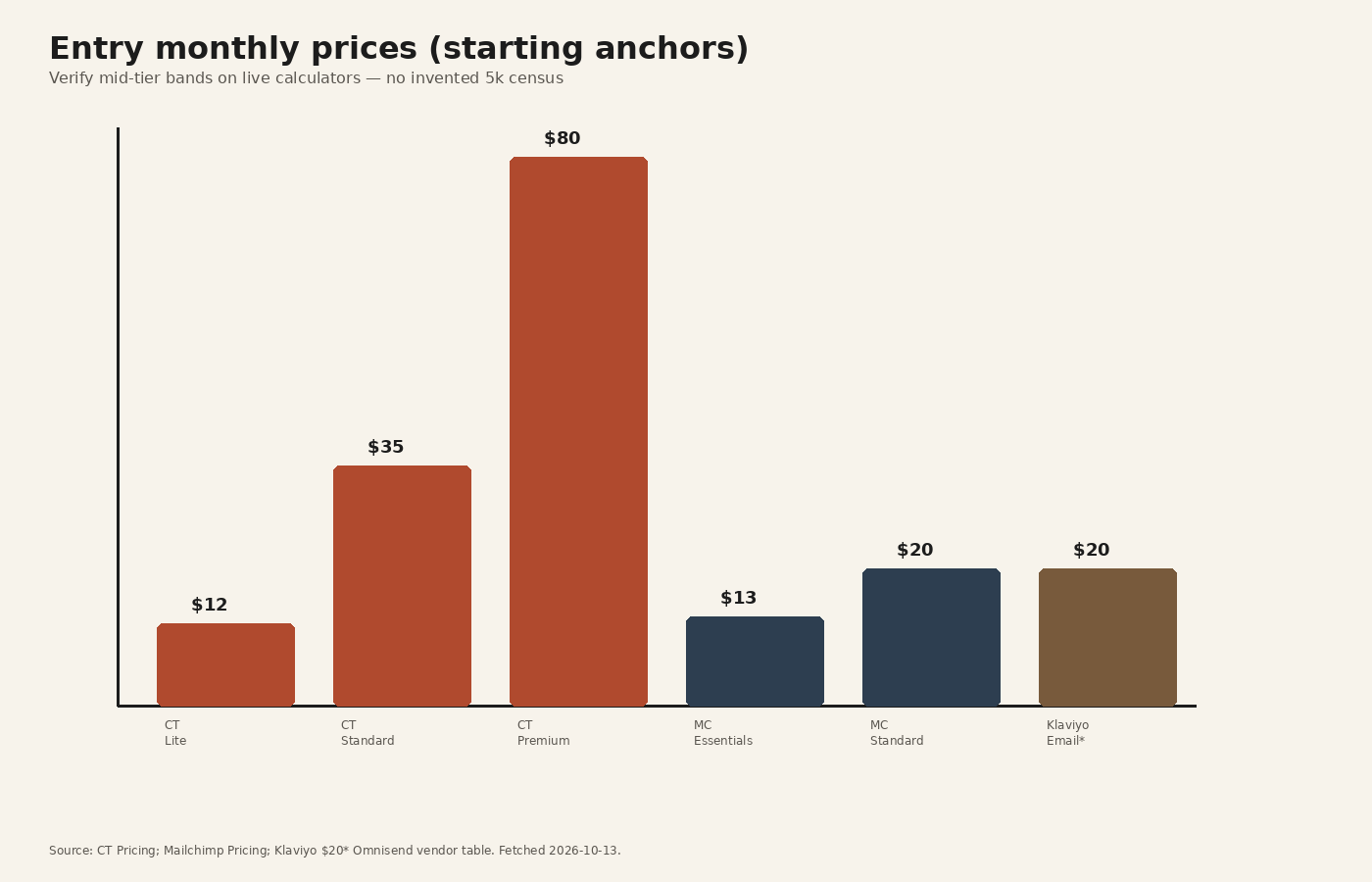
Source: Constant Contact Pricing and Mailchimp Pricing starting anchors; Klaviyo $20 at 500 from Omnisend vendor comparison. Mid-tier bands: verify live calculators.
Do not invent Constant Contact’s 5,000-contact cell from a secondary blog. Open CT’s tiers for your exact list.
Q: Which is best for a local shop, Mailchimp, Constant Contact, or Klaviyo? A: Match the seat. Constant Contact fits phone-supported local marketing on Lite/Standard. Mailchimp fits Free→Essentials→Standard when the list and automation stay simple. Klaviyo fits ecommerce flow depth. There is no public ranking that crowns one ESP for every local shop.
Q: Is Constant Contact cheaper than Mailchimp? A: At starting stickers, CT Lite ($12) sits near Mailchimp Essentials ($13), while CT Standard ($35) sits above Mailchimp Standard’s $20 start. Mailchimp Free can be cheaper until you exceed 250 contacts. Compare send meters and who counts, not logos.
Q: Is Klaviyo overkill for a local shop? A: Often yes if you only need newsletters and a few automations. Klaviyo earns its seat when catalog sync, browse/cart flows, and SMS packaging are core. Otherwise you pay ecommerce pricing for a newsletter job.
Q: Does Constant Contact have a free plan? A: No. Constant Contact offers a free trial and a 30-day money-back guarantee; paid plans start at Lite $12/month (Constant Contact Pricing).
Q: How do send limits compare? A: Constant Contact publishes 10× / 12× / 24× contacts on Lite/Standard/Premium. Mailchimp publishes 10× / 12× / 15× on Essentials/Standard/Premium. Klaviyo email allotments are commonly near 10× profiles; verify in-account before you plan a heavy month.
Mailchimp vs Constant Contact vs Klaviyo for a local shop is a seat ladder: billing unit, send meter, support surface, Free on-ramp, then ecommerce depth. Climb with primary pricing pages, not with a fake “best value” trophy. If email is only half the job and people still need a page to sell your offer, put the product on the feat. marketplace.
AddShoppers vs Omnisend for cart emails: AddShoppers redirects to Minty. Buy Omnisend's live cart automation with published Free/$16/$59 seats.
GetResponse double opt-in is off by default. Enable the list confirmation toggle, match form surfaces, and remember DOI alone is not GDPR compliance.
Mailing CPM is cost per 1,000 list recipients. Use Carroway size-band medians ($62.50→$7.77) and placement types—not one fake “good CPM.”