AddShoppers vs Omnisend (Cart Email Seat)
AddShoppers vs Omnisend for cart emails: AddShoppers redirects to Minty. Buy Omnisend's live cart automation with published Free/$16/$59 seats.
Preference center examples classified by control pattern—topics, frequency, channel, location, unsub opt-down—plus Dotdigital 15% relevance and SendGrid’s 20% unsub drop.

TL;DR: Preference center examples are useful when you copy the control pattern, not the brand wallpaper. Score pages on five rungs—topics, frequency/timing, channel, location/profile, and unsub-intercept opt-down—while a legal stop-all and RFC 8058 one-click stay non-negotiable. Dotdigital’s n=4,000 survey puts “very relevant” email at 15%. Twilio SendGrid reported a 20% unsubscribe drop after shipping a preference center (self-reported).
Most “preference center examples” posts are logo galleries. Pretty screenshots. No decision rule. Operators leave with a mood board and the same broken footer they started with.
Preference center examples only help when you can name the control each page actually ships—and when that page never eats the global stop-all or Gmail’s one-click header. The compliance rails live in preference center best practices. This page owns the pattern ladder and the named examples that illustrate each rung. Spam floors that make opt-down urgent live next to email deliverability benchmarks.
Preference center examples are public or documented pages that show how a brand lets subscribers change topics, frequency, channels, or profile data—while still offering a full marketing opt-out—so operators can copy the control pattern instead of the logo.
They are not unsubscribe confirmation pages with a sad survey. They are not login walls that hide the only exit. They are not “manage preferences” links that secretly force a global kill with three extra clicks. A useful example makes the chooser’s job obvious in one scroll and keeps the angry exit one honest control away.
Tip lists already tell you to “add frequency options.” That is advice. An example is adidas collecting interests, MATCHESFASHION previewing send days in a welcome flow, or J.Crew offering frequency and product opt-down when someone hits unsubscribe (Litmus; Dotdigital). If you cannot name the rung, you are browsing wallpaper.
Preference center examples matter because relevance is failing in public, cadence preferences vary wildly, and a labeled opt-down can cut total exits—while bad examples train spam clicks and civil-penalty risk.
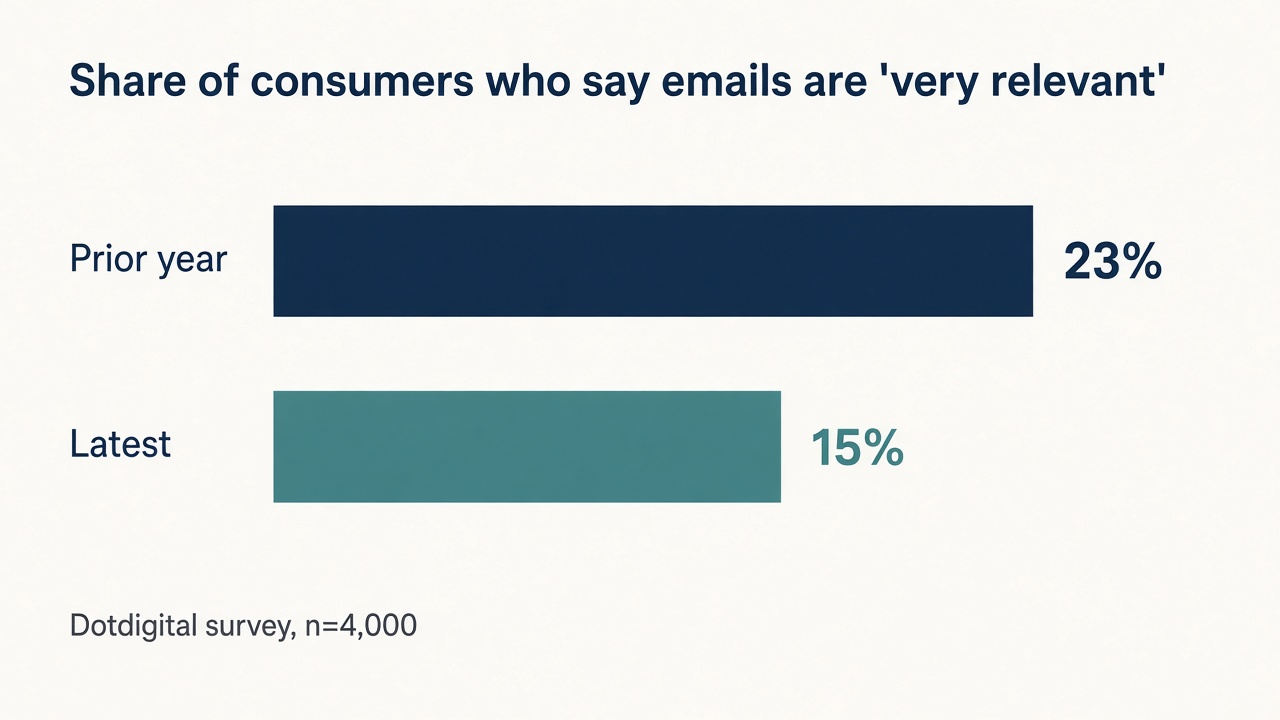
Source: Dotdigital, The power of preference centers (survey of 4,000 consumers). https://dotdigital.com/blog/the-power-of-preference-centers/
Preference center examples work when you score the page on a Preference Example Pattern Ladder: five control rungs plus a non-negotiable stop-all rail. Copy one rung you can operationalize this month. Ignore the brand’s illustration budget.
| Rung | Control the example ships | Named examples (documented) | Copy when… |
|---|---|---|---|
| 1. Topics / interests | Category or interest checkboxes (and holiday opt-outs) | adidas interests; Primary Halloween/holiday opt-outs (Litmus) | You already send distinct content lines |
| 2. Frequency / timing | Daily/weekly/monthly, day-of-week, pause/snooze | Zulily timing; MarketingProfs day picks; MATCHESFASHION shows send days in welcome (Litmus; Dotdigital) | Volume—not topic—drives exits |
| 3. Channel | Email vs push vs SMS (or combinations) | Spotify email and/or push (Litmus; Dotdigital) | You actually operate more than one channel |
| 4. Location / profile | Country, ZIP, size, birthday—with a clear “why we ask” | Sephora country/ZIP with transparency copy (Litmus) | Personalization needs zero-party fields you will use |
| 5. Unsub-intercept opt-down | Unsubscribe click → frequency/product choices before global kill | J.Crew frequency and product opt-down on unsubscribe (Dotdigital) | Many exits are “too much,” not “never again” |
Stop-all sits under every rung. CAN-SPAM’s menu is legal only if stop-all marketing remains available on a single page without fees or extra identity theater (FTC). One-click List-Unsubscribe headers are a separate rail that must not land on preferences (Google).
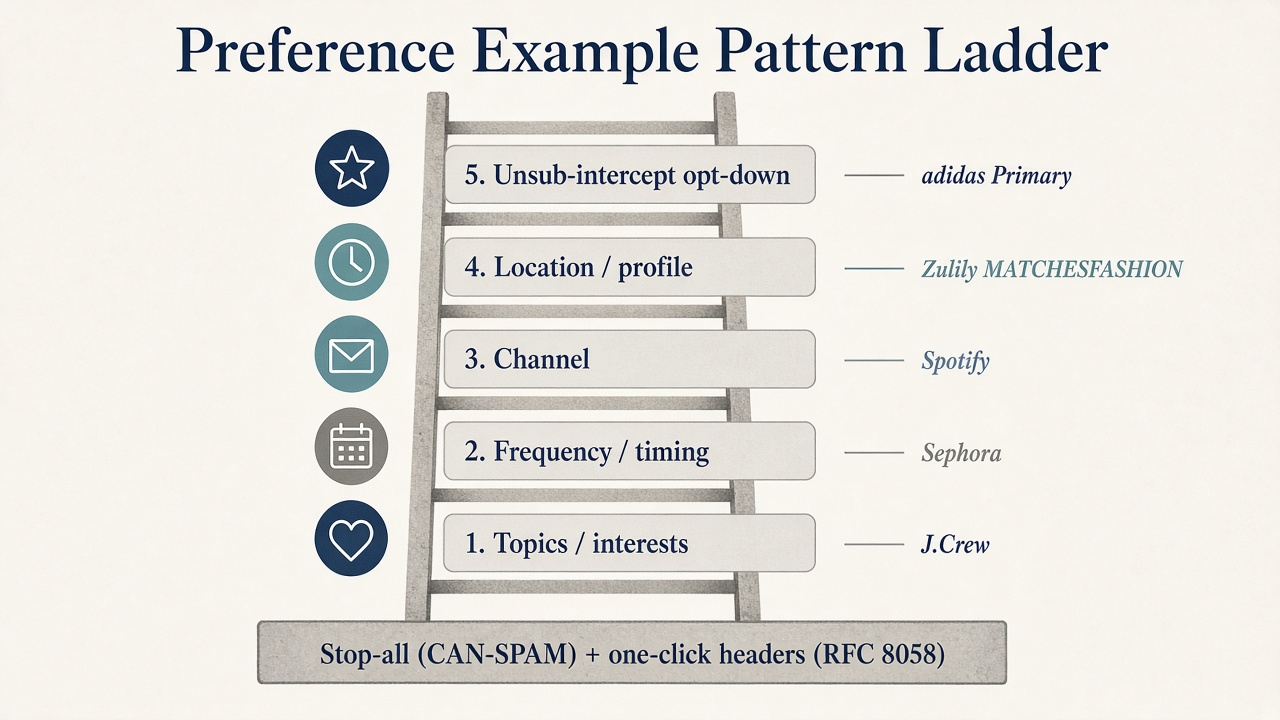
Source: Editorial Preference Example Pattern Ladder synthesizing Litmus (2022) and Dotdigital (2026) documented brand examples with FTC CAN-SPAM and Google one-click rails. https://www.litmus.com/blog/email-preferences-center-best-practices · https://dotdigital.com/blog/the-power-of-preference-centers/ · https://www.ftc.gov/business-guidance/resources/can-spam-act-compliance-guide-business · https://support.google.com/mail/answer/14229414
Topics. Litmus documents adidas collecting interests in an interactive layout and Primary letting people opt out of Halloween or holiday mail (Litmus). Copy this when you can honor the checkbox in the next campaign. A topic maze you never segment on is lying in form design.
Frequency / timing. Litmus shows Zulily and MarketingProfs offering timing controls; Dotdigital highlights MATCHESFASHION promoting preferences in welcome and previewing which days emails go out (Litmus; Dotdigital). That pairs with Dotdigital’s cadence split—34% monthly / 31% weekly / 93% reject daily (Dotdigital). If you cannot throttle, do not offer the dial.
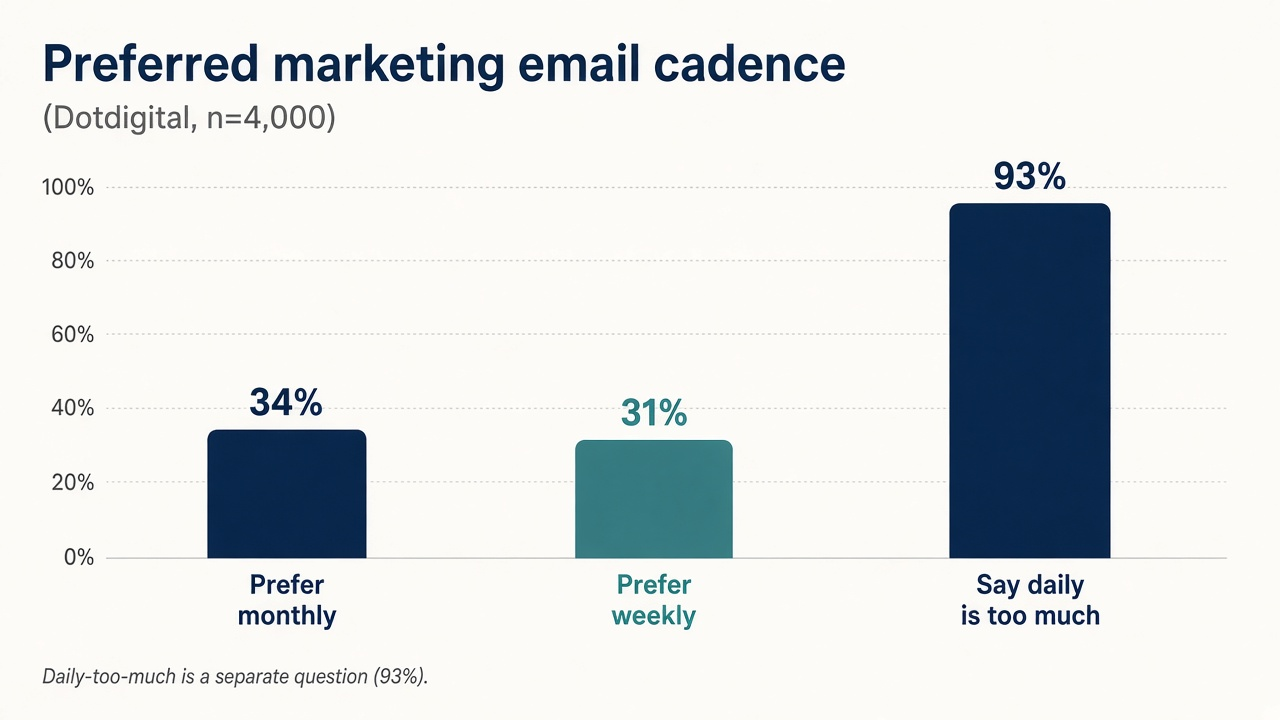
Source: Dotdigital, The power of preference centers (survey of 4,000 consumers). https://dotdigital.com/blog/the-power-of-preference-centers/
Channel. Spotify’s documented pattern is simple: topics plus email and/or push (Litmus; Dotdigital). Channel toggles without an SMS or push program are decorative checkboxes.
Location / profile. Sephora’s documented ask for country and ZIP includes transparency about use—Litmus’s point is the explanation, not the field count (Litmus). Progressive profiling beats a 20-field interrogation. Cadence still drives exits; see email frequency benchmarks.
Unsub-intercept opt-down. Dotdigital documents J.Crew presenting frequency or product choices when someone moves to unsubscribe (Dotdigital). Keep stop-all one clear control away. Operators already roast brands that bury the exit under mandatory surveys (r/Emailmarketing).
Live publisher preference URLs such as Newsweek and the Economist Group Preference Centre show dense newsletter menus—useful when your product is many editorial lines. Vendor galleries (for example Digioh’s Mejuri / MeUndies / Redbubble / G2 pages) are template showcases, not independent benchmarks (Digioh). Do not chart vendor conversion claims. There is no public dataset for “% of brands with a preference center” or a universal reclaim rate.
On r/Emailmarketing, operators report footer preference pages (no login) get used more than account walls; others argue full-blown centers “fell out of fashion” behind logins and that Gmail’s inbox one-click will dominate anyway (thread; thread). Both can be true. Build a body-link chooser. Keep headers as the angry exit. Do not force the chooser into the one-click path.
Promotion patterns from the same example corpus matter as much as the page itself. Litmus documents welcome emails (Casper expectation-setting, Protein customize CTAs), dedicated preference emails (Bespoke Post), progressive profiling (Rapha one ask; Kendra Scott birthday), and re-engagement nudges (Animoto) that point cold subscribers at choices before sunset (Litmus). If the only path to the ladder is a buried footer link, your “examples research” never reaches the inbox that needed it.
Q: What are the best preference center examples to copy? A: Copy by rung, not logo. Topics (adidas / Primary), frequency (Zulily / MATCHESFASHION), channel (Spotify), location with transparency (Sephora), and unsub-intercept opt-down (J.Crew) are the documented patterns worth stealing. Always keep a one-page stop-all.
Q: Where can I find email preference center examples? A: Litmus and Dotdigital document brand patterns with screenshots and write-ups; some publishers expose live pages (for example Newsweek and Economist Group). Vendor galleries show templates—label them as product marketing, not benchmarks.
Q: Do preference center examples still matter after Gmail one-click unsubscribe? A: Yes, for different jobs. One-click headers handle the angry global exit and must not open preferences. Body “Manage preferences” links still serve choosers who want fewer or different emails. Operators already note inbox one-click can dominate behavior—design for both rails.
Q: How much do preference centers reduce unsubscribes? A: Twilio SendGrid reported a 20% drop in total unsubscribes after launching a preference center (self-reported program result). There is no public dataset for a universal reclaim rate across brands. Track your own opt-down versus global unsub ratio.
Q: Is a preference center the same as an unsubscribe page? A: No. An unsubscribe page confirms a stop-all (or group) exit. A preference center is an opt-down and data layer for people who still want some messages. CAN-SPAM allows a menu only if stop-all marketing remains available.
Preference center examples earn their keep when they teach a control pattern you can ship: topics, frequency, channel, location, or unsub-intercept opt-down—always over a legal stop-all, never as a substitute for one-click headers. Relevance is stuck near 15% “very relevant” in Dotdigital’s survey; cadence preferences split; SendGrid’s labeled 20% unsub drop shows opt-down can work when it is honest. Steal the rung. Skip the wallpaper.
If you sell through partners as well as your own list, put the offer where affiliates can checkout beside you on feat..
AddShoppers vs Omnisend for cart emails: AddShoppers redirects to Minty. Buy Omnisend's live cart automation with published Free/$16/$59 seats.
GetResponse double opt-in is off by default. Enable the list confirmation toggle, match form surfaces, and remember DOI alone is not GDPR compliance.
Mailing CPM is cost per 1,000 list recipients. Use Carroway size-band medians ($62.50→$7.77) and placement types—not one fake “good CPM.”