AddShoppers vs Omnisend (Cart Email Seat)
AddShoppers vs Omnisend for cart emails: AddShoppers redirects to Minty. Buy Omnisend's live cart automation with published Free/$16/$59 seats.
Copy-paste insertion order template: header block, five CrossLetter deal lines, IAB cancel ladder (14/7/30), and a filled newsletter sample. Not legal advice.

TL;DR: An insertion order template is a fillable confirmation stack: a header block, five deal lines (placement, dates, price/payment, creative deadline, cancellation), a cancel ladder, and email-specific acknowledgments. Copy it, fill it, get both sides to reply “agreed.” Not legal advice.
Searchers type insertion order template when the media kit already worked and the calendar is about to hold a Tuesday slot. They do not need another glossary. They need fields they can paste into email before creative is late and memory disagrees.
If you still need the concept first, start with newsletter insertion order explained. This page is the fillable artifact. Pair it with how to invoice newsletter sponsors and newsletter sponsorship kill fee after the deal locks.
Key takeaways:
An insertion order template is a reusable, fillable form that turns a sold sponsorship into written fields both sides can confirm—parties, placement, dates, price and payment clock, creative deadline, and cancellation—before inventory is held.
It is not a media kit. The kit sells. The template books. It is not a twelve-page MSA. Many indie deals are a short confirmation email with the same fields every time (CrossLetter). Agencies may still attach IAB-style terms; your job is to make the newsletter lines unambiguous: primary vs mid-roll vs dedicated, which send date, which dollar amount from the rate card.
Display and print templates (Oveeo, RunMags, signNow-style forms) are useful for generic ad ops. Newsletter operators still need email-specific acknowledgments: list ownership, inbox uncertainty, and dedicated-versus-shared language. That is the gap this template closes.
A template matters because held inventory is irreversible once the send window closes, and verbal “sounds good” does not survive a creative swap.
Why operators keep searching for a ready insertion order template:
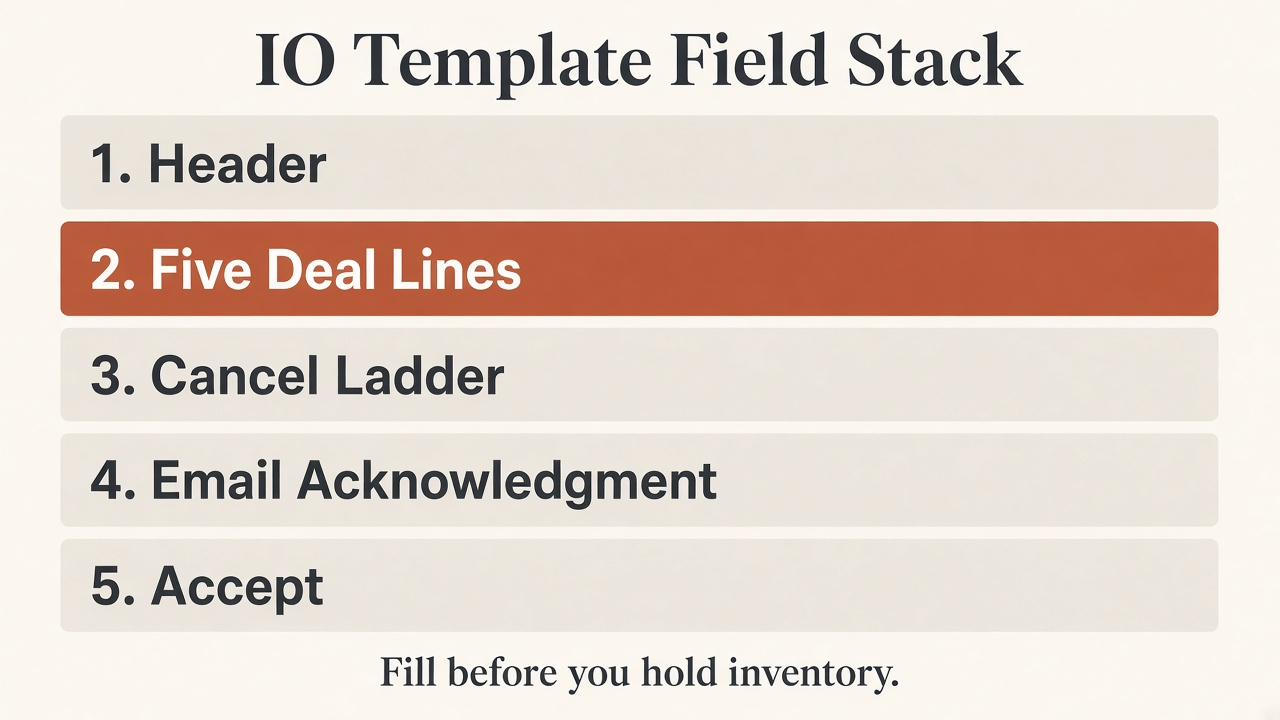
Source: Editorial stack from CrossLetter #13 and IAB Order-Specific Terms Email/Newsletter block (accessed 2026-10-12). https://crossletterplatform.beehiiv.com/p/the-collaborator-by-crossletter-13 · https://www.iab.com/wp-content/uploads/2026/02/IAB_Order_Specific_Terms_v1.0_Public_Comment_February_2026.pdf
An insertion order template works as five blocks you fill once per deal: header identity, five deal lines, a cancel ladder, email-specific acknowledgments, and signature or reply-all acceptance. Copy the blank stack below, fill every bracket, and send “confirming the below for our records.”
| Block | What you fill | Source / note |
|---|---|---|
| 1. Header | IO number, effective date, publisher, advertiser/agency, billing contact, campaign name | Standard ad-ops practice (IAB workflow field families) |
| 2. Five Deal Lines | Placement; date(s); price + payment clock; creative/copy/link deadline; cancellation | CrossLetter |
| 3. Cancel Ladder | Notice windows + fee or refund language | IAB 14 / 7 / 30 + your published ladder |
| 4. Email Acknowledgments | No inbox/open guarantee; list ownership; dedicated vs shared; sponsorship value = context unless Order guarantees performance | IAB Order-Specific Terms |
| 5. Accept | Both parties reply “agreed” or sign | Operational, not a court filing |
INSERTION ORDER — CONFIRMATION
IO #: [IO-YYYY-###]    Effective date: [YYYY-MM-DD]
Publisher: [Newsletter / Company]    Contact: [name, email]
Advertiser: [Brand]    Agency (if any): [Agency]
Billing contact: [name, email]    Campaign: [name]

1) PLACEMENT
   Type: [Primary / Mid-roll / Banner / Dedicated send / Other]
   Position notes: [e.g., above fold in issue body]
   Exclusive category?: [Yes — category / No]

2) DATE(S)
   Send date(s): [YYYY-MM-DD]
   One-off or run: [One-off / Multi-issue: list dates]
   Timezone: [e.g., America/Chicago]

3) PRICE AND PAYMENT
   Gross fee: $[amount] [USD]
   Deposit: $[amount or %] due [date]
   Balance due: [Net 15 / Net 30] from [send date / invoice date]
   Invoice email: [address]

4) SPONSOR DELIVERABLES AND DEADLINE
   Assets due: [YYYY-MM-DD] by [time + timezone]
   Deliverables: [copy length, image size, URLs, UTM, pixel]
   Late assets: [treat as postponement / cancel under ladder]

5) CANCELLATION
   Sponsor cancel without cause:
     - ≥[X] days before send: [refund / fee %]
     - [Y]–[Z] days: [refund / fee %]
     - <[Y] days: [100% fee / no refund]
   Publisher cancel (cannot deliver): [rebook / credit / refund]
   Non-cancellable SKUs: [dedicated / custom production — list]

EMAIL / NEWSLETTER ACKNOWLEDGMENTS
- Seller does not guarantee inbox placement, open rates, or delivery to all subscribers unless expressly stated above.
- Buyer receives no ownership of or access to the subscriber list.
- Placement is not exclusive unless marked Dedicated/sole-sponsored above.
- Sponsorship value is association, visibility, and context unless performance is expressly guaranteed above.

Acceptance: Reply “Agreed” to this email with the IO # in the subject, or sign below.
Publisher: ________________  Date: ______
Advertiser: ________________  Date: ______
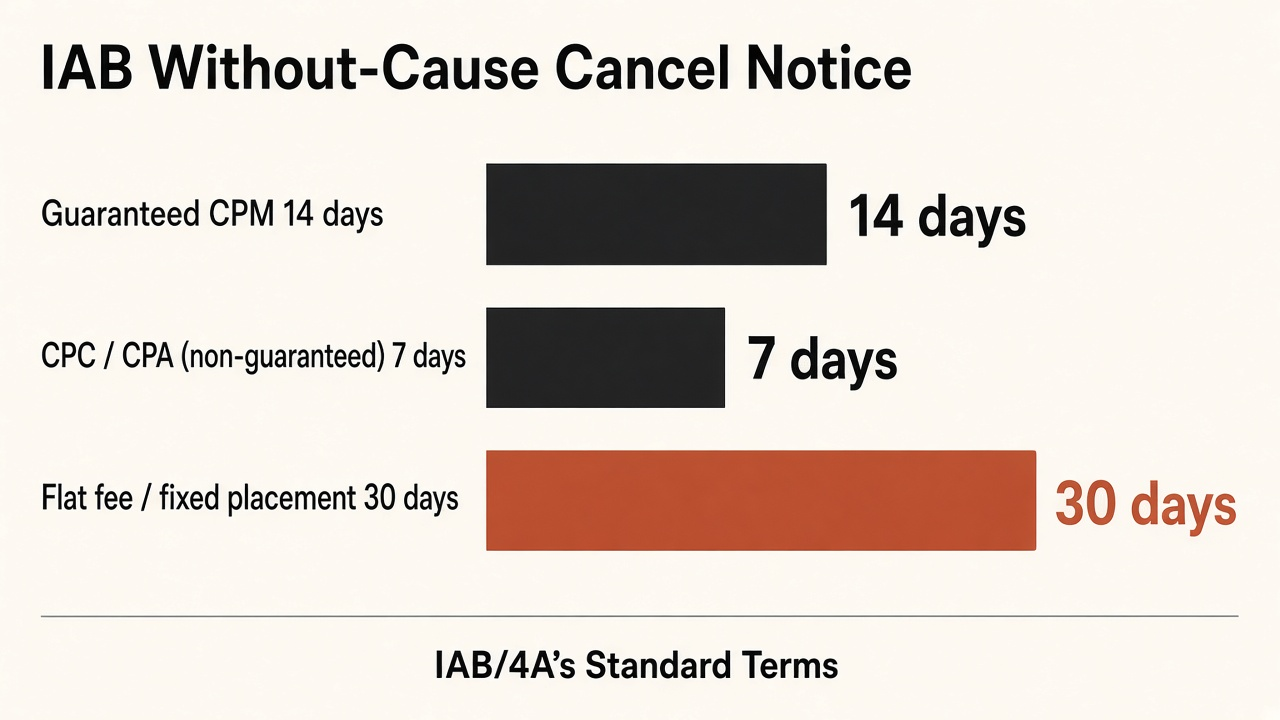
Source: IAB/4A’s Standard Terms & Conditions for Internet Advertising. https://www.iab.com/wp-content/uploads/2015/06/IAB_4As-tsandcs-FINAL.pdf
| Context | Without-cause notice (planning) | How to use it on the template |
|---|---|---|
| IAB flat fee / fixed placement | 30 days written notice | Baseline for fixed sponsorship fees |
| IAB guaranteed CPM | 14 days | Rare for pure newsletter flat fees; useful if you sold impressions |
| IAB non-guaranteed CPC/CPA | 7 days | Performance inventory |
| CrossLetter weekly planning | Full payment inside ~1 week of send; partial/rebook outside | Tighten for weekly lists (CrossLetter) |
| Named publisher ladders | React Weekly / GRC Engineer / Morning Brew schedules | Copy structure from kill fee—do not invent a median % |
There is no public dataset for one official average kill-fee percentage across newsletters. The template needs your ladder, not a rumor.
| Field | Example fill (not a rate-card census) |
|---|---|
| Placement | Primary sponsorship, issue body, no category exclusivity |
| Send date | 2026-11-04 (one-off), America/Chicago |
| Price | $1,200 USD; 50% deposit ($600) due on IO; balance Net 15 from send |
| Creative deadline | 2026-10-28 12:00 America/Chicago — 150 words + 600×200 image + tracked URL |
| Cancel | ≥14 days: 50% fee; 7–13 days: 75% fee; <7 days: 100% fee; dedicated custom creative non-cancellable after asset production starts |
Dollar amounts above are illustrative placeholders so the fields are readable. Price from your sponsorship rates by subscriber count and media kit. Remnant fill can sit on a newsletter ad network; the IO still names the surface.
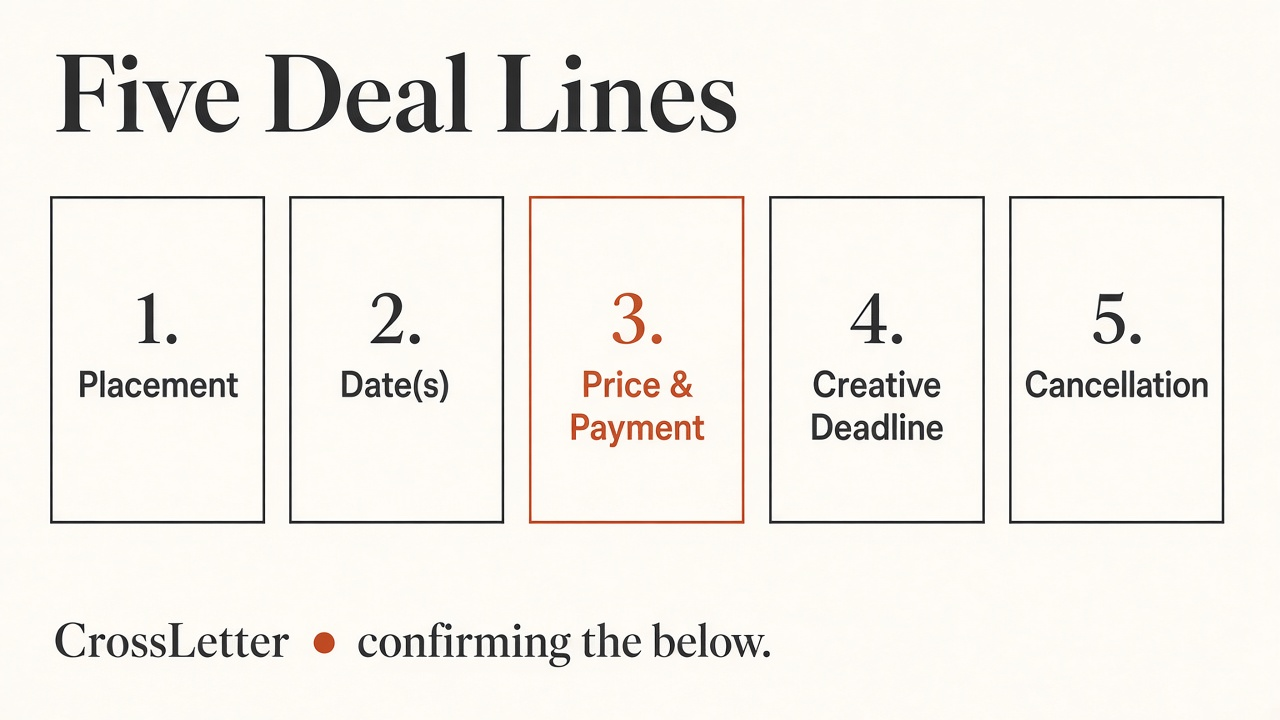
Source: CrossLetter, The Collaborator #13 (2026-09-25). https://crossletterplatform.beehiiv.com/p/the-collaborator-by-crossletter-13
Filling an insertion order template is a six-step ops job: pull rate-card numbers, complete every bracket, attach email acknowledgments, send for reply-all acceptance, invoice on the same clock, then archive the thread with the IO number.
Q: What belongs in an insertion order template? A: A header (parties, IO number, dates), five deal lines (placement, dates, price/payment, creative deadline, cancellation), a cancel ladder you will enforce, and email acknowledgments about inbox uncertainty and list ownership. Signatures or a clear “Agreed” reply close it.
Q: Is a short email enough, or do I need a PDF? A: For most indie newsletter deals, CrossLetter’s guidance is that a clean confirmation email listing the five fields is enough. Agencies may still want a PDF plus IAB-style terms. Match the paperwork to the buyer, not to theater.
Q: How is this different from newsletter insertion order explained? A: The explained page defines the job. This page is the copy-paste template with a filled sample and cancel ladder. Use both: definition first if you are new, template when the calendar is holding.
Q: What cancel window should I put on the template? A: Start from IAB’s without-cause baselines (14 / 7 / 30 days by buy type), then tighten for weekly inventory using a published ladder you will enforce. There is no public median kill-fee percentage to copy blindly.
Q: Should the template guarantee opens or CTR? A: Not by default. IAB’s Order-Specific Terms draft treats opens and inbox placement as non-guaranteed unless the Order expressly says otherwise, and frames sponsorship value as association and context. Guarantee delivery of the placement you sold; treat performance as a separate, explicit promise.
An insertion order template is the fillable stack that turns a sold sponsorship into held inventory without a memory contest. Ship the header, five deal lines, cancel ladder, and email acknowledgments before you say yes. When the job is co-branded product selling—not inbox sponsorship—list on feat..
AddShoppers vs Omnisend for cart emails: AddShoppers redirects to Minty. Buy Omnisend's live cart automation with published Free/$16/$59 seats.
GetResponse double opt-in is off by default. Enable the list confirmation toggle, match form surfaces, and remember DOI alone is not GDPR compliance.
Mailing CPM is cost per 1,000 list recipients. Use Carroway size-band medians ($62.50→$7.77) and placement types—not one fake “good CPM.”