AddShoppers vs Omnisend (Cart Email Seat)
AddShoppers vs Omnisend for cart emails: AddShoppers redirects to Minty. Buy Omnisend's live cart automation with published Free/$16/$59 seats.
Optimal cart abandonment email timing: Omnisend 30–60 min, Klaviyo 2–4h (4h default), Mailchimp 1h/1d/3d—test RPR, refuse a golden minute.

TL;DR: Optimal cart abandonment email timing benchmarks are platform delay ladders, not a golden minute. Omnisend often starts at 30–60 minutes; Klaviyo’s pre-built flow waits 4 hours and recommends 2–4 hours then 20–48 hours; Mailchimp’s classic series defaults to 1 hour / 1 day / 3 days. Test on revenue per recipient.
People search optimal cart abandonment email timing benchmarks when a flow builder asks for a delay and every blog answers with a different clock. That is not noise. It is three published playbooks disagreeing in public.
This page owns the timing ladder. Recovery-rate and revenue-per-recipient scores live in abandoned cart email benchmarks. Checkout-versus-cart intent lives in abandoned checkout email benchmarks. Browse flows live in browse abandonment best practices. Subject lines live in browse abandonment email subject lines.
Key takeaways:
Optimal cart abandonment email timing benchmarks are labeled delay windows—first send, gaps between messages, and quiet hours—published by ESP docs or marketplace reports for abandoned-cart (or abandoned-checkout) email flows.
They are not the same as recovery rate. A store can win on timing tests and still post a weak placed-order rate if creative, offer, and exit filters are wrong. Pair this page with abandoned cart email benchmarks for Klaviyo’s recovery meters. Almost 70% of carts are abandoned on average in the Baymard figure Klaviyo cites—timing is how you spend the recovery budget, not proof you will beat the category (Klaviyo Help).
Think of timing as the throttle on a flow you already own. The creative, the cart rebuild link, and the purchase-exit filter still do more work than shaving fifteen minutes off a delay that was never measured.
Send too early and you interrupt a shopper who still had the card out. Send too late and a competitor closes the tab. The cost of a wrong default is invisible until you A/B the delay on revenue per recipient.
Why the ladder matters:
Optimal cart abandonment email timing works as a Cart Timing Platform Ladder. Start from the published default on your ESP, then test one rung at a time on revenue per recipient.
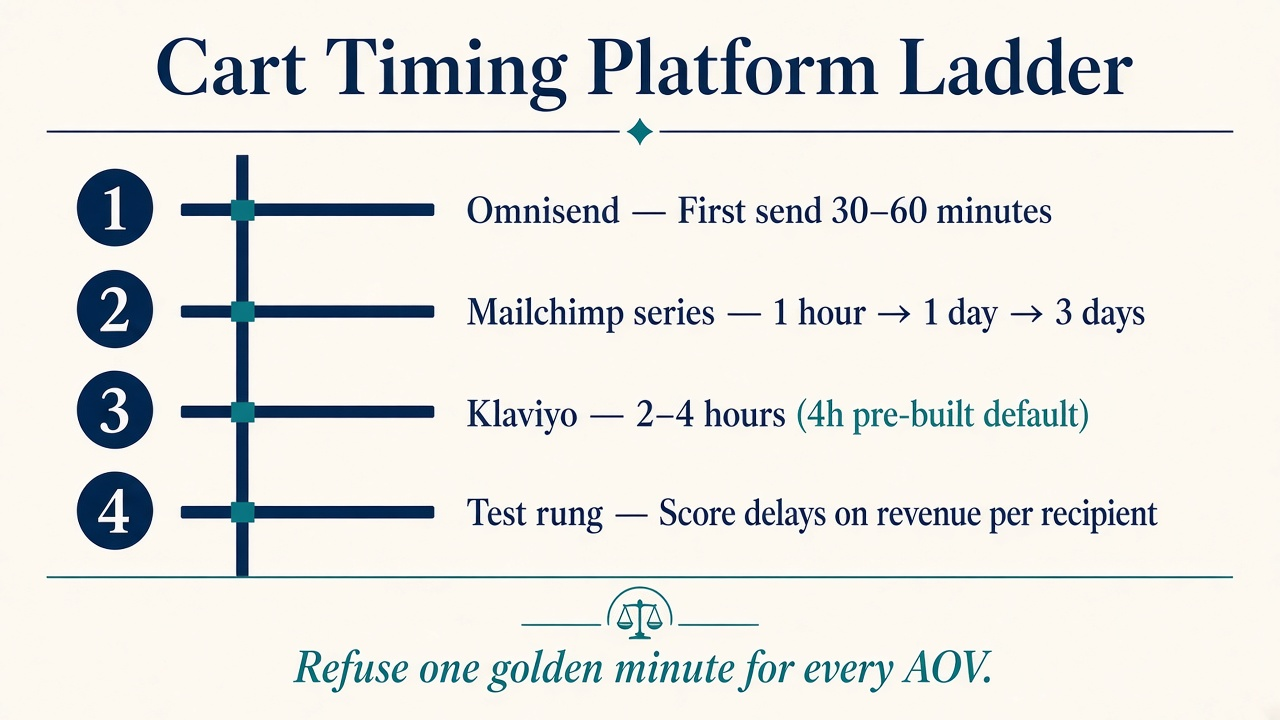
Source: Editorial Cart Timing Platform Ladder from Omnisend, Klaviyo Help, and Mailchimp Help docs fetched 2026-10-15.
| Platform | First-send published timing | Notes |
|---|---|---|
| Omnisend | 30–60 minutes | Faster recovery rail; add quiet hours (Omnisend) |
| Mailchimp (classic series email 1) | 1 hour | Series continues at 1 day and 3 days (Mailchimp Help) |
| Klaviyo (guidance) | 2–4 hours | Recommended first window (Klaviyo Help) |
| Klaviyo (pre-built default) | 4 hours | Library flow default (Klaviyo Help) |
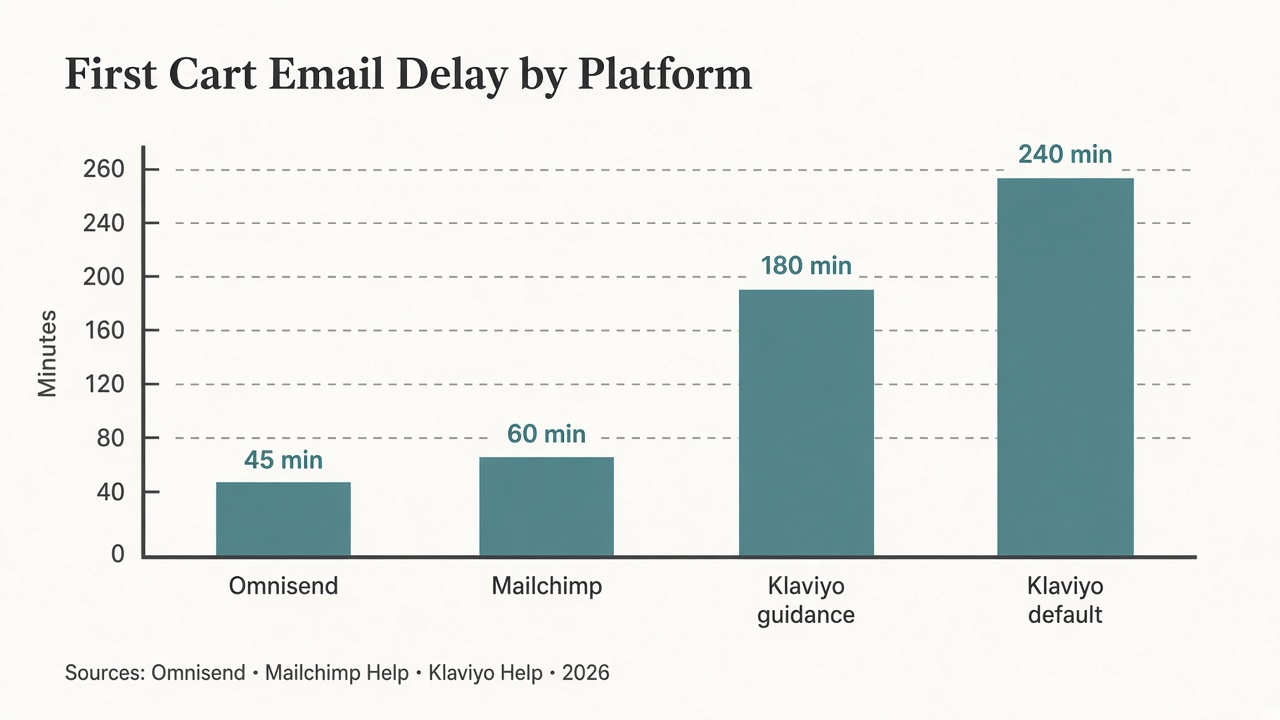
Source: Omnisend blog; Mailchimp classic series help; Klaviyo Help Center. Midpoints shown for ranges where noted. https://www.omnisend.com/blog/abandoned-cart-email/ · https://mailchimp.com/help/create-a-classic-abandoned-cart-series/ · https://help.klaviyo.com/hc/en-us/articles/115002779411
| Platform | After email 1 | After email 2 | Series length cue |
|---|---|---|---|
| Klaviyo | Second email 20–48 hours later (Help); blog also cites 24–48 hours after the first | Third is optional / exploratory | 2–3 messages optimal (Klaviyo Help; Klaviyo Blog) |
| Mailchimp classic series | 1 day after abandonment (and previous sent) | 3 days after abandonment (and previous sent) | Three-email default (Mailchimp Help) |
| Omnisend | Common operator pattern: follow-ups near 24h and 72h (test; not a universal law) | — | Keep exits on purchase (Omnisend) |
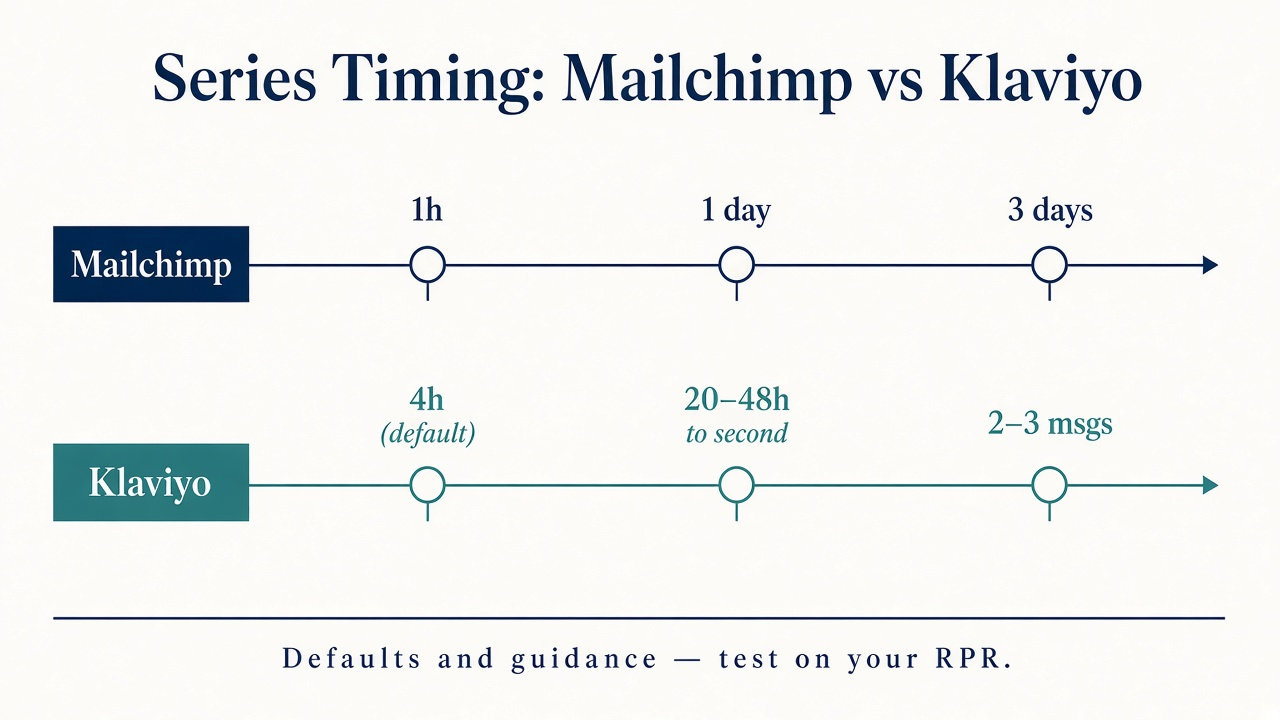
Source: Mailchimp Help classic series; Klaviyo Help Center timing guidance. https://mailchimp.com/help/create-a-classic-abandoned-cart-series/ · https://help.klaviyo.com/hc/en-us/articles/115002779411
There is no public dataset that crowns one optimal delay for every AOV band as a primary industry census. Secondary “cohort templates” (low / mid / high AOV hour grids) are planning aids. Label them secondary. Do not paste them into a board deck as measured law.
Score every timing change the same way you score an offer test: one variable, one week, revenue per recipient as the primary meter, placed-order rate as the secondary check. If a faster delay lifts opens but flatlines RPR, keep the slower clock.
Q: What are optimal cart abandonment email timing benchmarks? A: They are labeled first-send and series delays from ESP docs and reports—not one golden minute. Common published rails include Omnisend 30–60 minutes, Klaviyo 2–4 hours (4-hour pre-built default), and Mailchimp’s classic 1 hour / 1 day / 3 days series.
Q: When should I send the first abandoned cart email? A: Start from your ESP’s published default, then A/B a faster or slower rung on revenue per recipient. Klaviyo recommends 2–4 hours; Omnisend often cites 30–60 minutes; Mailchimp’s classic series starts at 1 hour.
Q: How many abandoned cart emails should I send? A: Klaviyo’s research across thousands of ecommerce customers points to 2–3 messages as the performance band. Mailchimp’s classic series ships three by default. Exit the flow on purchase either way.
Q: Is checkout abandonment timing the same as cart abandonment timing? A: Not always. Checkout starters usually show hotter intent, so operators often use shorter delays there. Keep the flows separate when your ESP supports both triggers.
Q: Is there one best delay for every store? A: No. There is no public dataset that proves a single optimal delay for every AOV and category. Treat platform defaults as starting rungs and test.
Optimal cart abandonment email timing is a Platform Delay Ladder: Omnisend’s faster first send, Klaviyo’s 2–4 hour guidance and 4-hour default, Mailchimp’s 1h/1d/3d series—tested on revenue per recipient, not inbox folklore. If what you need is creators selling an existing product through co-branded storefronts, list on feat.: https://www.feat.press.
AddShoppers vs Omnisend for cart emails: AddShoppers redirects to Minty. Buy Omnisend's live cart automation with published Free/$16/$59 seats.
GetResponse double opt-in is off by default. Enable the list confirmation toggle, match form surfaces, and remember DOI alone is not GDPR compliance.
Mailing CPM is cost per 1,000 list recipients. Use Carroway size-band medians ($62.50→$7.77) and placement types—not one fake “good CPM.”